Documents
Golden moment: Speech by UNAIDS Executive Director at the National Launch HIV Counselling and Testing Campaign in South Africa
26 de abril de 2010
To launch a new national testing campaign UNAIDS Executive Director joined South Africa’s President Jacob Zuma, Minister Motsoaledi, Premier Mokonyane and civil society representatives Ms Vuyiseka Dubula from the Treatment Action Campaign and Nkululeko Nxesi from the National Association of People living with AIDS.
Documents
Reunión de alto nivel de la Asamblea General de las Naciones Unidas sobre el sida
08 de junio de 2011
El movimiento del sida es una historia de personas que rompen con la conspiración del silencio y que exigen igualdad y dignidad. Y es la historia de personas que se enfrentan a las injusticias sociales y que se aferran a sus derechos. Es la historia de personas indignadas y de su llamada apasionada en favor de la justicia social.
Documents
A Game-Changing Moment – Speech by UNAIDS Executive Director to the 28th Programme Coordinating Board
21 de junio de 2011
Since we last met in December, together we have: Launched a new investment approach for an effective response to HIV; Renewed the global commitment to universal access; Mobilized the contributions of key partners for their engagement in the High Level Meeting and beyond; Supported a highly successful 2011 UN General Assembly High Level Meeting on AIDS and a groundbreaking new Political Declaration; Continued progress on implementing internal reforms at UNAIDS; Finalized a visionary budget that will enable UNAIDS to deliver bold results.
Documents
Getting to zero: Time to shape our destiny: Speech by UNAIDS Executive Director Michel Sidibé on the occasion of the 29th Meeting of the Programme Coordinating Board, 13 December 2011
13 de diciembre de 2011
Let us all be proud. A year ago, skeptics said that getting to zero was just a slogan. But countries, partners and people around the world have embraced the vision and are now working to translate it into reality. Our vision of zero has truly come to life and grown legs.
Documents
"From AIDS to Sustainable Health: Our moment of courage and ambition" Report of the UNAIDS Executive Director at the 32nd Meeting of the Programme Coordinating Board, Geneva, 25 June 2013
27 de junio de 2013
This PCB could not be more timely. We have less than 1000 days to report on our progress to achieve the Millennium Development Goals. Today it is important for us to take the time to reflect and shape our future — to look at what could be the way forward, not just for the global AIDS response, but more generally for global health and development.
Documents
33ème Congrès des Maires francophones- Assemblée générale de l’Association internationale des maires et responsables des capitaleset métropoles partiellement ou entièrement francophones (AIMF)
15 de noviembre de 2013
Les maires francophones constituent le dernier rempart contre l’exclusion. Plus que n’importe quel autre espace, la francophonie est la mieux à même de porter cette voix. Ensemble nous pouvons mettre fin au combat contre le sida ; faire en sorte que les 18 millions vivant avec le VIH qui ne sont pas sous traitement aujourd’hui puissent y avoir accès ; et faire en sorte que l’objectif de zéro nouvelle infection à VIH, zéro discrimination et zéro décès lié au sida soit réalisé.
Documents
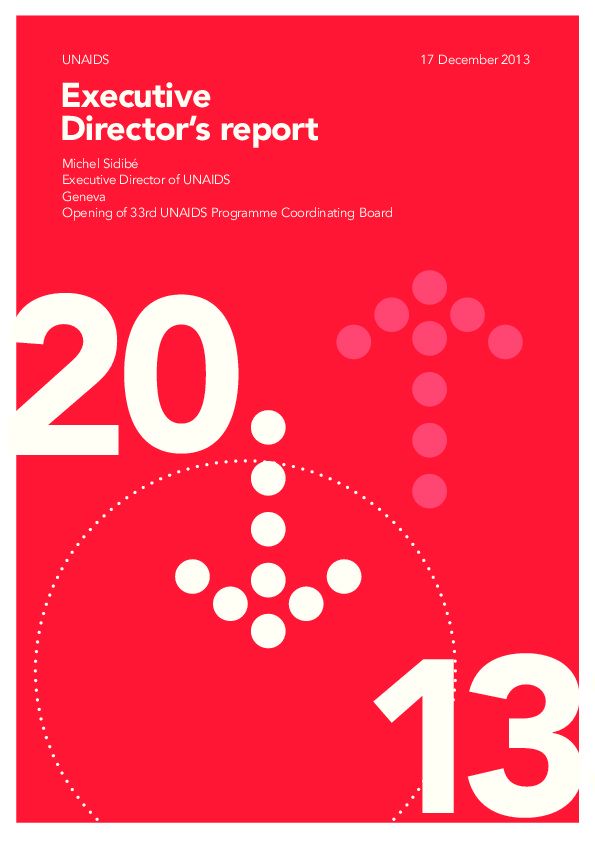
Executive Director’s report to 33rd UNAIDS Programme Coordinating Board
18 de diciembre de 2013
Ending AIDS will be a global achievement of historic dimensions. Not only will millions of lives be saved, but ending AIDS will drive better health, poverty and equity outcomes for the entire human family. Nobody has embodied this passion better than my friend and brother Ambassador Eric Goosby. Even if he is not with us today, I want to recognize his leadership of PEPFAR and the many contributions he made to the global AIDS response with distinction and heart. This is also the last PCB for Mabel Bianco from the NGO Delegation. Mabel, you have always been a great source of support and encouragement, and we will miss you. Finally, thanks to your support, UN Secretary-General Ban Ki-Moon has extended me into a second term as Executive Director of UNAIDS. I look forward to continuing our collaboration, and I remain at your service.
Documents
Turning audacity into action: Joining forces to address social drivers
09 de enero de 2014
When we talk about the social drivers and the structural dimensions of poverty, I always think about how it comes down to power— the power of relationships in society and the politics behind them. If we want to achieve the kind of transformation that will build more equitable societies, we must address the larger governance issues and the role of social empowerment. How do we harness the power of community movements to create demand for services, for access and for equity? We must not lose this perspective.
Documents
La réponse au VIH/sida : un modèle de transformation sociale pour relever les défis mondiaux du 21ème siècle
27 de abril de 2014
Au-delà de la langue qui nous unit ce soir, je crois que ce que nous véhiculons ensemble ce sont des valeurs communes, des principes de lutte contre la discrimination, l’exclusion et la stigmatisation. Ce n’est pas un hasard si la déclaration universelle des droits de l’homme fut rédigée en français. Nous ne sommes pas là ce soir pour avoir peur du futur. Bien au contraire, nous sommes ensemble aujourd’hui pour définir et donner un sens à notre avenir, pour faire en sorte que quelque part un jour des personnes se réunissent pour se dire que le monde francophone a contribué à mettre fin à cette épidémie. Le combat contre cette maladie, la lutte contre le sida ne peut être réduit à un simple problème, mais doit s’entendre comme un processus transformatif d’ampleur mondiale.
Documents
Opening address to 3rd Eastern Europe and Central Asia AIDS Conference (EECAAC 2009), by Michel Sidibé
28 de octubre de 2009
Where is the world HIV epidemic today? Like Winston Churchill said in 1942, “This is not the end. It is not even the beginning of the end. But it is, perhaps, the end of the beginning”. Today, over 33 million people worldwide live with HIV. 7,400 people are newly infected every day. For every 2 persons who are placed on antiretroviral treatment, 5 people are newly infected. 2 million people still die of AIDS every year. We have yet to break the trajectory of the epidemic.