Documents
Speech to the 9th Meeting of the UNAIDS Programme Coordinating Board, Geneva, 25 May 2000, by Peter Piot, UNAIDS Executive Director
12 mai 2005
I would like to emphasize that the impact of the epidemic is now starkly visible in the worst affected countries. Impacts on productivity, including agriculture, lead to knock-on effects in households. In the private sector AIDS undermines development by killing skilled and unskilled labour alike, increasing expenditures and reducing revenue.
Documents
Speech to the 7th Meeting of the UNAIDS Programme Coordinating Board, 2nd ad hoc thematic meeting, New Delhi, 09 December 1998, by Peter Piot, UNAIDS Executive Director
12 mai 2005
Welcome to the seventh meeting of the Programme Coordinating Board, our second thematic meeting, and our first in Asia. It is a great personal pleasure to be here in India on what is my third visit this year. The strengthening of the international partnership in support of the Government of India’s HIV/AIDS efforts has been a major priority for UNAIDS over the last 18 months.
Documents
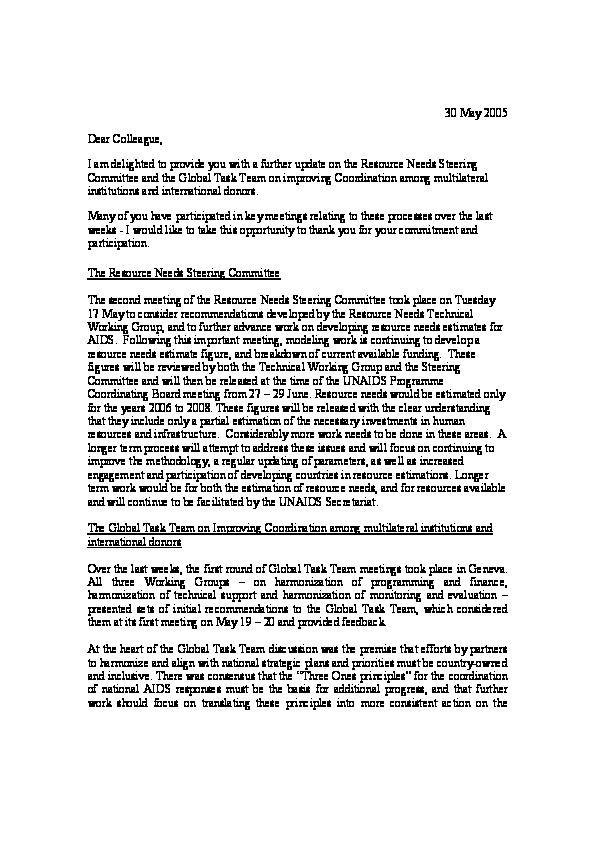
Progress update from Global Task Team and Resource Needs Steering Committee Co-Chairs
12 mai 2005
Update on the process of the Global Task Team and the Resource Needs Steering Committee, provided by their respective Co-Chairs, of developing resource needs estimates for AIDS.
Documents
Follow-up from UNAIDS Executive Director
30 mai 2005
Progess update from UNAIDS Executive Director Dr. Peter Piot on the Global Task Team and The Resource Needs Steering Committee in which he emphasizes the importance of harmonizing both process in the fight against AIDS.
Documents
Asia and Pacific Overview of the HIV Epidemic and Response
02 juillet 2005
Documents
Speech to the 7th International Congress on AIDS in Asia and the Pacific
06 juillet 2005
Documents
Statement to the United Nations Security Council
18 juillet 2005
Speech by UNAIDS Executive Director Dr Peter Piot on the progress made in implementing the resolution 1308 on AIDS and peacekeeping.
Documents
Statement to the United Nations Economic and Social Council, Substantive Session of 2005, Item 7 (g) of the Provisional Agenda: Report of UNAIDS, New York, 19th July 2005 by Dr Peter Piot, Executive Director
20 juillet 2005
I am grateful to have this opportunity to join you on behalf of the Cosponsoring organizations that make up UNAIDS, to introduce the report of the Joint United Nations Programme on HIV/AIDS over the past biennium. In this period, UNAIDS was strengthened by the addition of two new Cosponsors, the World Food Programme and the Office of the UN High Commissioner for Refugees, taking our numbers to 10, plus the UNAIDS Secretariat. Our efforts take place in a context very different to that of a decade ago, when this distinguished Council established UNAIDS. In the past few years, the world’s response to AIDS has gathered such strength that for the first time ever we have a real opportunity to halt and begin to reverse this devastating epidemic, as called for in Millennium Development Goal 6.
Documents
The Status of the Response: What Will it Take to Turn the Epidemic Around?; Special Lecture to the 3rd IAS Conference on HIV Pathogenesis and Treatment, by Peter Piot, UNAIDS Executive Director, Rio de Janeiro, 27 July 2005
19 août 2005
Today it’s fair to say that we are at a very different point from where we were 10 or even 5 years ago in terms of the global response to AIDS. Look where we were 10 years ago, about the time that UNAIDS was created.
Documents
Statement to the ASEAN-United Nations Summit by Dr Peter Piot, UNAIDS Executive Director, New York, 13 September, 2005
13 septembre 2005
I am honoured to have this opportunity to brief you on the challenges that AIDS poses to the ASEAN countries. The global AIDS epidemic is an exceptional crisis. It is not just another infectious disease epidemic or another health problem. It is one of the make-or-break issues of our times, no less than global climate change and mass extreme poverty. There is simply no precedent in modern history for such a massive, globalized and destructive epidemic. And we are still in the early phase of this epidemic – certainly in the ASEAN region.