Documents
Now more than ever: Targeting zero human rights violations of lesbian, gay, bisexual, transgender, and intersex (LGBTI) people in Africa
06 décembre 2013
Africa is changing! This change is visible in economics and in the increasing world interest for doing business in Africa. But the winds of change on our continent also blow on culture and society. The fact that we are all here today, calling for “zero human rights violations for LGBT people in Africa” is another illustration of this change. This change is not given. It is the fruit of the struggles and activism of many in this room and across the continent.
Documents
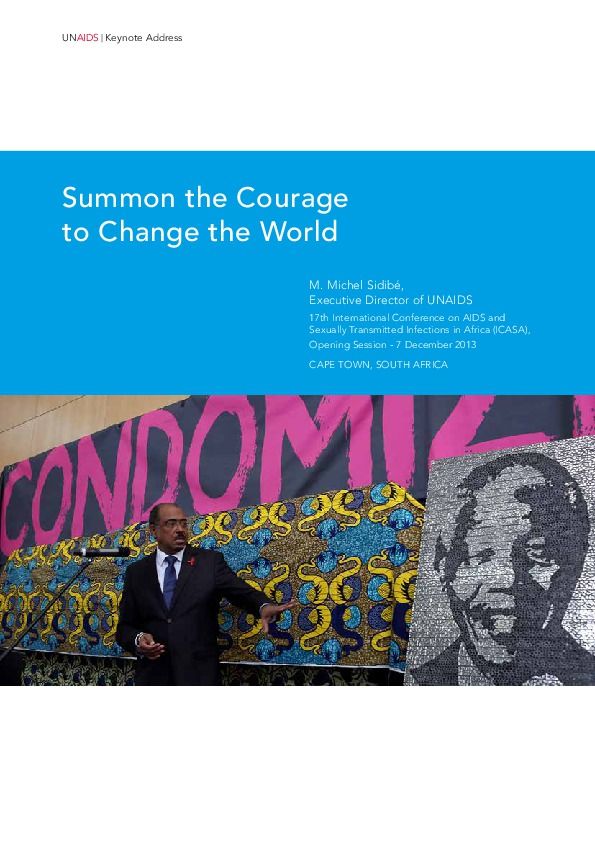
Summon the Courage to Change the World
07 décembre 2013
We need to be courageous enough confront society’s wrongs. It is unacceptable that women and girls, sex workers, drug users, migrants, prisoners and men who have sex with men are assaulted, violated and murdered, and yet our conscience is not revolted, nor our sense of human dignity challenged. How can the world accept that some people have access to services while others are excluded because of race, social status, income or sexual orientation? We must reject this double standard wherever we encounter it.
Documents
Rapport du Directeur exécutif - 33ème Conseil de Coordination du Programme de l’ONUSIDA
18 décembre 2013
La fin de l’épidémie de sida représentera un résultat d’une portée historique. Mettre fin à l’épidémie permettra non seulement de sauver des millions de vies, mais également de générer des progrès pour l’humanité entière en matière de santé, de pauvreté et d’équité.
Documents
Passer de l’audace à l’action
09 janvier 2014
Lorsque nous évoquons les dynamiques sociales et les dimensions structurelles de la pauvreté, je pense toujours au fait qu’il s’agit de pouvoir – le pouvoir des relations au sein de la société et les politiques qui en sont à l’origine. Si nous voulons réaliser le type de transformation qui créera des sociétés plus équitables, nous devons aborder les problèmes de gouvernance au sens plus large et le rôle de la responsabilisation sociale. Comment exploiter le pouvoir des mouvements communautaires afin de créer une demande pour les services, pour l’accès et pour l’équité ? Nous ne devons pas perdre cela de vue.
Documents
Global Ambassadors Sports for Development Summit
30 janvier 2014
Sports is the great equalizer of humankind—uniting rich and poor, young and old, majority and marginalized on a level playing field. The capacity of sports to reach and inspire people in society who can be difficult to reach—rural and urban poor, migrants, out-of-school youth and other people at risk—is unique and profound.
Documents
La réponse au VIH/sida : un modèle de transformation sociale pour relever les défis mondiaux du 21ème siècle
27 avril 2014
Au-delà de la langue qui nous unit ce soir, je crois que ce que nous véhiculons ensemble ce sont des valeurs communes, des principes de lutte contre la discrimination, l’exclusion et la stigmatisation. Ce n’est pas un hasard si la déclaration universelle des droits de l’homme fut rédigée en français. Nous ne sommes pas là ce soir pour avoir peur du futur. Bien au contraire, nous sommes ensemble aujourd’hui pour définir et donner un sens à notre avenir, pour faire en sorte que quelque part un jour des personnes se réunissent pour se dire que le monde francophone a contribué à mettre fin à cette épidémie. Le combat contre cette maladie, la lutte contre le sida ne peut être réduit à un simple problème, mais doit s’entendre comme un processus transformatif d’ampleur mondiale.
Documents
Fourth Conference on HIV/AIDS in Eastern Europe and Central Asia
12 mai 2014
I call on conference participants to adopt a bold, visionary conference declaration that answers my most difficult questions. This conference must show to the world that this region is serious about halting this epidemic. We must strengthen international and regional cooperation to ensure our successes are scaled up, sustained and expanded across the region. I also want us all to remember that in 1958, the Soviet Union proposed to the world that smallpox must be eradicated within 10 years. This led to one of the greatest global health victories of the 20th century. We cannot end the AIDS epidemic without the Russian Federation taking a decisive leadership role here in Russia, across this region and around the world.
Documents
“Breaking the Barriers – Partnership to Fight HIV/AIDS in Europe and Central Asia”, Opening Plenary Speech: Ministerial Conference, Dublin, 23 February 2004, by Dr Peter Piot, UNAIDS Executive Director and United Nations Under Secretary-General
04 août 2006
May I begin, Taoisech Ahern, by paying tribute to the initiative you have taken in making AIDS a central issue for Ireland’s Presidency of the European Union. In doing so, you are breaking down some of the most dangerous myths surrounding AIDS today: the myth that AIDS is only an African problem, and the myth that, on this continent, AIDS has been defeated.
Documents
‘Overcoming Challenges in the AIDS Response’
06 mai 2008
Keynote speech to the Second Eastern Europe and Central Asia AIDS Conference
Documents
Opening address to 3rd Eastern Europe and Central Asia AIDS Conference (EECAAC 2009), by Michel Sidibé
28 octobre 2009
Where is the world HIV epidemic today? Like Winston Churchill said in 1942, “This is not the end. It is not even the beginning of the end. But it is, perhaps, the end of the beginning”. Today, over 33 million people worldwide live with HIV. 7,400 people are newly infected every day. For every 2 persons who are placed on antiretroviral treatment, 5 people are newly infected. 2 million people still die of AIDS every year. We have yet to break the trajectory of the epidemic.