Documents
Rapport ONUSIDA sur l’épidémie mondiale de sida | 2010
23 novembre 2010
L’édition 2010 du Rapport ONUSIDA sur l'épidémie mondiale de sida est assortie de feuilles de résultats contenant des informations classées par pays sur les questions clés qui touchent la riposte au sida. Élaboré à partir des données les plus récentes provenant de 182 pays, cet ouvrage de référence mondial propose une analyse exhaustive de l’épidémie de sida et de la riposte. Pour la première fois, le rapport comprend des données de tendance sur l’incidence fournies par plus de 60 pays.

Documents
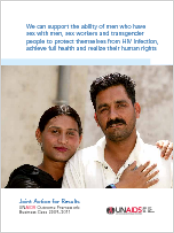
We can support the ability of men who have sex with men, sex workers and transgender people to protect themselves from HIV infection, achieve full health and realize their human rights
01 décembre 2010
In every region of the world, high HIV prevalence (of 5% or more) has been documented among men who have sex with men, sex workers and transgender people. This is the case not only in countries known to have concentrated epidemics but also in countries (largely in east and southern Africa) with generalized epidemics.
Documents
Ethical engagement of people who inject drugs in HIV prevention trials : WHO/UNAIDS HIV Vaccine Initiative Centre Of Excellence For Research In AIDS (CERiA) AIDS Vaccine for Asia Network (AVAN) | 12 – 13 December 2010
13 décembre 2010
Documents
Objectif : Zéro 2011–2015 Stratégie Programme commun des Nations Unies sur le VIH/sida (ONUSIDA)
21 décembre 2010
Cette Stratégie a été élaborée dans le cadre d’une large consultation, éclairée par les données les plus probantes et guidée par un impératif moral, atteindre l’accès universel à la prévention, au traitement, aux soins et à l’appui en matière de VIH et les objectifs du Millénaire pour le développement.

Documents
OMD6: Six choses à savoir concernant la riposte au sida aujourd’hui
21 décembre 2010
Il y a beaucoup à espérer alors que nous nous rapprochons de 2015 – année décisive fixée pour la réalisation des objectifs du Millénaire pour le développement (OMD). Bien des progrès ont déjà été enregistrés – il y a moins de gens qui décèdent de maladies liées au sida et le nombre de nouvelles infections à VIH a diminué de près de 20% sur les 10 dernières années.
Documents
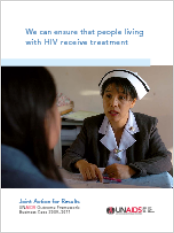
We can ensure that people living with HIV receive treatment
01 janvier 2011
As the number of people living with HIV worldwide continues to grow, HIV-related illness remains a leading cause of death. It is likely to continue to be a significant cause of premature mortality in the coming decades. Antiretroviral therapy (ART) enables people to regain control over their lives, dignity, productivity and employment and contributes to reducing further transmission of HIV and tuberculosis (TB). People living with HIV have a basic human right to equitable access to quality, efficient and sustainable interventions for HIV prevention and treatment.
Documents
Lettre aux partenaires 2011
18 février 2011
Dans sa Lettre aux partenaires 2011, le Directeur exécutif de l’ONUSIDA, Michel Sidibé, appelle à une restructuration de la riposte au sida. Il met en évidence une série de six nouveaux repères pour guider la riposte mondiale au sida dans son avancée.
Documents
Tirer parti des flexibilités de l’Accord sur les ADPIC pour améliorer l’accès au traitement du VIH
15 mars 2011
Le présent document examine comment les pays peuvent tirer parti des flexibilités de l’Accord sur les droits de propriété intellectuelle qui touchent au commerce (ADPIC) de l’Organisation mondiale du commerce (OMC) pour améliorer l’accès aux traitements du VIH.
Documents
The Responsibility of the Security Council in the Maintenance of International Peace and Security: HIV/AIDS and International Peacekeeping Operations
12 mai 2011
(UNAIDS/UNDPKO, May 2011)

Documents
Chronic care of HIV and noncommunicable diseases: How to leverage the HIV experience
26 mai 2011
Many countries with a high burden of HIV infection also face burgeoning epidemics of noncommunicable diseases. Similar to HIV, noncommunicable diseases are most frequent in low- and middle-income countries, and the age-adjusted death rates from noncommunicable diseases are nearly twice as high in low- and middle-income countries as in high-income countries. People living with HIV often also have high rates of noncommunicable diseases. With HIV programmes rapidly expanding, people with HIV are living longer and ageing, and are developing non-HIV-related chronic conditions similar to the rest of the population.