Documents
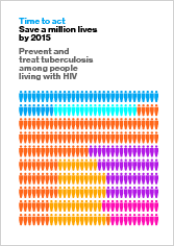
Time to act: Save a million lives by 2015 - Prevent and treat tuberculosis among people living with HIV
06 juin 2011
We live in a time of unprecedented hope for the 33.3 million people living with HIV worldwide. Antiretroviral therapy (ART) offers the promise of a full and fulfilling life. Now people living with HIV can raise their families, work and pursue their dreams. But a thief is in our midst—one that is routinely robbing people, and the countries they live in, of their futures. Every minute, three people living with HIV have their lives snatched away by tuberculosis (TB). Africa, hit hard by HIV, is also hit hard by TB. TB is the main cause of death in people living with HIV.
Documents
Bonnes pratiques de participation: Directives pour les essais de prévention biomédicale du VIH (2011)
29 juin 2011
Le Guide des bonnes pratiques de participation offrent aux bailleurs de fonds, aux promoteurs et aux responsables de la mise en oeuvre des essais, des directives systématiques visant à faire participer efficacement les parties prenantes à la conception et à la conduite des essais de méthodes biomédicales de prévention du VIH.
Documents
Santé positive, Dignité et Prévention : Un cadre d’action
01 juillet 2011
Les objectifs premiers de la Santé positive, Dignité et Prévention consistent à améliorer la dignité, la qualité et la durée de vie des personnes vivant avec le VIH ; ces objectifs, une fois atteints, auront un impact bénéfique sur leurs partenaires, leurs familles et leurs communautés, notamment avec la réduction de la probabilité de nouvelles infections.
Documents
Maximizing returns on investment: UNAIDS support to countries to make Global Fund money work
21 juillet 2011
This publication describes how the Joint United Nations Programme on HIV/AIDS (UNAIDS) partners with country partners and the Global Fund to Fight AIDS, Tuberculosis and Malaria (Global Fund) to strengthen the global response to AIDS and to accelerate progress towards universal access to HIV prevention, treatment, care and support, and the achievement of the Millennium Development Goals (MDGs).
Documents
Assurer l'avenir aujourd'hui – Synthèse des informations stratégiques sur le VIH et les jeunes
27 juillet 2011
Ce rapport montre que les engagements mondiaux ne seront concrétisés que si les besoins particuliers des jeunes femmes et des jeunes hommes sont reconnus et que leurs droits sont pleinement exercés, respectés et préservés. Pour réduire le nombre de nouvelles infections au VIH chez les jeunes, parvenir aux objectifs plus larges d'égalité fixés par les OMD et inverser la tendance générale de l'épidémie de sida, les efforts en matière de prévention et de traitement du VIH doivent être adaptés aux besoins spécifiques des jeunes gens.
Documents
Treatment 2.0: Is this the future of treatment?
24 août 2010
Imagine treatment 2.0. A radically simplified treatment platform that’s good for HIV prevention too!
Documents
HIV in Asia and the Pacific: Getting to zero
26 août 2011
This report provides the most up to date information on the HIV epidemic in the region in 2011. While the region has seen impressive gains—including a 20% drop in new HIV infections since 2001 and a three-fold increase in access to antiretroviral therapy since 2006—progress is threatened by an inadequate focus on key populations at higher risk of HIV infection and insufficient funding from both domestic and international sources.
Documents
People Living with HIV Stigma Index: Asia Pacific Regional Analysis 2011
29 août 2011
This report provides findings from the rollout of the People Living with HIV Stigma Index (PLHIV Stigma Index) in nine countries in Asia and the Pacific (Bangladesh, Cambodia, China, Fiji, Myanmar, Pakistan, Philippines, Sri Lanka, Thailand). It provides the first large-scale regional comparison of standardized human immunodeficiency virus (HIV)-related stigma indicators. The findings and interpretation represent an extraordinary effort by people living with HIV, organizations of people living with HIV, and supporting domestic and international agencies.
Documents
A guidance tool for including community systems strengthening in proposals for the Global Fund to Fight AIDS, Tuberculosis and Malaria
20 septembre 2011
There is general agreement that strong community participation in the response to HIV, tuberculosis (TB) and malaria is essential to controlling these epidemics. In the AIDS response, community-based organizations (CBOs) and other NGOs have played a critical role. They have been key providers of prevention, treatment, care and support services and have worked to create the social, political, legal and financial environment needed to effectively respond to the epidemic
Documents
Technical Support Facilities: Helping to build an efficient and sustainable AIDS response
28 octobre 2011
This report highlights the role that the Technical Support Facilities (TSF) have played in Africa and Asia to strengthen countries capacities to fund, plan, manage and coordinate effective, larger scale HIV programs. Established by UNAIDS in 2005, the TSFs have provided support to over 70 countries through 50,000 days of technical assistance and capacity development.