


Focus on
United Kingdom
OVERVIEW
Nuevas infecciones por el VIH
En 2018 alrededor de 4500 personas (un 73 % eran hombres y un 27 %, mujeres) fueron diagnosticadas con VIH en Reino Unido, un 28 % menos respecto a 2015 y un 6 % menos respecto a 2017.
Public Health England (la oficina ejecutiva del Departamento de salud y asistencia social de Reino Unido) señala que este descenso se debe a la tendencia en nuevos diagnósticos de VIH entre hombres gais y otros hombres que tienen relaciones sexuales con hombres, la cual se ha reducido en un 39 % desde el pico de 2015 hasta aproximadamente 1900 diagnósticos en 2018. En ese mismo periodo, el número de nuevos diagnósticos de VIH también se redujo un 24 % entre la gente que contrajo el virus por contacto heterosexual, y se pasó de unos 2300 nuevos casos en 2015 a 1550 en 2018.
Según Public Health England, la intensificación de la prevención combinada ha sido fundamental para disminuir desde 2012 la incidencia del VIH entre hombres gais y otros hombres que tienen relaciones sexuales con hombres. Durante la década pasada, la prevención combinada ha ido evolucionando. Hoy en día se recomienda realizar pruebas del VIH muy frecuentemente a las personas que mantienen relaciones sexuales sin protección con parejas nuevas o esporádicas. También se ha pasado al inicio más temprano e inmediato del tratamiento antirretroviral después del diagnóstico y se ha aumentado la disponibilidad de la profilaxis preexposición desde finales de 2015.
90–90–90
Según las cifras de 2017 manejadas por Public Health England, Reino Unido ha alcanzado los objetivos 90-90-90.
De las 100 000 personas que se calcula que vivían con el VIH en el país en 2017:
- un 92 % conocía su estado serológico.
- un 98 % de las personas que sabían que eran seropositivas estaban siguiendo un tratamiento antirretroviral.
- un 97 % de las personas que vivían con el VIH y seguían el tratamiento estaban viralmente suprimidas.
En general, un 87 % de las personas que vivían con el VIH en Reino Unido en 2017 se estima que tenían una carga viral indetectable, la cual las mantiene sanas y evita la transmisión del virus.
Viviendo con el VIH
Más de 96 000 personas fueron atendidas por VIH en Reino Unido en 2018. Más de la mitad (en torno a 52 000) eran blancas, y más de una cuarta parte (unas 28 000), negroafricanas.
La población que vive con el VIH diagnosticado se va haciendo mayor. En 2018, alrededor del 40 % de la gente que accedió a la atención sanitaria para el VIH en Reino Unido tenía 50 años o más.
Muertes
En 2018 fallecieron en Reino Unido unas 470 personas con VIH. Desde 2009, ha habido un descenso de un 20 % en el número de muertes entre las personas que viven con el VIH en Reino Unido.
Trends in new HIV diagnoses and in people receiving HIV-related care in the United Kingdom: data to the end of December 2018 (tendencias en los nuevos diagnósticos de VIH y en las personas que reciben atención relacionada con el VIH en Reino Unido: datos hasta finales de diciembre de 2018, en inglés).
Progress towards ending the HIV epidemic in the United Kingdom: 2018 report (poniendo fin a la epidemia del VIH en Reino Unido: informe de 2018, en inglés) Public Health England.
Read more
How London’s first dedicated HIV ward changed the AIDS response
Opened in 1987 by Princess Diana, the Broderip Ward at the Middlesex Hospital in London was the United Kingdom’s first ward dedicated to caring for HIV patients. UNAIDS Senior Adviser on Science, Peter Godfrey-Faussett, worked on the Broderip Ward as a newly qualified doctor and remembers it as an intense and highly emotional period.
Read more

Unwavering care for people who inject drugs on the streets of Glasgow
In Scotland, United Kingdom, the widespread availability of HIV prevention and harm reduction programmes and the expansion of antiretroviral treatment have been effective in controlling the spread of HIV since the 1980s. However, in 2015 there was a worrying outbreak of HIV among people who inject drugs in Glasgow, with the number of new HIV diagnoses tripling in just three years.
UNAIDS spoke to Ruth McKenna from Waverley Care, Scotland’s leading charity providing HIV, hepatitis C and sexual health care and support to people across Scotland, who explained some of the work that the charity has being doing to respond to the outbreak.
“Glasgow has a good needle–syringe exchange programme, so initially there was uncertainty as to why the increase was happening,” said Ms McKenna.
Read more

Interview with UNAIDS PrEP expert Rosalind Coleman
Pre-exposure prophylaxis (PrEP) is delivered by a pill made of a combination of medicines. It has proved to be highly effective in preventing HIV-negative people from acquiring the virus. It is being rolled out or piloted in many countries across the world, including the United Kingdom. UNAIDS PrEP expert Rosalind Coleman explains.
Read more
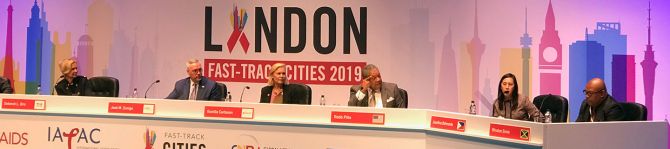
Five years on: 300 Fast-Track cities come together
More than 700 delegates from cities around the world have gathered in London, United Kingdom, for the first Fast-Track cities conference. The meeting, hosted by the International Association of Providers of AIDS Care (IAPAC) in partnership with UNAIDS and the Global Network of People Living with HIV (GNP+), is focusing on the efforts and progress that cities have made as well as the challenges and lessons learned over the past five years.
On World AIDS Day 2014, the Fast-Track cities initiative was launched in Paris, France, with 26 cities signing up to the initiative. It has now expanded to more than 300 cities and municipalities.
Speaking at the opening of the conference, Sadiq Khan, the Mayor of London, confirmed his commitment to the HIV Fast-Track response in his city, which accounts for 38% of all people living with HIV in the United Kingdom.
“I am proud of what we have achieved, but we need to go further,” Mr Khan said. “I wholeheartedly support the United Kingdom’s bold ambition to get to zero new HIV infections, zero AIDS-related deaths and zero discrimination.”
Read more

Mr Gay England brings visibility to HIV stigma
When Phillip Dzwonkiewicz won the Mr Gay England 2018 contest, he wanted to use his platform to talk about HIV. After years of struggling with his HIV-positive status, he no longer wanted to hide.
“I now live one life,” he said. “I live openly and it’s a massive weight off my shoulders.”
The next year, when competing in Mr Gay Europe 2018―he was runner up―he again used the platform to bring more visibility to HIV. “What still surprises me is how people tell me, “You don’t look like you have HIV”. It shows how misconceptions still exist,” he said.
Read more

Stigma makes HIV life-threatening
“If I am meant to be a leader, I needed to be truthful,” said Lloyd Russell-Moyle, British Member of Parliament, reflecting on his bold move to reveal his HIV-positive status in the House of Commons in late November 2018, days before World AIDS Day.
He explained that for years he would honour people for their outstanding work in the HIV field and yet he never opened up and was honest with people about living with HIV.
“The more people don’t talk about it, the harder it is for everyone. As a Member of Parliament my job involves speaking out, being an advocate and helping people in their journey,” Mr Russell-Moyle said.
Read more