

Feature Story
Towards universal access: meeting the challenge in Latin America
25 Enero 2006
25 Enero 2006 25 Enero 2006(Brasilia, 12-14 January 2006)
Lowering the prices of AIDS medicines and other essential commodities, securing additional donor support, increasing international awareness of the epidemic in the region, and reducing homophobia and gender discrimination were among the priority actions identified at the Latin America regional consultation on scaling up towards universal access.
In nearly all the Latin American countries, the highest levels of HIV infection are found among men who have sex with men.

Pedro Chequer, Coordinator Brazilian National STD/AIDS programme chairing a session of the The 1st regional consultation on Universal Access
The 1st regional consultation on Universal Access
The Latin American Regional Consultation on universal access, hosted by the Brazilian government, was organized by the Horizontal Technical Cooperation Group (HTCG) with seven civil society networks in Latin America and the Spanish-speaking Caribbean.
It brought together representatives of networks of people living with HIV, sex workers, men who have sex with men and other groups at high risk of exposure to HIV and also representatives of national AIDS authorities, the Assistant US Global AIDS Coordinator, representatives of the Catholic Church and UNAIDS Cosponsors.
Finding practical solutions at the local level
From the very first day, participants were urged to focus on solutions. “We have had a lot of plans,” said Michel Sidibe, Director of Country and Regional Support at UNAIDS. “We need more implementation,” he added.
The specificity of this international process is not only the focus on solutions but also countries’ ownership.
This means that there will be no globally set targets and that the countries, based on thorough assessment of their situation, will themselves determine what are their specific obstacles and what are the appropriate solutions to ensure that all women, men and children have access to the AIDS services that they need.
The United Nations General Assembly resolution adopted on 23 December 2005 calls for an inclusive country-driven process involving the relevant stakeholders from non governmental organizations, civil society and the private sector.
UNAIDS is actively assisting countries in facilitating this inclusive process aiming at coming as close as possible to the goal of universal access to treatment by 2010 for all those who need it.
Many national consultations are already scheduled to take place before the end of March 2006. The next regional consultation on Universal Access will take place in Tunis, Tunisia from 6 to 8 February 2006.
Related
Feature Story
World AIDS Day kicks off with theme "Stop AIDS. Keep the Promise."
28 Noviembre 2005
28 Noviembre 2005 28 Noviembre 2005
Every year, people around the world designate 1 December, World AIDS Day, as a time of reflection – to remember the friends and loved ones lost to AIDS, to heed the lessons learned over the year, and to take stock of the progress made to provide a comprehensive response to the epidemic.
The Declaration of Commitment is, in effect, a blueprint for action. It includes not hypothetical goals but concrete benchmarks to measure progress on prevention, reducing stigma, building health infrastructure, ensuring treatment, and providing much-needed leadership and resources. While many countries have made their own commitments to fight AIDS, the Declaration was the first recognition of AIDS as a global crisis requiring a global and collective solution.
The Declaration will only be as powerful as its fulfilment. By sustaining a single theme over five years, the Campaign hopes it will attract others and create a movement that gives those working on the response a forum to be heard – and a platform to act.
This year's theme also asks every individual to make a personal promise to fight AIDS. Since the beginning of the epidemic, individual people have played heroic roles in helping and caring for people living with HIV and AIDS. In the early days, as governments and organizations dithered, individuals acted. The World AIDS Campaign's call to "Stop AIDS. Make the Promise" encourages everyone - everywhere - to be a part of the solution. Added together, these individual commitments will tell governments that all people care about AIDS, that they want to be part of an effective response to it, and that they are willing to make their own commitments to ending the epidemic. Individuals from all over the world are already meeting the individual commitment challenge: to prevent HIV, treat every person living with HIV/AIDS with respect and dignity, to support local programmes that provide care and treatment. World AIDS Day is the perfect time for each individual and group to recommit themselves to those ideals.
After two decades of living in a world with HIV, 1 December is a reminder that with sufficient will and resources, we have the power to stop the epidemic. What is needed – for each of the 40 million people living with the disease – is the involvement of people from every walk of life. Everyone can contribute, whether by making a promise to take action or by promoting the campaign with friends and colleagues. To make your promise and to learn more about the World AIDS Campaign and how people around the world are renewing their commitment to the fight on World AIDS Day, visit http://www.worldaidscampaign.org/.
Related links:
World AIDS Campaign
Related
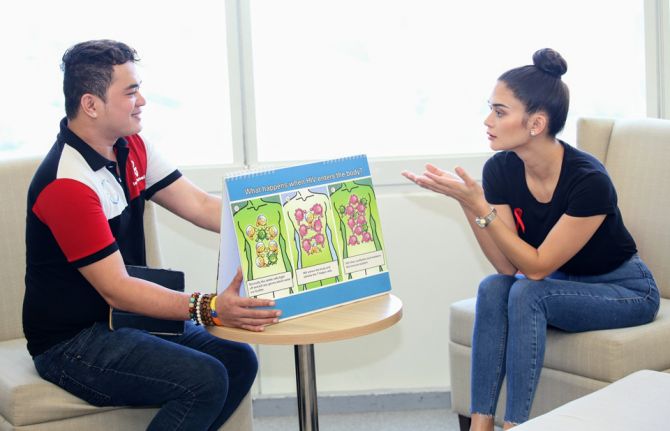 UNAIDS Goodwill Ambassador Pia Alonzo Wurtzbach ramps up HIV advocacy efforts
09 de agosto de 2017
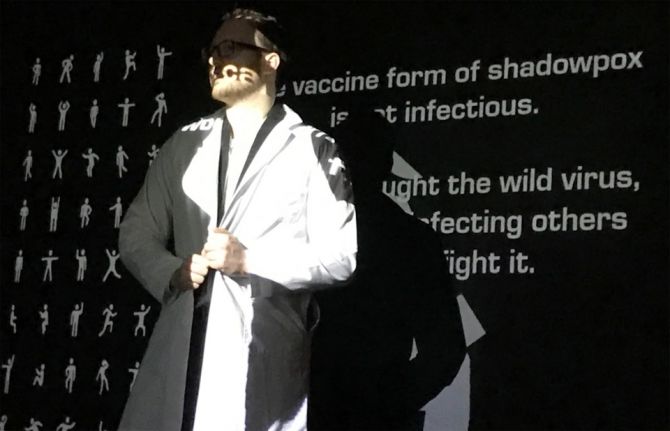 Immune Nations
23 de mayo de 2017
 Germany—ending AIDS by 2020
12 de mayo de 2017
Feature Story
Latin America and the Caribbean AIDS conference ends in El Salvador
11 Noviembre 2005
11 Noviembre 2005 11 Noviembre 2005
UNAIDS Executive Director Dr Peter Piot meets with the President of El Salvador Elías Antonio Saca González, host of the Presidential
Summit of Central American heads of state in San Salvador,
11 November 2005.
Photo credit: UNAIDS/Carlos H. Bruch
The III Latin America and the Caribbean Forum on HIV/AIDS/STDs (Foro 2005) and the IV Central American Congress on STD/HIV/AIDS (CONCASIDA) closed on Friday 11 November with a gathering of Presidents and other leaders from the Central America region.
UNAIDS Executive Director Dr Peter Piot attended the Presidential Summit and addressed the conference closing plenary.
At the summit, Dr Piot met with the President of El Salvador Elías Antonio Saca González, the host of the conference.
"There is momentum on leadership – made manifest in today's gathering of Presidents and other leaders from this region here today," said Dr Piot prior to the President's Summit. "Now is the time to act. So that together we can stop the threat of AIDS in our countries."
The President of Guatamela Oscar José Rafael Berger and the President of Costa Rica Abel Pacheco also attended the gathering, as well as the health ministers from Honduras and Nicaragua.
Dr Piot underlined the significant strides that have been made in the region to increase access to treatment. But, he added, these gains in treatment access need to be sustained and extended to the whole region. With more people living with HIV than ever in some countries, Dr Piot emphasized the urgent need to simultaneously increase HIV prevention programmes that reach all people at risk of infection, particularly those most marginalized such as men who have sex with men and sex workers.

"The region must revitalize its strategies to reach people most at risk – and they must address the deeper-rooted factors that affect vulnerability, such as social exclusion and inequalities of all kinds," he said.

Dr Piot urged leaders in the region to renew and reinvigorate their commitments at the highest political level and to agree to specific measures that will translate into concrete actions to reinforce AIDS responses nationally and regionally.
"The history of AIDS has shown us that when we are united, people win. Success depends on each of us truly being committed to tackling this exceptional crisis," said Dr Piot.
As part of the Presidential Summit, a declaration of enhanced commitment to a coordinated regional AIDS response was signed.
Related links:
UNAIDS press release: Putting the spotlight back on AIDS in Latin America and the Caribbean
Speech by UNAIDS Executive Director: The future of the HIV epidemics: leadership for action
Photos: View photos from CONCASIDA 2005
Related
Press Statement
Lecciones del abordaje integrado del VIH, la salud y los servicios sociales en KwaZulu-Natal
29 Septiembre 2011 29 Septiembre 2011El éxito logrado en el programa integrado de KwaZulu-Natal al combinar los servicios de VIH con los de cáncer cervicouterino y de mama, tuberculosis, educación y otros asuntos sociales y sanitarios fundamentales.

El gobernador de KwaZulu-Natal, Dr. Zweli Mkhize (izquierda), y el director ejecutivo de ONUSIDA. 29 de septiembre 2011.
ONUSIDA/ A. Debiky
GINEBRA, 29 de septiembre de 2011—El Director ejecutivo del Programa Conjunto de las Naciones Unidas sobre el Sida (ONUSIDA) elogió al gobernador de KwaZulu-Natal, Dr. Zweli Mkhize, por su empeño en integrar los servicios del VIH con los sanitarios, sociales y económicos.
Mediante la integración que se adoptó en KwaZulu-Natal, las comunidades locales pueden de una sola vez tener acceso fácil a la información, a los servicios de salud y a una gran variedad de servicios sociales y económicos que abordan temas de pobreza, educación y desarrollo.
“Este método holístico de dar acceso a la salud y los servicios sociales no es solo eficiente, sino también eficaz, y sirve de modelo para otras provincias e, incluso, otros países de la región”, aseveró Michel Sidibé, quien se encontraba de visita en Sudáfrica por siete días con el fin de conocer mejor los avances y obstáculos que enfrenta el país para ampliar su respuesta al VIH. “El trabajo que aquí se realiza es un ejemplo de cómo llevar los servicios al corazón de la comunidad, donde más se necesitan”.
El gobernador de KuaZulu-Natal, Dr. Zweli Mkhize, ha tenido un papel preponderante en la descentralización de la respuesta de Sudáfrica al VIH y en la integración del VIH al programa económico y social de la Provincia. El gobierno provincial emplazó programas integrados para hacer frente al VIH, la tuberculosis, el cáncer de mama y el cervicouterino, la pobreza, la seguridad alimentaria y otra serie de servicios sanitarios y sociales.
“Creemos que al conectar los servicios del VIH con otros servicios que la comunidad necesita podemos ayudar a Sudáfrica a lograr nuestros objetivos nacionales de reducir en 50% el número de nuevas infecciones por VIH para 2015 y ampliar de manera significativa el número de personas en tratamiento antirretrovírico”, señaló el Dr. Zweli Mkhize. “Nuestro modelo está funcionando”.
En KwaZulu-Natal, la prevalencia de la infección por VIH fue de 39,5% en 2009, la más alta de Sudáfrica. El método integrado que adoptara el gobierno provincial de KwaZulu-Natal ya ha contribuido al aumento de la captación de personas que se realizan la prueba de detección del VIH, que llegó a 2,9 millones de personas en la provincia a fines de junio de 2011. Asimismo, sirvió para ampliar el acceso al tratamiento antirretrovírico, que salva vidas, a 489 801 personas en 518 lugares en la provincia y contribuyó a la disminución de la tasa de infecciones de transmisión maternoinfantil de 21% hace cinco años a 2,8% en 2011.
Contacto
ONUSIDA SudáfricaNatalie Ridgard
tel. +27 83 642 6759
ridgardn@unaids.org
Oficina del Gobernador
Ndabezinhle Sibiya
tel. 0823754742
sibiyand@premier.kzntl.gov.za
Press centre
Download the printable version (PDF)
Press Release
UNAIDS launches ‘red card’ campaign against HIV
12 Junio 2010 12 Junio 2010New global initiative at the FIFA World Cup shines spotlight on the elimination of mother-to-child transmission of HIV
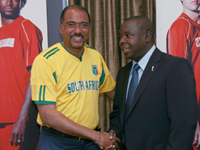 (From left) Mr Michel Sidibé, UNAIDS Executive Director, and Mr Kirsten Namatandani, President of South African Football Association (SAFA)
 Credit: Juda Ngwenya
JOHANNESBURG, 12 June 2010—A new campaign is using the power and outreach of football to unite the world around a common cause—preventing the transmission of HIV from mother to child. Launched today in South Africa by the UNAIDS Executive Director, Michel Sidibé, international musician Akon, UNAIDS Goodwill Ambassador and producer of the World Cup opening ceremony, Lebo M, UNAIDS National Goodwill Ambassador, Jimmie Earl Perry, and Kirsten Nematandani, President of the South African Football Association. The campaign aims to ensure an HIV-free generation by the 2014 FIFA World Cup to be held in Rio de Janeiro, Brazil.
Each year, an estimated 430 000 babies are born with HIV globally, the large majority in Africa. Over the course of a 90-minute football match, nearly 80 babies will become newly infected with HIV. In many parts of Africa, AIDS-related illness is the leading cause of death among infants and young children.
Through the campaign—backed by international football stars and UNAIDS Goodwill Ambassadors Michael Ballack of Germany and Emmanuel Adebayor of Togo—captains of 32 World Cup qualifying teams have been invited to sign the appeal: “From Soweto to Rio de Janeiro, give AIDS the red card and prevent babies from becoming infected with HIV.” Nineteen captains have already signed on, including host country South Africa and defending champion Italy.
“By the next football World Cup we can virtually eliminate HIV transmission to babies,” said UNAIDS Executive Director Michel Sidibé who attended the campaign launch in South Africa. “Let us give AIDS the red card permanently.”
The lives of mothers and their babies can be saved through a combination of HIV testing and counselling, access to effective antiretroviral prophylaxis and treatment, safer delivery practices, family planning, and counselling and support for optimal infant feeding practices.
An estimated 33.4 million people are living with HIV worldwide. Since 2001, there has been a 17% reduction in new HIV infections globally. However, for every two people who access antiretroviral treatment, five more become newly infected with HIV.
Contact:
UNAIDS New York | Richard Leonard | +1 646 666 8003 | LeonardR@unaids.org
UNAIDS South Africa | Sheba Okwenje | +127 11 517 1634 | okwenjeb@unaids.org
Press Release
El Estadio Olímpico se cubre de enormes lazos rojos para estimular la repuesta al sida en China y más allá
27 Noviembre 2008 27 Noviembre 2008El despliegue icónico en el estado “Nido de pájaro” pone de manifiesto el compromiso de China con la respuesta al sida.
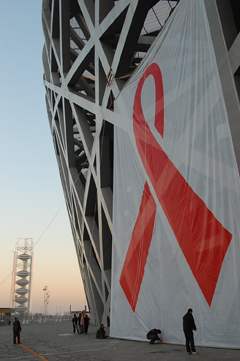
Beijing, 30 de noviembre de 2008 – Las autoridades del sida en China, con el apoyo de ONUSIDA, han desplegado hoy tres lazos rojos gigantes en el simbólico Estadio Nacional, conocido coloquialmente como el "Nido de pájaro" con motivo del Día Mundial del Sida. Esta muestra simboliza el compromiso de China con la repuesta al sida y, en particular, su voluntad de luchar contra el estigma y la discriminación.
“La epidemia del sida no se ha erradicado en ningún lugar. Los lazos del sida en el Nido de pájaro simbolizan la repercusión mundial de la epidemia y la necesidad de ofrecer una respuesta mundial unificada", declaró el Dr. Peter Piot, director ejecutivo de ONUSIDA.
El lazo rojo es un símbolo internacional de la sensibilización sobre el sida: cada vez son más las personas que lo llevan en todo el mundo para demostrar su preocupación por esta enfermedad. Sin embargo, el lazo rojo también simboliza esperanza y apoyo simbólico para aquellos que viven con el VIH o se ven afectados por él, así como para aquellos que han perdido a amigos y a familiares como consecuencia del sida.
El estigma y la discriminación no solo tienen un impacto negativo en las vidas de las personas seropositivas, sino que también impiden que hablen abiertamente sobre la enfermedad, lo que puede exponer a ellos mismos y a otros a un mayor riesgo de infección. Por otra parte, el miedo a ser discriminados también suele disuadir a las personas de someterse a las pruebas, lo que les impide beneficiarse de los tratamientos disponibles.
Diversas estudios muestran que el estigma y la discriminación todavía están fuertemente arraigados en China entre la población general. Una encuesta publicada recientemente, realizada a más 6000 personas en seis ciudades del país, concluyó lo siguiente:
- El 30% de los encuestados pensaban que no se debería permitir que los niños seropositivos acudieran a las mismas escuelas que el resto de los niños.
- Casi un 65% de los encuestados no estarían dispuestos a vivir en la misma casa que una persona seropositiva, y el 48% no desearía comer con una persona que vive con el VIH.
“El estigma y la discriminación son los principales obstáculos a la hora de ofrecer una respuesta efectiva al sida. Debemos implicar a todos los sectores de la sociedad China en la lucha contra estas cuestiones y trabajar conjuntamente para detener la enfermedad”, afirmó Chen Zhu, ministro de Salud de China.
En todo el mundo existen aproximadamente 33 millones de personas seropositivas. Las últimas estimaciones muestran que unas 700.000 viven China, donde se produjeron alrededor de 50.000 nuevas infecciones en 2007. Se estima que en ese mismo año 20.000 personas murieron a causa del sida en este país, donde la transmisión sexual es actualmente la principal vía de infección.
“Estas iniciativas son esenciales para mantener el impulso de la respuesta al sida. Elogio la labor del gobierno chino por ilustrar su liderazgo de una manera tan inspiradora”, afirmó el Dr. Piot.
El Estadio Olímpico se cubre de enormes lazos roj
Información relacionada:
Más sobre el día mundial del sida 2008
Declaraciones del Día mundial del sida
China
Reportajes:
El juez Edwin Cameron añade una nueva dimensión a las relaciones entre China y África (31 de octubre de 2008)
La Dra. Nafis Sadik, enviada especial del Secretario General, pide que se amplíe la respuesta al sida en China (24 de octubre de 2008)
La respuesta al sida de China (19 de septiembre de 2008)
ONUSIDA reconoce la labor de los líderes en la respuesta al sida en China (17 de septiembre de 2008)