

Feature Story
UNAIDS and partners launch ‘living positively’ book in Tanzania
17 février 2006
17 février 2006 17 février 2006
When young Tanzanian Vumilia Omar told her husband she had tested HIV positive, his reaction was one of anger and fury. “He didn’t want to look at me or our children,” she said, telling how her husband then left the family home taking all their possessions with him and leaving Vumilia and her children with nothing and nowhere to go.
Over time, Vumilia has slowly rebuilt her life – seeking advice from counselors and choosing to stand up against the stigma and discrimination she has often faced because of her HIV status. She now runs a successful tomato-selling business in the markets of Dar-es-Salaam and discusses her experiences as a young mother living with HIV in her own column in a popular magazine.
“I use more and more of my time to educate people on HIV and give advice to young people about living positively and how to live with hope,” she said.
Vumilia’s story is one of a collection of 26 similar testimonials of Tanzanians ‘living positively’ with HIV that feature in the book ‘Yaliyopita Si Ndwele’ (Life goes on), which was launched today in Dar-es-Salaam.
The book – produced jointly by UNAIDS and non-governmental organization FEMINA-HIP, with funding from Development Cooperation Ireland – was launched by UNAIDS Executive Director Dr Peter Piot at a special ceremony held as part of the high-level joint mission to the country of HRH Princess Mathilde of Belguim and the Executive Directors of UNAIDS and UNICEF.
The joint mission is visiting Tanzania from 14-17 February to gain a deeper understanding of the challenges AIDS poses for children and young people and the country’s AIDS response to date.
At the book launch ceremony, one of the collection’s authors, 13-year old Irene Kabaka, gave a statement to the delegation before handing a special copy of the book to HRH Princess Mathilde.
“Although there are only 26 stories, I am sure many people will relate to them,” she said.
In the foreword of the book, the head of the Tanzania Commission for AIDS (TACAIDS), Major General Lupogo said, “I’m impressed with the bravery of all who have broken the silence, by sharing their stories. They give strength and understanding to other citizens who will now understand their situation with empathy and humility,” he added.
‘Yaliyopita Si Ndwele’ (Life goes on) is available in Swahili. For more information, please contact FEMINA-HIP at femina-hip@raha.com
Read Vumilia’s full story from the collection, in English
Read the foreword of the collection by Major General Lupogo, Head of TACAIDS


Feature Story
AIDS mission to Rwanda to discuss coordination, next steps in AIDS response
13 février 2006
13 février 2006 13 février 2006This week, leaders from Luxemburg, United Kingdom Department for International Development (DFID), UNICEF and the Joint United Nations Programme on HIV/AIDS (UNAIDS) are visiting Rwanda for a two-day, high-level mission to gain a joint perspective on the progress of the national AIDS response and the ongoing challenges it faces.
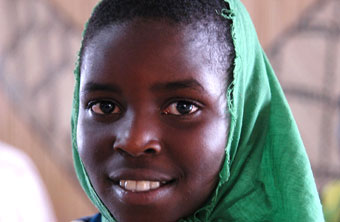
Joseline Nyiraguhimwa, age 11, at the site of the IMPORE Association, Prevention of Mother to Child Transmission Centre in Kacyiru, Rwanda. She has lost her father and lives with her mother.
Photo credit: UNAIDS/Riccardo Gangale
Over a quarter of a million people are estimated to be living with HIV in Rwanda, according to UNAIDS 2003 figures.
Over the last years – and against a backdrop of extremely difficult circumstances - the country’s AIDS response is showing encouraging signs of progress.
Political commitment to tackling AIDS is high, with the personal involvement of the President and the First Lady. The expansion of the country’s AIDS programme points to a welcome trend. Services to prevent mother-to-child transmission are available at 50% of all health centres in the country, sites offering voluntary counselling and testing have increased, and according to national estimates the number of people receiving antiretroviral therapy rose from 8700 in 2004 to more than 19000 by end 2005, a more than 50% increase. Over the past years, trends among pregnant women indicate signs of a decline in HIV prevalence in some areas.
But the country faces ongoing challenges to more rapid progress. Women are particularly hard hit by HIV in Rwanda - recent national data suggests that women aged 15 - 24 years old have five times the HIV prevalence rate than men of the same age group.
Children also need greater attention. Rwanda has one of the highest proportions of orphans in the world – 1.25 million, and in 2003 it was estimated that Rwanda had 22,000 children under 15 living with HIV.
This week, leaders from Luxemburg, United Kingdom Department for International Development (DFID), UNICEF and the Joint United Nations Programme on HIV/AIDS (UNAIDS) are visiting Rwanda for a high-level mission to gain a joint perspective on the progress of the national AIDS response and the ongoing challenges it faces.
Mr Jean-Louis Schiltz, Luxemburg Minister for Development Cooperation and Humanitarian Action; Sir Suma Chakrabarti, Permanent Secretary, United Kingdom Department for International Development (DFID); Ms. Ann M. Veneman, Executive Director of UNICEF and Dr Peter Piot, Executive Director of UNAIDS are meeting with representatives of the government including President of Rwanda, H.E. Paul Kagame and First Lady Mrs. Jeannette Kagame, civil society, UN and donor agencies to gain a collective understanding of the current challenges and opportunities for the AIDS response in Rwanda. Central to the mission is the exploration of ways to improve partner harmonization at all levels.
As part of the visit, the delegation is also visiting some key community-based programmes that provide care and support to people living with HIV, child headed households as well as prevention services, including HIV testing and counselling.
“Rwanda’s AIDS response is showing some significant positive trends which underline the commitment in the country to seriously tackle AIDS. This joint mission is a key opportunity for AIDS leaders and key players in the Rwandan response to revise the current situation and make concrete recommendations for future action,” said UNAIDS Country Coordinator, Dirk Van Hove.
View more photos of Mission to Rwanda
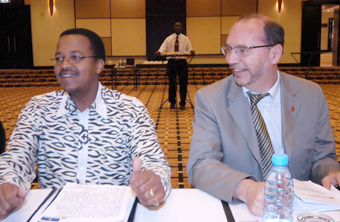
Kigali, 12 February 2006
Executive Director of UNAIDS Dr Peter Piot, (right), sits next to Dr. Innocent Nyaruhirira, Rwandan Minister of State in charge of HIV/AIDS.
Photo: UNAIDS/Riccardo Gangale
Related
Feature Story
World Not Doing Nearly Enough to Protect Children Affected by AIDS
09 février 2006
09 février 2006 09 février 2006Third Global Partners Forum Focuses on Protection, HIV Prevention, Treatment, Care
The global response to children affected by HIV and AIDS does not come close to matching the enormity of their rapidly expanding plight. By 2010 an estimated 18 million children in sub-Saharan Africa alone will be orphaned by the disease. Children living with sick and dying parents remain extremely vulnerable, and an estimated 4 million infected children do not have access to appropriate treatments.
This year’s Global Partners Forum, hosted by UNICEF and the UK Department for International Development (DFID), has brought together high level representatives from 90 international organisations, NGOs and governments in an effort to ramp up practical responses to the suffering of millions of children caught in the AIDS pandemic.
“Children are missing from the world’s response to the global AIDS pandemic,” said UNICEF Executive Director Ann M. Veneman. “Less than 10 per cent of the children who have been orphaned or made vulnerable by AIDS receive public support or services.”
This year’s forum will focus on ways to:
- Strengthen the capacity of families to protect and care for orphans and other children made vulnerable by HIV.
- Mobilize community-based responses to support affected families.
- Ensure equal and full access to education.
- Guarantee universal access to HIV prevention, treatment and care.
The forum will underline that communities and families should be the primary beneficiaries of an increased global AIDS response. A mix of economic assistance should be provided including direct cash grants for affected families, small loans and funds to pay community outreach workers.

“This is a crucial time in our global efforts to tackle HIV and AIDS- and a time to turn commitments into action,” said UK International Development Minister Gareth Thomas. “We must ensure that the needs of children are central to this and ensure that communities can fulfill their potential.”
Care and support for vulnerable children should not be limited to their material needs. More effort is required to provide orphans and other children traumatized by AIDS with counseling and psychosocial support.
To date, non-governmental and faith-based organizations as well as community groups have pioneered assistance to children and communities. Funds are needed to expand proven responses from pilot interventions to nationally scaled programmes.
Improving Access to Education
Education is one of the most important weapons against the spread of AIDS. The evidence for this is growing: in countries with severe epidemics, young people with higher levels of education are more likely to use condoms and less likely to engage in casual sex than less-educated peers. Educated children are also more likely to escape the poverty trap that ensnares orphans and children forced to take care of sick or dying parents.
However school fees remain a powerful barrier to educational access for the very children most at risk in many countries affected by AIDS. Ending school fees at the primary level is an essential step to achieving universal education. It can only be sustained if the international community increases funding to governments making the bold move to abolish school fees. With the abolition of primary school fees in Kenya, for instance, 1.3 million new pupils have poured into class rooms.
Ensuring that girls get equal access to education is also vital, especially as girls are disproportionately affected by HIV and AIDS. The UK government is a key partner in the United Nations Girls Education Initiative (UNGEI), a UNICEF-led effort to narrow the gender gap in education.
In addition, this year’s forum will focus on steps to ensure that children come as close as possible to gaining universal access to appropriate treatment and care by 2010; to prevent the spread of the disease among adolescents and young people; and to stop the transmission of the virus from mothers to their babies.
“Twenty five years into the epidemic, considerable progress has been made in mobilizing the world against AIDS,” said Dr Peter Piot, Executive Director of the Joint United Nations Programme on HIV/AIDS (UNAIDS). “But when it comes to accessing HIV prevention and treatment services, children and young people continue to be left behind. If we are to break the cycle of HIV infection, children and young people must know how to protect themselves from HIV.”
Legislative Protection
The forum will also examine ways to:
- Advocate for changes in law and policies governing the protection of vulnerable children.
- Raise awareness and reduce stigma for children affected by AIDS.
Improving systems of birth and death registration would have a positive impact. Currently it is difficult for children to obtain official records proving that they are orphans, which would make them eligible for such benefits as food aid or free medical care.
More about the Global Partners Forum at UNICEF
Feature Story
AIDS: everybody’s business
27 janvier 2006
27 janvier 2006 27 janvier 2006
AIDS affects business, employees, markets and productivity across the world. As business leaders meet in Davos this week for the World Economic Forum, many are turning their attention to the issue of the increasing impact of AIDS in the workplace.
A recent survey of business policy on AIDS, conducted by the Forum, has found that chief executives are becoming increasingly concerned about the impact of the epidemic on their companies. A growing number are willing to back their concerns with resources to scale up prevention and treatment programmes in the workplace. Nearly half of the almost 11,000 companies across 117 countries that responded to the questionnaire from the World Economic Forum expected AIDS to have a growing effect on their activities over the next five years.
“In recent years we have seen business become more aware of the threat posed by AIDS leading them to take a bigger role in acting against the disease,” said Ben Plumley, Director, Executive Office, UNAIDS. “The potential of the private sector’s contribution is immense and there is so much more it can still do to help. The findings of this report will really help us understand how we can engage more businesses in addressing the growing threat of HIV.”
Stigma and discrimination in the workplace is also highlighted in the report as a growing problem. Here, businesses can play an additional critical role -- by developing and implementing workplace policies to break down discrimination and support employees in accessing HIV treatment prevention services. Coalitions such as the Global Business Coalition on HIV/AIDS are helping companies meet these needs by bringing them together to share best practices.
High-profile campaigns – such as the new global brand ‘Product Red’ launched at the World Economic Forum on Thursday (26 January) are embracing marketing ideas o help show businesses ways to become more involved in the AIDS response. Product RED aims to engage the private sector in the fight against AIDS in Africa by channeling funds from the sale of RED products directly to the Global Fund to Fight AIDS, Tuberculosis and Malaria.
The Global Business Coalition on HIV/AIDS
DO THE (RED) THING
A report of the survey “Business and HIV/AIDS: A healthier partnership” was published by the World Economic Forum on January 12 and is available on the web at: http://www.weforum.org/pdf/Initiatives/gbs2006_report.pdf
Related
Feature Story
Towards universal access: meeting the challenge in Latin America
25 janvier 2006
25 janvier 2006 25 janvier 2006(Brasilia, 12-14 January 2006)
Lowering the prices of AIDS medicines and other essential commodities, securing additional donor support, increasing international awareness of the epidemic in the region, and reducing homophobia and gender discrimination were among the priority actions identified at the Latin America regional consultation on scaling up towards universal access.
In nearly all the Latin American countries, the highest levels of HIV infection are found among men who have sex with men.

Pedro Chequer, Coordinator Brazilian National STD/AIDS programme chairing a session of the The 1st regional consultation on Universal Access
The 1st regional consultation on Universal Access
The Latin American Regional Consultation on universal access, hosted by the Brazilian government, was organized by the Horizontal Technical Cooperation Group (HTCG) with seven civil society networks in Latin America and the Spanish-speaking Caribbean.
It brought together representatives of networks of people living with HIV, sex workers, men who have sex with men and other groups at high risk of exposure to HIV and also representatives of national AIDS authorities, the Assistant US Global AIDS Coordinator, representatives of the Catholic Church and UNAIDS Cosponsors.
Finding practical solutions at the local level
From the very first day, participants were urged to focus on solutions. “We have had a lot of plans,” said Michel Sidibe, Director of Country and Regional Support at UNAIDS. “We need more implementation,” he added.
The specificity of this international process is not only the focus on solutions but also countries’ ownership.
This means that there will be no globally set targets and that the countries, based on thorough assessment of their situation, will themselves determine what are their specific obstacles and what are the appropriate solutions to ensure that all women, men and children have access to the AIDS services that they need.
The United Nations General Assembly resolution adopted on 23 December 2005 calls for an inclusive country-driven process involving the relevant stakeholders from non governmental organizations, civil society and the private sector.
UNAIDS is actively assisting countries in facilitating this inclusive process aiming at coming as close as possible to the goal of universal access to treatment by 2010 for all those who need it.
Many national consultations are already scheduled to take place before the end of March 2006. The next regional consultation on Universal Access will take place in Tunis, Tunisia from 6 to 8 February 2006.
Feature Story
World AIDS Day kicks off with theme "Stop AIDS. Keep the Promise."
28 novembre 2005
28 novembre 2005 28 novembre 2005
Every year, people around the world designate 1 December, World AIDS Day, as a time of reflection – to remember the friends and loved ones lost to AIDS, to heed the lessons learned over the year, and to take stock of the progress made to provide a comprehensive response to the epidemic.
The Declaration of Commitment is, in effect, a blueprint for action. It includes not hypothetical goals but concrete benchmarks to measure progress on prevention, reducing stigma, building health infrastructure, ensuring treatment, and providing much-needed leadership and resources. While many countries have made their own commitments to fight AIDS, the Declaration was the first recognition of AIDS as a global crisis requiring a global and collective solution.
The Declaration will only be as powerful as its fulfilment. By sustaining a single theme over five years, the Campaign hopes it will attract others and create a movement that gives those working on the response a forum to be heard – and a platform to act.
This year's theme also asks every individual to make a personal promise to fight AIDS. Since the beginning of the epidemic, individual people have played heroic roles in helping and caring for people living with HIV and AIDS. In the early days, as governments and organizations dithered, individuals acted. The World AIDS Campaign's call to "Stop AIDS. Make the Promise" encourages everyone - everywhere - to be a part of the solution. Added together, these individual commitments will tell governments that all people care about AIDS, that they want to be part of an effective response to it, and that they are willing to make their own commitments to ending the epidemic. Individuals from all over the world are already meeting the individual commitment challenge: to prevent HIV, treat every person living with HIV/AIDS with respect and dignity, to support local programmes that provide care and treatment. World AIDS Day is the perfect time for each individual and group to recommit themselves to those ideals.
After two decades of living in a world with HIV, 1 December is a reminder that with sufficient will and resources, we have the power to stop the epidemic. What is needed – for each of the 40 million people living with the disease – is the involvement of people from every walk of life. Everyone can contribute, whether by making a promise to take action or by promoting the campaign with friends and colleagues. To make your promise and to learn more about the World AIDS Campaign and how people around the world are renewing their commitment to the fight on World AIDS Day, visit http://www.worldaidscampaign.org/.
Related links:
World AIDS Campaign
Related
 Immune Nations
23 mai 2017
 Germany—ending AIDS by 2020
12 mai 2017
Feature Story
Latin America and the Caribbean AIDS conference ends in El Salvador
11 novembre 2005
11 novembre 2005 11 novembre 2005
UNAIDS Executive Director Dr Peter Piot meets with the President of El Salvador Elías Antonio Saca González, host of the Presidential
Summit of Central American heads of state in San Salvador,
11 November 2005.
Photo credit: UNAIDS/Carlos H. Bruch
The III Latin America and the Caribbean Forum on HIV/AIDS/STDs (Foro 2005) and the IV Central American Congress on STD/HIV/AIDS (CONCASIDA) closed on Friday 11 November with a gathering of Presidents and other leaders from the Central America region.
UNAIDS Executive Director Dr Peter Piot attended the Presidential Summit and addressed the conference closing plenary.
At the summit, Dr Piot met with the President of El Salvador Elías Antonio Saca González, the host of the conference.
"There is momentum on leadership – made manifest in today's gathering of Presidents and other leaders from this region here today," said Dr Piot prior to the President's Summit. "Now is the time to act. So that together we can stop the threat of AIDS in our countries."
The President of Guatamela Oscar José Rafael Berger and the President of Costa Rica Abel Pacheco also attended the gathering, as well as the health ministers from Honduras and Nicaragua.
Dr Piot underlined the significant strides that have been made in the region to increase access to treatment. But, he added, these gains in treatment access need to be sustained and extended to the whole region. With more people living with HIV than ever in some countries, Dr Piot emphasized the urgent need to simultaneously increase HIV prevention programmes that reach all people at risk of infection, particularly those most marginalized such as men who have sex with men and sex workers.

"The region must revitalize its strategies to reach people most at risk – and they must address the deeper-rooted factors that affect vulnerability, such as social exclusion and inequalities of all kinds," he said.

Dr Piot urged leaders in the region to renew and reinvigorate their commitments at the highest political level and to agree to specific measures that will translate into concrete actions to reinforce AIDS responses nationally and regionally.
"The history of AIDS has shown us that when we are united, people win. Success depends on each of us truly being committed to tackling this exceptional crisis," said Dr Piot.
As part of the Presidential Summit, a declaration of enhanced commitment to a coordinated regional AIDS response was signed.
Related links:
UNAIDS press release: Putting the spotlight back on AIDS in Latin America and the Caribbean
Speech by UNAIDS Executive Director: The future of the HIV epidemics: leadership for action
Photos: View photos from CONCASIDA 2005
Feature Story
L'ONUSIDA est endeuillée par le décès d'Abel Shinana
12 juin 2014 18 février 2025
Abel Shinana participant à un atelier national sur le VIH en association à des mesures de prévention où il a apporté de précieux éléments et recommandations sur la manière d'aborder les besoins des populations clé à plus haut risque.
Jusqu'à très récemment, les besoins et les droits des professionnels du sexe étaient largement ignorés en Namibie. Toutefois, ces dernières années la situation a changé. Les professionnels du sexe se sont organisés, ils se sont exprimés sur les abus et les obstacles auxquels ils font face pour l'accès aux services anti-VIH, et les populations ont écouté.
Abel Shinana, l'ancien coordonnateur de l'African Sex Workers Alliance en Namibie, a fortement contribué à ce changement. Jeune professionnel du sexe, Abel était ouvert, sérieux et engagé dans le mouvement. Lorsqu'il a démarré en tant que coordonnateur d'ASWA il y a plus d'un an, il était quelque peu timide et réservé. En quelques mois, Abel s'est transformé en courageux et ardent défenseur des droits des professionnels du sexe, des personnes vivant avec le VIH et des populations LGBTI. Il était également un partenaire crucial pour l'UNFPA et l'ONUSIDA dans ses efforts de lutte contre le VIH parmi les professionnels du sexe, au niveau des pays comme au plan mondial.
Il y a tout juste 2 semaines, Abel était un présentateur et actif participant lors d'un atelier national sur le VIH en association à des mesures de prévention et a apporté de précieux éléments et recommandations sur la manière d'aborder les besoins des populations clé à plus haut risque. Il a récemment également co-rédigé un Rapport d'évaluation communautaire sur le VIH et les professionnels du sexe et était l'auteur principal du résumé qui a été accepté pour être présenté lors de la Conférence Internationale sur le sida 2012 qui se tiendra en juillet à Washington.
En mars de cette année, Abel a coordonné la toute première commémoration de la journée internationale sur les droits des professionnels du sexe qui a généré une couverture médiatique considérable et contribué à une plus grande compréhension sur le fait que les professionnels du sexe ont également des droits. Aucun doute, Abel était l'une des ces nouvelles et fortes voix pour les droits de l'homme des professionnels du sexe en Afrique, mettant le vécu des professionnels du sexe au centre des débats politiques.
Le décès prématuré et tragique de ce jeune leader engagé, victime d'un accident de voiture, représente une perte majeure pour le mouvement naissant des professionnels du sexe en Namibie et bien au-delà. Les torrents de sympathie des partenaires à tous les niveaux en sont le témoignage. Pour nous à l'ONUSIDA et à l'UNFPA en Namibie, nous avons également perdu un ami cher.


Feature Story
L'ONUSIDA demande au Pape Benoît XVI son soutien dans les initiatives visant à stopper les nouvelles infections au VIH chez les enfants
12 juin 2014 18 février 2025
Le Directeur exécutif de l'ONUSIDA Michel Sidibé avec le Pape Benoît XVI.
Photo : L'Osservatore Romano
Le Directeur exécutif de l'ONUSIDA Michel Sidibé a demandé au Pape Benoît XVI un engagement personnel dans l'arrêt des nouvelles infections au VIH chez les enfants. Lors d'une audience avec le Pape, M. Sidibé lui a indiqué que l'élimination des infections au VIH chez les enfants était un objectif atteignable qui, grâce à des efforts concertés, pourrait être atteint d'ici 2015.
« Des millions de personnes dans le monde vivant avec et touchées par le VIH sont pris en charge par des organisations de santé catholiques », a déclaré M. Sidibé. « Le plein engagement de l'Église catholique dans les initiatives visant à éliminer les nouvelles infections au VIH chez les enfants est d'une importance capitale. »
Le Vatican estime que les organisations reliées à l'Église catholique fournissent près de 25 % de l'ensemble des services de traitement, de soins et d'appui en matière de VIH dans le monde. En 2010, le Vatican a rapporté que plus de 5 000 hôpitaux, 18 000 dispensaires et 9 000 orphelinats, dont un grand nombre sont impliqués dans des activités liées au sida, étaient soutenues par l'Église catholique.
Pour atteindre l'objectif d'arrêter les nouvelles infections au VIH chez les enfants à l'horizon 2015, l'ONUSIDA et ses partenaires ont lancé un Plan mondial pour éliminer les nouvelles infections au VIH chez les enfants à l'horizon 2015 et maintenir leurs mères en vie, à l'occasion de la Réunion de haut niveau sur le VIH/sida des Nations Unies de 2011. Le plan décrit une stratégie principalement axée sur les 22 pays qui représentent plus de 90 % des nouvelles infections au VIH chez les enfants dans le monde.
Après l'audience, M. Sidibé a rencontré M. Michel Roy, secrétaire général de Caritas Internationalis, une confédération de 164 organisations catholiques d'aide humanitaire, de développement et de services sociaux opérant dans plus de 200 pays et territoires dans le monde. En tant que précieux partenaire de l'ONUSIDA, Caritas Internationalis est l'une des organisations de la société civile représentées au comité de direction du Plan mondial pour éliminer les nouvelles infections au VIH chez les enfants.
Le plein engagement de l'Église catholique dans les initiatives visant à éliminer les nouvelles infections au VIH chez les enfants est d'une importance capitale
Michel Sidibé, directeur exécutif de l'ONUSIDA
Les organisations confessionnelles jouent un rôle considérable dans la prévention, le traitement, les soins et l'appui aux personnes vivant avec et touchées par le VIH. L'Organisation mondiale de la Santé a estimé que les groupes confessionnels prodiguent entre 30 % et 70 % de l'ensemble des soins en Afrique. Pendant leur conversation approfondie au sujet du Plan mondial et des opportunités de renforcement de leur collaboration et de leurs partenariats dans la riposte au VIH, Michel Sidibé a déclaré : « L'élimination des naissances séropositives est un objectif atteignable. Nous sommes tous d'accord sur ce point, tout comme sur l'importance de maintenir en vie les mères des enfants. »
M. Michel Roy a déclaré : « La riposte mondiale au VIH est une priorité de Caritas Internationalis depuis ces 25 dernières années. Nous poursuivrons notre engagement dans ce domaine. Nous soutenons activement les efforts visant à éliminer l'infection au VIH chez les enfants. La campagne « HAART for Children » de Caritas partage l'objectif commun de promouvoir l'adoption renforcée de programmes de prévention de la transmission mère-enfant et de s'assurer que les enfants vivant avec le VIH, ainsi que leurs mères, ont accès à un diagnostic et un traitement précoces. »
M. Sidibé a ensuite rencontré le Cardinal Peter Turkson, président du Conseil pontifical « Justice et Paix ». En 2009, le Cardinal, originaire du Ghana, a co-présidé la deuxième Assemblée spéciale pour l'Afrique du Synode des Évêques. Sous la direction du Cardinal Turkson, les évêques ont discuté du VIH et leur message final encourageait l'Église à s'engager encore plus dans l'élimination du sida.
Dans leurs discussions, le Cardinal Turkson et M. Sidibé ont parlé de l'épidémie de sida en Afrique, des financements durables et du VIH en tant que frein au développement.
« La riposte au VIH est une question de justice sociale », a déclaré M. Sidibé. « Il s'agit de mieux déployer les ressources dans les pays et plus particulièrement de veiller à une redistribution plus équitable entre le nord et le sud. »
Concernant le plan pour éliminer les nouvelles infections au VIH chez les enfants, le Cardinal Turkson a déclaré : « Avec les technologies médicales disponibles, s'assurer que les enfants naissent sans infection au VIH est l'objectif que le genre humain peut et devrait atteindre, sans tarder ; cela contribuerait au développement humain, économique et social des pays concernés. »
Reconnaissant le travail important de la communauté religieuse dans la riposte au sida, l'ONUSIDA a établi un cadre stratégique en 2009 –– pour renforcer les partenariats entre l'ONUSIDA et les organisations confessionnelles. Le cadre décrit la nécessité pour les leaders religieux mondiaux et nationaux d'adopter une action publique de soutien à la riposte au sida et de renforcer la capacité des organisations confessionnelles à travailler dans le domaine du VIH.
À l'occasion de sa visite à Rome, M. Sidibé a également rencontré Staffan de Mistura, sous-secrétaire d'État au Ministère des affaires étrangères italien, avec lequel il a discuté de l'importance pour l'Italie de maintenir sa longue tradition de leadership en matière de riposte mondiale au sida. M. de Mistura a exprimé le fort soutien de l'Italie pour la vision de l'ONUSIDA : zéro nouvelle infection au VIH, zéro discrimination et zéro décès lié au sida, ainsi que l'intérêt particulier qu'elle porte au plan mondial destiné à éliminer les nouvelles infections au VIH chez les enfants.

Press Statement
Enseignements à tirer de l’approche intégrée du KwaZulu-Natal à l’égard des services anti-VIH, médicaux et sociaux
29 septembre 2011 29 septembre 2011Le programme d’intégration du KwaZulu-Natal réussit à combiner les services anti-VIH avec les services spécialisés dans les cancers du col de l’utérus et du sein, la tuberculose, l’éducation sanitaire et les questions sociales et médicales délicates.

Le Premier ministre du KwaZulu-Natal, le Dr Zweli Mkhize, et le directeur exécutif de l’ONUSIDA. 29 septembre 2011.
Photo: ONUSIDA/ A. Debiky
GENÈVE, 29 septembre 2011—Le Directeur exécutif du Programme commun des Nations Unies sur le VIH/sida (ONUSIDA) a salué l’engagement du Premier ministre du KwaZulu-Natal, le Dr Zweli Mkhize, en faveur de l’intégration des services anti-VIH et des services médicaux, sociaux et économiques.
Depuis l’adoption de cette approche intégrée par le KwaZulu-Natal, les communautés locales disposent d’un centre à guichet unique qui leur permet d’avoir facilement accès à l’information, aux services médicaux et à un large éventail de services sociaux et économiques spécialisés dans la réduction de la pauvreté, l’éducation et le développement.
« Cette approche globale de l'accès aux services médicaux et sociaux n’est pas seulement efficiente mais elle est également efficace, du fait qu’elle sert de modèle à d’autres provinces et même à plusieurs États de la région », a déclaré Michel Sidibé, lors de la visite de sept jours qu'il a effectuée en Afrique du Sud pour s’informer des progrès et des difficultés du pays dans l’intensification de sa riposte au VIH. « Le travail mené ici est un exemple de la manière dont les services peuvent être apportés au cœur de la communauté, là où ils sont les plus nécessaires. »
Le Premier ministre du KwaZulu-Natal, le Dr Zweli Mkhize, a joué un rôle leader dans la décentralisation de la riposte sud-africaine au sida et l’intégration des services anti-VIH dans l’action économique et sociale de la province. Le gouvernement provincial a mis en place des programmes intégrés pour assurer les services contre le VIH, la tuberculose, les cancers du sein et du col de l’utérus, la pauvreté et l’insécurité alimentaire ainsi qu’un éventail d’autres services médicaux et sociaux.
« En reliant les services anti-VIH aux autres services dont la communauté a besoin, nous savons que nous aidons l’Afrique du Sud à atteindre ses objectifs nationaux, lesquels visent la réduction du nombre des nouvelles infections au VIH de 50 % avant 2015, et l’accroissement de la part des personnes sous traitement antirétroviral », a déclaré le Dr Zweli Mkhize. « Notre modèle porte des fruits. »
La prévalence du VIH était de 39,5 % en 2009 au KwaZulu-Natal – soit la plus élevée d’Afrique du Sud. L’approche intégrée adoptée par le gouvernement provincial du KwaZulu-Natal a d’ores et déjà contribué à élargir le recours au dépistage anti-VIH, lequel avait concerné 2,9 millions de personnes dans la province à la fin de juin 2011. Cette approche a également élargi l’accès aux thérapies antirétrovirales salutaires, lesquelles sont au nombre de 489 801 dans 518 lieux de la province, et réduit le taux des infections de la mère à l’enfant qui est passé de 21 % il y a cinq ans à 2,8 % en 2011.
Contact
ONUSIDA Afrique du SudNatalie Ridgard
tel. +27 83 642 6759
ridgardn@unaids.org
Bureau du Premier ministre
Ndabezinhle Sibiya
tel. 0823754742
sibiyand@premier.kzntl.gov.za
Press centre
Download the printable version (PDF)