Feature Story
International Health Partnership launch
05 Septiembre 2007
05 Septiembre 2007 05 Septiembre 2007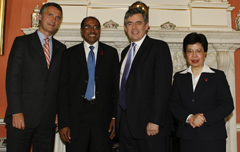 From left to right: Norwegian Prime Minister
 Jens Stoltenberg, UNAIDS Deputy Executive
Director Michel Sidibe, British Prime Minister
Gordon Brown, and Dr Margaret Chan, Director-
General of the World Health Organization
(Photo: Richard Lewis/Crown Copyright)
Leaders from donor countries, funding organizations, developing nations, and international agencies came together in London on Wednesday 5 September to launch a new international partnership to help improve healthcare systems in the developing world.
Led by the government of the United Kingdom, the International Health Partnership was launched formally by UK Prime Minister Gordon Brown at an event at 10 Downing Street, London.
The initiative aims to increase donor, country and international coordination on health and development issues in order to drive forward work on the health-related Millennium Development Goals (MDGs) – reducing child mortality, improving maternal health, and halting and reversing the spread of HIV.
Following a roundtable discussion focusing on implementation, participants signed a compact to work within countries’ national plans and improve coordination in order to address problems related to health worker staffing, infrastructure, health commodities, logistics, tracking progress, and effective financing. Partners will work together to ensure that health plans are well-designed, well-supported and well-implemented and to make their work more effective and better aligned with developing countries’ established priorities.
In a statement released on Wednesday 5 by the United Kingdom, Prime Minister Gordon Brown said, “There is no greater cause than that every man, woman and child in the world should be able to benefit from the best medicine and healthcare. Today we come together – donor governments, health agencies and developing countries – with the certainty that we have the knowledge and the power to save millions of lives through our efforts.”
In an initial phase, seven ‘first wave’ countries – Burundi, Cambodia, Ethiopia, Kenya, Mozambique, Nepal and Zambia – have joined the partnership and participated in the London event. Also attending were Heads of State and ministers from donor countries such as Norway and Canada and senior figures from international agencies, including UNAIDS. Philanthropist Bill Gates attended on behalf of the Bill and Melinda Gates Foundation.
Speaking at the event, UNAIDS Deputy Executive Director Michel Sidibe underlined the importance of the partnership. “To improve global health, it is critical that we have better coordination and mutual accountability from all parties: countries, donors, and the international organizations.” he said. “The International Health Partnership will be crucial in order to deliver on our commitments to the targets of Universal Access to HIV prevention, treatment, care, and support, and in reaching all the health-related Millennium Development Goals. The global response to AIDS has shown us that increased coordination can lead to progress. We also need to stay focused on the concrete results that we are all committed to, at the same time putting in place predictable, scaled-up financing for a long-term sustainable response.”
A joint statement from international health partners – UNAIDS, The GAVI Alliance, Global Fund to Fight Aids, Tuberculosis and Malaria, UNICEF, United Nations Population Fund, World Bank and the World Health Organization – welcomed the initiative: “We, as international health partners committed to improving health and development outcomes in the world, welcome and fully support the International Health Partnership's mission to strengthen health systems, and we congratulate those involved for setting it in motion.”
“We will be coordinated and accountable in this work and take every opportunity to capture knowledge and lessons learned in improving health programmes,” the partners stated.
The International Health Partnership is the first of several complementary initiatives being launched by donor countries over the next several weeks as part of a new Global Campaign for the Health Millennium Development Goals. More information will be featured in the coming weeks on the UNAIDS website.
Links:
Read the joint statement by international health partnersRead the UK press release
More on the International Health Partnership
Related
 Report highlights that women and marginalized people need urgent access to health-care services in Ukraine
11 de mayo de 2022
 Key considerations to integrate HIV and mental health interventions
28 de abril de 2022
 Welcoming Ukrainian refugees in Germany: big test for all
21 de abril de 2022
Feature Story
Faith leaders join in Nigeria on AIDS
04 Septiembre 2007
04 Septiembre 2007 04 Septiembre 2007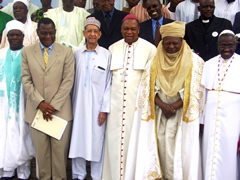
Relegious and government leaders at the opening
ceremony of the Forum.
Photo credits: UNAIDS/S. Aghaeze
Over 150 leaders from all denominations of Christian and Islamic faith communities came together in Abuja, Nigeria to take stock of faith-based organizations’ achievements and good practices within the AIDS response in the country and to examine challenges faced for the future. Hosted by the National Faith-Based Advisory Committee on AIDS – NFACA, the Forum was opened by the highest Muslim and Christian leaders in the country, the Sultan of Sokoto, Alhaji Muhammadu Saad Abubarkar III, represented by Dr Lateef Adegbite, Secretary-General of the Nigeria Supreme Council for Islamic Affairs and Most Reverend Dr John Onaiyekan, President of the Christian Association of Nigeria.
“I want the Christian and Muslim communities in this Forum to come up with a stronger position on HIV prevention, to do more for people infected and affected, and to be more involved in the campaign against stigma and discrimination,” Dr Adegbite said in his opening address.
Most Reverend Onaiyekan pleaded for more recognition and a commensurate allocation of resources to the faith-based AIDS programmes. “There is growing acknowledgement and appreciation– including among the United Nations agencies – of the tremendous role being played by religious institutions and organizations, especially in the poorer countries of the world. However, put bluntly, the money is not going to those who are doing most of the work. It is hoped that this anomaly will be redressed in good time,” he stated.
The bi-annual Forum is the third to have taken place in Nigeria to strengthen the faith-based response to AIDS in the country. The forums provided unique avenues for the Christian and Islamic faiths to interact and to strategize on their role in the national AIDS response.
At the 2007 Forum, the participants made recommendations on the way forward and on policy and strategic issues relating to HIV prevention, testing, care and support, and gender in the Forum’s communiqué. They agreed that faith-based organizations should identify their areas of competence and do more of what they do best, including HIV prevention, promoting and providing services and caring for people living with HIV. The religious leaders and scholars called for the Nigerian government to accelerate access to free medical treatment and care for all people living with HIV who need it.
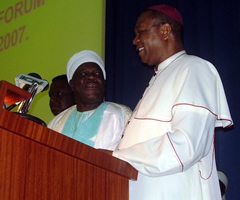
Most Reverend J. Onaiyekan and Dr Lateef Adegbite
declaring the Forum opened.
Photo credit: UNAIDS/S. Aghaeze
On the issue of HIV testing and counseling, the faith leaders committed to mobilizing their communities to access services on a voluntary and confidential basis as they had been exhorted to by Professor Babatunde Osotimehin, Director-General of the National Agency for the Control of AIDS, in his update on the status of the national response: “HIV generates harmony among faith communities. We expect this Forum to make a strong statement on how to mobilize communities to access voluntary and confidential HIV counseling and testing. Compulsory testing should not be in your vocabulary,” he said.
The Forum was organized by the National Agency for the Control of AIDS and supported by UNFPA and UNAIDS.
UNAIDS Country Coordinator Warren Naamara gave a goodwill message to participants of the Forum, underlining the importance of religious leader’s engagement in the AIDS response. “Your influence on opinions, policies, practices and attitudes reaches from the grassroots and remote communities to the very top level of government and decision-makers. Your compassion and support has always embraced the disenchanted and the vulnerable, the sick, the children and the weak in need of assistance,” he said. “Your speaking out against stigma and discrimination, against rejection and marginalization of people living with HIV, will make a world of difference to the everyday life of people infected, within and beyond their religious communities,” he added.
Links:
Read the opening address by Most Rev. John Onaiyekan, President of the Christian
Association of Nigeria
Read the goodwill message by Dr. Warren Naamara, UNAIDS Country Coordinator
Read the Forum Communiqué
Related
 Leave no one behind and that includes people who use drugs
04 de mayo de 2023
 Dangerous inequalities and overcoming them
18 de noviembre de 2022

Feature Story
Cricket chief and star show AIDS solidarity in India
04 Septiembre 2007
04 Septiembre 2007 04 Septiembre 2007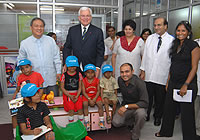
ICC chief Malcolm Speed (standing in centre),
cricketer Virender Sehwag (crouching) and
UNICEF Representative Cecilio Adorna (left)
with childrenand staff at the Kalawati Saran
Children’s Hospital in New Delhi.
Photo credits: UNICEF India/2007/Biswas
Head of the International Cricket Council (ICC), Malcolm Speed joined Indian star Virender Sehwag and Cecilio Adorna, UNICEF India country representative, in a visit to the Antiretroviral treatment centre of the Kalawati Saran Children’s Hospital in New Delhi at the end of August. The visit was part of the ICC's partnership with UNAIDS and UNICEF to raise awareness and reduce stigma around AIDS and the impact of AIDS on children through the global campaign, UNITE FOR CHILDREN UNITE AGAINST AIDS .
As well as playing an impromptu game of cricket with a group of young children, the delegation also had the opportunity to meet with children and mothers living with HIV.
“Cricket is not all about the game,” said Malcolm Speed. “Having a social awareness programme associated with it is not only an excellent way to reach out to the cricket fans but also an uplifting experience for the cricketers as well, and puts everything into perspective,” he added.
Virenda Sehwag added: “It is important for every one of us to spend time children living with HIV. It is a pleasure to be associated with the cause. When celebrities endorse a noble cause like this, it has more impact.”
In India, an estimated 70,000 children below the age of 15 are living with HIV. Worldwide, every day there are estimated to be nearly 1,800 new HIV infections in children under 15.
AIDS and young people will be a key theme of the upcoming ICC Twenty 20 World Championships being hosted by South Africa from 11 to 24 September as part of the unique partnership between the ICC, UNICEF, UNAIDS, the African Broadcast Media Partnership and the Kaiser Family Foundation, using the cricket tournament to draw attention to the impact of AIDS on the world’s children.
Links:
Watch video footage of Malcolm Speed’s visit to the Indian Children’s hospital | High | Low
Read more on the ICC Twenty20 World Championships
Read more on Unite for Children: Unite against AIDS
Related
 Indian partners reflect on a year after sex workers’ human rights affirmed
05 de octubre de 2023
 The urgency of HIV prevention among adolescent girls and young women
01 de junio de 2023
 A rainbow of hope for LGBTQI+ people in rural Japan
17 de mayo de 2023
Feature Story
Stars back AIDS awareness campaign at ICC World Twenty20 in South Africa
04 Septiembre 2007
04 Septiembre 2007 04 Septiembre 2007

The cricket World Twenty20 will focus
on children, young people and HIV.
Logo credits: ICC
International cricketers will highlight the situation of children and young people living with HIV as part of a far-reaching AIDS awareness campaign during the 2007 Twenty20 world cricket championship in South Africa.
Players, participating in the competition from 11 to 24 September in Johannesburg, will promote HIV prevention messages as part of the International Cricket Council's (ICC) ongoing partnership with UNAIDS and UNICEF.
Cricket fans will also be targeted by loveLife - South Africa's national youth HIV prevention programme - who are also partners in the initiative.
Top players, including South Africa captain Graeme Smith, Kumar Sangakkara of Sri Lanka and India's Yuvraj Singh will feature in public service announcements for the 'Unite for Children, Unite Against AIDS' campaign highlighting how HIV can affect the lives of young people. Broadcasters from 105 countries will be encouraged to use the messages that will be screened to fans on giant screens at the 27 matches during the tournament.
Other stars will visit UNICEF and loveLife community-based project activities in Cape Town, Durban and Johannesburg to promote AIDS awareness to young people and encourage them to develop life-skills to avoid HIV infection.
Players also plan to wear red ribbons in selected matches to demonstrate their support for people living with HIV.
Sri Lanka wicketkeeper-batsman Kumar Sangakkara said: "I hope people will listen to cricketers, I hope that our support helps and that it brings a different perspective to building interest in these issues and raising awareness. It's important to raise awareness any way that you can and if different voices and fresh faces help then that is good."
New Zealand cricketter Ross Taylor visiting
community-based project in South Africa.
Photo credits: ICC/Rebecca Hearfield
South Africa star AB de Villiers added: "I have a very soft heart and to see those children and the way they cope with HIV puts a lot of what I do as a cricketer in perspective. I have been involved in a few projects to do with 'Unite for Children, Unite Against AIDS' in different parts of the world where we have toured and it has been a very worthwhile thing to do.
"I feel a real calling to help wherever I can. The issue of AIDS is close to my heart because of the impact it has had on my country but I think we have a responsibility as high-profile sportsmen to do what we can as it helps to open eyes and it inspires people to do something about the problem. Awareness is a big factor in helping prevent the spread of HIV so the more we talk about it and keep it in the public eye the better."
India all-rounder Yuvraj Singh added: "Any social cause is important for top players playing any sport because people look up to you and you need to make them understand and educate them about issues relating to HIV. Through the ICC working with UNAIDS and UNICEF, we can deliver important messages to people all over the world."
Michael Hussey of Australia will also be supporting the campaign. He said: "When I visited an education project in the Caribbean during the ICC Cricket World Cup, I saw for myself the importance of educating young people on HIV and AIDS. UNICEF and UNAIDS play a vital role in addressing this epidemic and by supporting this partnership, by meeting young people and raising awareness of HIV and AIDS, I hope I can personally play a part in reducing discrimination."
As well as player-related activities, the 500 volunteers working at the event have all received HIV and AIDS education from loveLife health trainers, supported by UNAIDS. There will also be advertising boards at the grounds promoting the 'Unite for Children, Unite Against Aids' campaign.
The African Broadcast Media Partnership Against HIV/AIDS - a coalition of more than 50 African broadcast companies - will also be supporting the partnership, promoting player visits and event activities related to the partnership.
Cricket is popular in many of the countries that are most impacted by AIDS, including India and South Africa.
“UNAIDS has worked for many years with the ICC and the partnership has helped us reach large audiences with HIV prevention messages. Sport is a powerful force for change and the cricket players are great roles models helping us not only promote HIV prevention but also tackle the stigma and discrimination associated with HIV and AIDS,” said Andy Seale, team leader for civil society partnerships at UNAIDS.
Part of this story first appeared on the ICC web site: http://www.icc-cricket.com/
Links:
top cricketers talking about how children and young people are affected by HIV
Read feature story: Cricket chief and star show AIDS solidarity in India
Read more on the ICC Twenty20 World Championship
Read more on Unite for Children: Unite against AIDS
Related
The urgency of HIV prevention among adolescent girls and young women
01 de junio de 2023
 Thailand’s Mplus: HIV services delivered in style
13 de diciembre de 2022
 United for ending cervical cancer, HIV and inequities for women and girls
17 de noviembre de 2022
Feature Story
The process behind AIDS estimates
30 Agosto 2007
30 Agosto 2007 30 Agosto 2007Methodology explained
Knowing the status of the epidemic and monitoring the programmatic response are critical to understand where the epidemic is going and whether programmes are achieving desired impact. In order to Know the Epidemic, UNAIDS recommends the use of methodologies, tools and software which are regularly reviewed and adapted to respond to an evolving epidemic and changing needs.
Improving national and regional estimates
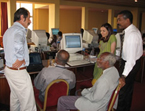
Between March and June 2007, national epidemiologists, analysts and heads of AIDS programmes from 124 countries have taken part in specialist UNAIDS training to improve and refine country HIV estimates.
Eleven regional training workshops have been conducted around the world to bring epidemiologists up to date with the latest developments in estimates tools and software packages including updated assumptions based on new evidence from research and added new features.
Results of recent population-based surveys

By mid 2007 a total of 26 countries in sub-Saharan Africa, two in the Caribbean and two in Asia had conducted nationally representative population-based surveys with HIV prevalence measurement. The results from these surveys are helping UNAIDS and goverments to refine and update AIDS estimates as new information becomes available.
2.5 million people living with HIV in India

As part of its continuous efforts to know its epidemic better, India’s National AIDS Control Organisation (NACO), supported by UNAIDS and WHO, have used improved data from more sources and revised the methodology used to analyse this new data to get a better understanding of the AIDS epidemic in India.
Related
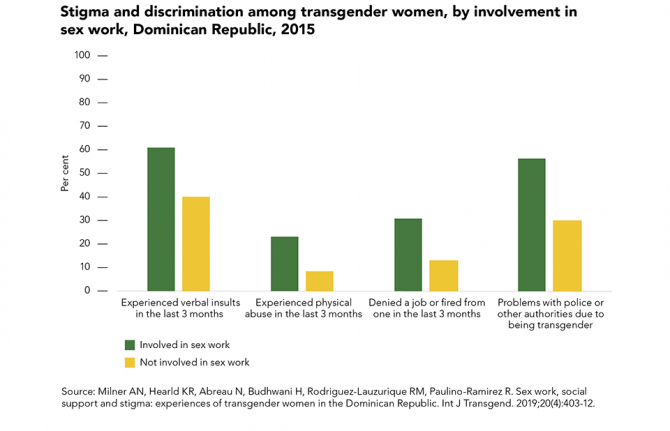 Transgender sex workers face frequent abuse
29 de marzo de 2022
 Many key populations avoid health services
21 de febrero de 2022
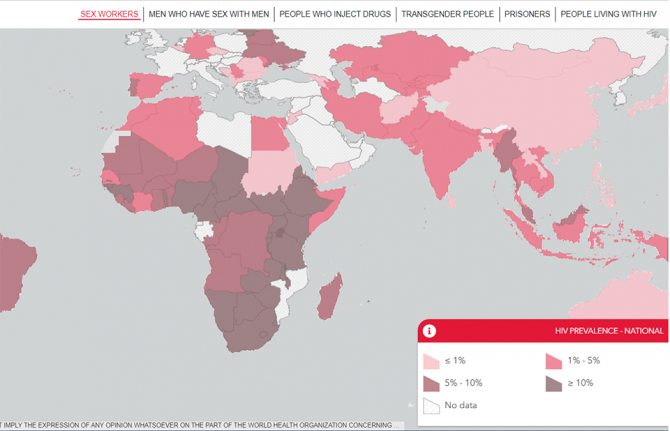 New indicators added to Key Populations Atlas
06 de enero de 2022
Feature Story
Funding estimates for AIDS research and development
30 Agosto 2007
30 Agosto 2007 30 Agosto 2007
The HIV Vaccines and Microbicides Resource
Tracking Working Group was created to generate
and disseminate high-quality, detailed and
comparable data on annual investments in
preventive HIV vaccine and microbicide research
and development
For a comprehensive response to AIDS, developing additional HIV prevention methods and tools to prevent HIV – such as HIV vaccines and microbicides -- is a key component.
The continuing research and development of such prevention technologies relies on adequate and efficient funding and spending – and supporting this, high quality, detailed data on investment in this area of the AIDS response is critical.
In 2004, UNAIDS, the Alliance for Microbicide Development (AMD), the AIDS Vaccine Advocacy Coalition (AVAC) and the International AIDS Vaccine Initiative (IAVI) established a collaborative project to track funding for HIV vaccines and microbicide research and development.
The HIV Vaccines and Microbicides Resource Tracking Working Group was created to generate and disseminate high-quality, detailed and comparable data on annual investments in preventive HIV vaccine and microbicide research and development and policy and advocacy activities. These data can be used to monitor current levels of effort; identify trends in investment, spending, and research focus; identify areas needing more resources and effort; assess the impact of public policies aimed at increasing investment in new prevention technologies; and provide a fact base for policy advocacy on research and development investments and allocations.
The collaboration aims to monitor progress in the implementation of the Declaration of Commitment on HIV/AIDS, adopted at the United Nations General Assembly Special Session (UNGASS) on HIV/AIDS in 2001. This declaration contains a number of global and national indicators that are being monitored on an annual basis by UNAIDS and others. The second of the global commitment and action indicators, is the “Amount of public funds available for research and development of vaccines and microbicides.”
In August 2007, the Working Group released a summary of the resource tracking efforts – the most up to date available data on sources of global funding and its allocation. These figures are produced to support larger resource needs estimations for the global AIDS response as a whole, which will be published in the later half of 2007
Among findings within the 2007 Working Group estimates on research and development are that while the current levels of funding are significant, there is a critical need to sustain and increase research and development investments for preventive vaccines, microbicides and other new options to optimally accelerate the development of and ensure eventual access to these HIV prevention tools.
As stated in the latest estimates report from the Working Group, in 2006, total global investment in preventive HIV-vaccine research and development was an estimated US$933 million, a 23% increase over 2005 funding levels. This increase in funding can primarily be attributed to new research initiatives funded through the US National Institutes of Health (NIH), Canada, the European Commission (EC) and the Bill & Melinda Gates Foundation.
However, financing needs are likely to remain substantial in the coming years, as funding is needed to explore new approaches to vaccine and microbicide design; bring novel candidates into the pipeline; support clinical trials to test the safety, immunogenicity and efficacy of new products; and translate research results, such as those for adult male circumcision, into policies and programmes.
“The HIV Vaccines and Microbicides Resource Tracking Working Group group has systematically documented the amount of financial resources needed and the actual expenditures from public sources in research and development. This is a notable example in the resource tracking world because of the good quality of its results combined with a very dynamic group that is able to translate the financial estimates into a powerful advocacy tool”, said Jose Antonio Izazola-Licea, UNAIDS Senior Adviser, Resource and Finance Analysis.
Links:
Read the full document on latest estimates on research and development investment and spending
Visit the Working Group's web site
Related
Feature Story
Mary Fisher, representante especial de ONUSIDA, visita Zambia
29 Agosto 2007
29 Agosto 2007 29 Agosto 2007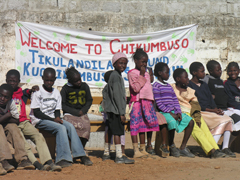
Durante su estancia en Lusaka, Mary Fisher visitó
varios centros de acogida para niños de la calle y
niñas vulnerables, incluyendo el Fountain of Hope
(Fuente de la Esperanza) y el Centro de formación
del programa Umoyo.
En agosto, como parte de su trabajo como representante especial de ONUSIDA, la activista sobre el sida, oradora, escritora y artista Mary Fisher visitó Lusaka (Zambia), para fomentar la sensibilización sobre el sida y respaldar varias iniciativas para el sida en el país. Fisher viajó con un grupo de líderes del mundo de la sanidad, de los negocios y del activismo de base procedentes de Estados Unidos y visitó lugares de toda la capital, incluyendo un centro de acogida para niños de la calle, una escuela comunitaria y un centro de formación para chicas jóvenes.
Durante su estancia en Lusaka, Mary Fisher visitó varios centros de acogida para niños de la calle y niñas vulnerables, incluyendo el Fountain of Hope y el Centro de formación del programa Umoyo. Estas organizaciones facilitan información sobre el VIH, servicios sanitarios gratuitos, materiales de prevención del VIH y asistencia educativa a miembros de las comunidades locales.
En el proyecto Chikumbuso para mujeres y huérfanos, Mary Fisher y sus compañeros se reunieron con madres solteras y viudas para conocer más de cerca sus actividades generadoras de ingresos, como la elaboración de pulseras, que les ayuda a mantener a sus familias. En Chikumbuso, las mujeres también recogen bolsas de plástico, con las que hacen monederos y bolsos, que luego venden en un mercado semanal de Lusaka. Según Mary Fisher, los ingresos que genera este proyecto “no sólo permiten que [las mujeres] puedan mantenerse a sí mismas y a sus familias, sino que también son una fuente de orgullo y esperanza".

Como parte de su trabajo como representante
especial de ONUSIDA, Mary Fisher visitó Lusaka,
Zambia, para fomentar la sensibilización sobre
el sida y respaldar varias iniciativas para el sida
en el país. Foto: El ONUSIDA / M. Aon
Como parte de su misión, Mary Fisher también se reunió con Maureen Mwanawasa, primera dama de Zambia y fundadora de la Iniciativa comunitaria de Maureen Mwanawasa, en un evento que tuvo lugar en la residencia oficial del presidente de Zambia. Durante el acontecimiento, la primera dama reiteró su apoyo al trabajo de sensibilización de Mary Fisher y dejó claro que los líderes políticos de Zambia están “decididos a frenar el avance del VIH”. Como presidenta de la Organización de primeras damas africanas y fundadora de su sección nacional en Zambia, la Iniciativa comunitaria de Maureen Mwanawasa, la primera dama de Zambia ha estado trabajando activamente para sensibilizar y poner en marcha programas sobre el VIH, no sólo en Zambia, sino en todo el continente africano.
Las tasas de prevalencia del VIH en Zambia permanecen altos, en un 18%, pero el país ha hecho grandes progresos en los últimos años: el número de personas que reciben tratamiento antirretrovírico ha aumentado y los programas de prevención, tratamiento, atención y apoyo del VIH en zonas rurales se han reforzado.
Mary Fisher es representante especial de ONUSIDA desde mayo de 2006. Su trabajo consiste en sensibilizar sobre la prevención, tratamiento, atención y apoyo del VIH, haciendo especial hincapié en mujeres y niños. Fisher también es la fundadora de CARE, la clínica de educación e investigación del SIDA que lleva su nombre en la Universidad de Alabama en Birminghan, y es miembro activo del Consejo de dirección de la Coalición mundial sobre la mujer y el sida.
Enlaces relacionados:
Otras actividades de Mary Fisher como representante especial de ONUSIDA
Related
The urgency of HIV prevention among adolescent girls and young women
01 de junio de 2023
 Asia Pacific women living with HIV speak out about rights violations
08 de marzo de 2023
 The First Fallen but We Will Overcome
03 de noviembre de 2022
Feature Story
Primera asociación para personas que viven con el VIH en Pakistán
24 Agosto 2007
24 Agosto 2007 24 Agosto 2007Una nueva iniciativa nacional de ONUSIDA en Pakistán pretende asegurarse de que comunidades y gobierno escuchan a los expertos (personas que viven con el VIH) a la hora de tomar decisiones sobre tratamiento, atención, apoyo y prevención.
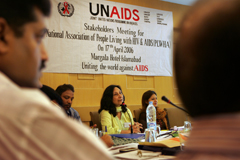
La asociación se creó el Día Mundial del SIDA de
2006 con el apoyo del gobierno de Pakistán y de
ONUSIDA y sus copatrocinadores de las Naciones
Unidas. Foto: ONUSIDA / J. Moore
Masood, de 24 años, es el miembro más reciente de una de las últimas iniciativas de ONUSIDA: la “Asociación de personas que viven con el VIH y el SIDA en Pakistán”.
La asociación se creó el Día Mundial del SIDA de 2006 con el apoyo del gobierno de Pakistán y de ONUSIDA y sus copatrocinadores de las Naciones Unidas. Su objetivo es asegurarse de que se cuenta con las personas que viven con el VIH a la hora de tomar decisiones sobre prevención, tratamiento, atención y apoyo a nivel federal y provincial.
Para ser fieles al principio de una mayor participación de las personas que viven con el VIH, todos los miembros de la junta directiva de la asociación son seropositivos. Ahora están trabajando para establecer la primera red entre personas que viven con el VIH en Pakistán que les sirva de plataforma para hablar al unísono.
"Según mi experiencia, la mayoría de las personas seropositivas tienen dificultades para transmitir sus necesidades, lo que a menudo se debe a la pobreza, al bajo índice de alfabetización y a la información limitada de que disponemos”, dice Masood.
“Aquí en Pakistán, el VIH no se considera una prioridad y las personas que viven con el VIH tiene muchos problemas relacionados con el tratamiento, la atención y el apoyo, así como con el estigma, la discriminación y la actitud de la sociedad hacia ellas". Los niños y las mujeres de las zonas rurales de Pakistán son los que más sufren el estigma y la discriminación. Se trata de mujeres a las que infectaron sus maridos, que en la mayoría de los casos habían emigrado en busca de trabajo y habían sido deportados de algunos países sin que se les informase de que eran seropositivos.
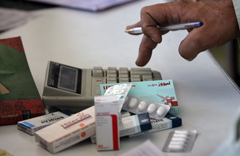
El objetivo es dar formación sobre técnicas de liderazgo
e información sanitaria, lo que incluye la observancia
del tratamiento antirretrovírico.
Foto: ONUSIDA / J. Moore
La Asociación ya ha empezado a reunir a las pocas ONGs y grupos de autoayuda que existen en Pakistán. El objetivo es dar formación sobre técnicas de liderazgo e información sanitaria, lo que incluye la observancia del tratamiento antirretrovírico.
Masood, que cuenta con un Máster en Administración y Dirección de Empresas por la Universidad de Lahore, les está ayudando a organizarse estratégicamente, a desarrollar políticas y a recaudar fondos.
Ya se ha realizado un taller de tres días sobre capacitación dedicado a los problemas de las personas que viven con el VIH en Pakistán y a cómo dirigir un grupo de autoayuda efectivo y positivo. Otro taller de dos días trató sobre cómo la alfabetización del VIH ayudaba a realizar análisis previos y a recoger las reacciones producidas por los nuevos folletos y otros materiales de información para las personas que viven con el VIH, que están disponibles en urdu e inglés.
ONUSIDA seguirá respaldando más talleres por todo el país y tiene la intención de hacerlo en colaboración con la Asociación de personas que viven con el VIH, con el gobierno provincial y federal y con organizaciones de la sociedad civil que trabajan con temas del sida.
“Queremos ayudar a mejorar la vida de las personas, que sientan que pertenecen a algo, darles capacidad política y fuerza de espíritu”, dice Masood.
Asimismo, la Asociación quiere contribuir al objetivo nacional de “evitar una epidemia generalizada en Pakistán frenando la propagación del VIH y el sida y acabando con el estigma y la discriminación hacia los infectados y afectados".
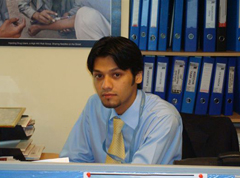
Masood, de 24 años, es el miembro más reciente de
una de las últimas iniciativas de ONUSIDA: la
“Asociación de personas que viven con el VIH y el
sida en Pakistán". Foto: ONUSIDA
*La epidemia del país está concentrada y se está intensificando. Pakistán presenta una de las tasas más altas del mundo en cuanto a consumo de drogas intravenosas (4,5 per cápita al año) y el 64% de sus consumidores reconoce no utilizar agujas esterilizadas. El uso frecuente y la reutilización de agujas sin esterilizar y contaminadas desemboca en una tasa de transmisión del VIH alta entre los consumidores de drogas intravenosas (10%). La Organización Mundial de la Salud y ONUSIDA calculan que la prevalencia actual podría ser de hasta 85.000 (46.000-210.000).
Durante la ceremonia de presentación de la Asociación de personas que viven con el VIH, el 1 de diciembre de 2006, el coordinador de ONUSIDA en el país, el Dr. Aldo Landi, dijo:
“Este es el primer paso del avance en la lucha contra el estigma y la discriminación". También destacó la necesidad de que las personas que viven con el VIH se involucren tanto a nivel federal como provincial y, lo que es más importante, la necesidad de que los derechos humanos de estas personas se respeten.
Masood es hemofílico y contrajo el VIH a través de sangre infectada. En Pakistán, se realizan pruebas de detección del VIH a aproximadamente el 50% de los productos sanguíneos antes de su transfusión y se utilizan un millón y medio de bolsas de sangre al año. Alrededor del 18% de las personas que viven con el VIH en Pakistán se infectaron a través de transfusiones sanguíneas.
“He dedicado muchos años de mi vida a los demás”, dice Masood, que antes de unirse a ONUSIDA hizo campaña por una mejora en el tratamiento de los hemofílicos y organizó, como voluntario, un proyecto financiado por UNICEF para una ONG de personas que viven con el VIH en Lahore.
“Soy muy ambicioso porque siento el dolor y me enfrento a él”, confiesa Masood. “Quiero cambiar las cosas de verdad animando a las personas que viven con el VIH a que se den cuenta de lo importante que es para ellos participar a todos los niveles”.
“Ellos mismos provocarán el cambio. Me alegra ser el primero”.
Enlaces relacionados:
Para saber más sobre Pakistán
Visitar el sitio web de ONUSIDA para Pakistán (en inglés)
Leer el informe "Ejecutar la estrategia de aprendizaje de las Naciones Unidas sobre VIH/SIDA: dieciséis estudios de caso". (pdf, 1Mb) (en inglés)
Related
 Seeking justice for HIV-related discrimination in the workplace in Guatemala
18 de diciembre de 2023
Indian partners reflect on a year after sex workers’ human rights affirmed
05 de octubre de 2023
Feature Story
Myanmar: hacia el acceso universal
21 Agosto 2007
21 Agosto 2007 21 Agosto 2007¿Qué necesita Myanmar para lograr el acceso universal a la prevención, el tratamiento, la atención y el apoyo relacionados con el VIH? Este fue el tema central de una reunión satélite celebrada el lunes 20 de agosto en el marco del VIII Congreso Internacional sobre sida en Asia y el Pacífico (ICAAP).
El año pasado Myanmar logró avances importantes en la respuesta al sida: desarrolló un nuevo plan estratégico nacional, que incluía el cumplimiento del plan operativo ya presupuestado, y a finales de 2006 presentó el "Fondo de las Tres Enfermedades", que empezó a ser operativo a principios de 2007. "Gracias a estos logros clave hay una posibilidad real y tangible de seguir extendiendo la respuesta al sida en Myanmar durante 2007 para lograr el acceso universal”, dijo Brian Williams, coordinador de ONUSIDA en el país.
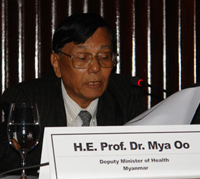
Dr. Mya Oo, viceministro de Sanidad de
Myanmar
Organizada por el Grupo temático de las Naciones Unidas sobre VIH/sida en Myanmar, la reunión satélite presentó una visión general sobre la situación actual de la epidemia, resumió los últimos logros obtenidos en la respuesta al sida en Myanmar y destacó que el país puede y debe apoyar un mayor alcance de la respuesta.
El viceministro de Sanidad de Myanmar, Dr. Mya Oo, insistió en el compromiso del país con la respuesta al sida y resumió los esfuerzos que se están realizando, entre los que se encuentra la creación de un Plan estratégico nacional multisectorial que hace hincapié en llegar a la poblaciónes más expuestas. El viceministro agradeció al Fondo de las Tres Enfermedades su inversión en los servicios de atención y prevención del VIH en Myanmar y pidió un aumento de los recursos en Myanmar para que la respuesta realmente se amplíe y tenga éxito.
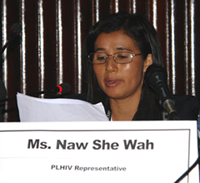
Naw She Wah, representante de las personas
que viven con el VIH para Myanmar
La segunda conferenciante principal, Naw She Wah, representante de las personas que viven con el VIH, habló de la necesidad de que las personas VIH-positivas tengan acceso al tratamiento, de que los grupos de autoayuda reciban más apoyo, lo que incluye el reconocimiento oficial de las autoridades, y apeló a las organizaciones internacionales para que aumenten su financiación y así poder ampliar la cobertura actual, que sólo se ocupa del 10% de las personas seropositivas que necesitan tratamiento.
Las presentaciones técnicas corrieron a cargo del Dr. Min Thwe, administrador del programa nacional del sida; el Dr. Wiwat Peerapatanapokin, epidemiólogo del Centro Este-Oeste que hace poco participó en un seminario sobre prevalencia del VIH celebrado en Myanamar; y el Dr. Frank Smithuis, representante en Myanmar de Médicos Sin Fronteras Holanda.
"Durante la reunión se destacó que en los últimos años Myanmar ha hecho progresos para demostrar que los servicios pueden llegar a aquéllos que lo necesitan, pero también se hizo hincapié en que la baja cobertura en el país requiere un aumento de la financiación procedente de fuentes nacionales e internacionales para lograr el acceso universal", dijo Brian Williams.
Enlaces relacionados:
Leer la presentación del Dr. Min Thwe, responsable del Programa nacional sobre sida del Ministerio de Sanidad – “Cobertura de los servicios para el VIH y el SIDA en Myanmar” (pdf, 740.42Kb) (en inglés)
Leer la presentación del Dr. Smithuis, representante de Médicos Sin Fronteras Holanda en Myanmar – “Prevención y tratamiento del VIH en Myanmar” (pdf, 1.15Mb) (en inglés)
Leer la presentación del Dr Wiwat Peerapatanapokin, epidemiólogo del Centro Este-Oeste – “Evolución de la epidemia del VIH en Myanmar en 2007” (pdf, 197.87Kb) (en inglés)
Related
 Peru approves groundbreaking law to extend health coverage for migrants with HIV and TB
21 de octubre de 2024
Indian partners reflect on a year after sex workers’ human rights affirmed
05 de octubre de 2023
A rainbow of hope for LGBTQI+ people in rural Japan
17 de mayo de 2023
Feature Story
VIII Congreso Internacional sobre el sida en Asia y el Pacífico. Fotogalería
21 Agosto 2007
21 Agosto 2007 21 Agosto 2007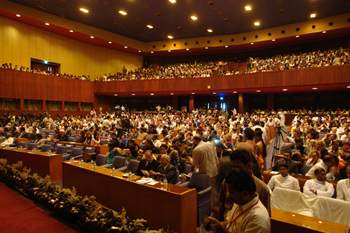
Panorámica de los asistentes a la ceremonia inaugural en el Bandaranaike Memorial International Conference Hall (BMICH) durante el VIII Congreso Internacional sobre el sida en Asia y el Pacífico, en Colombo (Sri Lanka), el 19 de agosto de 2007.
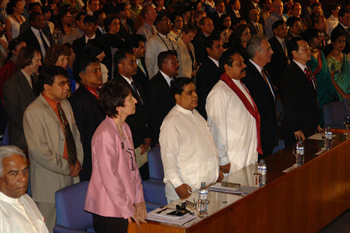
De izqda. a drcha. (primera fila): Deborah Landey, directora ejecutiva Adjunta de ONUSIDA; Nimal Siripala de Silva, ministro de Sanidad y Nutrición de Sri Lanka; Mahinda Rajapakse, presidente de la República Democrática Socialista de Sri Lanka; Michel Kazatchkine, director ejecutivo del Fondo Mundial de la lucha contra el sida, la tuberculosis y la malaria y el profesor Myung Hwan Cho, presidente de la Sociedad del sida en Asia y el Pacífico, escuchan el himno nacional en la ceremonia inaugural del VIII Congreso Internacional sobre el sida en Asia y el Pacífico, Colombo (Sri Lanka). 19 de agosto de 2007.
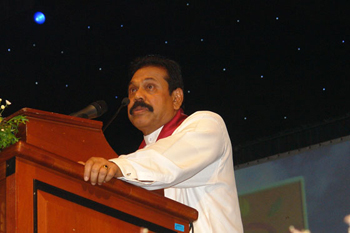
Mahinda Rajapakse, presidente de la República Democrática Socialista de Sri Lanka pronuncia su discurso inaugural en el VIII Congreso Internacional sobre el sida en Asia y el Pacífico. Colombo (Sri Lanka). 19 de agosto de 2007.
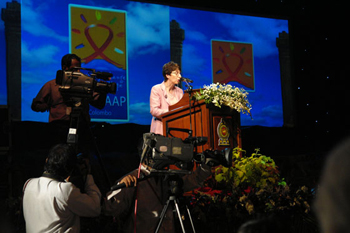
Deborah Landey, directora ejecutiva Adjunta de ONUSIDA, pronunció un discurso en nombre del director ejecutivo de ONUSIDA, el Dr. Peter Piot, en la ceremonia inaugural del VIII Congreso Internacional sobre el sida en Asia y el Pacífico. Colombo (Sri Lanka). 19 de agosto de 2007.
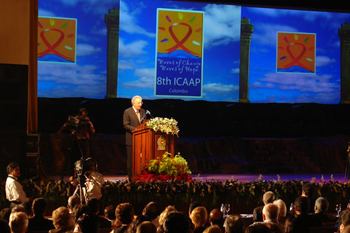
Michel Kazatchkine, director ejecutivo del Fondo Mundial de la lucha contra el sida, la tuberculosis y la malaria, durante su intervención en la ceremonia inaugural del VIII Congreso Internacional sobre el sida en Asia y el Pacífico. Colombo (Sri Lanka). 19 de agosto de 2007.
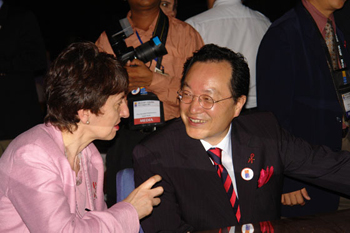
Deborah Landey, directora ejecutiva Adjunta de ONUSIDA, charla con el Prof. Myung Hwan Cho, presidente de la Sociedad del sida en Asia y el Pacífico en el VIII Congreso Internacional sobre el sida en Asia y el Pacífico. Colombo (Sri Lanka). 19 de agosto de 2007.
Fotografías: UNAIDS/Noel PELEGRIN
Enlaces relacionados:
Para saber más sobre el ICAAP
Related
Indian partners reflect on a year after sex workers’ human rights affirmed
05 de octubre de 2023
A rainbow of hope for LGBTQI+ people in rural Japan
17 de mayo de 2023