

Feature Story
AIDS: everybody’s business
27 января 2006
27 января 2006 27 января 2006
AIDS affects business, employees, markets and productivity across the world. As business leaders meet in Davos this week for the World Economic Forum, many are turning their attention to the issue of the increasing impact of AIDS in the workplace.
A recent survey of business policy on AIDS, conducted by the Forum, has found that chief executives are becoming increasingly concerned about the impact of the epidemic on their companies. A growing number are willing to back their concerns with resources to scale up prevention and treatment programmes in the workplace. Nearly half of the almost 11,000 companies across 117 countries that responded to the questionnaire from the World Economic Forum expected AIDS to have a growing effect on their activities over the next five years.
“In recent years we have seen business become more aware of the threat posed by AIDS leading them to take a bigger role in acting against the disease,” said Ben Plumley, Director, Executive Office, UNAIDS. “The potential of the private sector’s contribution is immense and there is so much more it can still do to help. The findings of this report will really help us understand how we can engage more businesses in addressing the growing threat of HIV.”
Stigma and discrimination in the workplace is also highlighted in the report as a growing problem. Here, businesses can play an additional critical role -- by developing and implementing workplace policies to break down discrimination and support employees in accessing HIV treatment prevention services. Coalitions such as the Global Business Coalition on HIV/AIDS are helping companies meet these needs by bringing them together to share best practices.
High-profile campaigns – such as the new global brand ‘Product Red’ launched at the World Economic Forum on Thursday (26 January) are embracing marketing ideas o help show businesses ways to become more involved in the AIDS response. Product RED aims to engage the private sector in the fight against AIDS in Africa by channeling funds from the sale of RED products directly to the Global Fund to Fight AIDS, Tuberculosis and Malaria.
The Global Business Coalition on HIV/AIDS
DO THE (RED) THING
A report of the survey “Business and HIV/AIDS: A healthier partnership” was published by the World Economic Forum on January 12 and is available on the web at: http://www.weforum.org/pdf/Initiatives/gbs2006_report.pdf
Related
 Walk in my shoes — UNAIDS Board devotes key session to HIV, adolescents and youth
20 декабря 2013 года.
 Know your HIV status: First European testing week takes off
27 ноября 2013 года.
 Asian Football Confederation and UNAIDS team-up to raise awareness of HIV
26 ноября 2013 года.
Feature Story
Towards universal access: meeting the challenge in Latin America
25 января 2006
25 января 2006 25 января 2006(Brasilia, 12-14 January 2006)
Lowering the prices of AIDS medicines and other essential commodities, securing additional donor support, increasing international awareness of the epidemic in the region, and reducing homophobia and gender discrimination were among the priority actions identified at the Latin America regional consultation on scaling up towards universal access.
In nearly all the Latin American countries, the highest levels of HIV infection are found among men who have sex with men.

Pedro Chequer, Coordinator Brazilian National STD/AIDS programme chairing a session of the The 1st regional consultation on Universal Access
The 1st regional consultation on Universal Access
The Latin American Regional Consultation on universal access, hosted by the Brazilian government, was organized by the Horizontal Technical Cooperation Group (HTCG) with seven civil society networks in Latin America and the Spanish-speaking Caribbean.
It brought together representatives of networks of people living with HIV, sex workers, men who have sex with men and other groups at high risk of exposure to HIV and also representatives of national AIDS authorities, the Assistant US Global AIDS Coordinator, representatives of the Catholic Church and UNAIDS Cosponsors.
Finding practical solutions at the local level
From the very first day, participants were urged to focus on solutions. “We have had a lot of plans,” said Michel Sidibe, Director of Country and Regional Support at UNAIDS. “We need more implementation,” he added.
The specificity of this international process is not only the focus on solutions but also countries’ ownership.
This means that there will be no globally set targets and that the countries, based on thorough assessment of their situation, will themselves determine what are their specific obstacles and what are the appropriate solutions to ensure that all women, men and children have access to the AIDS services that they need.
The United Nations General Assembly resolution adopted on 23 December 2005 calls for an inclusive country-driven process involving the relevant stakeholders from non governmental organizations, civil society and the private sector.
UNAIDS is actively assisting countries in facilitating this inclusive process aiming at coming as close as possible to the goal of universal access to treatment by 2010 for all those who need it.
Many national consultations are already scheduled to take place before the end of March 2006. The next regional consultation on Universal Access will take place in Tunis, Tunisia from 6 to 8 February 2006.
Related
 In Northeast Brazil, civil society and local government collaborate to increase HIV treatment adherence
03 апреля 2023 года.
 The First Fallen but We Will Overcome
03 ноября 2022 года.

Feature Story
World AIDS Day kicks off with theme "Stop AIDS. Keep the Promise."
28 ноября 2005
28 ноября 2005 28 ноября 2005
Every year, people around the world designate 1 December, World AIDS Day, as a time of reflection – to remember the friends and loved ones lost to AIDS, to heed the lessons learned over the year, and to take stock of the progress made to provide a comprehensive response to the epidemic.
The Declaration of Commitment is, in effect, a blueprint for action. It includes not hypothetical goals but concrete benchmarks to measure progress on prevention, reducing stigma, building health infrastructure, ensuring treatment, and providing much-needed leadership and resources. While many countries have made their own commitments to fight AIDS, the Declaration was the first recognition of AIDS as a global crisis requiring a global and collective solution.
The Declaration will only be as powerful as its fulfilment. By sustaining a single theme over five years, the Campaign hopes it will attract others and create a movement that gives those working on the response a forum to be heard – and a platform to act.
This year's theme also asks every individual to make a personal promise to fight AIDS. Since the beginning of the epidemic, individual people have played heroic roles in helping and caring for people living with HIV and AIDS. In the early days, as governments and organizations dithered, individuals acted. The World AIDS Campaign's call to "Stop AIDS. Make the Promise" encourages everyone - everywhere - to be a part of the solution. Added together, these individual commitments will tell governments that all people care about AIDS, that they want to be part of an effective response to it, and that they are willing to make their own commitments to ending the epidemic. Individuals from all over the world are already meeting the individual commitment challenge: to prevent HIV, treat every person living with HIV/AIDS with respect and dignity, to support local programmes that provide care and treatment. World AIDS Day is the perfect time for each individual and group to recommit themselves to those ideals.
After two decades of living in a world with HIV, 1 December is a reminder that with sufficient will and resources, we have the power to stop the epidemic. What is needed – for each of the 40 million people living with the disease – is the involvement of people from every walk of life. Everyone can contribute, whether by making a promise to take action or by promoting the campaign with friends and colleagues. To make your promise and to learn more about the World AIDS Campaign and how people around the world are renewing their commitment to the fight on World AIDS Day, visit http://www.worldaidscampaign.org/.
Related links:
World AIDS Campaign
Related
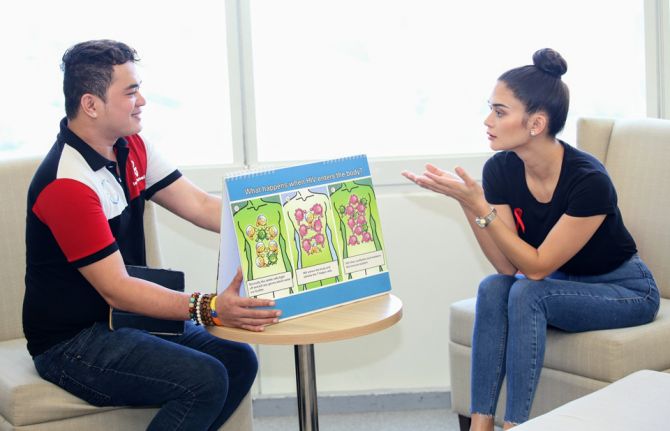 UNAIDS Goodwill Ambassador Pia Alonzo Wurtzbach ramps up HIV advocacy efforts
09 августаа 2017 года.
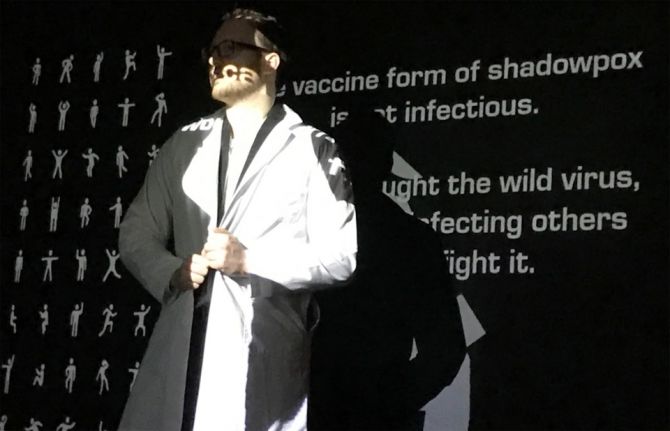 Immune Nations
23 мая 2017 года.
 Germany—ending AIDS by 2020
12 мая 2017 года.
Feature Story
Latin America and the Caribbean AIDS conference ends in El Salvador
11 ноября 2005
11 ноября 2005 11 ноября 2005
UNAIDS Executive Director Dr Peter Piot meets with the President of El Salvador Elías Antonio Saca González, host of the Presidential
Summit of Central American heads of state in San Salvador,
11 November 2005.
Photo credit: UNAIDS/Carlos H. Bruch
The III Latin America and the Caribbean Forum on HIV/AIDS/STDs (Foro 2005) and the IV Central American Congress on STD/HIV/AIDS (CONCASIDA) closed on Friday 11 November with a gathering of Presidents and other leaders from the Central America region.
UNAIDS Executive Director Dr Peter Piot attended the Presidential Summit and addressed the conference closing plenary.
At the summit, Dr Piot met with the President of El Salvador Elías Antonio Saca González, the host of the conference.
"There is momentum on leadership – made manifest in today's gathering of Presidents and other leaders from this region here today," said Dr Piot prior to the President's Summit. "Now is the time to act. So that together we can stop the threat of AIDS in our countries."
The President of Guatamela Oscar José Rafael Berger and the President of Costa Rica Abel Pacheco also attended the gathering, as well as the health ministers from Honduras and Nicaragua.
Dr Piot underlined the significant strides that have been made in the region to increase access to treatment. But, he added, these gains in treatment access need to be sustained and extended to the whole region. With more people living with HIV than ever in some countries, Dr Piot emphasized the urgent need to simultaneously increase HIV prevention programmes that reach all people at risk of infection, particularly those most marginalized such as men who have sex with men and sex workers.

"The region must revitalize its strategies to reach people most at risk – and they must address the deeper-rooted factors that affect vulnerability, such as social exclusion and inequalities of all kinds," he said.

Dr Piot urged leaders in the region to renew and reinvigorate their commitments at the highest political level and to agree to specific measures that will translate into concrete actions to reinforce AIDS responses nationally and regionally.
"The history of AIDS has shown us that when we are united, people win. Success depends on each of us truly being committed to tackling this exceptional crisis," said Dr Piot.
As part of the Presidential Summit, a declaration of enhanced commitment to a coordinated regional AIDS response was signed.
Related links:
UNAIDS press release: Putting the spotlight back on AIDS in Latin America and the Caribbean
Speech by UNAIDS Executive Director: The future of the HIV epidemics: leadership for action
Photos: View photos from CONCASIDA 2005
Related
In Northeast Brazil, civil society and local government collaborate to increase HIV treatment adherence
03 апреля 2023 года.
The First Fallen but We Will Overcome
03 ноября 2022 года.

Press Statement
Уроки, которые надо извлечь из опыта интегрированного подхода к предоставлению услуг в сфере ВИЧ, здравоохранения и социального обеспечения в Квазулу-Натал
29 сентября 2011 29 сентября 2011Программа интеграции в провинции Квазулу-Натал обеспечивает успешное предоставление услуг в сфере ВИЧ в комплексе с услугами для противодействия раку шейки матки, раку молочной железы и туберкулезу, а также с услугами в области информирования и образования и других актуальных проблем социальной сферы и здравоохранения.

Премьер-министр провинции Квазулу-Натал д-р Звели Мкхизе (слева) и Исполнительный директор ЮНЭЙДС.
29 сентября 2011г.
Фото: ЮНЭЙДС/А. Дебики
Женева, 29 сентября 2011 г.—Исполнительный директор Объединенной программы ООН по ВИЧ/СПИДу (ЮНЭЙДС) выразил глубокую признательность премьер-министру провинции Квазулу-Натал д‑ру Звели Мкхизе за его целенаправленную работу по интеграции услуг, связанных с ВИЧ, в работу служб в сферах здравоохранения и социально-экономического развития.
Благодаря внедрению интегрированного подхода в провинции Квазулу-Натал (ЮАР) местные сообщества могут пользоваться системой «одного окна», посредством которой им обеспечивается простой и удобный доступ к информации, услугам здравоохранения и широкого спектра служб в социально-экономических сферах, связанных с решением проблем бедности, образования и развития.
«Этот комплексный подход к предоставлению услуг здравоохранения и социального обеспечения является не просто практичным и рентабельным, но и эффективным, и служит моделью для внедрения в других провинциях и даже в других странах региона, — сказал Мишель Сидибе, находясь в Южно-Африканской Республике с семидневным визитом с целью более детального изучения проводимой деятельности и тех проблем, с которыми сталкивается эта страна в наращивании мер противодействия ВИЧ. — Проводимая здесь работа дает пример того, как надо доводить услуги до самых ключевых слоев населения, туда, где потребность в этих услугах наиболее высока».
Премьер-министр Квазулу-Натал д‑р Звели Мкхизе сыграл важнейшую роль в процессе децентрализации мер противодействия СПИДу в ЮАР и интеграции вопросов, связанных с ВИЧ, в программу экономического и социального развития провинции. Правительство провинции внедрило интегрированные программы для противодействия ВИЧ-инфекции, туберкулезу, раку молочной железы и раку шейки матки, решения проблем бедности, продовольственной безопасности и широкого спектра других задач в сферах здравоохранения и социального обеспечения.
«Мы уверены, что за счет консолидации услуг, связанных с ВИЧ, с работой других служб, необходимых сообществу, мы можем помочь Южно-Африканской Республике в выполнении наших национальных показателей по сокращению числа новых случаев ВИЧ-инфекции на 50 % к 2015 году и по кардинальному увеличению числа людей, получающих антиретровирусную терапию, — сказал д‑р Звели Мкхизе. — Наша модель работает».
Распространенность ВИЧ-инфекции в Квазулу-Натал в 2009 году составляла 39,5 % — рекордный показатель для Южно-Африканской Республики. Интегрированный подход, внедренный правительством провинции Квазулу-Натал, позволил уже к концу июня 2011 года увеличить охват услугами тестирования на ВИЧ-инфекцию в провинции до 2,9 миллиона человек. Также благодаря этому подходу был значительно расширен доступ к жизненно важной антиретровирусной терапии, которую получают 489801 человек в 518 центрах на территории провинции, а число случаев вертикальной передачи ВИЧ от матери ребенку снизилось с 21 % пять лет назад до 2,8 % в 2011 году.
Контакт
ЮНЭЙДС Южно-Африканская РеспубликаНатали Ридагрд
tel. +27 83 642 6759
ridgardn@unaids.org
Офис премьер-министра Квазулу-Натал
Ндабезинле Сибия
tel. 0823754742
sibiyand@premier.kzntl.gov.za
Press centre
Download the printable version (PDF)
Press Release
UNAIDS launches ‘red card’ campaign against HIV
12 июня 2010 12 июня 2010New global initiative at the FIFA World Cup shines spotlight on the elimination of mother-to-child transmission of HIV
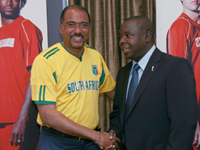 (From left) Mr Michel Sidibé, UNAIDS Executive Director, and Mr Kirsten Namatandani, President of South African Football Association (SAFA)
 Credit: Juda Ngwenya
JOHANNESBURG, 12 June 2010—A new campaign is using the power and outreach of football to unite the world around a common cause—preventing the transmission of HIV from mother to child. Launched today in South Africa by the UNAIDS Executive Director, Michel Sidibé, international musician Akon, UNAIDS Goodwill Ambassador and producer of the World Cup opening ceremony, Lebo M, UNAIDS National Goodwill Ambassador, Jimmie Earl Perry, and Kirsten Nematandani, President of the South African Football Association. The campaign aims to ensure an HIV-free generation by the 2014 FIFA World Cup to be held in Rio de Janeiro, Brazil.
Each year, an estimated 430 000 babies are born with HIV globally, the large majority in Africa. Over the course of a 90-minute football match, nearly 80 babies will become newly infected with HIV. In many parts of Africa, AIDS-related illness is the leading cause of death among infants and young children.
Through the campaign—backed by international football stars and UNAIDS Goodwill Ambassadors Michael Ballack of Germany and Emmanuel Adebayor of Togo—captains of 32 World Cup qualifying teams have been invited to sign the appeal: “From Soweto to Rio de Janeiro, give AIDS the red card and prevent babies from becoming infected with HIV.” Nineteen captains have already signed on, including host country South Africa and defending champion Italy.
“By the next football World Cup we can virtually eliminate HIV transmission to babies,” said UNAIDS Executive Director Michel Sidibé who attended the campaign launch in South Africa. “Let us give AIDS the red card permanently.”
The lives of mothers and their babies can be saved through a combination of HIV testing and counselling, access to effective antiretroviral prophylaxis and treatment, safer delivery practices, family planning, and counselling and support for optimal infant feeding practices.
An estimated 33.4 million people are living with HIV worldwide. Since 2001, there has been a 17% reduction in new HIV infections globally. However, for every two people who access antiretroviral treatment, five more become newly infected with HIV.
Contact:
UNAIDS New York | Richard Leonard | +1 646 666 8003 | LeonardR@unaids.org
UNAIDS South Africa | Sheba Okwenje | +127 11 517 1634 | okwenjeb@unaids.org
Press Release
Гигантские красные ленты размещены на Олимпийском стадионе, чтобы воодушевить людей на борьбу со СПИДом в Китае и за его пределами
27 ноября 2008 27 ноября 2008Размещение этих символов на стенах культового «Птичьего гнезда» подчеркивает приверженность Китая делу борьбы со СПИДом
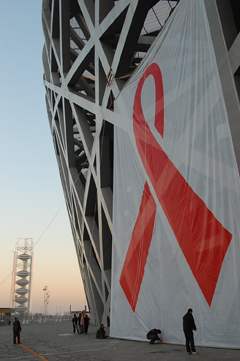
Пекин, 30 ноября 2008 г. – Китайские учреждения по противодействию СПИДу при поддержке ЮНЭЙДС сегодня разместили гигантские красные ленты на стенах культового Национального стадиона – известного под названием «Птичье гнездо» - в ознаменование Всемирного дня борьбы со СПИДом. Это мероприятие является демонстрацией приверженности Китая делу борьбы со СПИДом и, в частности, борьбы против стигмы и дискриминации.
«Покончить с эпидемией СПИДа пока еще нигде не удалось. Эти ленты в память о СПИДе на стадионе «Птичье гнездо» символизируют последствия эпидемии во всем мире и потребность в объединенной, всемирной ответной деятельности», - сказал Исполнительный директор ЮНЭЙДС д-р Питер Пиот. Красная лента является международным символом знания о СПИДе, и ее носят все больше людей во всем мире, демонстрируя свое неравнодушие и обеспокоенность в связи со СПИДом. Эта лента также является символом надежды и означает символическую поддержку для тех, кто живет с ВИЧ или пострадал от эпидемии, и для тех, кто потерял друзей, членов семьи и любимых из-за СПИДа. Стигма и дискриминация не только отрицательно воздействуют на жизни людей с ВИЧ, но и мешают людям говорить о СПИДе открыто, что потенциально подвергает их и других людей повышенному риску ВИЧ-инфекции. Кроме того, люди реже обращаются за услугами по тестированию и из-за этого не получают доступного лечения, если боятся дискриминации.
Результаты исследований показывают, что уровни стигмы и дискриминации среди населения Китая в целом до сих пор высоки. В отчете о недавно проведенном обследовании, в котором представлены результаты опроса более чем 6000 респондентов в шести городах Китая, сообщается следующее:
- 30% респондентов считают, что детям, живущим с ВИЧ, надо запретить учиться в одних школах с детьми, не инфицированными ВИЧ.
- Почти 65% респондентов не хотели бы жить в одном домохозяйстве с ВИЧ-положительным человеком, а 48% опрошенных не хотели бы есть за одним столом с человеком, живущим с ВИЧ.
«Стигма и дискриминация являются основными препятствиями к эффективному противодействию СПИДу. Нам необходимо вовлечь все слои общества Китая, чтобы бороться с этими явлениями и совместными усилиями остановить болезнь», - сказал министр здравоохранения Китая Чэнь Чжу.
Около 33 миллионов человек живут с ВИЧ во всем мире. По последним оценкам, примерно 700 000 человек живут с ВИЧ в Китае, где в 2007 г. произошло около 50 000 новых случаев инфекции. По оценкам, в 2007 г. около 20 000 человек умерли от СПИДа. В настоящее время ВИЧ-инфекция в Китае передается, в основном, половым путем.
«Такие мероприятия очень важны для сохранения динамики в противодействии СПИДу. Такая вдохновенная демонстрация лидерства правительством Китая заслуживает всяческой похвалы», - сказал д-р Пиот.
Контактная информация:
Г-н Оле Шак Хансен (Ole Schack Hansen) | ЮНЭЙДС-Китай | +86 10 8532 2226 | hanseno@unaids.org
ЮНЭЙДС
ЮНЭЙДС представляет собой инновационное совместное предприятие в системе Организации Объединенных Наций, объединяющее усилия и ресурсы Секретариата ЮНЭЙДС и десяти учреждений системы ООН в осуществлении мер в ответ на СПИД, Сотрудники Секретариата ЮНЭЙДС, находящегося в Женеве, Швейцария, работают более чем в 80 странах. Согласованные действия, осуществляемые системой ООН в ответ на СПИД, координируются в странах через тематические группы ООН и совместные программы по СПИДу. Коспонсорами являются УВКБ ООН, ЮНИСЕФ, ВПП, ПРООН, ЮНФПА, ЮНОДК, МОТ, ЮНЕСКО, ВОЗ и Всемирный банк. Посетите веб-сайт ЮНЭЙДС по адресу: www.unaids.org и www.unaids.org.cn
Гигантские красные ленты размещены на Олимпийском
Сопутствующая информация:
Всемирный день борьбы со СПИДом - 2008
Заявления по случаю Всемирного дня борьбы со СПИДом
Китай
Тематические статьи:
Судья Эдвин Камерон привносит новое измерение в отношения между Китаем и Африкой (31 октября 2008 г.)
Специальный посланник Генерального секретаря ООН по СПИДу д-р Нафиc Садик призывает расширить подходы к противодействию СПИДу в Китае (19 сентября 2008 г.)
В центре внимания – меры Китая в ответ на СПИД (19 сентября 2008 г.)
ЮНЭЙДС признает роль лидеров в осуществлении мер в ответ на СПИД в Китае (17 сентября 2008 г.)