Feature Story
President of India unites for children
30 Octubre 2007
30 Octubre 2007 30 Octubre 2007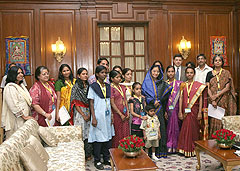
President of India Pratibha Patil met representatives
from UNAIDS, UNICEF, HIV positive networks and
government officials in New Delhi.
The Indian President, Pratibha Patil met representatives from UNAIDS, UNICEF, HIV positive networks and government officials in New Delhi to mark the second anniversary of the UNICEF/UNAIDS Unite for Children, Unite Against AIDS campaign. The President of India pledged her full support to the campaign and to addressing myths and misconceptions around HIV that are driving stigma and discrimination.
“Raising awareness is the key to fight the stigma and discrimination faced by the HIV positive people especially women and children,” President Patil said.
As part of the event, children and their mothers living with HIV shared their life experiences with The President. President Patil also met with peer educators who presented her with artwork of their messages on stigma and discrimination.
Anand*, a child living with HIV presented Suraksha Bandhan (a blue and red band in which the blue colour represents children and red represents AIDS) to President Patil as a sign of solidarity in the response to AIDS.
Unite for Children Unite Against AIDS is the largest campaign mounted to bring the world’s attention to the global impact of AIDS on children and young people. It also recognizes and addresses the needs of their caregivers. It offers urgent and specific interventions and calls to action. Launched in October 2005, UNICEF and UNAIDS are leading the initiative along with partners from all sectors of society, including governments, NGOs, academic institutions, faith-based groups, community groups and youth and sporting organizations.
Speaking on the occasion of the meeting with the President of India, Dr Dennis Broun, UNAIDS Country Coordinator for India, said that “since its launch two years ago, the campaign has transformed the lives of thousands of children and their families.”
“Great progress has been achieved on prevention and early detection of HIV infection in children, access to care and treatment and the fight against discrimination, notably in schools. Many famous personalities have supported this fight and their engagement has been crucial. There is more to be done and the whole UN family will continue to respond to AIDS in India,” he said.
The number of people living with HIV in India is estimated to be 2.0- 3.1 million. Some 70,000 children below the age of 15 are estimated to be living with HIV in the country.
Links:
Visit the Unite for Children Unite Against AIDS web site
Visit the UNAIDS India web site
Related
 UNAIDS launches the development of the new Global AIDS Strategy 2026-2031
20 de febrero de 2025
 Indian partners reflect on a year after sex workers’ human rights affirmed
05 de octubre de 2023
 The urgency of HIV prevention among adolescent girls and young women
01 de junio de 2023
Feature Story
Women join forces in Latin America
30 Octubre 2007
30 Octubre 2007 30 Octubre 2007
First Ladies and women leaders from Latin America
and UNAIDS Deputy Executive Director Deborah
Landey joined forces in the response to AIDS in the
region. Photo credit: UNAIDS
The Coalition of First Ladies and Women Leaders of Latin America on HIV held its third meeting in San Pedro Sula, Honduras on Friday 26 October to discuss the growing rates of HIV infection among women in Latin America and the impact of AIDS on women in the region.
Participants included the First Ladies of Honduras, Mexico, Dominican Republic and El Salvador, the First Ladies’ representative of Suriname, representatives from Ministries of Health, parliamentarians, representatives from the International Coalition of Women and civil society organizations including women living with HIV.
They expressed their firm commitment to take action in response to the AIDS epidemic. This commitment was reaffirmed by Deborah Landey, Deputy Executive Director UNAIDS, who gave a keynote speech at the meeting. “We must demonstrate and promote strong and sustained leadership, throughout the region, to place women at the centre of the agenda. Not mainstreamed. Not sidelined. At the centre,” she said.
Participants discussed ways of implementing the “action platform” which was approved at the last meeting of the Coalition held in Buenos Aires in April 2007. The “action platform” is a strategy designed to mitigate the impact of AIDS in the region, particularly in the context of universal access to HIV prevention, treatment, care and support, and which promotes women rights in a supportive environment, free of stigma and discrimination.
Also present at the meeting was the President of the Republic of Honduras, His Excellency Manuel Zelaya Rosales, who delivered a strong message to the participants emphasising the urgent need to address gender inequalities for an effective response to AIDS.
The Coalition of First Ladies and Women Leaders of Latin America, chaired by the First Lady of Honduras Her Excellency Xiomara Castro de Zelaya and supported by UNAIDS and UNFPA, was established in New York on June 2nd 2006, in the context of a parallel meeting of the 26th Special Session of the United Nations General Assembly.
The Coalition is the first initiative of its kind in the region. It involves First Ladies and women leaders in an alliance committed to advocating for stronger political leadership and resource mobilization to make universal access a reality, and reduce the vulnerability of women to AIDS in Latin American countries.
Links:
Read the speech by the UNAIDS Deputy Executive Director Deborah Landey
Watch the video of The Coalition of Latin American First Ladies and Women Leaders
Visit the web site of the Global Coalition on Women and AIDS
More on women and AIDS
More on AIDS in Latin America
Read other feature stories about AIDS in Latin America
Related
Feature Story
11th European AIDS Conference opens in Madrid
24 Octubre 2007
24 Octubre 2007 24 Octubre 2007
The 11th European AIDS
Conference focuses on issues related
to HIV clinical research and care in
Europe.
The 11th European AIDS Conference runs from 24-27 October in Madrid, Spain. The conference, held every other year and attended by several thousand delegates, focuses on issues related to HIV clinical research and care in Europe.
In a special session titled “What’s New in HIV Prevention”, UNAIDS Chief Scientific Advisor Catherine Hankins will address the conference on Friday 26 with a presentation about ethical issues related to research into biomedical HIV prevention methods, which include pre-exposure prophylaxis (the use of HIV medicines to prevent infection), male circumcision and microbicides. Dr. Hankins’ presentation will emphasize the ethical considerations facing stakeholders in HIV prevention trials – communities, researchers, sponsors and trial participants – as treatment and prevention standards evolve.
UNAIDS has been a leader in developing and updating standards for international HIV prevention trials. UNAIDS, in partnership with the AIDS Vaccine Advocacy Coalition, recently released best practices for conducting HIV prevention research, outlining core principles for ethical HIV prevention research. UNAIDS and the World Health Organization also this year released guidance on ethical considerations on HIV prevention trials. Among other things, the document calls for studies to be designed in such a way that, should new HIV prevention methods be proven effective while other trials are ongoing, stakeholders in the ongoing trial can negotiate whether or not to introduce the new intervention, which could affect the trial’s outcome.
“This conference gives us an opportunity to share with Europe’s HIV specialists crucial information about updated guidance on the ethical conduct of biomedical HIV prevention trials,” said Dr. Hankins. “Access to treatment and standards of prevention are evolving, and all stakeholders need to know how to ensure that trials of novel HIV prevention methods are carried out to the highest ethical standards."
Other sessions will focus on topics such as the impact and complications of HIV treatment, issues facing older patients, Hepatitis co-infection, HIV drug resistance and implementation of the European HIV treatment guidelines. A number of pharmaceutical research and development companies who are sponsoring the conference will conduct satellite symposia throughout the event to discuss their companies’ treatment advances.
The conference is organized by the European AIDS Clinical Society, which published the first common European treatment guidelines in 2001 in recognition of the need for standard treatment protocols across the continent. The guidelines were updated in 2005, and another update will be made available on the final day of the Madrid conference.
Previous conferences have been held in cities across Europe since 1989, most recently taking place in Dublin in 2005. The 12th European AIDS Conference is planned for Cologne, Germany in November 2009.
Links:
Visit the 11th European AIDS Conference / EACS website
Visit the European AIDS Clinical Society website
Related
 Welcoming Ukrainian refugees in Germany: big test for all
21 de abril de 2022
 ArtPositive—art to raise awareness around HIV-related stigma and discrimination
01 de octubre de 2021
 Science, HIV and COVID-19—where are we headed?
08 de junio de 2021
Feature Story
UNAIDS staff ‘stand up and speak out’ on International Poverty Day
19 Octubre 2007
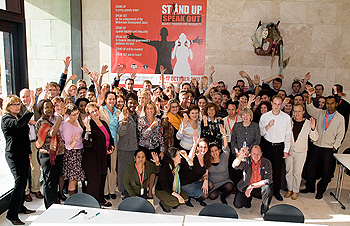
19 Octubre 2007 19 Octubre 2007On International Poverty Day (17 October 2007), UNAIDS Secretariat staff in Geneva joined the STAND UP and SPEAK OUT events taking place across the globe, calling for leaders to take action against poverty and inequality and to achieve and exceed the Millennium Development Goals.
|
|
Expressing themselves through written messages on a billboard, UNAIDS staff underlined the critical need to scale up the response to AIDS in the drive to reach the Millennium Development Goals. |
|
|
As part of the messages, UNAIDS Executive Director, Dr Peter Piot called for everyone to "Act everyday against poverty". |
|
|
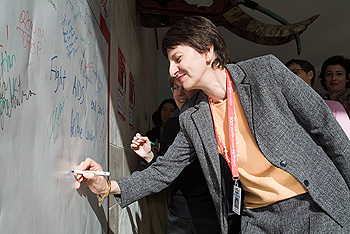
In her message, Deputy-Executive Director Deborah Landey urged the world to "Fight AIDS, end poverty". |
|
|
UNAIDS staff added their messages to the STAND UP and SPEAK OUT billboard |

|
|
The STAND UP and SPEAK OUT initiative aims at making governments honor their commitments on more and better aid, debt cancellation, trade justice, gender equality and public accountability by showing them that more and more people are taking a stand. |
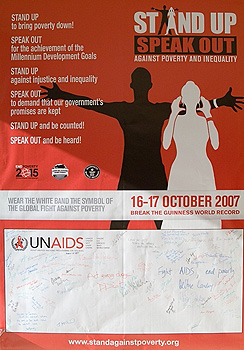
Photo credits: UNAIDS
Related
 Social entrepreneurship—a tool of self-empowerment for the LGBTI community
20 de abril de 2022
 Encouraging income generation and social entrepreneurship by people living with HIV in Brazil
29 de marzo de 2022
 High-level continental seminar on the right to health and social protection in Africa
09 de diciembre de 2021
Feature Story
Global Staff Meeting 2007 in Geneva
19 Octubre 2007
19 Octubre 2007 19 Octubre 2007The UNAIDS Global Staff Meeting took place at Palexpo in Geneva, Switzerland, from 1st to 5th October. The overall goal of the Global Staff Meeting is to put both the organization at large, and all staff in a position to respond effectively to the challenges and expectations of UNAIDS constituents in scaling up global and country level response. The agenda of the meeting included among others, skills building workshops, group discussions, panelists' reflections, conferences as well as feedback and evaluation of all the activities.
|
|
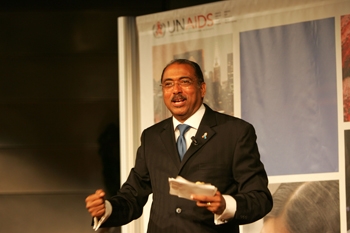
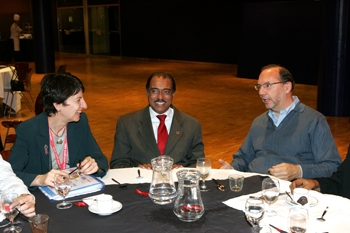
UNAIDS Deputy Executive Director, Programmes Michel Sidibe giving a motivating speech to the staff members present at the Global Staff Meeting. Geneva, 1-5 October 2007. |
|
|
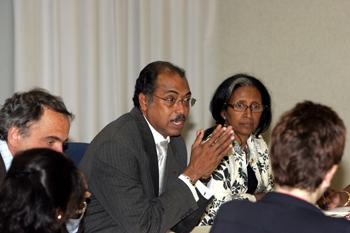
UNAIDS Deputy Executive Director, Programmes Michel Sidibe participating in one of the group discussions of the Global Staff Meeting. Geneva, 1-5 October 2007. |
|
|
From left to right: UNAIDS Deputy Executive Director, Management and External Relations Deborah Landey, UNAIDS Deputy Executive Director, Programmes Michel Sidibe and UNAIDS Executive Director Dr Peter Piot, participating together in a group session at the Global Staff Meeting. Geneva 1-5 October 2007. |
|
|
UNAIDS Deputy Executive Director, Programmes Michel Sidibe's intervention in one of the panel presentations at the Global Staff Meeting. Geneva 1-5 October 2007. |
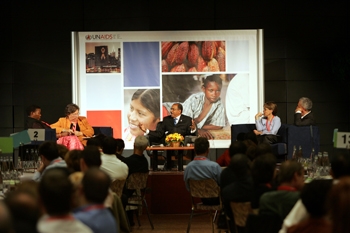
Photo credits: UNAIDS / P. Virot
Related
Welcoming Ukrainian refugees in Germany: big test for all
21 de abril de 2022
ArtPositive—art to raise awareness around HIV-related stigma and discrimination
01 de octubre de 2021
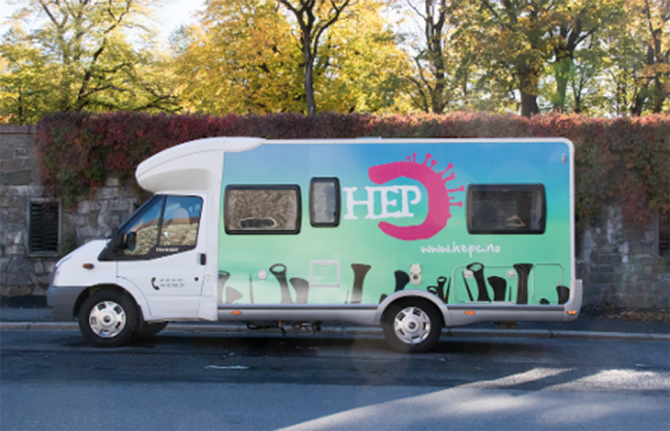 Norway’s community organizations ensuring health, dignity and rights
17 de marzo de 2020
Feature Story
Progress and challenges for Botswana
18 Octubre 2007
18 Octubre 2007 18 Octubre 2007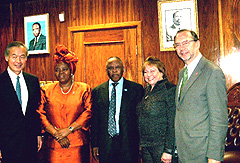
From left to right: Dr Tadatakai Yamada, Botswana
Minister of Health Professor Professor Sheila Tlou,
HE President Festus Mogae, Ms. Ann Veneman
and Dr Peter Piot.
With 25% of adults aged 15-49 estimated to be living with HIV, Botswana has one of the world’s highest HIV prevalence rates. Prevalence rates are particularly high among pregnant women – estimated at more than 32%.
Despite these continuing challenges, the country has made significant progress in its response to AIDS. The first African country to embark on a programme of rolling out free antiretrovirals to all its citizens living with HIV in need, Botswana dedicates considerable domestic resources to HIV. In addition to treatment, it has made impressive strides in preventing mother-to-child HIV transmission (down to 3%) and caring for children orphaned by AIDS. The country has also been a leader in expanding voluntary HIV testing and counselling – the offer of HIV testing has been routine in all health care settings since 2004.
A key catalyst for progress in Botswana’s AIDS response has been the establishment in 2000 of the African Comprehensive HIV/AIDS Partnership (ACHAP). This innovative collaboration to improve access to needed HIV services is a country-led public/private development partnership between the Government of Botswana, the Bill & Melinda Gates foundation and pharmaceutical company Merck & Co., Inc. and the Merck Company Foundation.
ACHAP was set up to support and enhance Botswana’s national HIV response, and works to scale up HIV prevention, expand access to HIV counselling and testing, support the national AIDS treatment programme, and to advocate for and empower communities and people living with HIV. ACHAP was instrumental in the establishment and roll-out in 2002 of Botswana’s national antiretroviral program, which as of July 2007 was providing treatment to more than 90,000 people. The partnership has also supported the training of over 7,000 health workers to improve and develop medical and management skills for AIDS programmes.
In their visit to the country, the joint mission met with HE President Festus Mogae and other leaders in Botswana’s national AIDS response. Dr. Piot commended the President, who chairs the National AIDS Council, for his leadership on AIDS, and underscored the commitment of UNAIDS and other partners to continue collaboration with Botswana. Dr Piot and Ms Veneman both pledged the United Nations’ continued support of Botswana’s HIV response. The delegation also visited hospitals and clinics in the districts of Francistown and Chobe, both of which are situated on high transit transport routes and have seen significant expansion over the last few years of voluntary HIV testing and counselling, treatment, care and support services.
“Botswana has shown an exceptional response to AIDS at the highest levels, and its progress in treatment access is an example to the world,” said UNAIDS Executive Director Peter Piot. “This energy must now inspire a dramatic scale up of comprehensive HIV prevention programmes for a sustainable, long-term AIDS response.”
Links:
Visit the ACHAP web site
UNAIDS Botswana country profile
Related
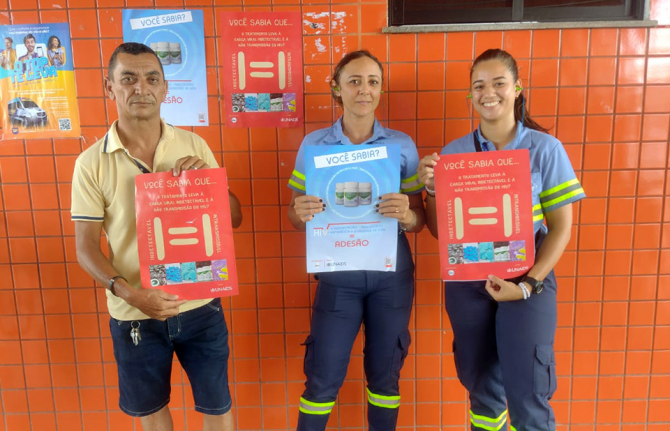 In Northeast Brazil, civil society and local government collaborate to increase HIV treatment adherence
03 de abril de 2023
 Dangerous inequalities and overcoming them
18 de noviembre de 2022
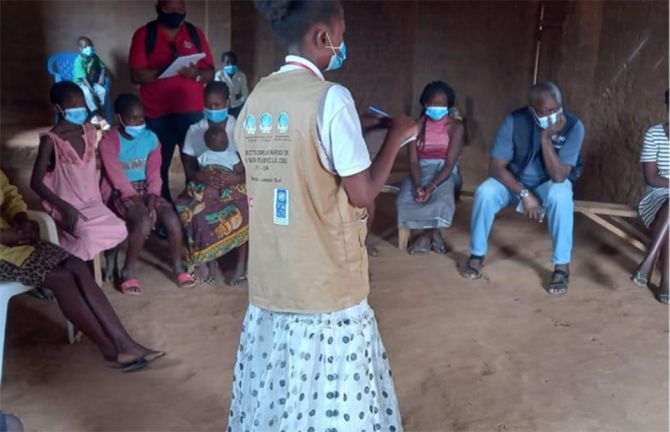
Feature Story
Invest in Women – It Pays
18 Octubre 2007
18 Octubre 2007 18 Octubre 2007At the Women Deliver conference in London (18 – 20 Oct 2007), UNAIDS Executive Director called for renewed political support and increased funding to make sure that women’s health become a national priority across the world. He stressed that healthy mothers and children are key to slowing down the AIDS epidemic.
Every minute of every day, a woman dies needlessly during pregnancy or childbirth, most in the developing world. Ten million women are lost in every generation. Huge disparities exist between rich and poor countries, and between the rich and poor in all countries. At the same time, four million newborn babies die every year, also from causes that are mainly preventable. Evidence and experience shows that with increased political will and adequate financial investment, most women and newborns can survive so that families, communities and nations can thrive.
Bringing to light the critical connection between women’s health, rights, education and poverty reduction, the global conference on maternal health ‘Women Deliver’ is taking place in London from 18 to 20 October 2007.
Co-Chaired by Mary Robinson, president of Realizing Rights, former president of Ireland, and former United Nations High Commissioner for Human Rights and by Asha Rose Migiro, Deputy Secretary-General of the United Nations, the conference encourages governments to integrate women’s health and rights into national plans and strategies.
At the Conference opening, UNAIDS Executive Director Peter Piot, underlined a number of similarities between the response to women’s health and the AIDS response. He cited the prevention of mother to child transmission of HIV as an intervention with proven results that is a potential catalyst to strengthen health systems.
Dr Piot noted that women are paying a heavy price today as a result of years of under-investment – including within the AIDS response. Despite accelerating progress in AIDS over the past few years, women and girls are still being left behind. About 18 million women are living with HIV today – many of them poor, most of them stigmatized, some at risk of violence, and too few are able to access HIV treatment. Only one in ten women in developing countries has access to drugs to prevent transmission of HIV to their children.
In his conclusion, Dr Piot suggested that the world should start talking about women’s health, morbidity and mortality and not just maternal mortality. He underlined that taking the issue beyond the health sector and focussing on socio-economic implications would attract governments’ attention in ways that women’s health has not.
The Women Deliver Conference runs until 20 October 2007
Links:
Read more on the Women Deliver conferenceRead more on the Global Women’s Coalition on AIDS
View the video by the Global Coalition on Women and AIDS that is being shown at the conference
Related
 Responding to gender-based violence through sorority and information
15 de diciembre de 2023
The urgency of HIV prevention among adolescent girls and young women
01 de junio de 2023
 Asia Pacific women living with HIV speak out about rights violations
08 de marzo de 2023
Feature Story
Levántate y alza tu voz
17 Octubre 2007
17 Octubre 2007 17 Octubre 2007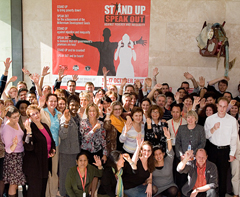
El personal de la Secretaría de ONUSIDA de Ginebra
se ha unido a los acontecimientos de Levántate y alza
tu voz, que han tenido lugar en todo el mundo.
El personal de la Secretaría de ONUSIDA de Ginebra se ha unido a los acontecimientos de Levántate y alza tu voz, que han tenido lugar en todo el mundo, para pedir a los líderes que tomen medidas contra la pobreza y la desigualdad, y para alcanzar y superar los Objetivos de Desarrollo del Milenio.
Para poder conseguir los Objetivos de Desarrollo del Milenio, el personal de ONUSIDA ha difundido la necesidad inmediata de ampliar la respuesta al sida. Uno de los mensajes lanzados ha sido el del director ejecutivo de ONUSIDA, el Dr. Peter Piot, que ha hecho un llamamiento mundial para “Actuar todos los días contra la pobreza” y el de su directora ejecutiva adjunta, Deborah Landey, que ha instado al mundo a “ Buscar una respuesta para el sida y acabar con la pobreza".
El pasado año, más de 23 millones de personas participaron en actividades similares a las de Levántate y alza tu voz, y establecieron un nuevo récord Guinness. Este año, los organizadores esperan batir este récord para que, de esta manera, el mensaje logre un mayor alcance.
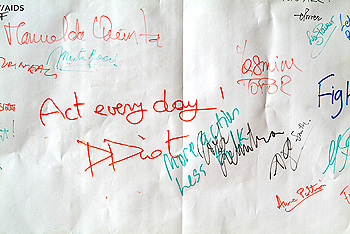
Uno de los mensajes lanzados ha sido el del director ejecutivo de ONUSIDA,
el Dr. Peter Piot, que ha hecho un llamamiento mundial para “Actuar todos
los días contra la pobreza”.
En el año 2000, los líderes de 189 países firmaron los Objetivos de Desarrollo del Milenio, un plan global con el que acordaron, entre otros aspectos, conseguir una reducción del 50 % de la pobreza extrema para el año 2015. Hasta ahora, todos los días, 50 000 personas mueren como consecuencia de dicha pobreza, y la distancia entre ricos y pobres es cada vez mayor. La iniciativa de Levántate y alza tu voz se centra en conseguir que los gobiernos cumplan sus compromisos con mayores y mejores ayudas, cancelación de deudas, comercio justo, igualdad de género y responsabilidad pública, mostrándoles cómo cada vez son más los que se involucran.
El Llamamiento Mundial a la Acción contra la Pobreza y la Campaña del Milenio de las Naciones Unidas, cofundadores de la iniciativa, están trabajando con un gran número de asociados a nivel nacional y local, desde escuelas y universidades hasta grupos comunitarios locales y grupos de mujeres, desde coros y clubs de deporte hasta grupos religiosos, desde sindicatos hasta corporaciones, y muchos más. Se han organizado acontecimientos interesantes y entretenidos en todo el mundo.
Enlaces:
Ver fotogalería de la iniciativa de ONUSIDA Levántate y alza tu voz.
Más información sobre la campaña de Levántate y alza tu voz.
Más información sobre los Objetivos de Desarrollo del Milenio de las Naciones Unidas.
Related
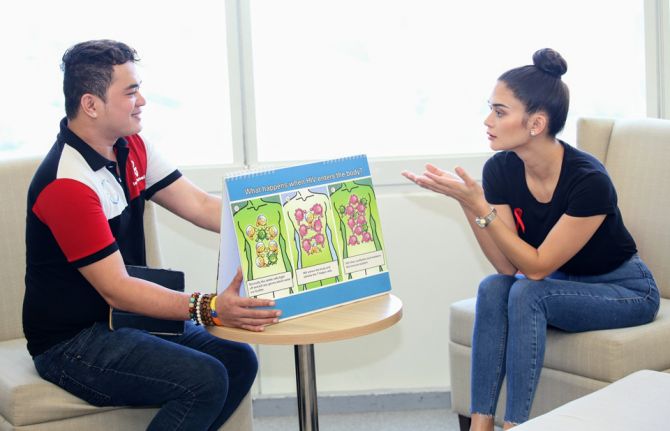 UNAIDS Goodwill Ambassador Pia Alonzo Wurtzbach ramps up HIV advocacy efforts
09 de agosto de 2017
 Immune Nations
23 de mayo de 2017
 Germany—ending AIDS by 2020
12 de mayo de 2017
Feature Story
European meeting discusses migration, TB and HIV
15 Octubre 2007
15 Octubre 2007 15 Octubre 2007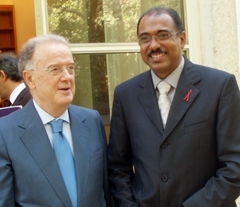
UNAIDS Deputy Director Michel Sidibe with former
President of Portugal and United Nations Special
Envoy to the Stop TB Programme, Jorge Sampaio.
Migration, mobile populations and tuberculosis were priority focus areas at the meeting of EU national AIDS Coordinators, organized by the Portuguese Presidency of the European Union. UNAIDS Deputy Director Michel Sidibe stressed that increased action in these areas is vital in the goal of universal access to HIV prevention, treatment, care and support.
“European governments have a big part to play in making universal access a reality,” said UNAIDS Deputy Director, Michel Sidibe. Underlining commitments on AIDS made by the EU member states, he urged governments to “provide leadership and funding at home and abroad [with] a special duty to support neighbours in Eastern Europe and North Africa.”
Held as part of the events organized during the Portuguese Presidency of the EU, participants included representatives from EU Member States and neighbouring countries.
With increased labour migration, or the movement of people across borders in the region, the issue of AIDS specific issues and responses concerning migrants and mobile populations in Europe was high on the meeting agenda.
Numerous factors related to migration, including socio-economic and cultural factors as well as government processes and the conditions in destination countries, impact on HIV risk and the rights of migrants living with HIV.
“AIDS spreads as economies boom - as people move from rural to urban areas, from country to country, in search of a better life,” said UNAIDS Deputy Executive Director Michel Sidibe, underlining that movement across borders introduces HIV risk as people spending long periods of time away from home are more likely to engage in casual sex, may be placed in situations which make them vulnerable to HIV and often find themselves living on the margins of society, where they cannot access the HIV prevention and treatment services they need.
“This is made worse when there is no consistency between States regarding access to HIV services. In some countries undocumented migrants can access services – provided they know where to go. In others they can’t. In some, they have to pay at point of service delivery; at others they don’t. This is not universal access!” Sidibe said, noting that UNAIDS, the International Labour Organization and the International Organization of Migration are currently drafting a policy on HIV and migration which is expected for release shortly.
Focus on migrant workers within the AIDS response is key, he underlined, “for humanitarian and human rights reasons. For public health reasons and for socio-economic reasons: if migrants are healthy, they can make an active contribution to economic growth.”
Sidibe noted Portugal’s response to the issue of HIV and migration as an example of best practice that should be built on across the EU. “Portugal has blazed a brave trail in two key areas - introducing harm reduction programmes for injecting drug users and providing HIV services to migrants – documented and undocumented,” he said.
Tuberculosis and the interaction between TB and HIV epidemics in the region was also a key focus area for the EU meeting. The development and spread of multi-drug resistant and extensively drug resistant tuberculosis, especially among people living with HIV, was underlined as a serious concern for Europe and Africa, and one that threatens the achievement of universal access and the millennium development goals.
Underlining the need for a joint response to TB and HIV in the region and worldwide, the UNAIDS Deputy Executive Director met with former Portuguese President and UN Special Envoy to the Stop TB Partnership, Jorge Sampaio. At the meeting, Sidibe stressed UNAIDS commitment to advocating for a joint response on TB and HIV and encouraged Special Envoy Sampaio to continue his important work on these key health issues.
During his intervention in Lisbon, the UNAIDS Deputy Executive Director also met with the Portuguese Minister of Health, Mr Correia de Campos, Secretary of State for European Affairs, Mr Manuel Lobo Antunes and with the Executive Secretary of the Community of Portuguese-speaking Countries, Ambassador Luís de Matos Monteiro da Fonseca. In all meetings, Sidibe underlined the importance of the next European Union - Africa Summit and that it will be crucial to have AIDS on the agenda.
“We must lead by example and assure universal access to HIV prevention, treatment, care and support within this region by 2010,” said Sidibe.
Links:
Read more on migration
Related
Welcoming Ukrainian refugees in Germany: big test for all
21 de abril de 2022
ArtPositive—art to raise awareness around HIV-related stigma and discrimination
01 de octubre de 2021
Norway’s community organizations ensuring health, dignity and rights
17 de marzo de 2020
Feature Story
Sport and HIV prevention
09 Octubre 2007
09 Octubre 2007 09 Octubre 2007 Chinese toolkit for HIV prevention launched in Beijing

Jointly developed by the IOC and UNAIDS,
this practical guide was put together to
reach millions of people involved in sports
in China and the region.
With the 2008 Beijing Olympic Games less than a year away, sporting fever is gripping China and the surrounding countries. And as athletes prepare to run, jump, kick and throw themselves onto the winners podium, HIV prevention is also emerging as an Olympic champion.
Sport and its impact, role and opportunity for HIV prevention is becoming a central theme to activities across China. In September a special workshop on HIV prevention through took place in Beijing, gathering fifty representatives from ten Asian countries to discuss how sporting organizations can become involved in HIV prevention and work to dispel stigma.
Organized by the International Olympic Committee (IOC), in cooperation with the Chinese Olympic Committee, UNAIDS, the Health Bureau of Beijing, the Chinese Red Cross and the International Federation of Red Cross and Red Crescent Societies, this was the second workshop of its kind and also saw the launch of the Chinese version of the first Toolkit for HIV prevention for the sports community.
Jointly developed by the IOC and UNAIDS, this practical guide was put together to reach millions of people involved in sports in China and the region to help them engage in AIDS-related activities and programmes. The English version, launched in 2005, has already been widely distributed and used by the English speaking sporting community.
“Millions of sports fans take part or watch sport every week in this region. Sport stimulates passion and has the capacity to unite whole nations. It is also a powerful force for change and information sharing on issues such as HIV,” said Andy Seale, Chief of Civil Society Partnerships at UNAIDS who attended the workshop and launch on behalf of UNAIDS Executive Director, Dr Peter Piot.
“The energy and excitement building globally around next year’s Olympic Games here in Beijing is palpable. It is fitting that we channel some of that energy into [HIV prevention],” he added.
“The energy and excitement building globally around next year’s Olympic Games here in Beijing is palpable; if we can direct the same energy towards HIV prevention this is a prime opportunity to move forward and reach out to people from all sectors,” added.
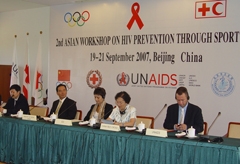
The opening ceremony of the HIV prevention and
sport workshop. L-R: Dr. Xaio Donglou, Deputy
Director General, Bureau of Disease Control,
Ministry of Health, Mr. Cai Zhenhua, Vice President
of the Chinese Olympic Committee and Vice-
Minister of Sport, Katia Mascagni, IOC Head of
International Organisations' Relations and
Cooperation, Ms. Han Lu, Executive Vice
President of Red Cross Society of China and Andy
Seale, Chief, Civil Society and Partnerships,
UNAIDS.
Delegates at the event reiterated the need to capitalize on the Beijing Games and other sporting events as opportunities for HIV prevention work and information campaigns. The participants also agreed to distribute and make use of the toolkit in educating athletes, coaches, officials and administrators, and adapt it to the local context, reach out to famous athletes as ambassadors and supporters for their activities and involve people living with HIV in their work.
At the end of the workshop, delegates called on the main stakeholders from the sport and health sectors to set up a task force building on existing partnerships. They also called for further action on developing an AIDS policy for each relevant organization, while ensuring that the progress and results were monitored and disseminated.
A message from IOC President Jacques Rogge underlined how sport can break down barriers, fight discrimination and make a difference in the AIDS response.
“Because the prevention of and fight against discrimination are the two fields in which sport can clearly make a difference, and because sport breaks down barriers, builds self-esteem and can teach life skills and healthy behaviour, the sports movement has decided to join the world campaign against AIDS," said Mr Rogge.
“More than ever, sport can be a catalyst in our society to improve quality of life and human well-being,” he added.
Links:
See the English version of the toolkit:
‘Together for HIV and AIDS Prevention – a toolkit for the sports community’
Read feature story:
‘China’s Olympic effort to raise AIDS awareness
Read feature story:
Planting trees for AIDS in China
Related
Indian partners reflect on a year after sex workers’ human rights affirmed
05 de octubre de 2023
 A rainbow of hope for LGBTQI+ people in rural Japan
17 de mayo de 2023