

Feature Story
Year in review: UNAIDS in 2007
19 декабря 2007
19 декабря 2007 19 декабря 20072007 has been an exciting year for UNAIDS particularly in the fields of research and monitoring and evaluation. Results from new studies were announced early in the year providing evidence that male circumcision can reduce the risk of HIV infection in men by up to 60%; and new and improved data gathering and methodology was used to produce revised estimates for HIV which showed that the global number of people living with HIV was significantly lower than previous estimates indicated.
Political leaders also stepped up to the table in 2007 with announcements from the G8 leaders of a projected $US 60 billion investment in AIDS, tuberculosis and malaria and a call from the US President to double the current funding for President Bush’s Emergency Plan for AIDS Relief to reach US$ 30 billion over five years.
A number of regional AIDS conference were held in 2007 giving each region an opportunity to put AIDS high on the agenda and examine their epidemics in depth. These conferences also provided a platform for participants to share ideas and strategies for moving the regional AIDS response forward.
Universal access and in particular HIV prevention have been a much talked about topics this year with UNAIDS and partners launching an e-forum on HIV prevention in southern and eastern Africa, the release of the UNAIDS 'Practical Guidelines for Intensifying HIV Prevention', the meeting of the reference group on HIV prevention and a call to intensify HIV prevention, all of which are highlighted in the ‘Year in review’.
Below are some of the highlights and key events which took place in 2007.
| JANUARY | |
| UNAIDS Policy Brief : HIV and Sex between men | |
 | Country and regional consultations have confirmed that stigma, discrimination and criminalization faced by men who have sex with men are major barriers to the movement for universal access to HIV prevention, treatment, care and support. UNAIDS has released a policy brief which outlines recommendations required to try and overcome these barriers. |
| FEBRUARY | |
| Be smart – protect yourself | |
 | German football star and UNAIDS Special Representative Michael Ballack has featured in a public service announcement on AIDS, speaking out on HIV prevention and urging young people to make the smart choices. |
| HIV and refugees | |
 | Conflict, persecution and violence affect millions of people worldwide, forcing them to uproot their lives. Refugees are those who flee their country of origin across national borders, often to a neighbouring country. UNAIDS in collaboration with UNHCR have developed a policy brief that focuses specifically on actions required to prevent and mitigate the effect of HIV on refugees and their host communities. |
| Male circumcision and HIV: a web special series | |
 | Male circumcision is one of the world’s oldest surgical practices; carvings depicting circumcisions have been found in ancient Egyptian temples dating as far back as 2300 BC. New research has produced evidence which shows that circumcision can reduce the risk of HIV infection in men by up to 60%. Read the three part special on HIV and male circumcision. |
| MARCH | |
| UNAIDS releases 'Practical Guidelines for Intensifying HIV Prevention' | |
 | UNAIDS has released Practical Guidelines for Intensifying HIV Prevention: Towards Universal Access to assist policy makers and planners in countries to strengthen their national HIV prevention response. |
| Responsibility and Partnership: Together against HIV/AIDS | |
 | Representatives of 27 European Union and neighbouring countries met in Bremen, Germany to discuss ways of strengthening political leadership in the response to AIDS. Over 600 people attended the 2007 European AIDS Conference which was organised by the German Federal Government in its capacity as current President of the European Union. |
| Together against TB and HIV | |
 | The lethal combination of TB and HIV was highlighted on this year’s World TB Day on 24th March. The weakened immune system caused by HIV makes people living with HIV at greatly increased risk of developing TB disease. TB is a leading cause of death among people living with HIV. UNAIDS, WHO and the Stop TB Partnership have pledged to work together to fight against these deadly viruses. |
| APRIL |
| Treatment figures reach 2 million | |
 | WHO, UNAIDS and UNICEF have launched a new report on scaling up priority AIDS interventions in the health sector. |
| IV Latin American and Caribbean Forum on HIV/AIDS | |
 | The IV Latin American and Caribbean Forum on HIV/AIDS and STD’s opened in Buenos Aires on 17 April under the theme "Latin America and the Caribbean: United in diversity towards universal access". |
| E-forum gets HIV prevention online | |
 | A new electronic discussion forum (e-form) on ‘accelerating HIV prevention’, launched by UNAIDS and partners in southern and eastern Africa, encourages people to get online to debate, share knowledge and build partnerships on HIV prevention issues. |
| MAY | |
| UN General Assembly meets on AIDS | |
 | At the 61st session of the General Assembly, United Nations Secretary-General Ban Ki-moon confirmed his support to the AIDS response promising to ensure that the international community remains united against the epidemic. |
| Injecting drug use: focused HIV prevention works | |
 | Drug users not only face physical risks of HIV infection, they are also vulnerable to HIV because of their social and legal status. Illegal in many countries, drug use is punishable by incarceration and is highly stigmatized, which further marginalizes people with drug dependence problems. As a consequence, injecting drug users are often not able or willing to access HIV services for fear of recrimination. |
 | UN Plus– the UN system-wide group of staff living with HIV– met with the United Nations Secretary-General Ban Ki-moon to brief him on the key achievements of the group since its inception in March 2005 and to discuss the opportunities and challenges and limitations that UN positive staff face at work. |
| UNAIDS welcomes call for $30 billion to the AIDS response | |
 | The Joint United Nations Programme on HIV/AIDS (UNAIDS) applauds the announcement by United States President George Bush regarding his intention to extend and expand the U.S. government’s investment in the global AIDS response. |
| HIV testing and counselling: new guidance | |
 | WHO and UNAIDS issued new guidance on informed, voluntary HIV testing and counselling in the world's health facilities on Wednesday 30 May, with a view to significantly increasing access to needed HIV treatment, care support and prevention services. |
| JUNE |
| Scaling up through partnerships | |
 | Donors, AIDS experts and implementers from around the world have gathered in Kigali, Rwanda to attend the 2007 HIV/AIDS Implementers’ Meeting. |
| JULY | |
| Call to intensify HIV prevention | |
 | In a new report released on HIV prevention, a panel of leading AIDS experts calls for a major increase in global HIV prevention programs, citing new projections that expanded access to prevention could avert approximately 30 million of the 60 million HIV infections expected to occur by 2015. |
| 2.5 million people living with HIV in India | |
 | As part of its continuous efforts to know its epidemic better, India’s National AIDS Control Organisation, supported by UNAIDS, has used data from the expanded surveillance system and a new population-based survey to produce more accurate estimates of the AIDS epidemic in India. |
| AUGUST | |
| Hope for street children | |
 | Street children in Cairo, are at a far higher risk of exposure to HIV than children who have a stable home life. Workers at the Hope Village Society, an organisation looking after Cairo’s street children, have been working with UNICEF and UNAIDS to incorporate AIDS awareness in their educational programmes. |
| New Blog gets HIV science online | |
 | For the latest news, views and reviews on HIV coverage in the scientific literature – log on to HIV this week! |
8th International congress on AIDS in Asia and the Pacific | |
 | The 8th International Congress on AIDS in Asia and the Pacific (ICAAP) took place in Colombo, Sri Lanka on from 19 - 24 August. The conference brought together more than 3,000 delegates from around 60 countries to discuss critical issues on AIDS in the region such as stigma and discrimination, access to HIV prevention and treatment and the importance of sustained political commitment on AIDS. |
| The process behind AIDS estimates | |
 | As part of continuing efforts to gain a better understanding of the AIDS epidemic, UNAIDS and WHO have taken a series of measures to improve the estimation process. Countries have been encouraged to expand their data collection methods, methodology used to analyse this new data has been improved and a series of workshops have been held to train people in countries in the complex process of estimating the AIDS epidemic. This process is resulting in more concise estimations and a better understanding of how epidemics are evolving. |
| SEPTEMBER | |
| Promoting sport and HIV prevention | |
 | ”LoveLife, together with the ICC, UNAIDS, UNICEF and the Kaiser Family Foundation, have joined together in a unique partnership to highlight the situation of children and young people living with and affected by HIV through the global game of cricket. |
| Financial resource requirements for AIDS | |
 | UNAIDS has produced a new report on the estimated financial resources required for the AIDS response to achieve the goal of universal access to HIV prevention, treatment, care and support. |
| OCTOBER | |
| Progress and challenges for Botswana | |
 | In a joint mission, UNICEF Executive Director Ann Veneman, UNAIDS Executive Director Peter Piot and Dr Tadatakai Yamada, President of the Bill & Melinda Gates Foundation’s Global Health Programme visited Botswana to gain a shared perspective of the progress and challenges facing the country in its AIDS response. |
| “Overwhelming and Inspiring” | |
 | Rupert Everett, the film and theatre actor (My Best Friend’s Wedding, Another Country), and Special Representative of UNAIDS visited Moscow and St Petersburg 23 – 26 September, to learn more about AIDS and tuberculosis in Russia and to help raise awareness about these two important, inter-linked diseases. |
| NOVEMBER | |
| CONCASIDA 2007 | |
 | The 5th Central American Congress on HIV was held in Managua, Nicaragua, from 4-9 November. Over 1,500 participants attended the Congress including representatives from governments, the United Nations, people living with HIV, women’s organizations, religious groups and the private sector. |
| Concern over Criminalization of HIV Transmission | |
 | Several countries have recently introduced laws to criminalise HIV transmission, or exposing another person to the virus. A number of jurisdictions have used general laws against serious bodily harm in cases where someone is accused of knowingly transmitting HIV or willingly exposing others to HIV transmission. |
First Global Parliamentary Meeting on AIDS | |
 | The First Global Parliamentary Meeting on HIV/AIDS was opened on Wednesday 28 November in Manila by Mr Manny Villar, President of the Senate of the Philippines. UNAIDS Deputy Executive Director, Michel Sidibe gave one of the key note speeches, highlighting the important role parliamentarians have to play in the global response to the epidemic. |
| AIDS on the agenda at Commonwealth Heads meeting | |
 | UNAIDS Deputy Executive Director Deborah Landey visited Kampala, Uganda from 16-17 November. In addition to meeting with various leaders in Uganda’s AIDS response from government and civil society, Dr Landey participated in a plenary session at the Commonwealth Heads of Governments Meeting (GHOGM), which was taking place in Kampala during her visit. |
| International consultation on AIDS estimates: Recommendations | |
 | An International Consultation on AIDS Epidemiological Estimates, convened jointly by the UNAIDS Secretariat and WHO, was held on 14-15 November 2007 in Geneva, Switzerland. The meeting brought together more than 30 technical experts and country epidemiologists from around the world to review the current processes and methodologies used by UNAIDS and WHO to produce HIV estimates at the country, regional and global level. |
| AIDS epidemic update 2007 | |
 | The 2007 AIDS epidemic update reports on the latest developments in the global AIDS epidemic. The 2007 edition provides the most recent estimates of the AIDS epidemic and explores new findings and trends in the epidemic’s evolution. |
| DECEMBER | |
| World AIDS Day 2007 | |
 | This year's World AIDS Day theme – leadership – reminds us that, from government leaders to individuals, we all have a leadership role to play in the AIDS response and we are all accountable for the promises made. On 1 December UNAIDS participated in events around the globe to commemorate this special day of remembrance and hope. |
| Meeting ethical concerns over HIV trials | |
 | In the first of a special three-part web series, www.unaids.org looks at the state of research into new HIV prevention technologies, the ethical debates around the issue, and the steps that have been taken to answer the concerns. The question of HIV trials, and in particular the involvement of women and adolescent girls in them, will be the subject of a two-day conference being hosted by UNAIDS in Geneva December 10-11. |
| More than words: ART for AIDS | |
 | World AIDS day 2007 marked the first anniversary of the UNAIDS’ Art for AIDS collection—an art collection created to recognize the role art has played in the response to AIDS. In a special three-part series, www.unaids.org tells the story of the collection, and the artists who helped create it. |
| Updated look and enhanced features for www.unaids.org | |
 | Welcome to the refreshed UNAIDS web site! We are delighted to introduce a new-look design, restructured navigation for the site and a host of new features including a live newsfeed from UNAIDS Cosponsors, the new ‘Knowledge Centre’ and the new ‘Multimedia Centre’. We hope this enables you to find the information you need more easily. We invite you to browse the refreshed site and welcome your feedback. |
Related
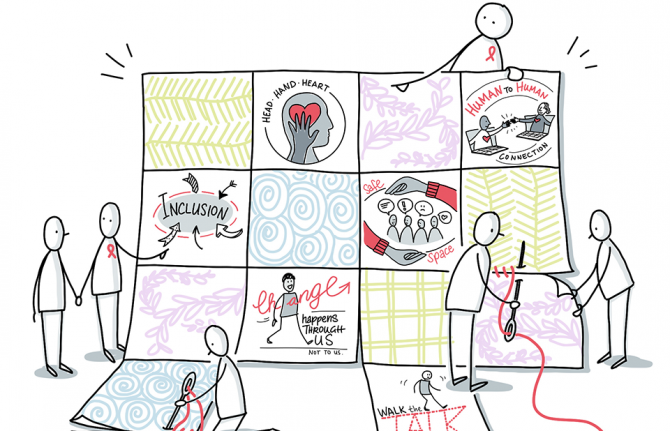 A Quilt in the Making: UNAIDS shares learnings from its journey of Culture Transformation
26 октября 2022 года.
 UNAIDS staff member talks about the invasion of Ukraine
18 мартаа 2022 года.
Feature Story
UN special session follow-up: A World Fit for Children +5
18 декабря 2007
18 декабря 2007 18 декабря 2007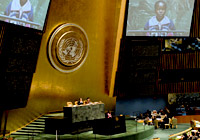
© UNICEF/HQ07-2010/Markisz
The declaration adopted by the General Assembly identified poverty eradication as the greatest global challenge facing children.
The commemorative high level plenary meeting devoted to the follow-up to the outcome of the United Nations special session held in 2002 has ended with the adoption of a new Declaration on Children which reaffirms the commitments laid out five years ago.
On 13 December 2007 more than 140 government delegations adopted the Declaration which addresses improving the lives of children.
In addition to Heads of State and government, some 130 high level national delegations gathered at United Nations Headquarters for the landmark conference to review progress on the ‘A World Fit for Children’ plan of action created by governments in 2002.
Twenty children participated in the plenary as members of their national delegations. Hundreds of NGOs also gathered in New York for discussions and advocacy on children’s issues.
 © UNICEF/HQ07-1930/Susan Markisz
 Ann M. Veneman (centre) with (left to right) Committee on the Rights of the Child Chair Dr. Yanhee Lee, UNAIDS Executive Director Dr. Peter Piot, Professor Ernesto Schiefelbein and Plan International Regional Director Dr. Deepali Khanna.
The day before the opening of the plenary, UNICEF released a new report—‘Progress for Children: A World Fit for Children Statistical Review’—on how well the world is doing in meeting its commitments for the world.
This report analyses progress towards the Millennium Development Goals in four priority areas for children: promoting healthy lives, providing a quality education, responding to AIDS, and protecting against abuse, exploitation and violence.
“This is the most comprehensive ‘Progress for Children’ report to date,” UNICEF Executive Director Ann M. Veneman told participants in a Town Hall meeting at UNICEF House on 10 December.
The open forum featured a panel of experts, including UNAIDS Executive Director Peter Piot and Yanhee Lee of the Committee on the Rights of the Child.
Also present were representatives of over 50 non-governmental organizations, who were encouraged to comment on the report and share their experiences in working in a wide range of programmes for children. Young delegates to this week’s UNICEF-sponsored Youth Forum also joined the discussion.
Right Hand Content
Cosponsors:
Read UNICEF reports on the ‘World Fit For Children + 5’ plenary
Publications:
Declaration of the commemorative high-level plenary meeting devoted to the follow-up to the outcome of the special session on children
Progress for Children: A World Fit for Children Statistical Review (December 2007)
Related
 Young role models combat HIV stigma in Central Asia
22 июня 2023 года.
 United for ending cervical cancer, HIV and inequities for women and girls
17 ноября 2022 года.
Feature Story
Updated look and enhanced features for www.unaids.org
14 декабря 2007
14 декабря 2007 14 декабря 2007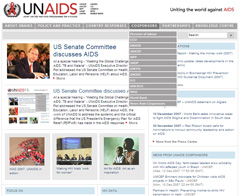
UNAIDS website new-look homepage, 14 December 2007
Welcome to the refreshed UNAIDS website!
UNAIDS is delighted to introduce a new-look design, restructured navigation for the site as well as and many rich new features including a live Cosponsor newsfeed, a new ‘Knowledge Centre’ and ‘Multimedia Centre’ and improved navigation menu. We hope this combination of enhanced functionality and usability will improve the web visitor’s experience.
The goal is to make it easier for all visitors—including advocates, policymakers, practitioners, the media, researchers and community members—to find information on AIDS and the work of UNAIDS and its Cosponsors through the web site. It will also make it easier to access key technical resources, learn about our partnerships and keep up-to-date on the latest UNAIDS news.
New features
Several new features including a new-look homepage with dropdown navigation menus, a live Cosponsor newsfeed, a new ‘Knowledge centre’ which houses all UNAIDS key data and resources and a new-look publications section and multimedia centre housing video, audio and photographic materials
Annemarie Hou, Chief of Communications and Knowledge Sharing, said: “Our aim has been to make the web site more intuitive, more comprehensive and to reduce duplication of material.”
“The launch of the new Knowledge Centre signals UNAIDS role as a go-to source for information about the epidemic and offers enhanced knowledge sharing to our partners and other stakeholders.”
We invite you to browse the new site and very much welcome your feedback. You can contact us with your ideas and suggestions by email: webmaster@unaids.org.
Related
 Walk in my shoes — UNAIDS Board devotes key session to HIV, adolescents and youth
20 декабря 2013 года.
 Know your HIV status: First European testing week takes off
27 ноября 2013 года.
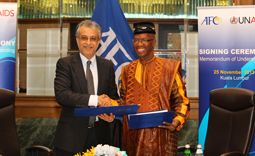 Asian Football Confederation and UNAIDS team-up to raise awareness of HIV
26 ноября 2013 года.
Feature Story
US Senate Committee discusses AIDS
13 декабря 2007
13 декабря 2007 13 декабря 2007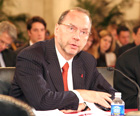
UNAIDS Executive Director Dr Peter Piot address US Senate Committee
At a special hearing - "Meeting the Global Challenge of AIDS, TB and Malaria" - UNAIDS Executive Director Dr Peter Piot addressed the US Senate Committee on Health, Education, Labor and Pensions (HELP) about AIDS, the work of UNAIDS to address the epidemic and the critical difference that the US President's Emergency Plan for AIDS Relief (PEPFAR) has made in the AIDS response.
Also addressing the Committee in Panel I were U.S. Global AIDS Coordinator, Ambassador Mark Dybul and Director of the US Centers for Disease Control and Prevention. Joining Dr Piot in Panel II were World Vision HIV educator Princess Zulu, Professor of the University of California, Dr Norman Hearst and Vice Chair of the IOM Evaluation Committee, Dr Helen Smits.
Resources:
Read written testimony provided by UNAIDS Executive Director Dr Piot to the US Senate committee on Health, Education; Labor and Pensions (HELP)
Read follow up questions submitted by HELP to Dr Piot
External links:
More on 'Meeting the Global Challenge of AIDS, TB and Malaria' - US Senate Committee web site
View the hearing
Related
 Partnering to get back on track to end AIDS by 2030
24 сентября 2021 года.
 Anambra, Nigeria, commits to eliminating vertical transmission of HIV by end of 2022
06 сентября 2021 года.
 Resources and funding for an effective AIDS response
10 июня 2021 года.
Feature Story
Making HIV trials “work for women”
13 декабря 2007
13 декабря 2007 13 декабря 2007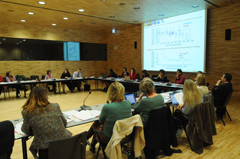
The meeting, sponsored by UNAIDS, the Global Coalition on Women and AIDS (GCWA), the International Center for Research on Women (ICRW) and the pharmaceutical company Tibotec, made recommendations in three core areas – policy and programmes, research and advocacy.
Health experts from international agencies, non-governmental and research organisations and universities as well as industry agreed on a series of steps aimed at ensuring that HIV trials and interventions are designed and implemented to reflect more closely the needs of women, who are increasingly affected by AIDS.
At the end of a two-day meeting at the UNAIDS Secretariat headquarters in Geneva, the group identified areas in which more research is required, including into the effect of sex differences on HIV interventions, and committed themselves to strengthening advocacy surrounding women and HIV trials amongst the donor community, governments and industry.
Describing the outcome as “heart warming”, Kathleen Cravero, Director of Crisis Prevention and Recovery at the United Nations Development Programme, said the issue of women and HIV was finally getting the attention it deserved. “I remember that not so long ago it was very hard to get anyone’s attention to that subject,” she told delegates.
Half of those living with HIV around the world are women, but the figure rises to over 60% in sub-Saharan Africa where infection rates are increasing amongst adolescents girls.
However, women are still under-represented in clinical trials for treatments and prevention strategies. The reasons are varied, and in part historical, but in developing countries they include cultural, social and economic factors, such as lack of empowerment for women.
This in turn requires that solutions to the problem go beyond strictly biomedical considerations to include structural issues, including poverty, delegates agreed.
The meeting, sponsored by UNAIDS, the Global Coalition on Women and AIDS (GCWA), the International Center for Research on Women (ICRW) and the pharmaceutical company Tibotec, made recommendations in three core areas – policy and programmes, research and advocacy.
The key themes identified were the overall issue of women’s involvement in trials, sex differences – gaps in knowledge, such as the varying effects of viral loads in men and women -- capacity building, opportunities for research, improving the dissemination of what is already known, adolescents, and sexual and reproductive health issues, including abortion and pregnancy in women living with HIV.
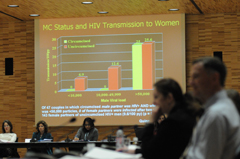
Half of those living with HIV around the world are women, but the figure rises to over 60% in sub-Saharan Africa where infection rates are increasing amongst adolescents girls.
On adolescent participation in trials, which is becoming a crucial issue given mounting infection rates in some parts of the world in this age-group, the group felt that more needed to be known about the benefits and drawbacks before clear recommendations could be made.
Targets for advocacy would include regulatory agencies, which would be encouraged to insist on the inclusion of more women in trials, research agencies and donors such as the Global Fund, medical journals and industry. The latter would be asked to set targets for the inclusion of women in testing.
Some future tasks were assigned amongst various organisations taking part in the meeting, attended by over 50 experts in various aspects of the AIDS response. The Global Coalition, for example, agreed to look into structural intervention issues, while UNAIDS will address the question of good participation practice (GPP).
It was suggested that the World Health Organisation, UNAIDS and the United Nations Population Fund (UNFPA) could call a special meeting to debate questions surrounding couples where one partner is HIV positive and the other not, often called sero-discordant couples, and issues such as fertility and pre-exposure prophylaxis.
The group, which will be issuing a full report on the outcome of the meeting, will also look into presenting a “report card” on HIV trials, assessing the degree to which they have included women.
All photo credit: UNAIDS/O.O'Hanlon
Resources
Policy and guidance:
Good participatory practice guidelines for biomedical HIV prevention trials (pdf, 3.04Mb)
Partners:
Global Coalition on Women and AIDS
International Center for Research on Women (ICRW)
Tibotec
Feature stories:
Read part 1 - Meeting ethical concerns over HIV trials
Read part 2 - The role of women in HIV trials
Read part 3 - Experts meet on women and HIV clinic trials
Read more on the meeting - Women and HIV research
Related information:
More on biomedical research
External links:
HIV Prevention Research: A Comprehensive Timeline
Publications:
Ethical considerations in biomedical HIV prevention trials (pdf, 750kb)
Good participatory practice - Guidelines for biomedical HIV prevention trials (pdf, 704 Kb)
Related
Feature Story
Women and HIV research
11 декабря 2007
11 декабря 2007 11 декабря 2007
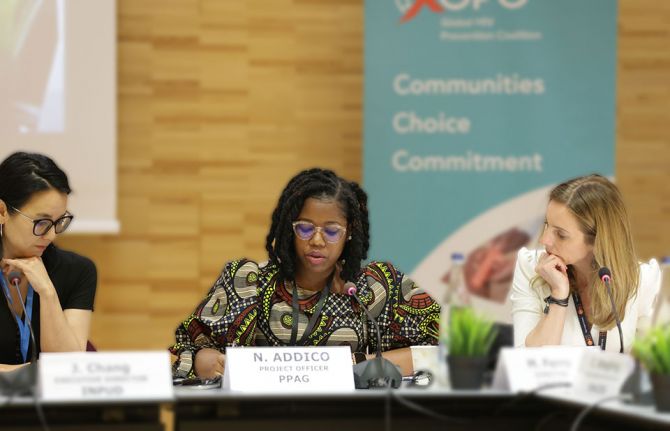
Meeting at UNAIDS in Geneva, health experts said
that cultural and social barriers can still stop women
taking part in HIV trials in sufficient numbers, while
too little is known about the effects of biological
differences between the sexes in such areas as the
impact of HIV drugs.
Women and adolescent girls are on the frontline in the AIDS epidemic but getting them the special treatments, HIV prevention strategies and protection they need will require a varied, multi-disciplined response -- medical, social and economic, health specialists agreed.
Meeting at UNAIDS in Geneva, health experts from international agencies, non-governmental organisations (NGOs), research institutions and the private sector, said that cultural and social barriers can still stop women taking part in HIV trials in sufficient numbers, while too little is known about the effects of biological differences between the sexes in such areas as the impact of HIV drugs.
Winding up the first of two days of discussions on Monday 10 December, Kristan Schoultz, Director of the Global Coalition on Women and AIDS, said delegates had made a thorough review of the challenges and difficulties and the moment had come to start putting forward proposals for solutions.
“I think we have determined some of the challenges we face, (now) we need to tease out of this a way forward,” she said.
The route lay beyond a strict interpretation of the conference’s theme – “Making HIV Trials Work for Women and Girl Adolescents” -- and should include economic and social changes to address background factors such as poverty and empowerment.
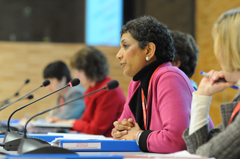
“We need to highlight the difference between sex
and gender differences. Gender also brings in
social, cultural and economic issues as opposed to
the straight biological issues,” said Geeta Rao Gupta,
President, the International Center for Research on
Women (ICRW).
“We need to highlight the difference between sex and gender differences. Gender also brings in social, cultural and economic issues as opposed to the straight biological issues,” said Geeta Rao Gupta, President, the International Center for Research on Women (ICRW).
Although women account for some 50% of people infected with HIV worldwide, in sub-Saharan Africa the figure is around 60% and amongst some ethnic minorities in developed countries women also account for a disproportionate percentage. In parts of southern Africa, girl adolescents are some four times more likely to become infected with HIV than males of the same age.
For years after AIDS was first recognized in the early 1980s, medical research continued to be largely male orientated. Clinical trials involving women of child-bearing age had been banned in the United States in the late 1970s, in part because of the thalidomide scandals, and the restriction was not lifted until the early 1990s. In addition, the epidemic was initially thought largely a disease affecting men who had sex with men.
“The current research emphasis being put on microbicides for women is an illustration of the way in which priorities have changed,” said Roberta Jean Black, tropical microbicides team leader of the U.S. National Institutes of Health.
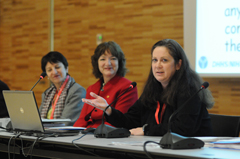
“The current research emphasis being put on
microbicides for women is an illustration of the way
in which priorities have changed,” said Roberta
Jean Black, tropical microbicides team leader of
the U.S. National Institutes of Health.
“Some of these inequalities simply represented misunderstandings of the disease and its evolution…We have responded successfully but the work is not done,” she added.
“The existing strategy was not designed with the percentage (of women) in mind. This is an iniquitous state of affairs,” declared Julie McHugh, company group chairman, virology, Tibotec.
More needs to be known about the progress of HIV in women.
“We are looking for answers for women. We now have women in menopause with HIV and we do not know anything about it,” said Heidi Nass, Director, Education and Policy Advocacy, Health HIV Care Program, University of Wisconsin. “We have seen the list (of things to do) a million times, it would be really nice to come out with action,” she added.
Gaps in understanding
There are many gaps in our understanding of HIV and how it evolves in women and the difference that gender can make, participants agreed. For example, CD4 tends to be higher in women, yet there appears to be no significant impact on the progress of the disease.
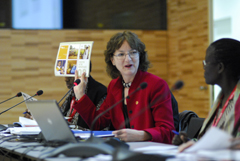
Most trials are not designed to detect sex
differences. “We are relying on safety trials from the
(rich, developed) north, and carried out on men,”
said Catherine Hankins, Chief Scientific Adviser to
UNAIDS.
But the difference can lead to delays in the timing of treatment for women. When it comes to mother-to-child-transmission (MTCT), this can have the unfortunate result that women who are not deemed sick, and are therefore not treated, are far more likely to infect their children than those who were inside the treatment threshold.
Most trials are not designed to detect sex differences. “We are relying on safety trials from the (rich, developed) north, and carried out on men,” said Catherine Hankins, Chief Scientific Adviser to UNAIDS.
There are also indications that some treatments have significant toxicity for women. Nevirapine, for example, can produce rashes and hepatic complaints. Toxicity can be one reason why women tend to abandon trials more often than men and is another area in which more research is needed.
Biologically different
Even if there are no side effects, it is possible that existing treatments may not be the best possible way of tackling HIV in women. Women are biologically different, so they need specific research.
Women in poorer countries can face a host of barriers to taking part in clinical trials. They may fear it will suggest that they are ill and lead to them being stigmatised, they could need permission from their partners or family – most people at risk are in long-term partnerships -- and they may not want to use contraception or they may fear for their future fertility.
Male circumcision provides no protection for women, although there could be secondary benefits for women, but more needs to be learned.
Difficult considerations
The whole question of trials for adolescents was thick with difficulties. Even a standard definition of what constitutes an adolescent is difficult to establish.
“Communities are very sensitive about involving young girls in trials for fear that they are promoting sexual activity,” said Gita Ramjee, Director, HIV/AIDS Lead Programme and HIV Prevention Research Unit, South African Medical Research Council.
Summing up the changes needed to help women and adolescent girls, Isabelle de Zoysa, senior adviser on HIV/AIDS at the World Health Organisation said: “We are looking how we move through gender unbiased, through gender sensitive to gender transforming.”
The conference, ‘Making HIV Trials Work for Women and Adolescent Girls’, takes place in Geneva on 10 – 11 December 2007. The meeting is co-sponsored by UNAIDS, the Global Coalition on Women and AIDS, the International Centre for Research on Women (ICRW), and Tibotec.
All photo credit: UNAIDS/O.O'Hanlon
Links:
Read part 1 - Meeting ethical concerns over HIV trials
Read part 2 - The role of women in HIV trials
Read part 3 - Experts meet on women and HIV clinic trials
More on biomedical research
HIV Prevention Research: A Comprehensive Timeline
Global Coalition on Women and AIDS
Tibotec
International Center for Research on Women (ICRW)
Publications:
Ethical considerations in biomedical HIV prevention trials (pdf, 750kb)
Good participatory practice guidelines for biomedical HIV prevention trials (pdf, 3.04Mb)
Related
Feature Story
Human rights and universal access
11 декабря 2007
11 декабря 2007 11 декабря 2007Human rights and its links to reaching the goal of universal access to HIV prevention, treatment, care and support was central to the discussions of the eighth meeting of the UNAIDS Reference Group on HIV and Human Rights, an independent advisory body to UNAIDS, that took place on 3-5 December 2007 in Geneva.
“The most critical issues in the HIV response are human rights issues, and UNAIDS [needs to] frontline these to push the HIV response towards universal access to HIV prevention, treatment, care and support,” said Reference Group Chair Mark Heywood when he summarized the Group’s conclusions to UNAIDS Deputy Executive Director (Programme) Michel Sidibe.
The Group – which includes HIV activists, lawyers, a High Court judge, people living with HIV, people working with sex workers and drug users, academics and the UN Special Rapporteur on the Right to Health – addressed a range of issues, including accountability for universal access commitments, human rights in the context of sex work and drug use, promotion of gender equality in national HIV responses.
Recent trends of criminalizing HIV transmission were also discussed. The Reference Group expressed its concern about the tendency of parliaments to criminalize HIV transmission and highlighted an increasing conflict between the push to help people get tested for HIV in order to get HIV treatment and the move to prosecute people who transmit HIV. It asked that UNAIDS empower its staff to work against this trend and urge governments to put in place the kind of laws that will really help stop the transmission of HIV: laws to protect the equality of women and to protect them against violence, laws to protect people living with HIV against discrimination, and laws to ensure sufficient programmes for HIV prevention for all populations groups in need of them.
The Reference Group also expressed concerns about reports of mandatory HIV testing. “We fully support the scale up of testing and counselling services as a human rights imperative, but providers must do so in a way that is based on dignity,” Heywood said in his summary report to UNAIDS. The Reference Group called for greater monitoring of this issue, as well as advocacy and technical assistance to ensure that mandatory testing practices are put to an end.
UNAIDS Deputy Executive Director, Michel Sidibe underlined the important role of UNAIDS staff in country – across the co-sponsored, joint UN programme – as human rights advocates. “AIDS will remain if we don’t deal with the human rights issues,” he said.
“All of our staff should be human rights oriented. We know that human rights must be at the basis of programmes that address the realities of those most vulnerable and those most affected by HIV,” he added.
He noted that much more work needs to be done to make HIV programmes respond to the local dynamics of the epidemic.
“Priority setting in national responses has generally not addressed the major challenges – the major vulnerabilities, issues of stigma, discrimination, gender inequality, and other human rights violations. We need better situation analysis, better understanding of the contextual factors, and we have to act on that information,” Sidibe said.
Audio:
Listen to Mark Heywood, Head of AIDS Law Project and National Secretary of Treatment Action Campaign (TAC)
Listen to Sofia Gruskin, Director of the International Health and Human Rights Program, Harvard School of Public Health
Links:
Read more on the UNAIDS Reference Group on HIV and Human Rights
Read more on Human Rights
Read UNAIDS Executive Director's statement on Human Rights Day 2007
Related
 Tajikistan takes a positive step towards decriminalization of HIV exposure and transmission
30 января 2024 года.
 A rainbow of hope for LGBTQI+ people in rural Japan
17 мая 2023 года.

Feature Story
Experts meet on women and HIV clinic trials
07 декабря 2007
07 декабря 2007 07 декабря 2007
The conference, ‘Making HIV Trials Work for
Women and Adolescent Girls’, is co-sponsored by
UNAIDS, the Global Coalition on Women and AIDS,
the International Centre for Research on Women
(ICRW), and Tibotec.
Specialists on AIDS and women’s health are meeting in Geneva from December 10-11 to review the latest developments in research into preventing and treating HIV among women and adolescent girls from HIV infection, and to make recommendations on priorities and strategies.
The conference, ‘Making HIV Trials Work for Women and Adolescent Girls’, is co-sponsored by UNAIDS, the Global Coalition on Women and AIDS, the International Centre for Research on Women (ICRW), and Tibotec. The Global Coalition is an alliance of civil society groups, networks of women living with HIV and U.N. agencies; ICRW presses for women’s needs to be integrated into the design and implementation of programmes and policies; and Tibotec is an international pharmaceuticals company.
In the last of three articles focusing on HIV clinical trials ahead of the conference, senior representatives of the sponsoring organisations were asked about the challenges of getting women involved in sufficient numbers in HIV trials, the current state of research into prevention and treatment strategies for women and what they hoped the two-day meeting could achieve.
Catherine Hankins, Chief Scientific Adviser to UNAIDS, was asked why the conference was being held now?
Hankins: Although great strides have been made in recent years to include women as participants in HIV treatment and prevention trials in adequate numbers to draw conclusions relevant for them, challenges remain in recruitment, retention, study design, pregnancy, and meaningful engagement of women in trial design, conduct, and monitoring. It is also clear that adolescent girls who are at very high risk of HIV exposure in some settings must participate in trials before the final results of efficacy in adults are known so that licensing of an effective product can proceed for both adolescents and adults at the same time. This conference focuses on the progress thus far, the challenges ahead, and solutions.
Question: Women make up an increasing percentage of people living with HIV, particularly in Africa. Do current international research programmes adequately reflect this?
Hankins: Yes, many of the Phase III efficacy trials underway for HIV prevention are taking place where incidence in women is highest – sub-Saharan Africa. These include microbicide trials, PrEP trials, trials of herpes simplex-2 suppression, and the vaccines trials.
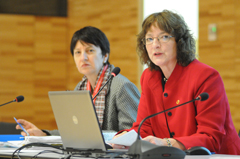
Catherine Hankins: "Combination prevention is key.
This means increasing the choices that women and
girls have to use synergistically at different times of
their lives and in different circumstances to protect
themselves from HIV".
Question: So what are the most promising lines of investigation? Is enough being done to find effective prevention tools and treatment for women?
Hankins: The first to report (already in 2008) will be the Carraguard microbicide trial and the herpes simplex-2 suppression trials. A number of other trials are underway but we are in this for the long haul. The amazingly consistent compelling results of the male circumcision trials may not be repeated for other HIV prevention products at quite the same efficacy level. Combination prevention is key. This means increasing the choices that women and girls have to use synergistically at different times of their lives and in different circumstances to protect themselves from HIV.
Question: What do you see coming out of this conference?
Hankins: Strong steps toward defining a research agenda, recommendations for policy and programmatic actions, and an advocacy strategy.
Kristan Schoultz, Director of the Global Coalition on Women and AIDS, was asked how the situation regarding women and AIDS had evolved since the coalition, which was launched by UNAIDS in 2004, and what she felt the coalition had achieved?
Schoultz: GCWA - together with women's groups and partners across the globe – has worked to put women's issues high on the agenda of top international AIDS forums. In 2006, U.N. Member states renewed and strengthened their commitments to scale up AIDS responses, and to address obstacles and barriers to access, particularly for women and girls. The ways in which gender inequalities and gender dynamics affect individual choices and behaviours are better understood and the issues facing women in a world of AIDS are more prominent in global and national advocacy.
However, the situation of women and girls in the AIDS response continues to be a major concern. We see rising rates of HIV infection among women in some regions and national AIDS responses have yet to sufficiently address the challenges and constraints women face in their everyday lives. We need to see more concerted work towards legal frameworks which secure women's rights, more funding for concrete programmes that benefit women, and greater participation of women's organizations in national decisions on AIDS programmes and budgets.
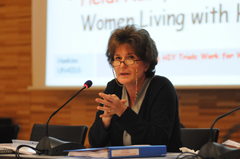
Kristan Schoultz: "Trials may need to investigate
the socioeconomic position of women and offer
support to potential trial participants".
Schoultz: Within any trial, three issues must be addessed: scientific justification, safety, and benefits for the community. With respect to women, challenges all essentially relate to safety and benefit. While women comprise a growing share of HIV infections every year, they are still underrepresented in HIV clinical trials which test the safety and efficacy of drugs. Drugs tested only on men can be dangerous for women. To get the gender-specific data that are needed, vaccine trials will need to enrol enough women and men to detect gender differences. Drugs work differently with female chemistry, and furthermore, drugs to help those conditions that emerge only in women may never be tested. From a medical viewpoint, women do not reap as much from advances in medical technology. At present, more women are now being enrolled in clinical trials. But many of the factors that affect women’s access to health services -- decision-making on health care, their social responsibilities, stigma associated with high-risk behavior, the threat of violence -- are the same barriers to their involvement in clinical trials. Simple factors, such as physical access to the location of the study, availability of child or family care, inhibit their participation. Trials may need to investigate the socioeconomic position of women and offer support to potential trial participants.
A huge challenge for women and adolescent girls is exercising their autonomy in participating in trials. The process of enrollment, securing informed consent, and protecting them from the risks that can result from research participation is fraught with deeply embedded social norms which are largely biased towards males. Gender-sensitive approaches are key when designing consent and recruitment procedures and risk-reduction interventions in HIV clinical trials.
Question: What contribution can this conference make?
Schoultz: UNAIDS and the Global Coalition on Women and AIDS are keen to have guidance on the links and complications of sex and gender on HIV treatments. We hope this meeting will deepen our understanding of these intersections in various clinical research areas. We hope that this meeting will help get HIV clinical trials done right for women.
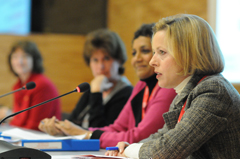
Julie McHugh: "Twenty five years of this epidemic
has taught us that women and girls are at the heart
of any successful response to HIV".
Julie McHugh, Company Group Chairman, Tibotec, was asked about what are currently the most promising avenues of research in HIV anywhere and for her company in particular.
McHugh: There has been a renewed push across the AIDS field recently with new treatments coming to patients with high genetic barriers to resistance, and superior efficacy and tolerability. This is an area that Tibotec is actively engaged in. Equally important are the development of new technologies and approaches that will simplify prevention and treatment approaches - in the fields of microbicides and Pre Exposure Prophylaxis particularly. But the key challenge for anyone concerned about reversing the global AIDS epidemic is making sure we have genuine partnerships between communities, international agencies, NGOs and the private sector to bring these new advances to women and girls. Highlighting this urgent need is the rationale for us holding this forum in Geneva.
Question: Do you feel that enough is being invested in HIV research worldwide?
McHugh: On the one hand, you could say that there is never enough being invested or conducted in HIV research. However, signficant increases in resources and commitments have been made in recent years across the public and private sectors. What we have to do is to ensure that these resources are most effectively used - and again, this calls for more enlightened and long term partnerships between sectors.
Question: What do you hope will come out of this conference?
McHugh: We want to raise awareness with policy makers and researchers of the importance of placing women and girls at the centre of HIV research. Twenty five years of this epidemic has taught us that women and girls are at the heart of any successful response to HIV.
All photo credit: UNAIDS/O.O'Hanlon
Links:
Three-part web series
Part 1: Meeting ethical concerns over HIV trials
Part 2: The role of women in HIV trials
Part 3: Experts meet on women and HIV clinic trials
More on biomedical research
HIV Prevention Research: A Comprehensive Timeline
Global Coalition on Women and AIDS
Tibotec
International Center for Research on Women (ICRW)
Publications:
Ethical considerations in biomedical HIV prevention trials (pdf, 750kb)
Good participatory practice guidelines for biomedical HIV prevention trials (pdf, 3.04Mb)
Related
Feature Story
Art as an inspiration
07 декабря 2007
07 декабря 2007 07 декабря 2007
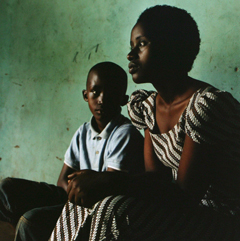
During the Rwanda leg of the visit, Jonathan met
Margaret, who not only became the subject for his
pictures—and part of the Art for AIDS collection--
but an inspiration for his life.
In February 2006, internationally renown photographer Jonathan Torgovnik travelled to Kenya, Tanzania and Rwanda for Newsweek magazine to cover the 25 years of AIDS through the eyes of UNAIDS Executive Director Peter Piot. During the Rwanda leg of the visit, Jonathan met Margaret, who not only became the subject for his pictures—and part of the Art for AIDS collection--but an inspiration for his life. In a special interview for the three-part series on Art for AIDS, Jonathan tells http://www.unaids.org/ his story.
Tell us about what happened in Rwanda
Well, in February 2006, I was on assignment for Newsweek in East Africa for the special issue on the 25 anniversary of AIDS. With Geoff Cowley (Newsweek health correspondent), we travelled through Kenya, Tanzania and Rwanada – with Peter Piot most of the time, following him, as the story was looking at 25 years, through Dr Piot’s eyes and life. In every country we went to, we also visited people living with HIV. In Rwanda, during one of the interviews, we met a woman named Margaret. She is a genocide survivor who was raped during the fighting and as a result contracted HIV. We also learned she had a child as result, and that probably, he too was living with HIV. Margaret took us through what had happened to her. Frankly, this was the most horrific interview I had ever heard. The level of brutality and sexual violence she went through was unthinkable, not to mention the memory of the slaughter of all her family. There were just so many multiple levels of trauma that she had gone through, and is still going through 13 years later.
What did this prompt you to do?
I found her story incredible and wanted to investigate more into the issue of children being born from rape, and what happens to them. So I started to investigate and found out that an estimated 20,000 children were born from rape during the genocide. I decided to go back several times and chronicle these women and their children’s stories through photography and words, to give them a voice. Sixty percent of women I interviewed had also contracted HIV from their rapists. And because of all the stigma attached to rape and HIV, these women and their children are often completely ostracised from community. All the women I have spoken to—about 30 now—feel the future for their children is very bleak. I asked them what would they do for these children if they could do something and they all underlined education as key. So I decided to start a foundation to raise money to pay for secondary school education for the children.

A selection of photographs by Jonathan Torgovnik
from the Kenya, Rwanda, Tanzania mission are
showcased in the UNAIDS ART for AIDS collection.
We raise money by publicising the stories, the chronicles of these women – placing them in mainstream magazines throughout the world and asking for donations. We have had some extremely generous donations after articles appeared in Germany, Spain and the UK. The response from the German public was particularly big. Leveraging the media and publishing the stories – giving the women a voice – works in all ways. We are reaching millions and so creating awareness and then mentioning the foundation with the hope that readers will send in donations.
We understand one of your Rwanda portraits has just won a big prize?
Yes, the annual UK National Portrait Gallery portrait prize! It’s an open submission, so I submitted some work and out of 7,000 one of the Rwanda portraits won first prize. It’s wonderful for me as a photographer but again here we have another opportunity to create awareness and to get the stories out there. Following the prize for example, the BBC picked the story, which helped leverage it some more.
How has your Rwanda experience changed you?
This project has changed my life – I have never worked on a subject or project where I have felt such a sense of mission, on the artistic side and humanistic side. And I have become much more interesting in covering other issues like this. Doing the trip with Dr Piot and hearing his stories and life history, hearing how dedicated he is to AIDS, really inspired me to continue working on this subject.
A selection of photographs by Jonathan Torgovnik from the Kenya, Rwanda, Tanzania mission are showcased in the UNAIDS ART for AIDS collection.
Links:
Visit the Foundation Rwanda web site
Read - More than words: ART for AIDS
Three-part series on Art for AIDS:
Part 1: Art for AIDS: A sculptor’s voice
Part 2: Art as an inspiration
Part 3: More than words: ART for AIDS
Read feature story - Contemporary African art and AIDS
Read feature story - Secretary General visits UNAIDS, Geneva
Related
Feature Story
President focuses on AIDS in Mexico
06 декабря 2007
06 декабря 2007 06 декабря 2007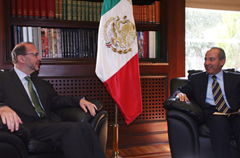
Dr Piot commended the President on his
commitment to making AIDS a priority and
particularly for the AIDS policies which have been
developed by the President’s administration.
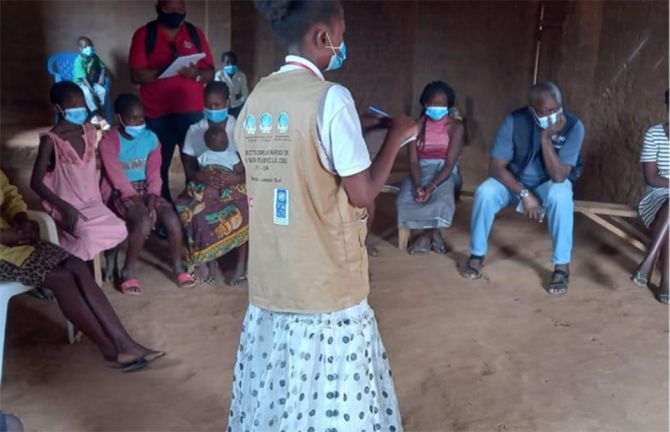
As part of a six-day visit to Mexico, the Executive Director of UNAIDS, Dr Peter Piot, met with Mexico’s President, Felipe Calderon Hinojosa, to discuss ways of increasing collaboration to strengthen the response to AIDS in the country.
Dr Piot commended the President on his commitment to making AIDS a priority and particularly for the AIDS policies which have been developed by the President’s administration.
Also on the agenda were discussions around Mexico’s decentralized approach to the AIDS response, which has proved to be particularly effective. Dr Piot emphasized that the local capacity which has been built-up through this model should be used as an example for other countries to follow.
The meeting came just two days after Dr Piot commemorated World AIDS Day in Mexico at the X National congress on AIDS 2007. Following-up on the 1 December theme of Leadership, Dr Piot encouraged the President of Mexico to continue his leadership on south-to-south collaborations on AIDS together with leaders from other countries in Latin America.
Looking ahead to 2008, the two men discussed the upcoming International AIDS Conference which Mexico will be hosting next August. This will be the first time that the event has been held in Latin America. President Calderon recognized the importance of next year’s conference and has already made plans to be present at the opening ceremony, news which was warmly welcomed by Dr Piot.
Links:
Read UNAIDS Executive Director's speech at the closing ceremony of the X national congress on AIDS 2007
Read more about World AIDS Day
Related
 Two years on: UNAIDS supports Ukraine’s commitment to the HIV response
23 февраля 2024 года.
 In Northeast Brazil, civil society and local government collaborate to increase HIV treatment adherence
03 апреля 2023 года.
 Dangerous inequalities and overcoming them
18 ноября 2022 года.