

Feature Story
Business Coalitions: a joint response to AIDS
24 января 2008
24 января 2008 24 января 2008
The World Economic Forums’ initiative for health the ‘Global Health Initiative’, supported by UNAIDS, has released the first report on Business Coalitions at the World Economic Forum’s annual meeting in Davos. The report is an in-depth study of the activities of Business Coalitions and will help define how they can better support the private sector in responding to AIDS.
Business Coalitions on AIDS have emerged as an effective platform for the private sector response to the epidemic. AIDS has already claimed the lives of 25 million in the global workforce and remains a serious threat to business.
Although some companies are already effectively addressing AIDS in the workplace, others despite being aware of the risks to their business, simply do not know how or where to start mitigating risks.Business Coalitions have emerged to fill this gap and provide the private sector with the tools and processes it needs to effectively address AIDS in the workplace.
Business Coalitions act as a voice for the private sector, often through representation on national AIDS committees and by interacting with other key stakeholders. They support the business response to AIDS through advocacy and the design, development and implementation of workplace programmes by providing the necessary materials, tools and training.
"UNAIDS has supported the development of a number of national business coalitions on HIV in regions heavily impacted by the epidemic,” said Peter Piot, Executive Director, UNAIDS. “Business coalitions are a valued and respected partner in the AIDS response. Thanks to their growing influence, more companies are engaging in activities to tackle AIDS. But such companies remain in the minority. I hope this report will help encourage others to get involved.”
To date, four regional Business Coalitions and 47 national Business Coalitions have been established with a further 10 national Business Coalitions scheduled for launch in 2008-2009. Collectively, these coalitions have already reached over one million organisations with AIDS workplace policies and programmes.
Coalitions have formed partnerships with key stakeholders at national, regional and international levels. In addition to the private sector, these include international donors, other regional and national Business Coalitions, governments and civil society groups. These relationships are critical in delivering a coordinated response to the epidemic.
The regional coalitions serve as a platform for national coalitions to come together, share experiences, exchange expertise and find solutions to some of the more complex challenges, common to the region. UNAIDS is currently working with over 30 regional and national business coalitions, helping to support the private sector response to AIDS.
Business Coalitions Tackling AIDS: A Worldwide Review , January 2008 presents the current Business Coalition landscape and suggests next steps for all stakeholders to build on the global momentum and success with engaging the private sector.
The report was developed by the GHI in partnership with the World Bank, UNAIDS and Deutsche Gesellschaft für Technische Zusammenarbeit (GTZ) and with the support of the Corporate Council of Africa (CCA) and the PharmAccess Foundation.
Business Coalitions: a joint response to AIDS
Media information:
Related links:
Global Health Initiative
World Economic Forum
Feature stories:
Business and the AIDS response
Publications:
Related
 Helping Ukrainian refugees with HIV treatment and support in Berlin
20 мая 2022 года.
 Welcoming Ukrainian refugees in Germany: big test for all
21 апреля 2022 года.
Feature Story
UNAIDS Executive Director meets Mexican delegation
22 января 2008
22 января 2008 22 января 2008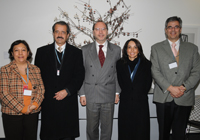
L to R: Dulce Valle Álvarez, Advisor at the
Mexican Permanent mission in Geneva,
Dr José Ángel Córdova Villalobos, Minister
of Health, UNAIDS Executive Director, Dr
Peter Piot, Dr María de los Ángeles
Fromow, Head of the Social Participation
unit and Dr Mauricio Hernández,
Undersecretary of Prevention and
Promotion of Health.
Photo credit: UNIADS/O.O'Hanlon
The Mexican Minister of Health, Dr José Ángel Córdova Villalobos, made a recent visit to UNAIDS headquarters in Geneva to meet with Exective Director Dr Peter Piot to discuss plans for the upcoming International AIDS Conference taking place in Mexico City from 3-8 August 2008.
The meeting follows on from Dr Piot's visit to Mexico last month where he joined government and civil society representatives in commemorating World AIDS Day in the Mexican town of Leon. During his visit to the country he also stopped off in Mexico City to discuss the initial preparations for the conference with senior officials.
Whilst in Geneva, the Mexican delegation expressed their interest in collaborating with UNAIDS to organize two high-level thematic meetings during the International AIDS Conference. The first will invite First Ladies from the Latin American and Caribbean regions to discuss the feminization of the epidemic in the region with the First Lady of Mexico, Margarita Zavala de Calderón; the other will invite regional Ministers of Health and Education to look at specific AIDS-related issues pertinent to these sectors in the Latin America region. The Mexican delegation requested the assistance of UNAIDS in developing the content and focus of these meetings.
UNAIDS Executive Director meets Mexican delegatio
Related Links:
XVII International AIDS Conference 2008
Related stories:
President focuses on AIDS in Mexico (05 December 2007)
Related
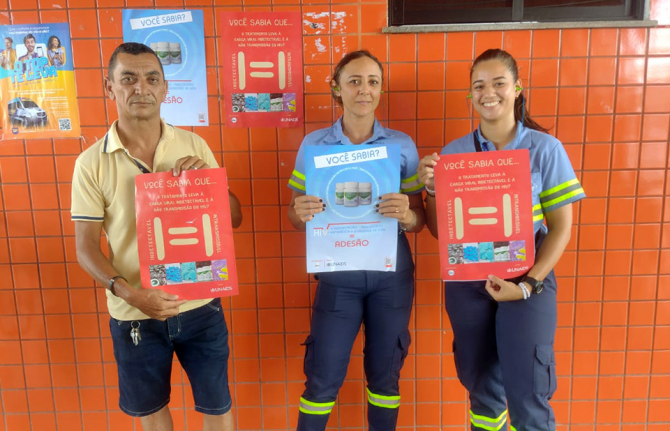 In Northeast Brazil, civil society and local government collaborate to increase HIV treatment adherence
03 апреля 2023 года.
 The First Fallen but We Will Overcome
03 ноября 2022 года.

Feature Story
Business and the AIDS response
22 января 2008
22 января 2008 22 января 2008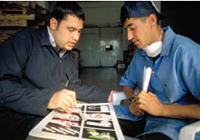
More and more businesses are introducing
HIV prevention programmes to educate
their staff about HIV.
UNAIDS works closely with the private sector and recognises the significant contribution the business community makes to the global response to the AIDS epidemic. This week, world business leaders will come together at the World Economic Forum in Davos to discuss global priorities for 2008––including the business community’s contribution to the AIDS response.
In every region of the world, today’s most successful businesses are an integral part of the societies around them and more and more private sector leaders are recognising that the well being and security of the communities they serve are essential to their shared futures.
AIDS has had a profound impact on the business community. The global labour force has lost 28 million people to AIDS––which in the most affected countries has taken a direct toll on markets, investments, services and education.
Unlike most other health crises, HIV largely strikes people of working age, around nine out of ten people living with HIV today are in their most productive years.
AIDS reduces the supply of labour, increasing operational costs, reducing productivity, slowing economic growth and threatening the livelihoods of both workers and employers.
But businesses are fighting back. With the realisation that the workplace is one of the most effective environments to promote AIDS awareness and support people living with HIV, businesses around the world are investing in the AIDS response.
“The business community understands that their reach, expertise, skills and resources can make a real difference to the AIDS response––helping to keep both their workforce and their businesses healthy,” said Dr Peter Piot, Executive Director of UNAIDS.

HIV programmes introduced into the
workplace are playing an important role in
reducing stigma around the disease and
supporting people in accessing essential
HIV services.
More and more businesses are introducing HIV prevention programmes to educate their staff about HIV. These vital programmes are giving employees the tools they need to protect themselves and their families from HIV.
Studies show that two out of three people living with HIV go to work, and for many the fear of losing their jobs or being shunned by colleagues prevents them from disclosing their HIV status––denying them access to vital treatment and support services. HIV programmes introduced into the workplace are playing an important role in reducing stigma around the disease and supporting people in accessing essential HIV services.
The business community are also looking outside their own walls to make a difference. Companies are using their knowledge and expertise, resources and networks to build capacity in the AIDS response, promote behavioural change, mobilise private and public funds and share best practices.
The role of the business community is proving central to the response to the epidemic and UNAIDS will continue to work with business of all sizes and sectors to further strengthen the AIDS response.
UNAIDS is currently working with partners from the travel & tourism, telecommunication, sports, mines, PR/advertisement, finance, media, pharmaceuticals, oil & petroleum and automobile industries. UNAIDS also works closely with over 30 regional and national business coalitions.
Links:
Read more about UNAIDS and private sector partnerships
Business and the AIDS response
Related
Helping Ukrainian refugees with HIV treatment and support in Berlin
20 мая 2022 года.
Welcoming Ukrainian refugees in Germany: big test for all
21 апреля 2022 года.
Feature Story
Civil society’s role in joint reviews of AIDS responses
18 января 2008
18 января 2008 18 января 2008Country experiences of joint reviews of national AIDS responses were discussed and analyzed at a consultation organized by UNAIDS which took place in Geneva on 15 – 16 January 2008.
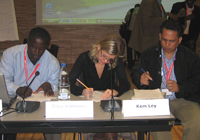
L to R: Daniel Motsatsing, Executive
Secretary BONASO (Botswana), Olga
Varetska, Head M & E, International
HIV/AIDS Alliance (Ukraine) and Kem Ley
from the HIV/AIDS Coordinating
Committee (Cambodia).
The meeting was part of a process to develop guidance for National AIDS Councils and their partners at country level to help plan and execute joint reviews of national AIDS programmes.
Joint Reviews are essential to identify gaps, harmonize resources and align activities of the multiple players involved in the national AIDS response, underlining the commitment to partnership and coordination by all stakeholders.
Participants included representatives of national AIDS coordinating authorities, civil society, UNAIDS regional and country offices, UNAIDS Cosponsors and bilaterals.
Civil society contribution to the national AIDS responses and their involvement in the joint reviews was one of the major topics analyzed at the consultation. Civil society participants coming from the Botswana Network of AIDS Service Organizations (BONASO), the Cambodia HIV / AIDS Coordination Committee (HACC) and Alliance Ukraine brought reports of the scope of their contribution in their respective national AIDS response joint review.
Civil society representatives underlined that the main challenges they encountered during the joint review in their countries were the unequal or lack of representation of key populations in the process and the absence of appropriate instruments to feed back the review results to the field level and to civil society.
During the consultation, participants emphasized the key roles of civil society in the joint review, not only as provider of first-hand data as programme implementers but also as provider of technical expertise related to the review.
“Civil society organizations are not only at the heart of service delivery but also key to reviewing and appraising national AIDS responses ’’ stated Andy Seale, Chief of the UNAIDS Civil Society Partnerships Team.
Finally, it was stressed that the main contribution of the civil society, as representatives of the communities and acting as external actors, has been to bring a key element of independent oversight and a strong sense of accountability to the whole process of national AIDS programmes joint review.
Civil society’s role in joint reviews of AIDS res
Feature story:
Related
 Unlocking community actions in Uzbekistan
30 мартаа 2026 года.
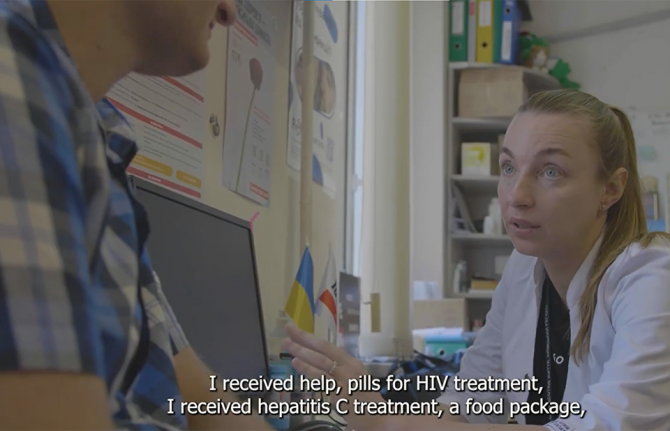 Two years on: UNAIDS supports Ukraine’s commitment to the HIV response
23 февраля 2024 года.
Feature Story
2008 High-Level Meeting on AIDS
15 января 2008
15 января 2008 15 января 2008The 2008 high-level meeting on AIDS will take place at the United Nations headquarters in New York on 10 - 11 June. It will review progress made in implementing the 2001 Declaration of Commitment on HIV/AIDS and the 2006 Political Declaration on HIV/AIDS.
Ahead of this high-level meeting, United Nations Secretary General Ban Ki-moon will submit a comprehensive and analytical report for consideration by Member States. The SG’s Report will be based on national reports that Member States were requested to submit to UNAIDS by 31 January 2008.
The organizational arrangements for the high-level meeting are outlined in a resolution adopted by the General Assembly on 19 December 2007. Detailed information about the plenary meetings, the thematic panel discussions, and the informal interactive civil society hearing will be provided in due course.
The high-level meeting will provide an important forum for various stakeholders, including government representatives and accredited civil society participants. Discussions are expected to focus on the progress made, challenges remaining and sustainable ways to overcome them.
Civil society engagement in the 2008 high-level meeting on AIDS
UNAIDS has been working closely with the Office of the President of the General Assembly (OPGA), the Non-Governmental Liaison Service (NGLS) and the Civil Society Support Mechanism (CSSM) to support civil society engagement in the high-level meeting and in the country level reporting processes on AIDS. The CSSM is a coalition led by the International Council of AIDS Service Organizations (ICASO) and the International Women’s Health Coalition (IWHC).
On-line civil society application form
The on-line application form was officially launched on Wednesday, 23 January 2008. It includes background information on the high-level meeting and Civil Society Hearing, as well as two different forms: a registration form for those organizations in consultative status with ECOSOC; and an accreditation form for non-ECOSOC accredited organizations wishing to attend the high-level meeting.
Civil Society Task Force
A Civil Society Task Force is currently being set up, in cooperation with the Civil Society Support Mechanism, to support UNAIDS and the OPGA in key decisions relating to the attendance and participation of civil society organizations and the private sector in the high-level meeting.
2008 High-Level Meeting on AIDS
Related links:
Related
Unlocking community actions in Uzbekistan
30 мартаа 2026 года.
In Northeast Brazil, civil society and local government collaborate to increase HIV treatment adherence
03 апреля 2023 года.
 LGBTQ+ shelter in Lviv provides lifeline to displaced Ukrainians
27 февраля 2023 года.
Feature Story
Strengthening partnership: UNAIDS and the International HIV/AIDS Alliance
11 января 2008
11 января 2008 11 января 2008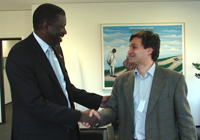
UNAIDS Director of Partnerships and
External Relations, Elhadj As Sy (L) and
Alvaro Bermejo, Executive Director of the
International HIV/AIDS Alliance (R) during
the signing of the collaboration
agreement. Geneva, 11 January 2008.
Working towards the global efforts to reach universal access to HIV prevention, treatment, care and support services for all those in need, UNAIDS has renewed its collaboration with the International HIV/AIDS Alliance.
The first agreement, which ran from 2004 to 2007, enabled strong civil society mobilisation for HIV prevention intensification, focusing particularly on empowering women to lead the AIDS response and underlining the key role of civil society in national AIDS responses.
“This is a strategic collaboration which is critical to securing greater impact, paving the way towards universal access,” said UNAIDS Director of Partnerships and External Relations, Elhadj As Sy at the signing of the renewed agreement.
The renewed partnership will focus on strengthening civil society responses to AIDS and aims to achieve the following objectives:
- Promoting direct involvement and leadership of civil society responses to HIV.– including people living with HIV and key populations.
- Promoting human rights-based responses to HIV
- Mobilising country-level public, private and civil society partnerships.
- Promoting evidence informed policy and good practice and the use of strategic information.
- Building capacity to track, monitor and evaluate country responses within a single, agreed national framework.
- Facilitating increased access to HIV prevention, treatment, care and support services.
- Facilitating access to technical and financial resources at country level.
- Facilitating and supporting the involvement of civil society and people living with HIV in planning, implementation and evaluation of national HIV strategies.
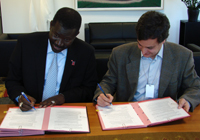
The renewed partnership will focus on
strengthening civil society responses to
AIDS.
The Alliance is a global partnership of nationally-based organisations working to support community action on HIV. These national partners help local community groups and other NGOs to take action on AIDS, and are supported by technical expertise, policy work and fundraising facilitated by the UK-based international secretariat and across the Alliance, in regional programmes and representative offices in the USA and Brussels. The Alliance also works on a range of international activities such as support for South–South cooperation, operations research, knowledge sharing, training and good practice development, as well policy analysis and advocacy.
“We are delighted with this renewed partnership that will scale up our community empowerment objectives and our joint impact on the HIV epidemic. The Alliance is committed to bring all its leverage in this partnership as part of its contribution towards universal access” said Alvaro Bermejo, the Executive Director of the Alliance.
Strengthening partnership: UNAIDS and the Interna
External links:
Related
Unlocking community actions in Uzbekistan
30 мартаа 2026 года.
In Northeast Brazil, civil society and local government collaborate to increase HIV treatment adherence
03 апреля 2023 года.
LGBTQ+ shelter in Lviv provides lifeline to displaced Ukrainians
27 февраля 2023 года.
Feature Story
Making a difference: UNAIDS in Ukraine
08 января 2008
08 января 2008 08 января 2008
UNAIDS Country Coordinator in Ukraine,
Dr Ana Shakarishvili, speaking at the
UNAIDS global staff meeting in October
2007. Photo Credit: UNAIDS
In the first of web special series focusing on the work of UNAIDS staff at country level, http://www.unaids.org/ talks to UNAIDS Country Coordinator in Ukraine, Dr Ana Shakarishvili, about the response in the country, her role and her motivations.
In the two years that Ana Shakarishvili has been the UNAIDS Country Coordinator in Ukraine, she has seen a lot of changes. The high profile of the epidemic in the country has led to a dramatic increase in attention from donors and other partners. “Our work entails a lot of coordination between UN agencies and very active support to the UN Theme Group and Joint Team on AIDS,” says Shakarishvili. “Dealing with different agencies with different mandates, and different personalities, is an inseparable part of our lives.”
In addition to typical UNAIDS work around advocacy, coordination of the AIDS response and monitoring and evaluation, the Ukraine office provides technical support in many areas. “In other words our daily lives are enormously busy. We work overtime, there’s no day that ends early,” says Shakarishvili. “But in terms of the daily work, the greatest thing we share is real teamwork. There is an amazing level of coordination and understanding between each partner and that is something we are proud of.”

Ukraine has the most severe epidemic in
Europe. Over 400,000 people were
estimated to be living with HIV in Ukraine
in 2006. Photo Credit: UNAIDS
Ukraine has the most severe epidemic in Europe, and despite the support of government and donor programmes, the epidemic continues to grow. “It is even more concerning that we now have an unprecedented high level of resources available in the country, including two grants from the Global Fund amounting to $243 million,” says Shakarishvili. It was this conundrum that led the government’s National Coordinating Council on AIDS to request an ambitious piece of research that will evaluate the national AIDS response so far. This external evaluation, which is being coordinated by UNAIDS, will look at the work of all partners in 130 programmatic areas.
“We will have a database on what is working and what needs to be done in the future,” says Shakarishvili. “Nothing at this kind of scale has ever been done in the world. And we are really proud of that. It does put us in a rather interesting position of being responsible for pulling together efforts for this evaluation that will inform further discussions at both national and sub-national levels about what should be done next.”
The importance of this evaluation cannot be overestimated: it will feed directly into the government’s new national AIDS plan which is to be developed in 2008. The UNAIDS office and the cosponsors will play a major role in this process, helping the government to revise its national AIDS programme, including national and sub-national access targets. “We are trying to help the government develop a totally new format for the national AIDS plan which will be well-costed with clear universal access and monitoring and evaluation targets and technical support requirements,” says Shakarishvili. “Up until now the national plans were vague and were more like a framework than a clear plan.” For the first time the government plan will also include contributions of all sectors of the government as well as civil society organisations, the private sector and the donor community.
Dr Shakarishvili notes that one of the biggest challenges of working in Ukraine is the political instability that the country has experienced in recent years. Frequent elections and changes in government affect the continuity of the work and the capacity and commitment of government to make sustainable progress. “The NGOs, and civil society organisations are very mobilised and very strong especially at the national level, compared with other countries that I have seen. There is a coalition of NGOs uniting over 70 NGOs providing HIV services. But there is still somehow a level of complacency in the governmental sector. We need to encourage more and greater leadership on the issue particularly from the governmental sector. The decree of President Yushchenko that was issued just after the World AIDS Day a few weeks ago, calls for urgent scaling up of response to AIDS and increased accountability. That gives all of us much hope,” she says.

Ukraine has managed to increase the
number of people on treatment from 200
in 2004/5 to currently over 7000.
Photo Credit: UNAIDS
Despite the challenges there has been progress. “We are really seeing some differences at the national level, which is a result of joint advocacy, including that from the UN.” Aspiration also comes from daily contact with the civil society organisations that provide many HIV services in the country. “We call ourselves one big family. We work pretty much together with the government, parliamentarians, NGOs, communities of people living with HIV, development partners and the private business. Its a huge sector.”
Shakarishvili joined UNAIDS after a long career in the Centers for Disease Control and Prevention in the US. “I love it here”, she says. “Despite the large work loads, what motivates me at the moment, is this momentum to do more in Ukraine, to really make a difference by changing the way the epidemic is going and preventing that from becoming generalized. There is enormous potential that this country has, a real belief that Ukraine should be able to slow down this epidemic and achieve universal access targets in a few years.”
“There are fantastic people and competent organizations here, and we hope and trust that people and communities can make a difference. If we don’t rapidly scale up efforts and make an impact in Ukraine, there is less hope for other countries in the region, especially Russia.” On the other hand, successes in Ukraine will bring hope for others. “Ukraine has managed to increase the number of people on treatment from 200 in 2004/5 to currently over 7000, reach the coverage level of prevention programmes of 35% of injecting drug users, and finally allow the importation of methadone for substitution maintenance treatment for injecting drug users – these are the messages to the rest of the world,” says Shakarishvili.
Making a difference: UNAIDS in Ukraine
Feature stories:
Positive response to AIDS in Ukraine (17 Sept 2007)Love, live, dream: women against AIDS in Armenia, Moldova, Kazakhstan, Russia, Ukraine (13 Jul 2007)
Harm reduction to be scaled up in Ukraine (11 Apr 2006)
One woman’s fight against AIDS in Ukraine (13 Mar 2007)
AIDS theme at Ukraine Fashion week (25 Oct 2006)
Related
 Power to earn and live—overcoming inequalities and supporting women living with HIV in Tajikistan
23 июля 2025 года.
 HIV services and social reintegration programmes for prisoners and newly released detainees in Kyrgyzstan at risk of collapse
08 мая 2025 года.
 Three Years On: From crisis to prospective recovery
20 февраля 2025 года.
Feature Story
Addressing the health worker shortage crisis
08 января 2008
08 января 2008 08 января 2008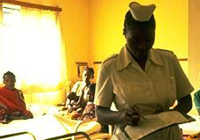 At least 57 countries have a crisis shortage of health workers; 36 of those are in Africa. Photo credits: UNAIDS
One of the major constraints to addressing both the AIDS epidemic and global access to essential health care services is the serious shortage of healthcare workers. WHO, UNAIDS and the US President’s Emergency Pan for AIDS Relief (PEPFAR) are launching innovative new guidelines to help strengthen health systems through ‘task shifting’ among the health workforce, at the first ever Global Conference on Task Shifting being held in Addis Ababa from 8-10 January 2008.
‘Task shifting’ is the name given to a process of delegation whereby tasks are moved, where appropriate, to less specialized health workers. By reorganizing the workforce in this way, task shifting presents a viable solution for improving health care coverage by making more efficient use of the human resources already available and by quickly increasing capacity while training and retention programmes are expanded. Several countries are already using task shifting to strengthen their health systems and scale up access to AIDS treatment and care.
The Global Conference on Task Shifting will convene health ministers and other senior government officials, opinion leaders, United Nations agencies and non-governmental organizations from both industrialized and resource-constrained countries.
Addressing the health worker shortage crisis
Related


Feature Story
India: largest-ever gathering of people living with HIV
02 января 2008
02 января 2008 02 января 2008
Over 7,000 people living with HIV came
together in Shilparamam-Hyderabad.
Photo credits: UNAIDS
India hosted its largest ever gathering of people living with HIV in December 2007. Over 7,000 people living with HIV came together in Shilparamam-Hyderabad on 7 December for a special event organized by the Andhra Pradesh State AIDS Control Society (APSACS) with the support of UNAIDS and several other partners. As part of the State’s “Be Bold” campaign, a behaviour change communication initiative, the 2007 convention beat the record crowd of 3,800 people living with HIV at the same venue in December 2006.

Union Minister for Labour and Convenor
of the Parliamentary Forum on AIDS,
Oscar Fernandez, restating commitment to
the 2006 'Hyderabad Declaration'.
Photo credits: UNAIDS
The event brought together a variety of stakeholders to reiterate commitment to reducing stigma, increasing access to services for people living with HIV and to creating an enabling environment for preventing the spread of HIV. It was also an opportunity to restate commitment to the “Hyderabad Declaration”, which was originally signed at the 2006 event.
“It was festive time for people living with HIV. Women participated in the Rangoli competition, children participated in the painting competition and games organized specially for them. Adults also listened to lectures on treatment adherence and precautions against opportunistic infections,” said G. Asok Kumar, Project Director at on of the APSACS. “Such a huge gathering of people living with HIV helped considerably reduce stigma,” he added.

Oscar Fernandez meeting with a number of
the convention participants.
Photo credits: UNAIDS
The event was inaugurated by Oscar Fernandez, the Union Minister for Labour and Convener of the Parliamentary Forum on AIDS (PFA), J.D. Seelam, Co-Convener PFA, Dr Sailajanath, Convener and Shri B. Kamalaker Rao, Co-Convener of Andhra Pradesh Legislators Forum on AIDS among many other Government officials.
The convention reflected on the progress that has been made since the last meeting in 2006. According to State figures, in just a year, the number of people receiving antiretroviral therapy increased from just 2,200 in 2006 to 25,000 in December 2007. The number of people living with HIV accessing health care services has also gone up phenomenally. In the last year more than 600,000 pregnant mothers had an HIV test. The overall number of HIV tests carried out in the state in the last 11 months reached1.5 million, up from 1.3 million tests registered during the whole period from 2000 to 2006.
India: largest-ever gathering of people living wi
Related
Unlocking community actions in Uzbekistan
30 мартаа 2026 года.
 Cities leading the way to achieving key targets in the HIV response
27 сентября 2023 года.
 A rainbow of hope for LGBTQI+ people in rural Japan
17 мая 2023 года.
Feature Story
Innovative approaches at grassroots level in Zambia
26 декабря 2007
26 декабря 2007 26 декабря 2007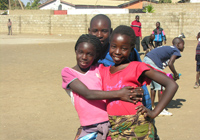
Young people in Zambia.
Photo credits: UNAIDS/M.Aon
Slowing the high rate of new infections in young girls in Zambia is being addressed with urgency by leadership on several levels across the country.
The high rate of infections in young girls is a key element of the epidemic in Zambia. Girls are at risk for several reasons including the fact that hey are often economically dependent on men, or fear violence from them, so however well educated they are about the risks, they cannot say no to sex. In Zambia there is also pressure on women to demonstrate their fertility, so they do not use condoms and a cultural trend for inter-generational relationships also puts girls at risk: statistics show that HIV prevalence peaks in men between the ages of 29 and 34; in women it is 15 – 24.
Addressing this issue, a partnership called “Women for Change” works with traditional leaders in Zambia who are all men, conducting education around relationships in addition to mediation skills in community disputes, for example, over issues about land.
Rainbow Coalition of NGOs targeting HIV and women’s rights
Zambia has also seen the recent founding of the Rainbow Coalition. Its patron, Mrs Elizabeth Mataka is also Executive Director of ZNAN and the United Nations Secretary General’s Special Envoy on AIDS in Africa.
The Rainbow Coalition was founded with the support of the Open Society Initiative for Southern Africa. It has brought together for the first time, diverse NGOs concerned with HIV and women’s rights issues, to bid for Global Fund grants.
Their work has helped to persuade the Global Fund to issue stringent guidelines to recipients of its grants to ensure that they take into account the needs of women and girls equally with men.
Sisonke Msimang, AIDS programme manager at the Open Society Initiative for Southern Africa, says: “It’s absolutely great that through this exercise the Global Fund has reviewed the conditions for awarding grant money in future.
“With modifications in the rules, it should be easier for the Rainbow Coalition to target the grants available from the Global Fund. That’s what we are pushing for now.”
Coordinated partnership key
Recently arrived in Zambia, UNAIDS’ Partnerships Adviser, Maha Aon, says one of her greatest challenges is to learn more about how to make prevention work for girls in a context like Zambia, and to ensure partners are working together for the best results.

About 300 representatives of community-
based organisations, mostly from
district-level, were invited to a national AIDS
conference organized by the Zambia National
AIDS Network (ZNAN).
Photo credits: ZNAN
The issue of women and girls was a central consideration at a national AIDS conference on the role of civil society in the quest for universal access held in Zambia earlier this year.
About 300 representatives of community-based organizations, mostly from district-level, were invited to the conference organized by the Zambia National AIDS Network (ZNAN).
“At the three-day ZNAN conference, there were many discussions on how to ensure different civil society constituencies working in the field organized and nominated representatives to participate at a national level and feed back to their constituencies,” she said.
Through workshops and seminars, they examined the work at grassroots level in prevention, treatment, care and support. They shared their successes and challenges, and debated civil society’s advocacy agenda around human rights issues ranging from gender to working with most-at-risk populations.
“There are many partners working on HIV in Zambia, but the main challenge is to get the programmes and money down to the districts and in a country as vast as Zambia with the poor quality of roads, this is not an easy feat.”
“At UNAIDS we find ourselves advocating for improved road systems, for income generation activities, for a strengthened civil society movement…issues that are key to development in general and not just to the micro-level issue of virus transmission.
“The Zambian government and people’s openness, frankness and sincerity in dealing with development in general, and HIV in particular is absolutely humbling, and the mere presence of this myriad of international partners and development aid make it obligatory for us to work on delivering.”
Innovative approaches at grassroots level in Zamb
Feature stories:
UNAIDS Special Representative Mary Fisher visits Zambia (29 Aug 2007)
Publications:
Zambia UNGASS report English (pdf, 559Kb)
Related
 The power of women supporting women - Mentor program for women living with and affected by HIV in Kazakhstan
13 сентября 2024 года.
 The urgency of HIV prevention among adolescent girls and young women
01 июня 2023 года.
A rainbow of hope for LGBTQI+ people in rural Japan
17 мая 2023 года.