

Press Statement
UNAIDS saddened by passing of United States Representative Donald M. Payne
09 March 2012 09 March 2012GENEVA, 9 March 2012—The Joint United Nations Programme on HIV/AIDS (UNAIDS) is deeply saddened by the death of United States Representative Donald M. Payne.
Congressman Payne served for more than 20 years in the United States House of Representatives, dedicating his life to improving the lives of people in his home country and around the world.
Congressman Payne was instrumental in co-authoring the original United States President’s Emergency Plan for AIDS Relief (PEPFAR) legislation in 2003, legislation that continues to save the lives of millions of people. He was known for his holistic approach to health, focusing on the whole person living with or at risk of HIV—ensuring that issues such as nutrition, disease prevention, and human rights were integrated.
As both Chairman and Ranking Member of the United States Subcommittee on Africa, Global Health, and Human Rights of the House Foreign Affairs Committee, Congressman Payne worked tirelessly to advocate for equity and access. His vision and dedication will be greatly missed.
Press centre
Download the printable version (PDF)
Press Statement
UNAIDS welcomes further evidence of the positive impact of antiretroviral therapy on preventing new HIV infections
08 March 2012 08 March 2012GENEVA, 8 March 2012—Researchers from the Africa Centre for Health and Population Studies have presented results which show that in areas where antiretroviral therapy uptake is high (greater than 30%) people who do not have HIV are 38% less likely to acquire the virus than in areas of low uptake (less than 10%).
“These findings are extremely important. UNAIDS encourages all countries and communities to achieve high coverage of antiretroviral therapy, both for the benefit of people living with HIV and for the communities in which they live,” said Paul De Lay, Deputy Executive Director, Programme, Joint United Nations Programme on HIV/AIDS (UNAIDS).
It is the first time the positive impact of antiretroviral therapy on HIV incidence has been demonstrated in a community setting. The findings also confirm results from the recent HPTN052 study which showed that if an HIV-positive person adheres to an effective antiretroviral therapy regimen, the risk of transmitting the virus to their uninfected sexual partner can be reduced by 96%.
The study used HIV surveillance data collected since 2003 in a rural area of KwaZulu-Natal in South Africa. In the study area, 20 000 people living with HIV had accessed antiretroviral therapy since 2004 through public-sector primary health care.
More than 16 500 HIV negative people living in the study area were followed from 2004 to 2011 though population-based HIV surveillance. During the study period 1 413 people were newly infected with HIV––an incidence rate of 2.6%. In areas where more than 30% of all people living with HIV were receiving antiretroviral therapy, the incidence rate was significantly lower compared to areas where less than 10% of all people living with HIV were accessing treatment. Holding other risk factors constant, people were nearly 40% less likely to acquire HIV in the ‘high uptake’ areas.
South Africa has expanded the eligibility criteria for initiation of antiretroviral therapy in recent years, whereby people living with HIV with a CD4 cell count of less than 350 are eligible for antiretroviral therapy––in line with 2010 World Health Organization recommendations.
“The results give clear evidence that HIV incidence is reduced as a result of high coverage of antiretroviral therapy,” said Frank Tanser from the Africa Centre for Health and Population Studies, University of KwaZulu-Natal, South Africa. “It is the first time that we have been able to show such results in a population setting––an important finding which will help guide the AIDS response.”
Abstract: Effect of ART Coverage on Rate of New HIV Infections in a Hyper-endemic, Rural Population: South Africa http://retroconference.org/2012/
Press centre
Download the printable version (PDF)
Press Statement
UNAIDS and PEPFAR welcome the launch of the Business Leadership Council to end new HIV infections among children by 2015
27 January 2012 27 January 2012Top business leaders unite behind the global goal of a “Generation Born HIV Free”
Davos, Switzerland, 27 January 2012 — UNAIDS and PEPFAR welcome the launch at the World Economic Forum in Davos, Switzerland of two new initiatives by business leaders—the Business Leadership Council for a “Generation Born HIV Free” and the Social Media Syndicate to end new HIV infections in children.
The Business Leadership Council was started as part of the private sector’s contribution to the Global Plan towards elimination of new HIV infections among children and keeping their mothers alive (Global Plan). The Global Plan was launched in 2011 at the United Nations High Level Meeting on AIDS and focuses on 22 countries, mostly in sub-Saharan Africa, that make up nearly 90% of all new HIV infections among infants.
“We will not reach our goal of zero new HIV infections among children without the passion and determination of the world’s business leaders,” said Michel Sidibé, UNAIDS Executive Director. “The private sector not only brings financial resources, but also their expertise in management, marketing and connecting with people at the grassroots.”
Ambassador Eric Goosby, U.S. Global AIDS Coordinator, participated in today’s announcement and stated, “I commend these business leaders for their commitment and partnership. The launch of the Business Leadership Council (BLC) and the Social Media Syndicate is a clear sign that the private sector is ready to step up.” He added, “By working together, I believe that we will soon see a day when no baby is born with HIV, when many more mothers are kept healthy and alive to raise their families, and communities have more hope for a brighter future.”
In 2010, an estimated 390 000 children were newly infected with HIV. Most of the new HIV infections were in low- and middle-income countries. In high-income countries the number was close to zero. HIV infections among children can be easily averted if mothers living with HIV are provided optimal antiretroviral drugs during pregnancy, childbirth and breastfeeding. Protecting a child from HIV can cost as little as US$300 and saves at least three times more in health care costs alone for a child living with HIV.
The Social Media Syndicate will coordinate the most influential, individual publishers on the Social Web to share messages and actions needed to welcome a “Generation Born HIV Free” and to achieve all the health-related Millennium Development Goals.
Getting to zero new HIV infections among children and keeping their mothers alive requires political will, community support and health services that are tailored to meet the needs of women and children.
There has been significant progress in reducing the number of children born with HIV. There was a 30% reduction in the number of children infected with HIV between 2002 and 2010. Since the launch of the Global Plan most of the priority countries have embarked on accelerated efforts to reach pregnant women with HIV services. In Botswana, the percentage of infants born with HIV declined to 4% in 2010. Lesotho, Namibia, South Africa, and Swaziland have all reached more than 80% of pregnant women with HIV prevention services.
Contact
UNAIDS GenevaSophie Barton-Knott
tel. +41 22 791 1697
bartonknotts@unaids.org
PEPFAR Contact
Estela B. Astacio
tel. +01 202 663 2338
astacioe@state.gov
Press centre
Download the printable version (PDF)
Press Statement
New US$ 750 million pledge by the Bill & Melinda Gates Foundation to support the Global Fund is timely and will save lives
26 January 2012 26 January 2012As new resources for the AIDS response are declining, the support of the Gates Foundation will help restore confidence in meeting global AIDS, tuberculosis and malaria targets
GENEVA, 26 January 2012—UNAIDS welcomes the grant of US$ 750 million by the Bill & Melinda Gates Foundation to the Global Fund to Fight AIDS, Tuberculosis and Malaria.
“At this crucial time, when lives are being lost for lack of resources to provide treatment to people living with HIV, the Bill & Melinda Gates Foundation has restored hope to people living with and at risk of HIV,” said Michel Sidibé, UNAIDS Executive Director. “This financial pledge—together with the Foundation’s unwavering commitment to innovation, research and HIV prevention—will make a difference today and tomorrow.”
World leaders agreed to pledge between US$ 22-24 billion each year by 2015 at the United Nations High Level meeting on AIDS in June 2011. However the resources available today are far less than the total need. In 2010 US$ 15.3 billion was available for the AIDS response in low- and middle-income countries.
The majority of the countries in sub-Saharan Africa—the region most affected by AIDS—depend on international aid to provide antiretroviral treatment for people living with HIV. Countries faced a major setback with the recent cancellation of Round 11 grants by the Global Fund. The immediate injection of new resources will help countries ensure that there no interruptions to on-going programmes as they continue to scale up lifesaving programmes.
Press centre
Download the printable version (PDF)
Press Statement
UNAIDS commits its support to the Global Fund and calls for solidarity
24 January 2012 24 January 2012A fully-funded Global Fund is essential to help countries reach their AIDS response targets by 2015
Geneva, 24 January 2012—In the ten years since the Global Fund to Fight AIDS, Tuberculosis and Malaria (Global Fund) was established, the organization has made a profound difference in saving millions of lives around the world. It has created momentum and helped countries achieve results.
- In the past decade, the Global Fund has approved more than US$ 22.6 billion in grants to 150 countries.
- Global Fund grants are helping countries provide 3.3 million people access to HIV treatment.
- The Global Fund has ensured that more than one million pregnant women living with HIV have had access to antiretroviral drugs to prevent the transmission of HIV to their children.
UNAIDS is confident, that in the Global Fund’s transition phase, its transformation plan will help deliver further results. UNAIDS will continue to work in partnership with countries and with the Global Fund to reduce risks and ensure high-impact programmes continue on the ground.
The remarkable progress achieved in the AIDS response must be sustained and accelerated. UNAIDS urges the international community to urgently explore innovative sources of funding to bridge the gap in global resources for AIDS. It also calls on countries to revise and reprioritize AIDS investments as well as national AIDS strategies.
In 2011, UN member states pledged to invest between US$ 22-24 billion per year by 2015 for the global AIDS response. Last year, US$ 15 billion was available, however international funding has fallen from US$ 8.7 billion in 2009 to US$ 7.6 billion in 2010.
Press centre
Download the printable version (PDF)
Press Release
UNAIDS Board approves efforts to accelerate progress towards 2015 targets
15 December 2011 15 December 2011GENEVA, 15 December 2011—The Programme Coordinating Board of the Joint United Nations Programme on HIV/AIDS (UNAIDS) convened from 13-15 December to review and follow up on recommendations of the 2011 UN General Assembly High Level Meeting on AIDS. The Board took note of the progress made by countries and civil society organizations in implementing the 2011 Political Declaration on AIDS as well as the support provided by UNAIDS.
In his report to the 29th Board meeting, UNAIDS Executive Director Michel Sidibé noted that leaders around the world are joining the call for an AIDS free generation and endorsing the UNAIDS vision of zero new HIV infections, zero discrimination and zero AIDS-related deaths.
“A year ago, skeptics said that getting to zero was just a slogan. But countries, partners and people around the world have embraced the vision and are now working to translate it into reality,” said Mr Sidibé. “Failure to scale up to the targets of the Political Declaration would not only be ethically wrong, but shortsighted and unacceptable. Now is not the time to halt our investments. If we do not seize the opportunity now, costs will simply escalate and the zero will cease to be viable as a vision.”
A report from civil society delegates, the UNAIDS results, accountability and budget matrix, progress made on implementation of the Second Independent Evaluation and the technical support provided by UNAIDS was welcomed by the delegates. The Board requested the establishment of a time-limited, consultative process to better define UNAIDS’ technical support, as well as areas of core competency and strengths.
UNAIDS also presented a progress report on the Global Plan towards the elimination of new HIV infections among children and keeping their mother alive. Eleven countries have launched national plans towards the global targets of a 90% reduction in new HIV infections among children and a 50% reduction in AIDS-related maternal deaths by 2015.
During the three-day meeting, Professor Salim Abdool Karim presented the results of a study that has offered new hope for a female-controlled HIV prevention tool. Conducted by researchers at the Centre for the AIDS Programme of Research in South Africa (CAPRISA), the study found the antiretroviral medicine tenofovir, when applied consistently, is effective in reducing HIV infections in women by up to 54%. Prof. Karim stressed the need for a female-controlled HIV prevention option to address the vulnerabilities and inequities facing women and girls in protecting themselves against HIV.
A thematic segment on HIV and enabling legal environments provided an opportunity for delegates to exchange developments and perspectives on the role of law in the AIDS response. Moderated by journalist Riz Khan, interventions from countries and civil society organizations focused on national situations in the application of law, law enforcement and access to justice for people living with or vulnerable to HIV. In the closing session, Justice Michael Kirby urged the audience to turn ‘words into actions’.
Several hundred participants and observers from UN Member States, international organizations, civil society and non-governmental organizations attended the meeting, which was chaired by El Salvador with Poland acting as Vice-Chair and Egypt as Rapporteur. In 2012, Poland will assume the role of Chair, and the Board elected India as Vice-Chair and the United States of America as Rapporteur. The UNAIDS Executive Director’s report to the Board, decisions, recommendations and conclusions from the meeting can be found at: unaids.org.
Press Statement
UNAIDS congratulates United States’ leadership to end AIDS
01 December 2011 01 December 2011GENEVA, 1 December 2011—The Joint United Nations Programme on HIV/AIDS (UNAIDS) congratulates President Barack Obama on his bold commitment to provide AIDS treatment to 6 million people by 2013 and reach 1.5 million pregnant women living with HIV to protect their children from becoming infected with HIV. This reinforces the collaboration between UNAIDS and the United States on the global plan towards elimination of new HIV infections among children by 2015—the foundation for an AIDS free generation.
“The commitments made by President Obama today will save lives and help move us towards an AIDS free generation,” said Michel Sidibé, Executive Director of UNAIDS. “Getting to zero and ending AIDS is a shared responsibility.”
UNAIDS also welcomes the United States’ strong bipartisan commitment to the global AIDS response. This unprecedented solidarity has made the United States the largest global AIDS donor, providing more than half (54.2%) of all international AIDS assistance available to low- and middle-income countries in 2010. The PEPFAR programme, initiated under the leadership of President George W. Bush and expanded by President Obama, currently provides lifesaving HIV prevention, treatment, care and support services to millions of people, especially in sub-Saharan Africa, the region most affected by the epidemic.
World leaders have pledged to invest between US$ 22-24 billion by 2015 for the AIDS response. In recent years, international assistance has begun to decline, jeopardizing the ability of countries to sustain and scale up access to prevention and treatment services. UNAIDS urges members of the G8 and G20 to expand their investments in AIDS—domestic and international. It also calls on all developing countries to increase their funding for their national AIDS programmes.
President Obama’s call to step up HIV prevention efforts using high-impact combination tools, such as treatment as prevention, male circumcision, antiretrovirals to stop new HIV infections among children and consistent condom use, has the potential to avert millions of new HIV infections. This approach, endorsed by UNAIDS, uses the best of new science and will save both money and lives.
Press centre
Download the printable version (PDF)
Press Statement
UNAIDS applauds China’s decision to fill its HIV resource gap
01 December 2011 01 December 2011China calls for shared responsibility in achieving zero new HIV infections, zero discrimination, zero AIDS-related deaths
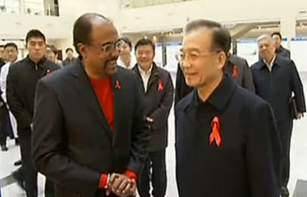
UNAIDS Executive Director Michel Sidibé and China’s Premier H.E. Wen Jiabao at a World AIDS Day event in Beijing.
BEIJING/GENEVA, 1 December 2011—China has pledged to fill its HIV resource gap by increasing domestic investments. This pledge was made China’s Premier H.E. Wen Jiabao at a World AIDS Day event in Beijing. The Premier also called on the international community to fully meet its commitments and achieve a world with zero new HIV infections, zero discrimination and zero AIDS-related deaths.
“I see no reason for the Global Fund to withdraw its support to China,” said Premier Wen Jiabao at the AIDS roundtable in Beijing. “I have asked the Minister of Finance to close the gap left by the Global Fund. We will rely on our own efforts.”
This new commitment from China comes at a crucial moment as resources for AIDS are declining and the Global Fund to Fight AIDS, Tuberculosis, and Malaria is facing a major setback in resource mobilization, leading to the cancellation of its next call for country proposals (Round 11), putting millions of lives at risk.
"China's voice could not have come at a more critical time in the AIDS response. We are in a period of high risk and welcome this bold decision," said Michel Sidibé, Executive Director of UNAIDS, when thanking the Premier of China. "I am confident that a new socially sustainable agenda can be forged that promotes country ownership and shared responsibility.”
More than 6.6 million people are on HIV treatment in low- and middle-income countries and rates of new HIV infections have fallen in most parts of the world. Domestic investments have steadily increased, but the magnitude of the epidemic in Africa means that continued international solidarity and investments are vital.
“Getting Round 11 back on track is a top priority especially as Africa is leading the world in reducing new HIV infections and AIDS-related deaths. Its international partners must come forward and help countries multiply their success,” said Mr Sidibé. “This call is not just about shared responsibility but also of shared values.”
China has scaled up its AIDS response in a short timespan, including its evidence-informed HIV prevention services. By rapidly scaling up access to drug substitution therapies, it has reduced new HIV infections among people using these services to close to zero. China has also made important advances in its anti-discrimination programmes and support for civil society organizations.
“To defeat AIDS, it will take the whole society,” said Premier Wen Jiabao. “China is willing to play its part.” China’s rapid scale up model can be replicated in other countries—especially in strengthening the capacity of community health workers to deliver HIV services. In addition, China can provide vital technology transfer in key areas of innovation of HIV treatment, including development of new antiretroviral medicines, investing in research and development, telecommunications, e-health infrastructure and supply chain management.
Contact
UNAIDS GenevaSophie Barton-Knott
tel. +41 22 791 1697
bartonknotts@unaids.org
UNAIDS China
Guy Taylor
tel. +86 10 85322226 ext 117
taylorg@unaids.org
UNAIDS Geneva
Sophie Barton-Knott
tel. +41 79 514 6896 / +41 22 791 1697
bartonknotts@unaids.org
UNAIDS China
Guy Taylor
tel. +86 10 85322226 ext 117
taylorg@unaids.org
Press centre
Download the printable version (PDF)
Press Statement
Decline in AIDS funding risks jeopardizing recent gains made by countries
27 November 2011 27 November 2011Countries, donors, and other partners must mobilize around new UNAIDS strategic investment framework—to generate new resources and optimize AIDS-related investments
GENEVA, 27 November 2011—The unprecedented results and progress achieved by the global AIDS response in 2011 must be sustained and accelerated. Latest data from the Joint United Nations Programme on HIV/AIDS (UNAIDS) shows that new HIV infections and AIDS-related deaths have fallen to the lowest levels and more than 6.6 million people now have access to HIV treatment. Greater investments in tuberculosis and malaria programmes have also led to reductions in tuberculosis and malaria-related deaths among people living with HIV.
These gains are threatened by a decline in resources available for HIV prevention and treatment in low- and middle-income countries. And now could be further aggravated by the recently revised resource forecast—showing a shortfall in funding available through the Global Fund to Fight AIDS, Tuberculosis and Malaria (Global Fund).
The Global Fund has announced plans to replace its next call for country proposals (Round 11) with a new transitional funding mechanism. The new mechanism will focus on the continuation of essential prevention, treatment and care services currently financed by the Global Fund—making new funding available only in 2014. This announcement could jeopardize global efforts to achieve Millennium Development Goal 6—to halt and reverse the spread of AIDS, tuberculosis and malaria by 2015.
"This delay could keep countries from their efforts to save lives at a time when the AIDS response has seen game-changing results," said Michel Sidibé, Executive Director of UNAIDS. "The Global Fund's new five-year strategy as well as its consolidated transformation plan are steps in the right direction. These plans should restore confidence and position the Global Fund as an important and effective financing mechanism for AIDS, tuberculosis and malaria."
UNAIDS urges the international community to urgently explore innovative sources of funding to bridge the gap in global resources for AIDS, including a financial transaction tax to fund critical health and development programmes. It also calls on countries to revise and reprioritize AIDS investments as well as national AIDS strategies using the new UNAIDS strategic investment framework to deliver maximum results and value for money.
"We need new financial modalities and sources of funding such as the financial transaction tax to maintain the momentum of the AIDS response," said Mr Sidibé. "Using the advances in science, we can help countries to use the new investment framework to optimize results for people and save lives."
In response to the financial challenges and opportunities facing countries, UNAIDS is committed to working together with countries; regional bodies including the African Union, African Development Bank and NEPAD; donors such as PEPFAR, DFID and Government of France; civil society organizations and the Global Fund to achieve the bold new targets set by world leaders in the 2011 United Nations Political Declaration on HIV/AIDS.
UN member states have pledged to invest between US$ 22-24 billion by 2015 for the global AIDS response. Last year, US$ 15 billion was available, however international funding has fallen from US$ 8.7 billion in 2009 to US$ 7.6 billion in 2010.
Press centre
Download the printable version (PDF)
Press Release
New reports show philanthropic funding for AIDS down at pivotal moment in the response
10 November 2011 10 November 2011Donors urged not to shift resources away from AIDS as response shows return on investments
Washington, D.C., London, Geneva, 10 November 2011 – New reports released today shows that AIDS-related funding from United States and European philanthropic donors totaled US$ 612 million in 2010, a combined 7% decrease (US$ 44 million) from 2009. The reports, produced by the European HIV/AIDS Funders Group (EFG) and Funders Concerned About AIDS (FCAA), with support from the Joint United Nations Programme on HIV/AIDS (UNAIDS), also show that the number of donors giving more than US$ 300,000 to HIV has reduced by 30% over the last three years.
“The global response to AIDS, now in its 30th year, has demonstrated the power of political commitment and financing,” said John Barnes, Executive Director, FCAA. “Profound successes have been achieved – such as more than 6 million people on lifesaving treatment. Commitment and resources must rise now to meet existing needs and take advantage of new opportunities so that we do not experience another 30 years of AIDS.”
Funding from donor governments also decreased in 2010 after sharp increases in funding at the beginning of the decade. There is estimated to be, at a minimum, a US$ 6 billion annual gap between investment needs and available resources.
UNAIDS has developed an investment framework which shows that 12.2 million new HIV infections and 7.4 million HIV-related deaths could be averted between 2011 and 2020 if funding is scaled up to US$ 24 billion by 2015.
“Investing strategically today will not only save lives, it will also ultimately result in significant cost savings in the future,” said Paul De Lay, Deputy Executive Director, Programme, UNAIDS. “We have an opportunity to make a real impact but it will require a concerted effort from all sectors including philanthropic donors who play an important role in reaching people most affected by the epidemic.”
The total disbursed by US-based philanthropies reduced from US$ 492 million in 2009 to US$ 459 million in 2010. The key driver of the decrease was a decline in funding from the largest private AIDS funder, the Bill & Melinda Gates Foundation, which represents 47% of all HIV philanthropic funding from US funders. This decrease, however, is largely due to the multi-year nature of their commitments and the Foundation forecasts an increase in 2011 disbursements.
Disbursements from all US funders other than the Gates Foundation decreased by 2% from 2009 to 2010 primarily due to a trend of funders exiting the field of HIV-specific funding and moving into areas such as sexual and reproductive health and health systems strengthening.
Funding from European-based philanthropies also decreased by 6%, from US$ 163 million in 2009 to US$ 153 million in 2010.
UNAIDS, FCAA and EFG emphasize that philanthropy has a catalytic role to play in the response to HIV through its commitment to address key focus areas, such as advocacy, that are not often covered by other sources of funding.
“Private philanthropic donors need to reprioritize and support strategically smarter, more efficient interventions that target the needs of communities most impacted by the epidemic,” said Kate Harrison, Portfolio Manager, Comic Relief UK, and EFG Steering Committee member.
Projections for 2011 suggest that total AIDS-related philanthropy funding levels may increase in both the US and Europe. Over a quarter of US funders forecast anticipated increases in 2011, including the top funder, the Gates Foundation. Over a third of European funders, including five of the top 10 funders, forecasted funding to HIV increasing in 2011.
“Even if the 2010 decrease in philanthropic funding for HIV is just a blip, every dollar lost enables new HIV infections, costs lives, can contribute to human rights violations, and stalls progress in the global AIDS response,” said Mr Barnes. “To seize the opportunities now clearly in front of us to end this epidemic, it is critical that we continue to mobilize increased and strategic funding for AIDS.”
The FCAA and EFG annual resource tracking reports intend to inform stakeholders about the overall distribution and trends of US and European AIDS philanthropic funding, facilitate greater coordination and transparency among funders, and encourage expanded philanthropic support for HIV work.
To download the complete reports:
- U.S. Philanthropic Support to Address HIV/AIDS in 2010 at www.fcaaids.org
- European Philanthropic Support to Address HIV/AIDS in 2010 at www.hivaidsfunders.org
About EFG
The European HIV/AIDS Funders Group (EFG) is a knowledge-based network dedicated to strengthening European philanthropy in the field of HIV/AIDS. The group aims to mobilise philanthropic leadership and resources to address the global HIV/AIDS pandemic and its social and economic consequences and to promote an enabling environment for strategic and independent giving in this field as well as fields closely connected to HIV/AIDS such human rights, global health, and global development.
About FCAA
Funders Concerned About AIDS (FCAA) was founded in 1987 with the goal of mobilizing the philanthropic leadership, ideas and resources of U.S.-based funders to eradicate the HIV/AIDS pandemic –domestically and internationally– and to address its social and economic consequences. FCAA is the only U.S.-based organization comprised of and for private philanthropic institutions concerned about, engaged in, or potentially active in the fight against HIV/AIDS.
About UNAIDS
UNAIDS, the Joint United Nations Programme on HIV/AIDS, is an innovative United Nations partnership that leads and inspires the world in achieving universal access to HIV prevention, treatment, care and support. Learn more at unaids.org.
Contact
FCAASarah Hamilton
tel. +1 509 339 6247
sarah@fcaaids.org
EFG
Erika Baehr
tel. +1 781 899 1936
rt@hivaidsfunders.org
UNAIDS Geneva
Sophie Barton-Knott
tel. +41 22 791 1697
bartonknotts@unaids.org