Documents
Sexually transmitted diseases:policies and principles for prevention and care
19 May 1999
The objective of this document is to outline the policies and principles for the prevention and care of sexually transmitted disease (STD) to assist Ministry of Health officials who have the responsibility of developing and implementing STD programmes. Although the document is not intended to be a detailed description of activities that may be used in implementation, some areas have been amplified in annexes to serve as models that can be adapted to suit local situations.
Documents
STI guidelines
05 July 2000
UNAIDS/WHO Working Group on Global HIV/AIDS/STI
Documents
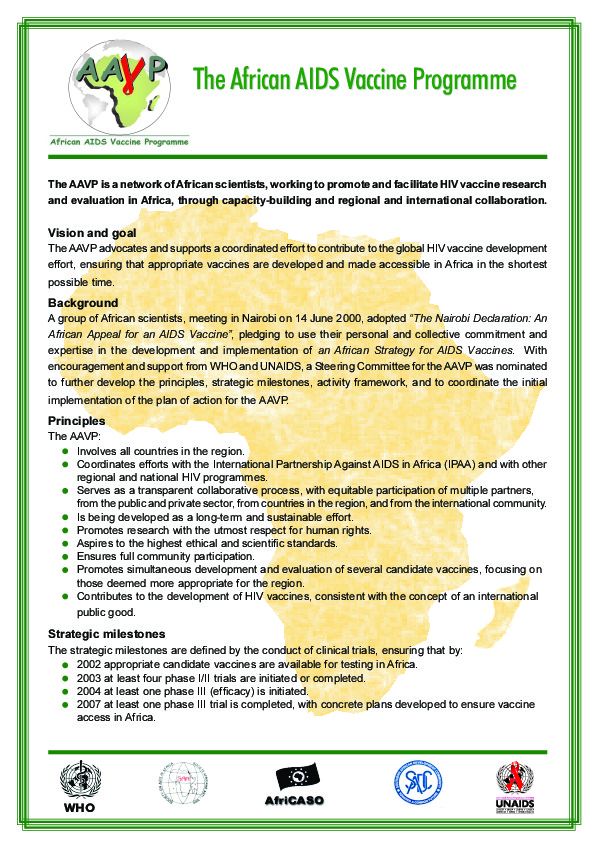
The African AIDS Vaccine Programme
09 May 2001
In June 2000, a group of African scientists met in Nairobi and pledged to use their personal and collective expertise to develop/implement an African strategy for AIDS vaccines, thus forming the African AIDS Vaccine Programme (AAVP). This two-page document discusses the AAVP’s principles (i.e. it promotes research with the utmost respect for human rights, aspires to the highest ethical and scientific standards, and ensures full community participation), strategic milestones, and activity framework.
Documents
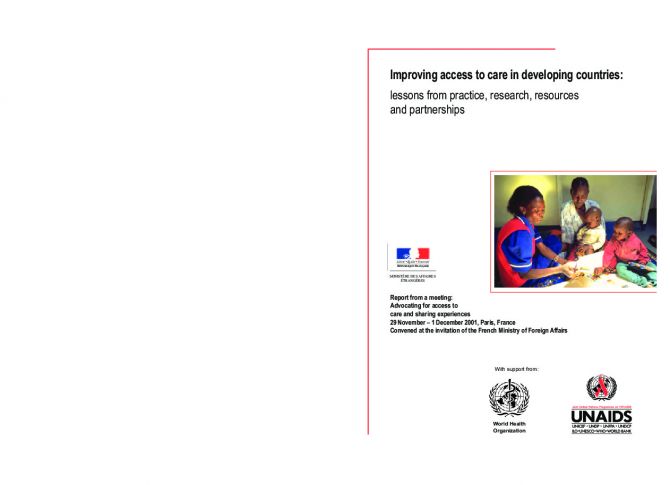
Improving access to care in developing countries : lessons from practice, research, resources and partnerships. Report from a meeting : advocating for access to care and sharing experiences, 29 November – 1 December 2001, Paris
08 July 2002
These background papers collate analyses on key issues and lessons learnt in the implementation of the care agenda. They are the product of 12 months of consultations initiated by the French Ministry of Foreign Affairs, with over 150 specialists representing a broad range of fields relevant to providing care for people living with HIV/AIDS. This publication features contributions from experts that reflect the breadth of a Technical Network on Access to Care. The papers were the background to the Declaration for a Framework for Action: Improving Access to HIV/AIDS Care in Developing Countries which was adopted on 1 December 2001 at a meeting held in Paris, convened at the invitation of the French Ministry of Foreign Affairs with the support of the UNAIDS Secretariat and the World Health Organization (WHO).
Documents
Initiating second generation HIV surveillance systems : practical
10 December 2002
The purpose of the guidelines is to assist National AIDS Programmes (NAPs) and Ministries of Health in implementing second generation HIV surveillance systems through a logical and standardized process. More specifically, the guidelines are primarily addressed to programme managers, epidemiologists, social scientists and other experts working in or with national programmes on surveillance issues. They include the following: assessment, consensus, plan and protocol development, implementation and, finally, monitoring and evaluation.
Documents
Handbook on access to HIV/AIDS-related treatment : a collection of information, tools and resources for NGOs, CBOs and PLWHA groups
13 May 2003
Drawing on the broad experience of UNAIDS, WHO and the International HIV/AIDS Alliance, the Handbook on access to HIV/AIDS-related treatment provides nongovernmental organizations, community-based organizations and groups of people living with HIV/AIDS with a practical resource for responding to issues of access to treatment for HIV/AIDS in developing countries. The handbook will: build practical skills among NGOs, CBOs and PLWHA groups by using participatory activities and sharing experiences; provide a training resource for NGO support programmes, training organizations and individuals; facilitate ongoing learning about the HIV/AIDS-related treatment work of NGOs, CBOs and PLWHA groups. The handbook is intended to assist groups in finding ways of understanding, planning and undertaking work on HIV/AIDS related treatment. It is suitable for use with people of varying levels of experience and offers flexibility to facilitators who need to gear their work towards specific schedules and situations.
Documents
Young people and HIV/AIDS : Opportunity in crisis
07 October 2003
This report contains important new data about why young people are key to defeating the global HIV/AIDS epidemic, including results from more than 60 new national surveys. It reaffirms that we must accord top priority to making investments in the well-being of young people and to engaging them in the fight against HIV/AIDS.
Documents
HIV and infant feeding : a policy statement developed collaboratively by UNAIDS, UNICEF and WHO
05 November 2003
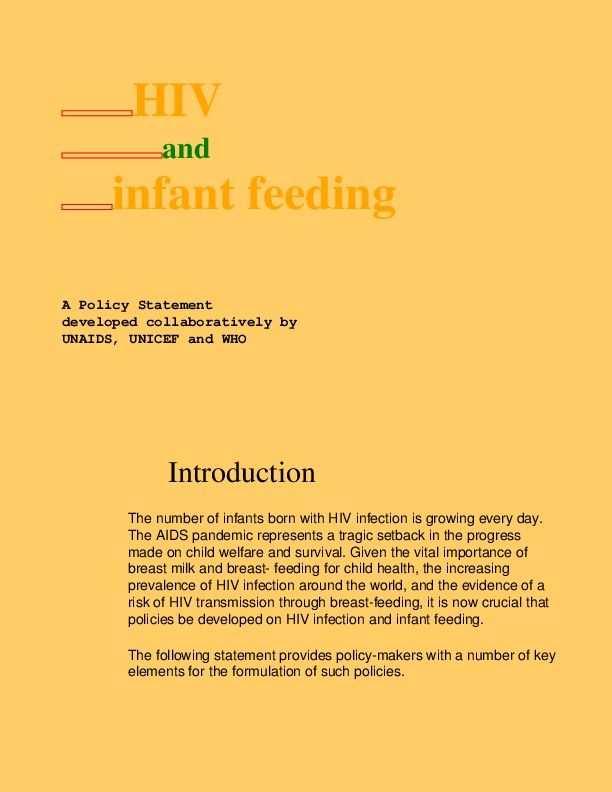
The number of infants born with HIV infection increases every day. The vast majority of these children are infected through their mothers. Given the vital importance of breastfeeding to a child’s health, and the risk of HIV transmission through breastfeeding, the development of policies on HIV infection and infant feeding is crucial. This document provides policy-makers with key elements for the creation of the aforementioned policies, such as promoting and supporting breastfeeding, improving access to HIV counselling and testing, and preventing commercial pressures for artificial feeding. It also highlights the prevention of HIV infection in women through the promotion of safer sex and the adequate treatment of sexually transmitted infections
Documents
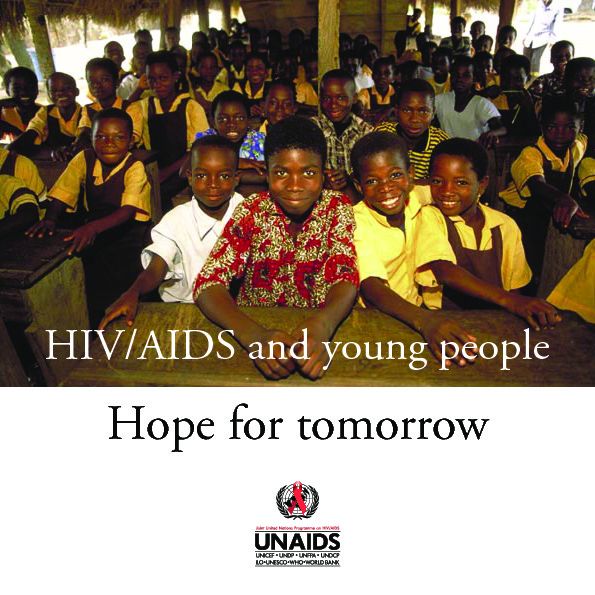
HIV/AIDS and young people : hope for tomorrow
23 March 2004
“Young people are the key in the fight against AIDS. By giving them the support they need, we can empower them to protect themselves against the virus. By giving them honest and straightforward information, we can break the circle of silence across all society. By creating effective campaigns for education and prevention, we can turn young people’s enthusiasm, drive and dreams for the future into powerful tools for tackling the epidemic.” - Kofi Annan, United Nations Secretary-General
Documents
Case study on estimating HIV infection in a concentrated epidemic : lessons from Indonesia
11 May 2004
This case study from the UNAIDS/WHO Working Group on Global HIV/AIDS/STI Surveillance recalls the reasons for making national estimates of HIV infection, and goes on to present the difficulties posed by concentrated epidemics and the challenges faced by Indonesia. It discusses how to decide on a process and put it into practice, and shares lessons learnt from the work in Indonesia. The study concludes that Indonesia’s experience demonstrates that it is possible to make such estimates in a huge, geographically, culturally and epidemiologically diverse country. Other countries with HIV epidemics concentrated in populations with high risk behaviour can benefit from Indonesia’s experience by adopting a similar estimation process.