Documents
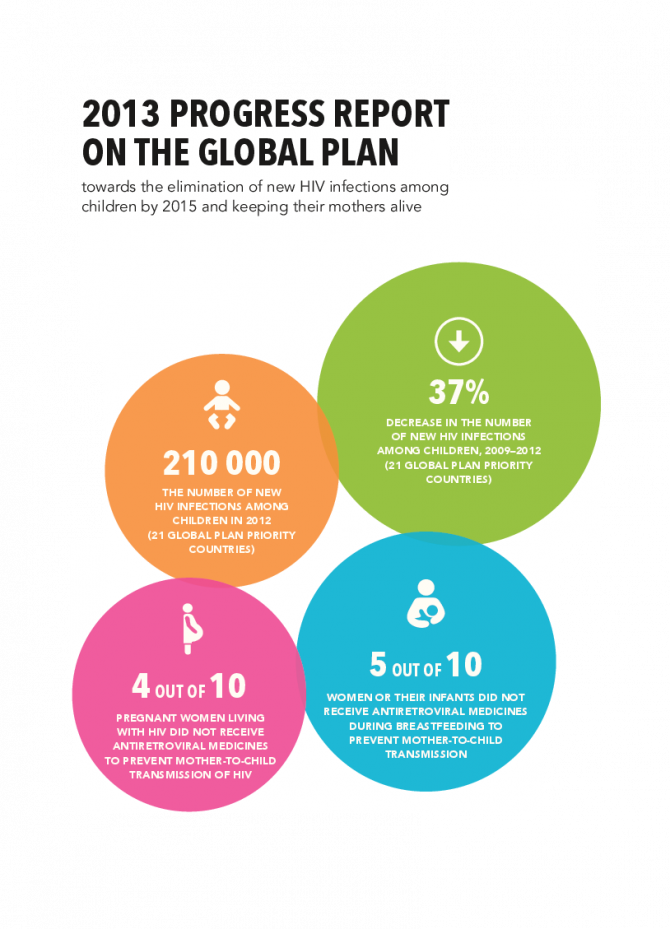
2013 progress report on the Global Plan towards the elimination of new HIV infections among children by 2015 and keeping their mothers alive
25 June 2013
We are encouraged by the progress made by countries in reducing the number of children newly infected with HIV. Two years have passed since the launch of the Global Plan, when countries embraced the goal of moving towards eliminating new HIV infections among children and keeping their mothers alive. Since then, there has been momentum in scaling up access to HIV prevention and treatment services for women and children – especially in the 21 Global Plan priority countries in sub-Saharan Africa. Ghana and South Africa have led the way, with the largest decreases in the numbers of new HIV infections among children from 2009 to 2012.
Documents
UNAIDS Cosponsor | 2015 | United Nations Educational, Cultural and Scientific Organization
01 January 2015
UNESCO is one of the six founding UNAIDS Cosponsors. Under the UNAIDS Division of Labour, UNESCO is responsible for leading efforts to support countries in scaling up the education sector response to HIV. With over 70 offices, institutes and regional bureaux around the world, UNESCO has more than 50 staff members dedicated to working on HIV and health education. Of these, the majority are National Programme Officers based in countries that UNAIDS has prioritized for high-impact interventions. The agency draws on its unique spectrum of competencies across the diverse spheres of education, the sciences, culture, communication and information to push for a truly multisectoral and comprehensive response to HIV.
Documents
Prisons and AIDS: UNAIDS Point of view
04 April 1997
The AIDS virus has been found in prisons in most countries of the world. This should be a source of the utmost concern -- not only for prisoners and prison staff, but for society in general.
Documents
Prisons and AIDS: UNAIDS Technical update
04 April 1997
In many prisons around the world there is a much higher prevalence of HIV than there is in society outside. There is usually also a much higher rate of certain other diseases, such as hepatitis B and C, syphilis and tuberculosis. Experience has shown that there is a lot that can be done to check the spread of HIV, but for that to occur, those responsible for the prison system must first recognize certain risk factors and forms of behaviour in prisons.
Documents
Refugees and AIDS : UNAIDS point of view
04 April 1997
This paper discusses the precarious existence of refugees and why HIV/AIDS is such a critical factor to them (a lack of a safe blood supply, the emergence of prostitution in exchange for food and other essentials, and an insufficient supply of condoms and health care). The report also documents various facts and figures, and offers suggestions as to how issues regarding refugees and AIDS can be handled.
Documents
Refugees and AIDS: UNAIDS Technical update
24 November 1997
In an emergency, the most immediate concern of relief workers is to save people at risk of imminent death from injury, starvation, exposure, or disease. In the past, this concern has largely dictated priorities for action. Since the last 1970’s and early 1980’s, a new threat has arisen – AIDS.
Documents
Learning and teaching about AIDS at school
24 November 1997
Young people are especially vulnerable to HIV and other sexually transmitted diseases (STDs). They are also vulnerable as regards drug use (and not just injected drugs). Even if they are not engaging in risk behaviors today, they may soon be exposed to situations that put them at risk. Very often they cannot talk easily or at all about AIDS, or about the risk behaviors that can lead to HIV infection, at home or in their community. However, most of them do attend school at some point, and school is an entry point where these topics – often difficult to discuss elsewhere - can be addressed.
Documents
Women and AIDS
24 November 1997
Women continue to make strides towards equality with men. Wherever they are educated, able to generate income, and enjoy equal protection under the law, they are in a position to have some control over their economic, social and personal life. Yet for millions of women, these goals are still remote. These are the women who are the most vulnerable to infection with HIV, the virus that results in AIDS.
Documents
Blood Safety and AIDS
25 November 1997
Blood transfusions save millions of lives each year, but in places where a safe blood supply is not guaranteed, those receiving transfused blood have an increased risk of being infected with HIV
Documents
Tuberculosis and AIDS
25 November 1997
The growing epidemic of human immunodeficiency virus (HIV) has breathed new life into an old enemy – tuberculosis. The HIV epidemic spurs the spread of TB and increases the tuberculosis risk for the whole population. For those who are HIV-positive, the TB risk is especially great and the outcome often fatal.