Documents
UNAIDS Executive Director’s speech: Shaping the destiny of the AIDS epidemic
21 November 2011
We have to remember, we have been talking about HIV prevention in Germany for a very long time. You have been at the forefront, and have helped to change completely the nature of the response. I want to thank you for helping us to shape our strategies against this epidemic. So it is fitting that we are in Germany today to launch this 2011 UNAIDS World AIDS Day Report—30 years after the first days of AIDS.
Documents
UNAIDS Executive Director’s speech: Taking stock: AIDS, TRIPS and global health after Doha.
23 November 2011
Today, 10 years after DOHA, it is time to take stock of what TRIPS has brought to the global public health debate, and how it has helped us to transform, or not. This is also a key opportunity to think about what should come next. AIDS is a good entry point for this discussion. It shows us the possibilities of TRIPS, but also the limitations.
Documents
UNAIDS Executive Director’s World AIDS Day 2011 message
25 November 2011
Never before in the history of AIDS have we reached a moment where we are able to stand up and say with conviction the end of AIDS is in sight. It has been a year of achievements, of collective action, of resilience and of courage. In spite of the economic downturn that has stretched the AIDS response to its limits, millions of lives have been saved, as HIV treatment and prevention efforts continue to show results.
Documents
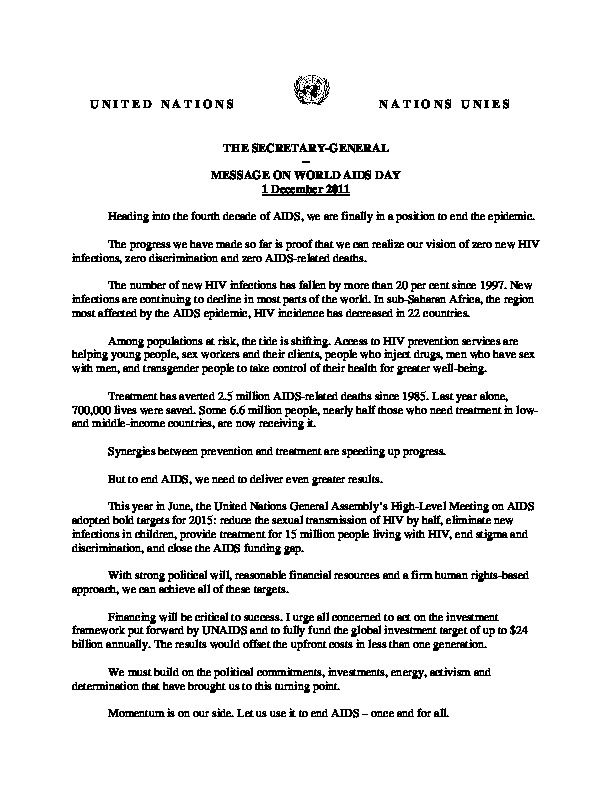
UN Secretary-General's Message on World AIDS Day 2011
28 November 2011
Heading into the fourth decade of AIDS, we are finally in a position to end the epidemic. The progress we have made so far is proof that we can realize our vision of zero new HIV infections, zero discrimination and zero AIDS-related deaths.
Documents
Speech by Jan Beagle, UNAIDS Deputy Executive Director, Management and External Relations, at the Opening of the ICASA Community Village, Addis Ababa, Ethiopia
04 December 2011
We work with communities at all levels: country, regional and global. UNAIDS is the only UN organization that has civil society as part of its governance with civil society seats for each region on our Board.
Documents
ICASA 2011 Opening Address by Michel Sidibé, Executive Director of UNAIDS: Africa’s AIDS Response at the Crossroads: A Make or Break Moment
04 December 2011
The AIDS movement in Africa is a powerful story of people breaking the conspiracy of silence surrounding this epidemic and demanding equity and dignity. We have seen unprecedented progress that must be sustained and enhanced. But we are at a "make or break" point. If we accept the status quo, we will forsake the 9 million people in low- and middle-income countries still waiting for HIV treatment. Our collective failure to meet this challenge will mean more deaths, more orphans and more new infections.
Documents
Getting to zero: Time to shape our destiny: Speech by UNAIDS Executive Director Michel Sidibé on the occasion of the 29th Meeting of the Programme Coordinating Board, 13 December 2011
13 December 2011
Let us all be proud. A year ago, skeptics said that getting to zero was just a slogan. But countries, partners and people around the world have embraced the vision and are now working to translate it into reality. Our vision of zero has truly come to life and grown legs.
Documents
Ninth General Assembly of the Organization of African First Ladies against HIV/AIDS, Addis Ababa, Ethiopia
31 January 2011
I am honoured to be here today, and I thank you for your warm welcome. I want to begin by expressing my deep gratitude to OAFLA members for your leadership and contributions to the AIDS response in Africa. I congratulate you, because the work of African First Ladies has been increasingly visible and has made a real difference in the lives of our mothers, sisters and children.
Documents
Speech by Ms. Jantine Jacobi, Chief, Gender Equality and Diversity Division on the occasion of the United Nations Commission on the Status of Women, 57th session, New York
11 March 2013
To help measure progress on gender equality and HIV, a global indicator on “prevalence of recent intimate partner violence” has been added to the core indicators for country reporting on the progress in the AIDS response, with 52 countries having reported on the indicator. The UNAIDS family would like to reiterate its readiness to work with all partners to eliminate violence against women and girls and work towards the vision of Zero new HIV infections, Zero AIDS-related deaths, and Zero discrimination.
Documents
Concluding remarks by the Deputy Executive Director, Management and Governance on UBRAF Multi-stakeholder Consultation
04 March 2013
The consultation has provided an opportunity to reflect on the extent to which the UBRAF has enhanced coordination and coherence in planning and implementation and increased accountability.