Documents
Women’s and girls’ health needs a holistic approach
01 August 2013
We cannot afford to have a woman coming into a health-care facility for TB screening one day, then going somewhere else for HIV services on another day, and seeking other types of care at different times and places. We need to consider that a woman is not a collection of health conditions or needs, but a whole human being who requires holistic support to thrive.
Documents
Reaching Zero: Translating commitment into action, speech by UNAIDS Executive Director Michel Sidibé on the occasion of IAPAC HIV Treatment Summit
22 September 2013
Today, we can say that treatment is possible, people are living better quality lives and we are seeing less death because of the revolution that brought these medicines to people. We are seeing declines in mortality rates in many places. Malawi can say that they quickly increased the number of people on treatment, and today have seen an almost 50 percent reduction in AIDS-related deaths. So we have truly moved from despair to hope.

Documents
"Promoting empowerment of people in achieving poverty eradication, social integration and full employment and decent work for all" - speech by M. Ninan Varughese, Officer-in-Charge, UNAIDS New York Office, delivered in New York on 12 February 2013 on...
12 February 2013
UNAIDS would like to call on all stakeholders to further strengthen efforts to eliminate all forms of HIV-related stigma and discrimination, and promote and protect human rights of all people living with, affected by or at risk of HIV. This is critical not only to ensure an effective response to the AIDS epidemic, but also to achieve sustainable development that is human-centered and promotes social integration and inclusion. UNAIDS will continue to work with all partners towards the achievement of these goals.
Documents
Speech by UNAIDS Executive Director Michel Sidibé on the occasion of the High-Level Segment of the 22nd Session of the UN Human Rights Council, Geneva, 28 February 2013
28 February 2013
It was people living with HIV, those affected, who turned everything around in this epidemic. They made the response to HIV and AIDS a responsibility for us all. They challenged us to recognize them as people with a human right to live in health – not as victims or criminals. Over the years, they have inspired and driven progress in the AIDS response. They have been true human rights defenders - fighting for their lives and for the lives of millions of others.

Documents
33ème Congrès des Maires francophones- Assemblée générale de l’Association internationale des maires et responsables des capitaleset métropoles partiellement ou entièrement francophones (AIMF)
15 November 2013
Les maires francophones constituent le dernier rempart contre l’exclusion. Plus que n’importe quel autre espace, la francophonie est la mieux à même de porter cette voix. Ensemble nous pouvons mettre fin au combat contre le sida ; faire en sorte que les 18 millions vivant avec le VIH qui ne sont pas sous traitement aujourd’hui puissent y avoir accès ; et faire en sorte que l’objectif de zéro nouvelle infection à VIH, zéro discrimination et zéro décès lié au sida soit réalisé.
Documents
Opening address at the 11th International Congress on AIDS in Asia and the Pacific (ICAAP)
18 November 2013
Let us stimulate a reenergized movement which, together with the International AIDS Conference in Melbourne, can leverage the AIDS response, in this region, and globally, as an entry point for people-centred development, respect for human rights and social transformation.
Documents
Now more than ever: Targeting zero human rights violations of lesbian, gay, bisexual, transgender, and intersex (LGBTI) people in Africa
06 December 2013
Africa is changing! This change is visible in economics and in the increasing world interest for doing business in Africa. But the winds of change on our continent also blow on culture and society. The fact that we are all here today, calling for “zero human rights violations for LGBT people in Africa” is another illustration of this change. This change is not given. It is the fruit of the struggles and activism of many in this room and across the continent.

Documents
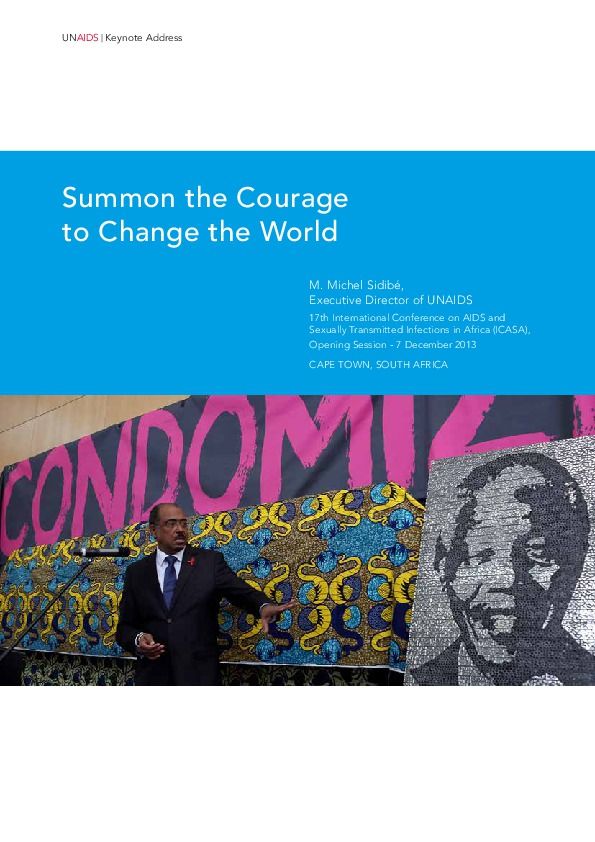
Summon the Courage to Change the World
07 December 2013
We need to be courageous enough confront society’s wrongs. It is unacceptable that women and girls, sex workers, drug users, migrants, prisoners and men who have sex with men are assaulted, violated and murdered, and yet our conscience is not revolted, nor our sense of human dignity challenged. How can the world accept that some people have access to services while others are excluded because of race, social status, income or sexual orientation? We must reject this double standard wherever we encounter it.
Documents
Executive Director’s report to 33rd UNAIDS Programme Coordinating Board
18 December 2013
Ending AIDS will be a global achievement of historic dimensions. Not only will millions of lives be saved, but ending AIDS will drive better health, poverty and equity outcomes for the entire human family. Nobody has embodied this passion better than my friend and brother Ambassador Eric Goosby. Even if he is not with us today, I want to recognize his leadership of PEPFAR and the many contributions he made to the global AIDS response with distinction and heart. This is also the last PCB for Mabel Bianco from the NGO Delegation. Mabel, you have always been a great source of support and encouragement, and we will miss you. Finally, thanks to your support, UN Secretary-General Ban Ki-Moon has extended me into a second term as Executive Director of UNAIDS. I look forward to continuing our collaboration, and I remain at your service.

Documents
Turning audacity into action: Joining forces to address social drivers
09 January 2014
When we talk about the social drivers and the structural dimensions of poverty, I always think about how it comes down to power— the power of relationships in society and the politics behind them. If we want to achieve the kind of transformation that will build more equitable societies, we must address the larger governance issues and the role of social empowerment. How do we harness the power of community movements to create demand for services, for access and for equity? We must not lose this perspective.