Documents
UNAIDS Executive Director’s delivery of the 2012 Lancet Lecture
13 November 2012
Today, the dialogue on AIDS has shifted from applauding incremental scale-up to expressing a true belief that we will end this epidemic. But we have reached a moment of truth. We need to understand and integrate the magnitude of the changes that are happening into a new narrative for global health.
Documents
UNAIDS Executive Director’s speech to launch US Blueprint for an AIDS-free generation
29 November 2012
The PEPFAR Blueprint for an AIDS-free generation is not just another plan. It is a clear, practical way to move the world towards the goals adopted at the UN High Level Meeting on AIDS.
Documents
UNAIDS Deputy Executive Director's speech at the Annual HIV Conference of Poland in Warsaw
03 December 2012
The AIDS response can be a catalyst for broader health, human rights and development outcomes, and an engine for social change – towards more inclusive societies that take responsibility for investing in the well-being and dignity of all their people. We look forward to continuing to partner with you to reach the goal of zero new HIV infections, zero discrimination and zero AIDS related deaths in this region.
Documents
"Unprecedented progress, but AIDS is not over: Maintaining commitment for the next 1000 days and opportunities for the Post-2015 era." UNAIDS Executive Director’s speech to the 31st Programme Coordinating Board
11 December 2012
Dear friends, we are seeing sustained progress. We are quickening the pace of action. But we must make no mistake—this epidemic is not over.
Documents
Speech by UNAIDS Executive Director in Burkina Faso on the occasion of the Third Pan-African Youth Leadership Summit
20 December 2012
Ladies and gentlemen, dear participants: This Pan-African Youth Summit is extremely timely. It is being held at a critical period in the evolution of our societies, when the world starts to collectively reflect on the Post-2012 development agenda.

Documents
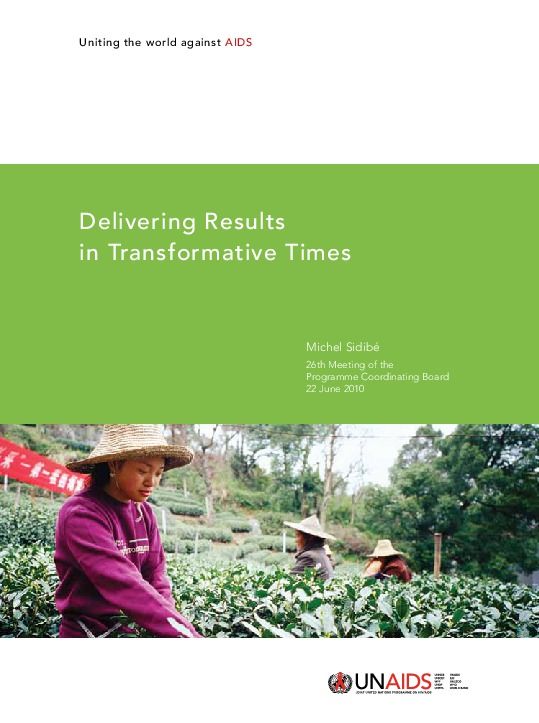
Delivering Results in Transformative Times
23 June 2010
Speech to the 26th Meeting of the Programme Coordinating Board. Conditions are in flux around the world and the context of AIDS is changing. The global economic crisis has not abated. Countries in the North and the South that were once financially secure have moved from relative abundance to forced austerity, dealing a direct blow to AIDS funding. Struggling economies are starkly exposed to the risk of ARV stockouts and the spectre of turning new patients away.
Documents
MESSAGE ON THE OCCASION OF WORLD AIDS DAY 1 December 2003 Dr Peter Piot
25 November 2003
Documents
"MESSAGE ON THE OCCASION OF WORLD AIDS DAY" 1 December 2004, Dr Peter Piot, Executive Director of UNAIDS and Under Secretary-General of the United Nations
01 December 2004
This World AIDS Day, the news is sobering -- the epidemic continues to spread in every region of the
world. The number of people living with HIV globally has reached its highest level with close to 40
million people, up from 36.6 million in 2002. The steepest increases in HIV infections occurred in East
Asia, Eastern Europe and Central Asia over the past two years.
Documents
SECRETARY-GENERAL HAILS WOMEN AS MOST COURAGEOUS, CREATIVE CHAMPIONS
IN FIGHT AGAINST HIV/AIDS, IN WORLD AIDS DAY MESSAGE
28 December 2004
Women are our most courageous and creative champions in the fight against HIV/AIDS. In most
countries and communities I have visited around the world, it is women’s voices that are heard above all others;
women advocates and activists who are moved to act selflessly and speak publicly, often risking prejudice,
abuse or violence, in order to improve the lives of others.
Documents
“Why AIDS is exceptional” Speech given at the London School of EconomicsLondon, 8 February 2005
15 February 2005
Is the AIDS pandemic so exceptional a threat that it is in a league altogether different
to other infectious diseases or causes of ill health? Is the pandemic so exceptional a
threat that its control should not be just one of many Millennium Development Goals
but rather an overarching priority, a prerequisite to achieving the MDGs? Is the threat
so exceptional that it demands a binding first call on the attention of political leaders
as well as on finances? So exceptional that it demands that we undertake
fundamental changes on many fronts if we are to succeed?