Documents
HIV prevention among adolescent girls and young women
19 July 2016
This programming guidance is meant to inform programmes that aim to reduce HIV infection among adolescent girls and young women in countries and locations where HIV incidence is high among adolescent girls and young women and where HIV is primarily spread through heterosexual transmission. This report primarily is for policymakers, planners and implementers of HIV prevention programmes across multiple sectors, including organizations led by young people. The document also is useful for experts in wider health and social sector programmes, including health workers and teaching staff, or any other professionals who can integrate dimensions of HIV prevention into their area of work.
Documents
UNAIDS Terminology Guidelines
01 July 2024
Language influences the way we think, how we perceive reality, and how we behave. With respect to HIV, language can embody stigma and discrimination, which impacts access to testing, acquisition of HIV, and engagement with treatment. Language plays a role in supporting respect and empowerment of individuals, as communities shape how they are referred to and the labels they wish to use. Consideration and use of appropriate language can strengthen the global response to the HIV pandemic by diminishing stigma and discrimination and increasing support and understanding for individuals and communities living with HIV. Comments and suggestions for modifications should be sent to editorialboard@unaids.org
Documents
Considerations and guidance for countries adopting national health identifiers
01 June 2014
The existence of national health identifiers (NHIDs) ensures that each patient has one unique identity within the health system. This facilitates the development of longitudinal medical records and allows users of services to be tracked across health-care sectors.
Documents
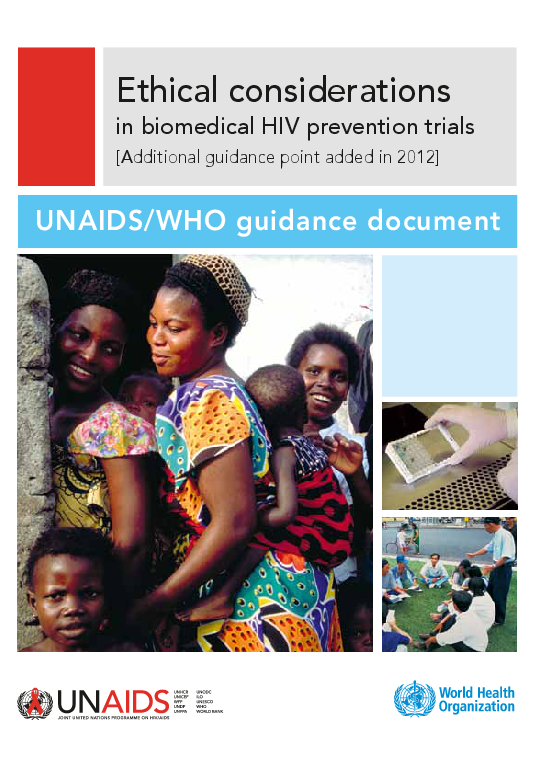
Ethical considerations in biomedical HIV prevention trials
01 July 2012
Well into the third decade of the HIV epidemic, there remains no effective HIV preventive vaccine, microbicide, product or drug to reduce the risk of HIV acquisition. As the numbers of those infected by HIV and dying from AIDS continue to increase, the need for such biomedical HIV preventive interventions becomes ever more urgent. Several such products are at various stages of development, including some currently in phase III efficacy trials. The successful development of effective HIV preventive interventions requires that many different candidates be studied simultaneously in different populations around the world.
Documents
UNAIDS gender assessment tool: Towards a gender-transformative HIV response
05 May 2014
The Gender assessment tool for national HIV responses is intended to assist countries assess their HIV epidemic, context and response from a gender perspective, helping them to make their HIV responses gender transformative and (as such) more effective. The Tool is specifically designed to support the development or review of national strategic plans (NSP) and to inform submissions to both country investment cases and the Global Fund to Fight AIDS, Tuberculosis and Malaria (GFATM).