Documents
Information for in-person participants
10 December 2024
Documents
Secure Platform Account Creation Guide
10 December 2024

Documents
Code of conduct to prevent abusive conduct and sexual misconduct at UNAIDS events and gatherings
10 December 2024
Documents
Plenary debate of the Summit of the Future
23 September 2024
UNAIDS Executive Director Winnie Byanyima's remarks at the Plenary debate of the Summit of the Future, New York, 23 September 2024

Documents
Revitalized Multilateralism
24 September 2024
UNAIDS Executive Director Winnie Byanyima's opening and closing remarks - UNAIDS-PEPFAR-Global Fund high-level event “Revitalized Multilateralism: Recommitting to Ending AIDS Together”, 79th United Nations General Assembly, New York, 24 September 2024

Documents
African Union Year of Education
23 September 2024
UNAIDS Executive Director Winnie Byanyima's remarks at the high-level event commemorating the African Union Year of Education 2024—“Investing in Tomorrow: The African Union Year of Education - Catalyzing Progress for Africa and the World”, New York, 23 September 2024
Documents
Linking UN Summit of the Future with COP29
26 September 2024
UNAIDS Executive Director Winnie Byanyima's remarks at the NGIC High-Level Meeting “Trust and Global Governance, Climate Action: Linking the UN Summit of the Future with COP29”, 79th United Nations General Assembly, New York, 26 September 2024
Documents
Intersessional: Modalities and Procedures for 2024 PCB Meetings
10 December 2024
Documents
Thailand 2022
13 December 2022
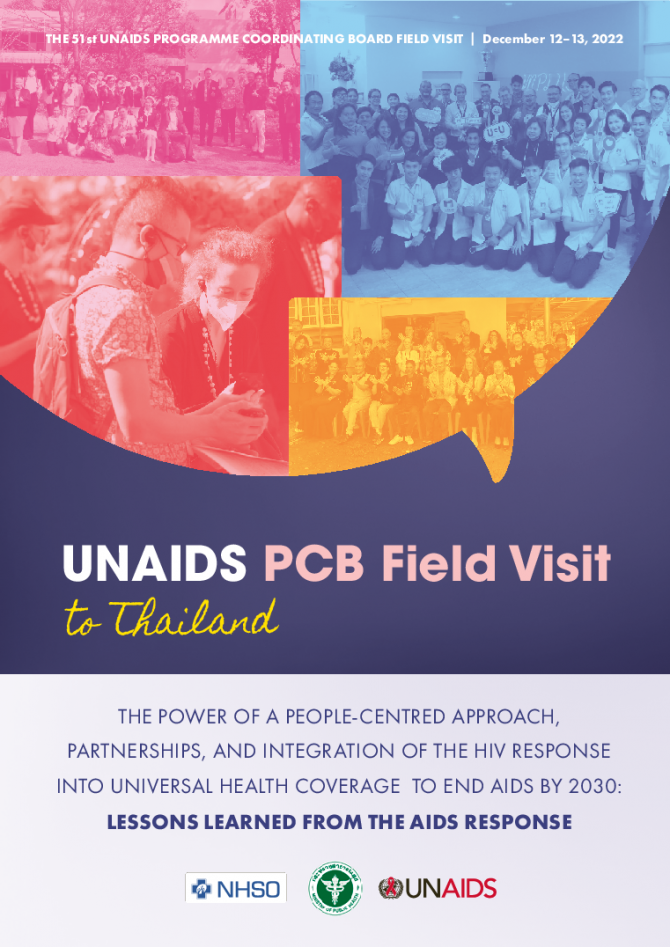
UNAIDS PCB-51 field visit, Thailand, 12-13 December 2022 - The power of a people-centred approach, partnerships, and integration of the HIV response into universal health coverage to end AIDS by 2030 - Lessons learned from the AIDS response. The 51st meeting of the UNAIDS Programme Coordinating Board (PCB) was hosted by the Government of Thailand (as Chair of the PCB) in Chiang Mai from December 13 – 16, 2022. It was the first time in 14 years that the board met outside Geneva and the second time it convened in Chiang Mai. During the meeting, delegates from government, civil society and the development community reviewed a range of approaches to accelerate progress to end AIDS. Among these were: the first international definition of a community-led response to a pandemic; strategies to increase the impact of the “Undetectable = Untransmittable” agenda (U=U); and innovative approaches to engaging men in all their diversity.
Documents
Slide deck - 2024 global AIDS update
22 July 2024