Feature Story
Innovative high-level leadership to strengthen and sustain the HIV response in Uganda
16 December 2025
16 December 2025 16 December 2025This story first appeared in the recently released World AIDS Day report 2025
Across eastern and southern Africa, men and boys are less likely to test for HIV, initiate antiretroviral therapy or remain engaged in care. As a result, although HIV prevalence is higher among women and girls, the number of AIDS-related deaths is higher among men and boys in the region.
One leader recognized the challenge and decided to use his influence to create positive change. In the traditional kingdom of the Buganda people within present-day Uganda, the King, His Majesty Mutebi II, has championed health and well-being over the course of his reign, including through a series of campaigns that aim to instil healthy social norms and health-seeking behaviours. Previous campaigns have focused on promoting polio immunization, blood donation, maternal and child health and physical exercise. Buganda is home to 12 million of the 49 million people living in Uganda.
Beginning in 2016, Uganda decided to harness the influence of traditional leadership to encourage men and boys to test for HIV, and for those who test positive to start and stay on treatment. This national effort, which the King carried forward in Buganda, is premised on the conviction that social influencers such as the King are uniquely well positioned to change the attitudes and social norms of men and boys. In 2017, UNAIDS appointed the King as a UNAIDS Goodwill Ambassador on ending AIDS in eastern and southern Africa to support and highlight the King’s leadership to improve HIV outcomes among men and boys in the kingdom.
To undertake his health promotion campaigns, the King leverages his influence to obtain financial support for campaigns and to maximize their reach and effectiveness. The King has been able to attract financial support for the health campaigns from private-sector partners such as Airtel Uganda and DFCU Bank to contribute to the health campaign focused on men and boys.
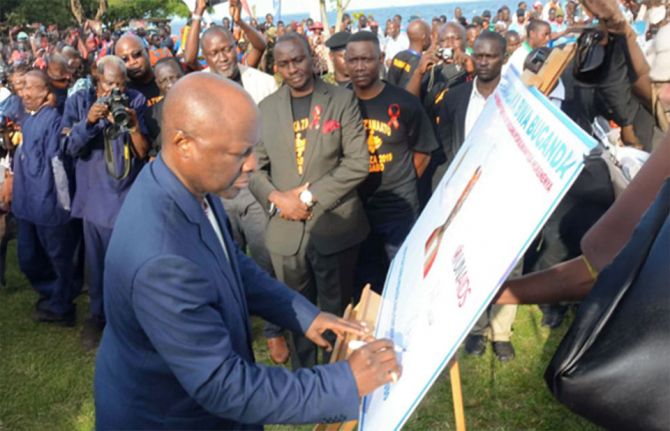
The King’s HIV advocacy campaign, Abaami Munyenye (“Men are Stars”), focused on men and boys aged 15–49 years living in districts with a high HIV burden. The campaign used innovative means to generate resources and reach men and boys with key messages, including at major sporting events, such as a marathon to celebrate the King’s birthday, which attracted 50 000–60 000 participants (85% male), and the Malaza football cup, which attracted 20 000–30 000 fans. In addition to leveraging these events to reach tens of thousands of men and boys with health promotion messages, the fees paid by event participants raised funds to support health services for men and boys.
The advocacy campaign has had a clear positive impact on HIV outcomes in Buganda. From 2016 to 2020, the percentage of people living with HIV who knew their HIV status rose from 89% to 94%, HIV treatment coverage increased from 64% to 92%, and the number of new HIV infections declined by 52%.
The King’s previous health promotion campaigns typically ran for three years each, but there was consideration in 2025 to replace the HIV campaign. With donor cutbacks potentially jeopardizing national momentum towards HIV epidemic control, the King determined that now was not the time to move on from the HIV response. As a result, the campaign to improve HIV outcomes is now continuing across the kingdom.