

Feature Story
UN Deputy Secretary-General reaffirms commitment to a responsible UNAIDS transition and UN commitment to the AIDS response at Board meeting
22 December 2025
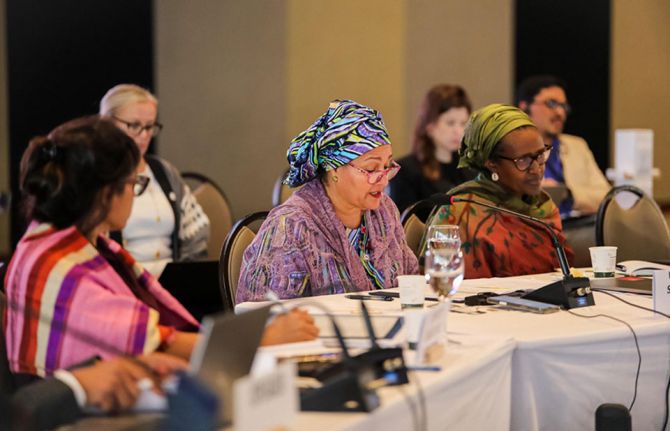
22 December 2025 22 December 2025The United Nations Deputy Secretary-General, Amina Mohammed, joined the 57th meeting of the UNAIDS Programme Coordinating Board (PCB) in Brasilia, bringing a clear message: the UN will stand with governments and communities until AIDS is ended as a public health threat.
In her remarks to the Board, the Deputy Secretary-General commended the inclusive and constructive nature of the deliberations and reaffirmed that the ongoing UN80 reform process will strengthen – not diminish – the global AIDS response. She stressed that reform must be deliberate and protect what works. “There is a sense of urgency, but let me underscore here, we are not in a hurry to fail... We must achieve common ground around all the concerns that the PCB and civil society have aired over the last few weeks in particular,” she said.
Ms. Mohammed warned of growing financial pressures on countries and donors, highlighting the strain on domestic resources in low- and middle-income countries, driven by debt and the cost of debt servicing. “Governments, even if they wanted to prioritize HIV and AIDS as a budget spend, quite frankly are taking away from education, taking away from health, because they cannot meet that [cost],” she said. “Part of what we have to do today with this strategy and with the transitions that we offer in UN80 – and UNAIDS is one of them – is how to convince the international community to come back.”
The UN80 initiative aims to make the UN development system more coherent, integrated, and fit for purpose in a rapidly changing world. For UNAIDS, this means a two-phase transition that preserves its core functions and highest-value contributions to the global AIDS response – leadership and advocacy, convening and coordination, accountability and data, and community engagement.
During its meeting, the PCB adopted landmark decisions that will shape the next phase of the HIV response:
- Global AIDS Strategy 2026–2031: A bold, evidence-informed roadmap grounded in human rights, gender equality, and community leadership. The strategy will guide preparations for the 2026 UN General Assembly High-Level Meeting on AIDS and negotiations for the political declaration.
- UNAIDS and UN80 transition: The Board reaffirmed its commitment to a responsible, inclusive transition of the UNAIDS Joint Programme within the wider UN development system. A PCB Working Group will be established in early 2026 to ensure the process is orderly, transparent, and safeguards UNAIDS’ core functions.
“I have seen many across the agencies that I chair in the UN Sustainable Development Group … This is a really good one. Why? Because it has so much clarity, it has so much of a division of labour, but I think that in this particular case, what has helped it is this nature of inclusion that you have had, and demonstrated, in the PCB, with civil society having such a strong voice,” said Ms Mohammed.
The PCB meeting also featured a one-day thematic discussion on long-acting antiretrovirals, highlighting their potential to transform HIV prevention and treatment. With political will, financing, and partnerships, these innovations can dramatically reduce new infections and accelerate progress toward ending AIDS.
“Ending AIDS remains achievable,” she concluded. “But only if resources match our ambition.”