Feature Story
‘I never lacked anything—except answers’ - a young man’s journey of being born with a disease he did not understand
19 January 2026
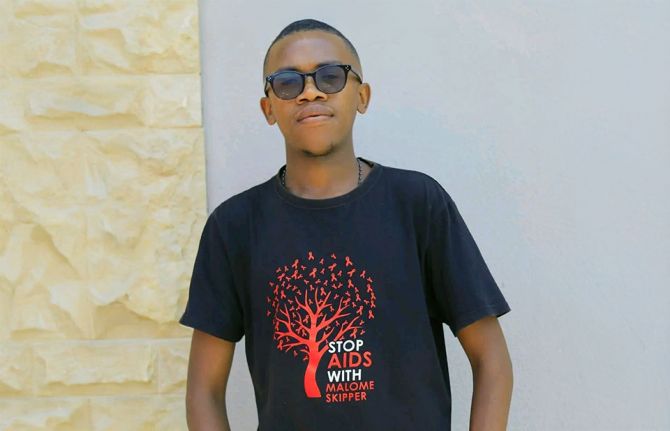
19 January 2026 19 January 2026For 24-year-old Rakhants’a Lehloibi, growing up in the rural village of Maphutseng, in Lesotho, meant navigating life with a secret he didn’t fully understand. Born with HIV, he spent his earliest years believing the antiretroviral (ARV) treatment he took daily was simply to stop frequent nosebleeds—a story his grandmother told to shield him from the stigma surrounding HIV.
“Life was tough, but my grandmother gave me all the love in the world,” he recalled. “I never felt like I lacked anything—except answers.”
Rakhants’a’s mother died when he was very young, leaving his grandmother to raise him. In 2007, when he was just 4 years old, he became severely ill. Traditional healers were consulted, but their remedies failed. It was only when he was taken to a local clinic that he was tested and diagnosed with HIV.
“Back then, I didn’t even know what HIV was,” he said. “My grandmother told me the pills I was taking were to stop nosebleeds. I believed her.”
In Lesotho—as in much of sub-Saharan Africa—stigma against people living with HIV remains widespread. Many conceal their status to avoid rejection by family and community.
“For years, I took pills but I didn’t understand why. I missed school for clinic visits. I watched my grandmother struggle just to make sure I got my medication,” Rakhants’a said. Eventually, doubting the need for treatment since his nosebleeds stopped, he began skipping doses. “I didn’t know I was putting my life at risk.”
The stigma he faced only deepened his struggle. “Kids at school whispered that I had AIDS. I felt isolated, ashamed and angry. I even thought about running away just to escape the pain. But I kept going. I passed my exams and later moved to the country’s capital Maseru to live with my sister and attend high school.”
UNAIDS country Director for Lesotho, Pepukai Chikukwa, agrees that "Though HIV stigma has reduced over the years, it is still a critical barrier to the AIDS epidemic, obstructing access to life-saving HIV prevention and treatment." Ms Chikukwa adds that it pushes people away from care and increases their risk of infection. Ms Chikukwa noted that “Addressing HIV-related stigma and discrimination requires a coordinated, multi-level, and multi-setting approach involving individuals, communities, organizations and policymakers.”
It was in Maseru that Rakhants’a’s life began to change. At Baylor Clinic, he finally learned the truth about his diagnosis and joined the Teen Club, a support network for young people living with HIV.
“For the first time, I met others like me. I realized I had been born with HIV, passed on from my late mother. That was a turning point.”
Still, the journey was not easy. Poor adherence to HIV treatment meant that Rakhants’a’s viral load was dangerously high. One health worker bluntly told him he was “as good as dead.” Placed on second-line treatment—five pills a day instead of one—he felt overwhelmed.
“At first, it was hard. But instead of giving up, I prayed every day and asked my mother to watch over me. Slowly, things changed. I gained strength, I took my medication properly, and within three months, my viral load was suppressed.”
Today, Rakhants’a uses his voice to fight stigma and inspire others. Through social media and community platforms, he spreads a message of hope and resilience.
“Being HIV positive doesn’t mean your life is over,” he said. “With proper treatment and support, we can live full, healthy lives.”
According to UNAIDS, there are 260,000 people living with HIV in Lesotho and 3200 people became newly infected with HIV in 2024. There were 6,400 children aged between 0 to 14 years, living with HIV. Nonetheless, 97% of people living with HIV know their status, of those, 97% are receiving HIV treatment and 99% of those are virally suppressed. In 2023, 11.3% of women and 18.5% of men aged 15 – 49 years old reported discriminatory attitudes toward people living with HIV.