Feature Story
"Funding Community-led harm reduction is not optional to end AIDS” - An interview with Anton Basenko
23 July 2026
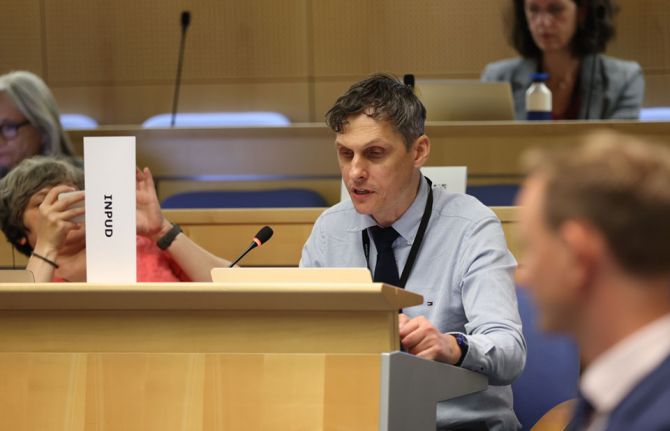
23 July 2026 23 July 2026UNAIDS sat down with Anton Basenko, Executive Director of International Network for People who Use Drugs (INPUD) during the latest coordinating board meeting where Member States and partners discussed how people who inject drugs are disproportionately impacted by the HIV epidemic worldwide.
In 2024, HIV prevalence among people who inject drugs reported was ten times higher than for the rest of the adult (15–49 years) population and people who inject drugs were estimated to be 34 times more likely to contract HIV than the general adult population.
Q: How did you become an activist and advocate?
A: I began using drugs as a teenager and started injecting when I was 16. Like millions of people around the world, I spent years avoiding healthcare not because I did not need it, but because healthcare did not feel safe.
In 2002, Ukraine started to scale up the limited offer of harm reduction services. I did not go there because someone convinced me to seek treatment. I went to a drop-in centre run by Club Eney because I needed sterile injecting equipment. What I found there was much more than syringes. After almost 10 years of spending days looking for money, avoiding the police and buying drugs, I was in awe of the peer-led, peer-run place and realized, 'People care about me.'
I had lost many friends and suffered many overdoses and lost my job so this outreach was like a miracle. That is where later, in 2023, I found out I was HIV+ and had Hepatitis C and needed treatment. I also qualified for opioid agonist therapy (OAT), which is another miracle. They were running a pilot programme at the time. Within months I transformed and regained confidence. So much so that when it was time to validate the pilot programme, I was asked to testify at the Ministry of Health Public Hearings. Wearing a tie and speaking about my experience, I overheard people from the opponents of the OAT group say afterwards, 'His outfit is too expensive and he looks too clean to be a real drug user,' which made me think that OAT definitely works and I clearly had convinced people from all sides during the meeting.
Q: When is it that you really pushed for harm reduction services?
A: In 2005, I went to the OAT site at the Kyiv Narcological Dispensary to get my daily dose of medicine and saw that the door was closed. I was in total shock and I felt all my hopes disappear. The majority of us were so afraid of withdrawal symptoms that we relapsed. Ukraine was in the midst of rolling out harm reduction and there had been a backlog. I was an emotional train wreck. Thank goodness the centre called us back a month and half later and I was able to get back on the medicine. It took me six months to get back on track. That experience taught me that policies are not written in isolation. They determine whether people live or die. They determine whether services remain open or disappear. And they determine whether communities are treated as partners—or as problems. Today, more than twenty years later, that lesson remains just as relevant.
Q: Was that a turning point for you?
A: It definitely motivated me and as of 2009 I volunteered and started working for a grassroots organisation in Kyiv as a peer-counselor at the OAT site. Slowly I left my marketing job and dedicated myself to the cause. At first, I worked for the Association of Substitution Therapy Advocates of Ukraine (ASTAU), and later joined the leading HIV CSO in EECA region, Alliance for Public Health. Feeling my commitment to invest my knowledge and motivation into the development of the global drug users’ rights movement and communities mobilisation, I co-founded Ukrainian Network of People who Use Drugs (VOLNa), contributed to the Eastern European Central Asian Network of People who Use Drugs (ENPUD), and worked for European AIDS Treatment Group (EATG.) I have also given a lot of speeches at AIDS and Harm Reduction conferences! And after being on the board of INPUD, I was appointed as INPUD Executive Director in 2025.
Q: INPUD's latest report ' The Human Costs of Policy Change: A World in Turmoil' documents the impact of recent funding cuts. What are they?
A: We are witnessing needle and syringe programs closing or being severely reduced. A lack of access to harm reduction supplies spiked from 47% in 2025 to 64% in 2026, stigma and discrimination jumped from 60% to 77%, policing or criminalisation increased from 42% to 64%. For women who use drugs, the consequences have been even more severe, with reductions in gender-based violence services, child-friendly spaces and low-threshold treatment programs. As someone who has lived through HIV, hepatitis C, criminalisation and exclusion from healthcare, I know that people do not stop using drugs because services disappear. They simply disappear from services until they return with advanced HIV, tuberculosis, hepatitis C, or... they DO not return at all.
Q: What is your main call to action?
A: The lesson is clear. Funding community-led harm reduction is not optional. It is one of the most cost-effective investments in the HIV response. We cannot end AIDS while allowing the organisations closest to affected communities to disappear. INPUD wants donors, partners, governments to protect and expand sustainable, direct and flexible funding for community-led organisations of people who use drugs and safeguard comprehensive harm reduction services, including needle and syringe programmes and opioid agonist therapy. Also know that the funding cuts collided with criminalisation and shrinking civic space which has been horrible. We must accelerate drug policy reform, including decriminalisation, as an essential structural intervention to end AIDS.
Q: You keep hammering one message, what is it?
A: Our message is simple: if communities disappear, the HIV response disappears with them.
Q: And what are you proudest of?
A: Professionally, I am very happy to have started harm reduction programmes in probation services. It has gone from a pilot programme to full scale in Ukraine and proud to mobilise the successful country drug users network, VOLNa, which unites more than 1,500 individual members and is a real driver of critical changes in Ukraine and EECA region.
I am also very proud of my son who is now seven years old living free of HIV.
UNAIDS advocates for harm reduction responses to be tailored to the realities of people who use drugs, recognizing that HIV risk and access are shaped by gender inequality, age, sexual orientation, incarceration, displacement and humanitarian crises. We must move away from criminal sanctions for drug use and possession for personal use and instead adopt public health and human-rights based approaches. Integrating harm reduction into national health systems and domestic financing frameworks will guarantee that essential services do not stop putting people’s lives at risk. Finally, UNAIDS believes in strengthening and protecting community leadership. Organizations led by people who use drugs must be able to register, operate and access funding freely.