

Feature Story
UNAIDS at the World Health Summit 2026
09 October 2026
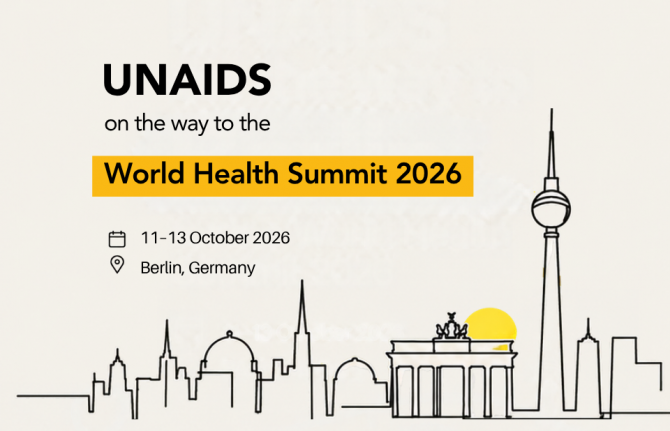
09 October 2026 09 October 2026This year’s World Health Summit will be held in Berlin, Germany from 11 to 13 October under the theme: From Crisis to Resilience: Innovating for Health. At the Summit UNAIDS will share its knowledge and expertise in the future of the HIV response, global health financing, pandemic preparedness and inequalities that are preventing progress.
The World Health Summit 2026 takes place at a critical moment. In June, countries adopted a new Political Declaration on HIV/AIDS, reaffirming the goal to end AIDS as a public health threat by 2030. The focus now must shift from political commitment to implementation.
This year has seen a sequence of major milestones, including the High-Level Meeting on HIV/AIDS, AIDS 2026 and UNGA81. Together, these events and commitments have helped draw from the AIDS response to further debates on equitable financing, health sovereignty, pandemic preparedness, resilience and the future of multilateral cooperation. It also coincides with a pivotal moment for the future of the UNAIDS and its transformation.
UNAIDS objectives at the World Health Summit:
- Stress that AIDS is not over and that a broad, multisectoral coalition is needed to turn commitments into action to save lives and end AIDS by 2030
- Draw on the lessons from the HIV response to address broader global health challenges and future pandemics
- Ensure a considered and safe transition to country ownership of HIV responses that ‘does no harm’ to people living with and affected by HIV
- Emphasise the critical importance of maintain and building community-based and community-led services to respond to HIV and other health emergencies
EVENTS
Sunday 11 October
9:00-10:30
Global health architecture reform: From recommendations to action at the regional and country levels
This session focuses on what reform looks like from the regional and country level. The discussion will explore "what's actually changing" and "what's next". The session draws on experiences from countries, regional institutions, funders, and global actors to examine whether a more regionalised approach can make global health cooperation more responsive, coherent, and accountable.
11:00-12.30
Advancing equitable, person-centred HIV prevention and care in Europe
This side event, co-organized by the International AIDS Society (IAS) and AIDS action Europe, will highlight how person-centred, community-led HIV prevention and care informed by lived experience can reshape and redefine service delivery and related policies. It will reinforce why community-led systems must be recognized and resourced as integral to public health delivery.
At a time of shifting global financing priorities and growing pressure on health systems, the event will provide a platform for exchange on enabling policies and examples of person-centred HIV programming to expand access to HIV testing, prevention, care and related services for people living with HIV and populations vulnerable to HIV acquisition.
Monday 12 October
11:00-12:00
Long-acting innovation, lasting impact: Advancing the global HIV response
The discussion will feature Mark Dybul, former Executive Director of the Global Fund and former U.S. Global AIDS Coordinator leading PEPFAR, who will share an exclusive preview of Rockefeller-funded economic modelling from Imperial College London and Georgetown University examining the potential impact of accelerating the rollout of long-acting PrEP for populations at higher risk of acquiring HIV across high-, middle- and low-income settings. The event will also explore barriers to countries and at-risk populations accessing long-acting HIV prevention and treatment options, with a particular focus on regulatory, financing and supply chain challenges, with a deep dive into the unique barriers faced by middle-income countries and regions.
14:00-15:30
G7 and G20: Fit for future global health challenges?
The G7 and G20 have played a pivotal role in shaping global health agendas. Through their convening power, they have translated shared priorities into coordinated responses, have mobilized resources and fostered tangible political action.
This session will examine where both fora stand today, how they interact with another, and whether the G7 and G20 remain fit-for-purpose to advance global health priorities: Should they be adapted to continue driving effective global health action in an increasingly multipolar world?
14:00-15:30
RoundTable discussion - Resilience in the HIV response: From innovation to impact
Aligning with this year’s Summit theme of resilience and innovation, this special session will be a roundtable discussion with a facilitated conversation between legislators and experts, focused on policy leadership in the HIV response. Discussions will cover the latest innovations in the HIV response and the role of legislators in driving implementation; how to build resilience into public health systems; sustainable financing; and the necessary political priorities to ensure the HIV response delivers equitable public health outcomes for key populations.
18.00-19.30
World Health Summit signature event: “From crisis to resilience: Innovating for health”
How can global health move from a crisis response to lasting resilience and turn shared ambition into concrete action? The World Health Summit 2026 Signature Event will bring together global leaders, multilateral institutions, youth voices and partners in philanthropy and innovation to explore the political choices, institutional changes, and innovations needed to deliver better health for all.
Tuesday 13 October
09:00-10:30
Safeguarding the global HIV response in a changing multilateral environment
This workshop brings together donors, policymakers, civil society and UN system representatives. Looking ahead, the session will consider what lessons the UNAIDS experience may offer for wider multilateral reform efforts, such as the UN80 reform process, particularly how institutions can work in a more efficient and coordinated manner, while increasing specialization, legitimacy, accountability and responsiveness including to communities and CSOs.