

Press Statement
United Nations High-Level Meeting on HIV/AIDS concludes with strong support for a bold political declaration for ending AIDS as a public health threat by 2030
24 June 2026 24 June 2026NEW YORK/GENEVA, 23 June 2026— At a moment of growing pressure and roadblocks to international cooperation, the United Nations High-Level Meeting on HIV/AIDS concluded today with overwhelming majority of Member States adopting a new Political Declaration on HIV and AIDS with strong support. The declaration reaffirms global commitment to ending AIDS as a public health threat by 2030 and sets specific and important new targets.
The outcome follows weeks of negotiations with all Member States and engagement with communities, civil society and partners and demonstrates that, even in an environment marked by reduced international financing and multilateralism, countries continue to recognise the urgency of sustaining progress against HIV.
The declaration will serve as an important road map to advance further success in the global HIV response over the next five years, guiding global efforts to accelerate additional progress despite decreases in funding for HIV and anti-rights headwinds. Notably, the 2026 political declaration reflects the ambitious targets contained in the new Global AIDS Strategy 2026-2031 and committed to convene a High-Level Meeting in 2031 to review progress against the pandemic after the 2030 milestone.
Setting out an agenda to evolve the global AIDS response for the shifting pandemic, it includes important new and ambitious targets and commitments to increase equitable coverage of HIV testing, treatment and prevention; addressing funding gaps; protect human rights and gender equity; expand access to HIV medicines and other technologies through sharing of technology and strengthening local production for sustainability; and expanding the space for communities and civil society in the AIDS response.
“This Political Declaration has sent a clear message: HIV remains one of the defining health and development challenges of our time, and the world cannot afford complacency. We leave New York with renewed political commitment and a shared understanding that progress is possible when countries lead, communities are empowered and solidarity is sustained. South Africa remains firmly committed to ending AIDS as a public health threat and to ensuring that no one is left behind in the next phase of the response,” said Dr Aaron Motsoaledi, Minister of Health of South Africa.
Javier Padilla, Spain’s State Secretary for Health said, “This is a positive development in a moment when multilateral cooperation is being tested. Countries have sent an important signal. Despite differences and a more complex political context, there remains strong support for sustaining progress and accelerating action to end AIDS.”
"This outcome shows that even in a very difficult global environment, countries remain committed to collective action in responding to the AIDS pandemic. The challenge now is to sustain investment, strengthen partnerships and deliver results for people,” said Madalitso Baloyi, Minister of Health from Malawi.
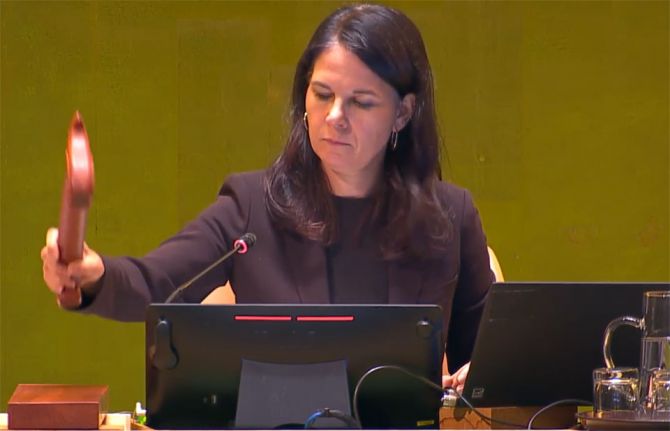
The High-Level Meeting on HIV/AIDS was convened by the President of the General Assembly, Annalena Baerbock with the co-facilitators—Permanent Representative of the Republic of Botswana, Ambassador David Masole, and Permanent Representative of Georgia, Ambassador David Bakradze leading negotiations on the political declaration.
“That so many Member States voted to support this political declaration in the moment is recognition that our progress remains worth protecting and that there is willingness to sustain the actions we need to achieve the 2030 goal.” said Winnie Byanyima, Executive Director of UNAIDS.
“The strong support shown for this Political Declaration on HIV, reflects our shared recognition of the progress achieved to date, while acknowledging that important challenges remain,” said Mariangela Simao, Brazil's Secretary of Health and environmental Surveillance at the Ministry of Health.
The High-Level Meeting brought together people living with HIV, communities, civil society, the private sector, scientists and leaders to reflect on progress in the AIDS response, the risks to sustaining it and priorities for the next five years.
Member States emphasized that domestic resource mobilization and international solidarity must reinforce one another rather than act as substitutes and stressed that financing transitions must support sustainable national responses.
Delegates highlighted the opportunities created by integration, innovation, and the importance of ensuring equitable access to new prevention and treatment approaches.
The importance of community leadership was highlighted throughout discussions and the declaration itself. There was also reaffirmation for the fact that communities continue to play an indispensable role in service delivery, accountability and reaching people left behind. Speakers and the declaration stressed that communities must remain central to implementation and governance.
“In today’s political context, this political declaration is a major win. Communities have fought for every gain in the HIV response, nothing has been handed to us. This declaration shows that commitment to ending AIDS remains strong, and communities will continue pushing until AIDS is ended as a public health threat,” said Florence Anam, Executive Director of GNP+. Delegates emphasized the continuing role of the United Nations and the importance of reinforcing the unique, multi-stakeholder coordiantion of the Joint United Nations Programme on HIV/AIDS (UNAIDS).
“Governments of the world, supported by communities, have come together and affirmed that multilateralism is alive and well. A majority of countries have adopted a strong declaration that sets ambitious targets for the world to race to the 2030 goal of ending AIDS as a public health threat. They have kept the promise of 25 years ago,” said Winnie Byanyima.
UNAIDS
The Joint United Nations Programme on HIV/AIDS (UNAIDS) leads and inspires the world to achieve its shared vision of zero new HIV infections, zero discrimination and zero AIDS-related deaths. UNAIDS unites the efforts of 11 UN organizations—UNHCR, UNICEF, WFP, UNDP, UNFPA, UNODC, UN Women, ILO, UNESCO, WHO and the World Bank—and works closely with global and national partners towards ending the AIDS epidemic by 2030 as part of the Sustainable Development Goals. Learn more at unaids.org and connect with us on Facebook, Twitter, Instagram and YouTube.