

Press Release
Decades of HIV progress are threatened by barriers to access - but governments and communities can prevent a resurgence, warns UNAIDS
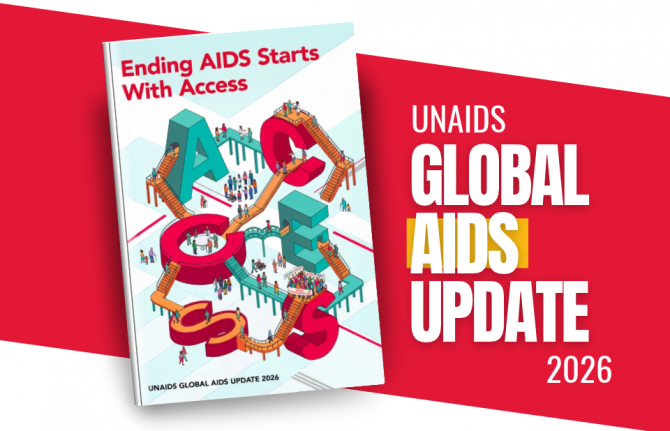
24 November 2026 24 November 2026New UNAIDS report ‘Ending AIDS Starts with Access’ shows that HIV prevention programmes have been dismantled, community services have closed and countries face growing challenges in sustaining HIV responses.
LONDON/GENEVA, 24 November 2026—As UNAIDS marks its 30th year, UNAIDS has today launched a new report warning that although the world has moved closer towards controlling the HIV epidemic, cuts and shifts in international HIV financing and anti-rights and anti-gender campaigns are creating a global crisis that threatens to reverse one of the greatest public health achievements in history.
HIV, which was once a death sentence, has become a manageable health condition for millions of people thanks to life-saving HIV medicines. Some 32.1 million of the 40 million people living with HIV are now on treatment. In addition, a twice-yearly injection, lenacapavir, and other new long-acting prevention innovations in the pipeline, offer the prospect of protecting millions more people from acquiring HIV.
However, new UNAIDS analysis shows that HIV resources available in low- and middle-income countries fell by more than US$ 1 billion in 2025, leaving a US$ 4.3 billion gap between available resources and what is needed annually to stay on track to end AIDS as a public health threat by 2030.
Prevention programmes among the hardest hit
The report shows that HIV prevention programmes are being shuttered, community-led services are closing, health systems are losing staff and many countries facing severe fiscal pressures cannot absorb the scale of the funding shortfalls on their own.
"The world is sleepwalking into a preventable crisis," said Winnie Byanyima, Executive Director of UNAIDS. "We know what happens when HIV prevention collapses. People become infected, treatment needs rise, costs soar and lives are lost. Every clinic that closes, every outreach worker who loses their job and every young woman turned away from prevention services today risks becoming a new HIV infection tomorrow."
The number of people accessing medicine to prevent HIV (PrEP) orally declined sharply in 2025, with approximately 446,000 fewer people protected than the previous year across reporting countries. Data from select countries suggest that among key populations, PrEP use declined by 59% among sex workers, 58% among people who inject drugs, 23% among transgender people and 17% among gay men and other men who have sex with men. Instead of the more than 20 million people UNAIDS estimates to need PrEP, by 2030 only 2.6 million had access in 2025.
Condom programmes have also been severely affected, with global condom distribution falling from 3 billion to 2.7 billion condoms between 2024 and 2025. Voluntary medical male circumcision programmes, another proven HIV prevention option, saw procedures drop by 53% across priority countries over the same period.
"HIV infections do not happen because prevention tools do not exist. They happen when people cannot access those tools," said Winnie Byanyima. "It is unconscionable that just as the world has breakthrough prevention technologies capable of dramatically reducing new infections, funding cuts are putting those tools out of reach for the people who need them most."
Community services and systems disappearing
Although recognition of the vital role of civil society organizations has grown, funding support has not reflected their contributions to HIV programmes, and much of this support has been withdrawn in the past two years, forcing many organizations to cut back or halt their HIV work.
These setbacks are aggravated by the ongoing encroachment on civic space and the increasing use by some countries of legal and bureaucratic controls that make it difficult and sometimes dangerous for community-led and other civil society organizations to function.
One study found that more than three-quarters of civil society organizations surveyed reported service disruptions, with more than 80% operating at less than half their capacity by the end of 2025.
"Community organizations are not an optional extra. They are often the only trusted bridge between health systems and the people most at risk of HIV," said Winnie Byanyima. "When community clinics close and outreach workers disappear, we do not just lose services. We lose trust, we lose access and we lose lives."
Countries face impossible choices
Although UNAIDS data from 55 countries show increased domestic HIV spending in response to the crisis, many face severe constraints that make replacing international financing impossible in the short term. In many highly affected countries, debt-servicing obligations now exceed government health spending by two- or even three-fold, leaving little fiscal space to rapidly absorb funding losses.
To give an example, Western and Central Africa is around 90% dependent on external funding for HIV treatment and external resources account for approximately 98% of all HIV resources in Nigeria, 94% in Mozambique and 80% in Uganda. International donors finance all reported prevention spending in Eritrea and Zambia, 98% in Nigeria, 94% in Mozambique and Namibia, 93% in Ethiopia, 88% in Uganda and 86% in Malawi. Even countries with stronger domestic financing remain heavily dependent on donors for HIV prevention programmes.
A delayed but dangerous threat
UNAIDS warns that the worst impact may still be ahead. Current UNAIDS HIV estimates do not yet capture the full effects of the 2025 funding disruptions because of the lag between when the cuts happen and when people might fall out of care or lack access to prevention options. Existing treatment programmes continue to provide protection in the short term, but reductions in testing, prevention, outreach, treatment initiation and adherence support will eventually translate into increased HIV transmission and rising AIDS-related illness and deaths.
The warning signs are already visible. Fewer HIV tests are being conducted, laboratory systems are weakening, fewer people are initiating treatment and community support systems that help people remain in care are being dismantled. Viral load testing and CD4 testing have declined across several countries, threatening the quality of treatment programmes.
Advanced HIV disease (AHD), defined as a CD4 count below 200 cells/µL or WHO stage 3 or 4, remains a major cause of illness and death among people living with HIV despite global treatment gains. In 2025, an estimated 3.4 million people worldwide were living with advanced HIV disease, representing about 8% of all people living with HIV. A recent review found that one in eight people presenting with AHD died within a year, with most deaths occurring within the first three months.
The report raises particular concern about the erosion of the systems that prevent and manage advanced HIV disease. Community-led outreach, treatment adherence support, laboratory services and CD4 testing have all been affected by funding losses. A study from six countries found a 35% decline in CD4 testing between 2024 and 2025, while other analysis shows that viral load testing has fallen by 16% to 68%.
These disruptions make it harder to identify people whose treatment is failing, detect advanced disease early and provide lifesaving care, including tuberculosis screening, cryptococcal meningitis screening and rapid treatment optimization.
Despite the current crisis, UNAIDS stresses that the world can still reach the goal of ending AIDS as a public health threat by 2030. Achieving that goal could prevent 3.2 million new HIV infections and avert 1.3 million AIDS-related deaths by the end of the decade. Preventing a resurgence of the HIV epidemic depends on countries building responses they can sustain: making HIV a national priority, integrating services into inclusive, rights-based health systems, and advancing reforms that remove stigma, discrimination and exclusion. Communities must lead this work. People living with HIV, women, young people and key populations bring the knowledge and reach needed to connect those most often excluded with services and sustain progress.
UNAIDS
The Joint United Nations Programme on HIV/AIDS (UNAIDS) leads and inspires the world to achieve its shared vision of zero new HIV infections, zero discrimination and zero AIDS-related deaths. UNAIDS unites the efforts of 11 UN organizations—UNHCR, UNICEF, WFP, UNDP, UNFPA, UNODC, UN Women, ILO, UNESCO, WHO and the World Bank—and works closely with global and national partners towards ending the AIDS epidemic by 2030 as part of the Sustainable Development Goals. Learn more at unaids.org and connect with us on Facebook, Twitter, Instagram and YouTube.