
Documents
Universal Health Coverage—Leaving no one behind
28 January 2016
It is timely and topical that we are here in Bangkok, at the dawn of a new era in development, for these important discussions of priority setting. Thailand should be applauded for the transformations it has achieved for the health of its people. You have demonstrated that countries can reach universal access to HIV services, and that we can dream of the day when we will end AIDS as a public health threat. HIV treatment has been fully integrated into the country’s UHC system with spectacular results: In just seven years, the number of people accessing treatment has grown from 40,000 to more than a quarter of a million.
Documents
PCB-37 - UNAIDS Executive Director's report
28 October 2015
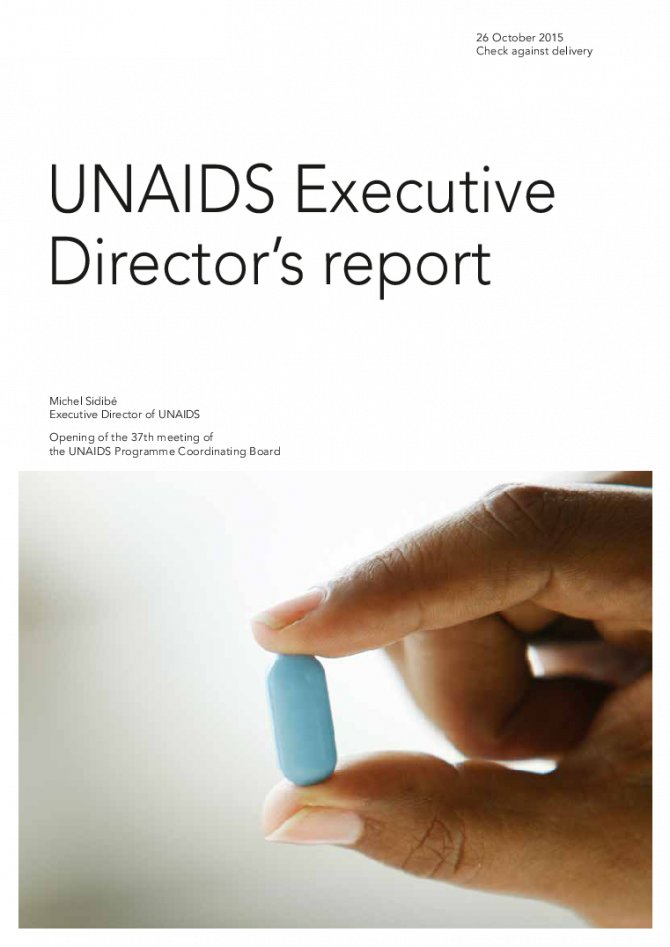
This 37th meeting of the PCB comes at a critical moment in our history—and for our future. It is timely that we are meeting so soon after the world adopted the 2030 Agenda for Sustainable Development and has collectively committed to end the AIDS epidemic as a public health threat by 2030. When we proposed this deadline, people thought it was a dream. But thanks to your passion and leadership, the world has embraced it as an achievable goal.
Documents
Tackling inequalities, empowering women and girls and leaving no one behind
26 September 2015
Excellencies, ladies and gentlemen, UNAIDS welcomes the historic adoption of ‘Transforming our world: The 2030 Agenda for Sustainable Development’ - which is the result of a mighty collaborative effort across the public and private sectors and civil society.
Documents
UNAIDS Executive Director's report to PCB-36
03 July 2015
2015 finds us at a true turning point in development—how it is debated and how it is practiced. In September, UN member states are expected to adopt one of the most ambitious agendas in history—the Sustainable Development Goals (SDGs)—which will guide social, economic and environmental action over the next 15 years. The world will begin reaping the benefits of a momentous shift towards society-wide, people-centred approaches to health, climate and social equity.
Documents
Reviewing progress made in the implementation of the Beijing Declaration and Platform for Action (BPFA), 20 years after its adoption at the Fourth World Conference on Women in 1995
20 March 2015
This statement is on behalf of the Secretariat and the cosponsors of the Joint United Nations Programme on HIV/AIDS (UNAIDS). We appreciate the opportunity to discuss how action to address HIV, including through work responding to the Millennium Development Goals, has helped to ‘advance the goals of equality, development and peace for all women everywhere in the interest of all humanity’ as outlined in the Beijing Declaration and Platform for Action and its reviews, and further elaborated in the 1994 ICPD and its subsequent reviews – as well as how this progress can be accelerated and scaled up before the end of the MDGs and in the era of the Sustainable Development Goals.
Documents
Executive Director's Report - Down to the details: Fast-Tracking the response to end the AIDS epidemic by 2030
11 December 2014
My friends, we must continue to collectively reflect on how we can become more fit for purpose for the post-2015 transformative agenda—both at UNAIDS and in the United Nations system as a whole. We discussed this at the Chief Executives Board and agreed that a United Nations system that can deliver on the post-2015 agenda must effectively meet the challenges of the twenty-first century. These challenges are diverse and complex and demand the effective coordination of government, civil society, the private sector, academia and others. UNAIDS is uniquely placed to bring together all actors.
Documents
UNAIDS Executive Director's World AIDS Day 2014 message
24 November 2014
On World AIDS Day 2014, it is time to redouble our efforts, to fast-track our actions and close the gap between people who have access to HIV prevention, treatment, care and support services and people who are being left behind.
Documents
90-90-90: A transformative agenda to leave no one behind
25 October 2014
This bold new set of targets, 90-90-90, will do more than reduce new HIV infections and AIDS-related deaths. It will be a transformative agenda for reaching people who are left behind. We have heard from Minister Tien that—with a lot of effort—they have been able to put 38 percent of people in Vietnam who need it on HIV treatment. By 2020, our cascading targets are to have at least 90 percent of all Vietnamese living with HIV know their diagnosis; 90 percent of those people to be receiving antiretroviral treatment; and 90 percent of those on HIV treatment to have an undetectable viral load.
Documents
The last climb: ending AIDS, leaving no one behind
20 July 2014
My friends, let us not leave Melbourne thinking that it will be easy to reach the summit. Complacency will cause us to stumble. Will future generations say that we squandered the opportunity of a lifetime? I know the path will be steep and the obstacles many. Let us do this in memory of our colleagues who died en route to Melbourne and the millions who have died of AIDS-related illnesses and of the tens of millions of people living with HIV. If every person here tonight, and everyone working to end the epidemic, acts with the same sense of urgency, the same hope and the same commitment to fight for those left behind, we will scale this mountain. But only if we go arm in arm will we reach the top and the end.

Documents
Speech by Michel Sidibé, Executive Director of UNAIDS on the occasion of New York Forum for Africa, Libreville, Gabon
23 May 2014
Today we can tell the world that soon there will be more African children born with AIDS. There are several countries, including Gabon and Rwanda, where we already have generations born without AIDS. And I believe that this is a small indication of this victory, which of course has resulted in change on several levels. Today we can say that we have not only reduced the price of the drug. We produce one of the best drugs in the world, in South Africa, and no longer for $15,000 per year, but $80 per year per person.
