Documents
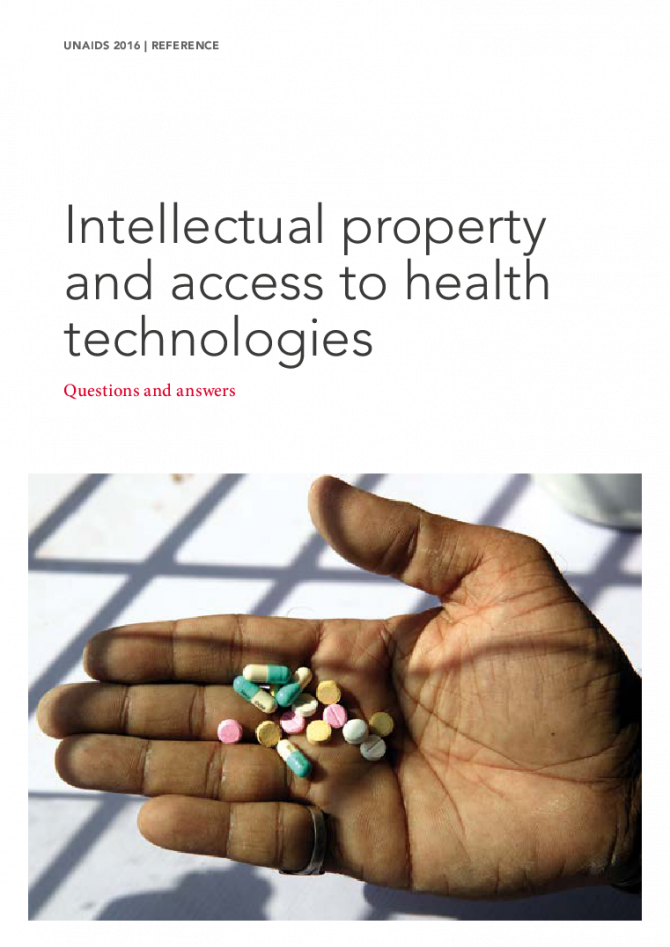
Intellectual property and access to health technologies
27 May 2016
This document provides a review of key issues related to intellectual property policies and their potential impact on access to HIV and other medicines. It is intended as an introduction to the issues for civil society engaged in the response to HIV and other health concerns.
Documents
Fast-Tracking combination prevention
19 October 2015
To reduce new HIV infections globally to fewer than 500 000 by 2020, a step towards ending the HIV epidemic as a public health threat by 2030, we need to Fast-Track the response, including renewed commitment to, sustained funding for and scaled-up implementation of HIV prevention programmes.
Documents
Do no harm - Health, human rights and people who use drugs
15 April 2016
Evidence supports the need for a shift in the global approach to drug use. In this report, Do no harm: health, human rights and people who use drugs, UNAIDS shows what works to reduce the impact of HIV and other harms related to drug use. Countries that have moved away from laws and policies that are harmful to people who use drugs and that have increased investment in harm reduction have reduced new HIV infections and improved health outcomes. These policies also deliver broader social benefits, such as lower levels of drug-related crime and reduced pressure on health-care and criminal justice systems.
Documents
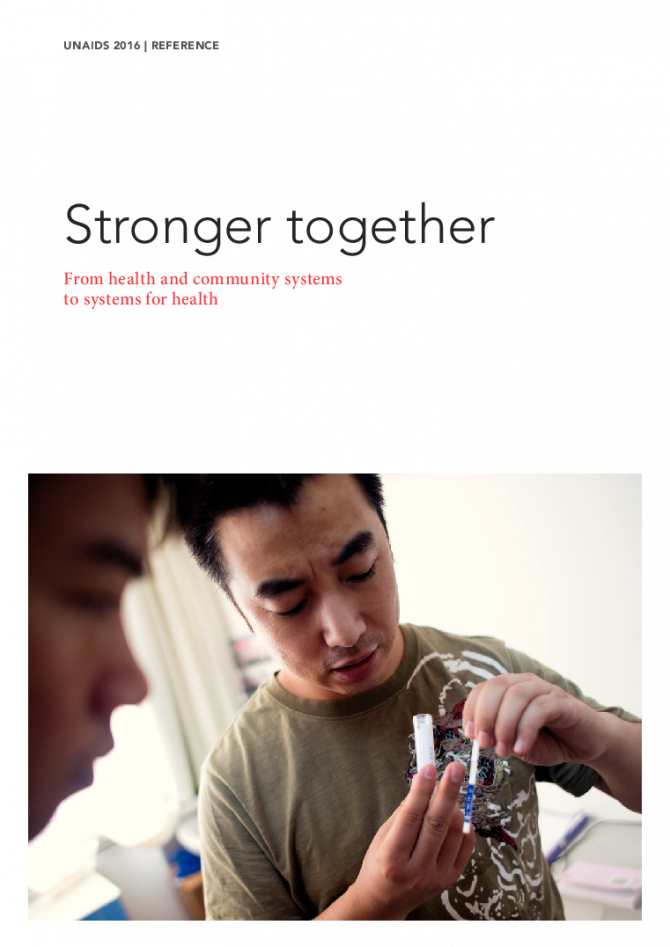
Stronger together: From health and community systems to systems for health
04 April 2016
This report is intended as a guide to governments, in particular ministers of health and finance, in making decisions on the integration of community responses to HIV in national AIDS plans, including budget allocations. Resilient systems for health that integrate community responses will be key to ending the AIDS epidemic by 2030.
Documents
Invest in advocacy
04 April 2016
Advocacy by people living with and affected by HIV has been critical to the progress made the response to HIV since the beginning of the epidemic. Advocacy has sparked action in the face of denialism and indifference, mobilized unprecedented financial resources and enabled communities to participate in designing health services that meet their needs. When traditional policy- making processes stall due to bureaucracy, advocacy shines a light on the problem and leverages community power and political will to drive action and innovation. This is why AIDS advocates around the world remain a major force for an accelerated, more equitable scale-up of effective HIV and health programming.

Documents
Fast-Track update on investments needed in the AIDS response
01 April 2016
The world has pledged within the Sustainable Development Goals to end the AIDS epidemic as a public health threat by 2030. Such an extraordinary achievement will require an extraordinary and urgent effort—fully funding and front-loading investment in comprehensive HIV responses and intensifying the focus on the populations and locations in greatest need. The UNAIDS 2016–2021 Strategy elaborates this Fast-Track approach. Adopted by the UNAIDS Programme Coordinating Board in October 2015, the Strategy contains HIV service coverage targets that need to be achieved by 2020 to establish the momentum necessary to overcome one of the largest public health threats in human history by 2030.
Documents
ten targets: 2011 United Nations Political Declaration on HIV and AIDS
31 December 2015
In this report we review global progress made towards those 10 targets in advance of the critical milestone of the 2016 United Nations General Assembly High-Level Meeting on Ending AIDS and in the context of the target of ending AIDS by 2030 as part of the Sustainable Development Goals. This is an important opportunity to reflect on progress, but also to identify where gaps remain and to take action to ensure that no one is being left behind by the global AIDS response. The UNAIDS 2016–2021 Strategy aims to harness the momentum we have achieved to date. If we do not Fast-Track our efforts the number of new HIV infections and AIDS-related deaths will rebound. Investment in AIDS must not falter; in fact, in the short-term it needs to increase. Front-loading investment now will ultimately lead to greater impact and long-term cost-saving.

Documents
A public health and rights approach to drugs
18 December 2015
UNAIDS welcomes the stronger health and rights approach that is emerging in current drug control debates in the context of the 2016 UNGASS on the World Drug Problem. This trend needs to be translated into concrete operational and measurable commitments by Member States.

Documents
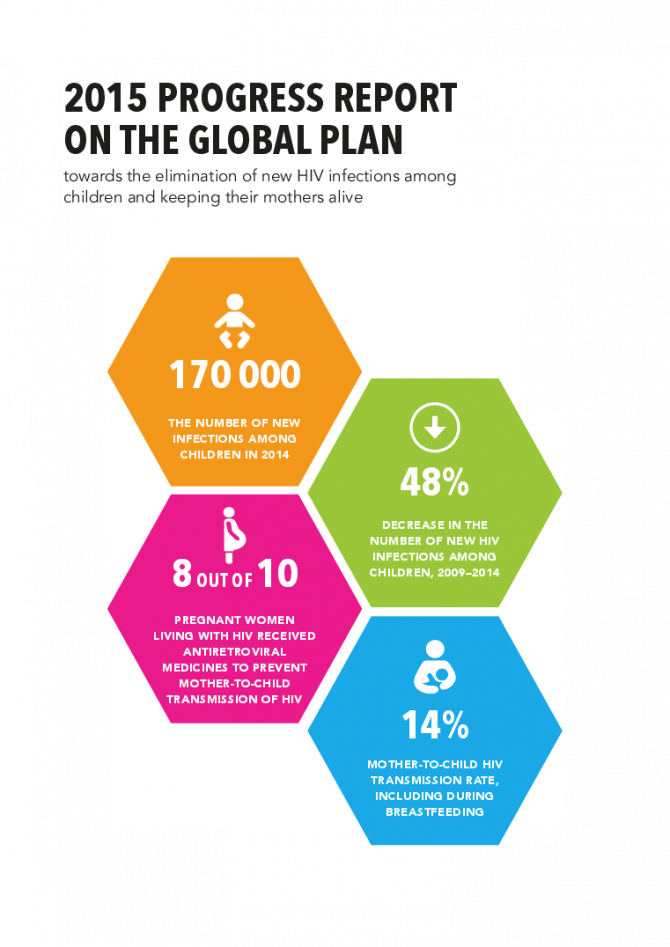
2015 progress report on the global plan towards the elimination of new HIV infections among children and keeping their mothers alive
26 November 2015
This is the fourth annual report of the Global Plan, and it summarizes the progress made through December 2014. The final accountability report of the Global Plan will be issued in 2016 when data for the end of 2015 will be available. The Global Plan was developed during 2010 by a Global Task Team (GTT) co-chaired by UNAIDS and the Government of the United States. The GTT consisted of a consortium of stakeholders from 25 countries and 30 civil society groups, private sector partners, networks of people living with HIV and international organizations. The Global Plan was launched as a major new global initiative in 2011, but it uses 2009 as the baseline year against which to measure progress.
Documents
Fast-Track cities update, December 2015
31 December 2015
Launched only a year ago, Fast-Track cities has rapidly taken root and grown. This is the first annual update on progress in implementing the Fast-Track cities approach and it supports one of the seven key commitments contained in the Paris Declaration. This report reflects on the actions taken by cities and by the four core partners— the city of Paris, UNAIDS, the United Nations Human Settlements Programme (UN-Habitat) and the International Association of Providers of AIDS Care (IAPAC)—towards ending the AIDS epidemic as a public health threat by 2030. Future reports will illustrate good practices and quantifiable evidence of progress that will inspire and inform Fast-Track cities and the many stakeholders helping to confront AIDS as a health and development challenge.