Documents
Oral pre-exposure prophylaxis–questions and answers
12 July 2015
Implementing PrEP poses new challenges in planning, managing and funding combination prevention. Realizing the promise of PrEP will require governments, funders, civil society and other stakeholders to join forces to systematically address them–licensing antiretroviral medicines for PrEP use, setting priorities for locations and populations for implementation, making services user-friendly and ensuring adherence. These efforts are worthwhile based on their contribution to achieving the global targets of less than 500 000 people annually acquiring HIV in 2020 and the end of AIDS as a public health threat by 2030.

Documents
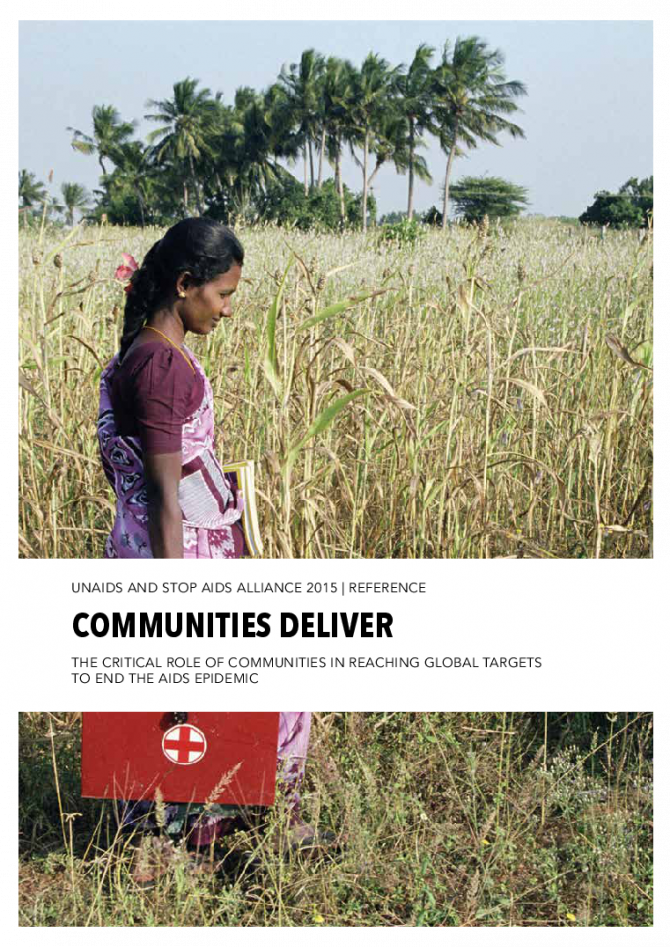
The critical role of communities in reaching global targets to end the AIDS epidemic
13 August 2015
This report draws on multiple sources to document the many ways in which communities are advancing the response to AIDS, and the evidence for the effectiveness of these responses. Core areas of community-based activities include advocacy, service provision, community-based research and financing; each of these areas is illustrated by examples of community-based actions.
Documents
Understanding Fast-Track
07 July 2015
Achieving the Fast-Track milestones by 2020 will put the world on a trajectory to end the AIDS epidemic by 2030. The gains will be massive. UNAIDS calculations show that reaching the 2020 milestones will produce multiple major benefits compared to maintaining the current approach.
Documents
AIDS by the numbers 2015
24 November 2015
The world has halted and reversed the spread of HIV. The epidemic has been forced into decline. New HIV infections and AIDS-related deaths have fallen dramatically since the peak of the epidemic. Now the response is going one step further—ending the AIDS epidemic by 2030.
Documents
On the Fast-Track to end AIDS by 2030: Focus on location and population
24 November 2015
Within the pages of this World AIDS Day report, Focus on location and population, are more than 50 examples of how countries are getting on the Fast-Track. It shows how governments are working with community groups and international partners to scale up health and social services that put people at the centre and located where they can do more people more good.
Read the publication on ISSUU
- Part 1 (Foreword - Conclusions)
- Part 2a (Where services are needed - Lesotho)
- Part 2b (Malawi - References)
Download
Documents
The Cities Report
28 November 2014
Urban areas are also home to millions of people who have fallen through the cracks of social, political and economic life. People who lack access to education, health services and prevention measures face significantly higher health risks. Under these social conditions, many diseases including HIV spread more quickly. Additionally, poor sanitation and crowding foster the spread of tuberculosis, which is the leading cause of death among people living with HIV. Cities need to address their significant disparities in access to basic services, social justice and economic opportunities. Using a Fast-Track AIDS response, cities can improve social equality for people affected by HIV and those living with the disease, while also addressing related public health challenges in new and innovative ways to prevent disease. Methodology Additional resources
Documents
Sustaining the human rights response to HIV
20 October 2015
The human rights response to HIV, largely implemented by civil society, has been crucial to the HIV response, but it appears that the funding for this work is insufficient and may be threatened further. Based on these concerns—and with the support of the Ford Foundation—UNAIDS commissioned research to better understand the current and future funding landscape as experienced by the civil society groups that are implementing key human rights programmes in the HIV response. This paper presents the results of this research and makes recommendations in an effort to ensure sufficient and sustainable funding for that crucial work until the end of the AIDS epidemic.

Documents
Daily Development: Exploring global development and the people behind it
14 October 2015
Global goals inspire action. They forge new pathways towards a better future and they demonstrate just how inextricably linked we are in this world. Early on in the AIDS response we learned that responding to AIDS could not be done in isolation. We would need a people-centred approach that left no one behind. And the response became an example of what a holistic development agenda could look like when evidence and human rights meet hope and resilience. By reaching and exceeding Millennium Development Goal 6, we halted and reversed the AIDS epidemic and ensured more than 15 million people had access to life-saving HIV treatment. When goals are reached we reach even higher.
Documents
Ending the AIDS epidemic: the advantage of cities
18 September 2015
Cities gave rise to the first cases of HIV infection ever recognized, and the role of urban areas in the global AIDS response has only intensified over time. Globally, 200 cities account for roughly 25% of all people living with HIV. In many countries, a single city accounts for 40% or more of all people living with HIV.
Documents
Cities unite to Fast-Track to end the AIDS epidemic. Event summary: taking action World AIDS Day 2014
15 April 2015
Ending the AIDS epidemic by 2030 is feasible if the world’s major cities act immediately and decisively to Fast-Track their AIDS responses by 2020. Success will rely upon cities frontloading investments and stepping up the pace of delivering HIV services, especially the roll-out of antiretroviral therapy.