
Feature Story
Unlocking community actions in Uzbekistan
30 March 2026
30 March 2026 30 March 2026Civil society organizations in Uzbekistan help deliver peer-to-peer outreach, HIV testing, awareness-raising and prevention. As external funding for HIV declines in the land-locked country in Central Asia, it now faces a critical task: ensuring that prevention and community-led services are sustained.
Community organizations provide support that is not always visible in the country. Over the years, their direct engagement with populations affected by HIV or at risk of HIV has shown that barriers to services exist. Stigma, fear, limited awareness and existing policy constraints continue to prevent people from accessing testing, treatment and health care.
“Our added value lies in our grassroots experience,” said Sobir, a local representative of a community organization providing HIV services. “We know what the challenges are in the healthcare system and understand where the gaps are.”
He gave the example of self-testing kits. Despite being available online people still did not use them. “The government is working to expand access, but our role is to help ensure these services actually reach people and that they trust us.”
With an estimated 60,000 people living with HIV and a growing share of infections linked to sexual transmission, Uzbekistan ranks among the third highest epidemic in Eastern Europe and Central Asia.
Uzbekistan has made significant progress in expanding access to HIV testing and treatment and strengthening national ownership of its response. Most HIV treatment and diagnostic services are now financed through the state budget, and treatment is free and accessible to all people in need. But HIV prevention programmes and community outreach have so far relied heavily on external support, including from the Global Fund to Fight AIDS, Tuberculosis and Malaria.
“Bridging this gap will be essential to maintaining progress and reducing new HIV infections,” said Eamonn Murphy, UNAIDS Regional Director for Eastern Europe and Central Asia and Asia-Pacific. “Treatment alone will not end the epidemic. Strengthening prevention, supporting community-led services and addressing stigma are critical.”
In his view with sustained investment in community-led services, strong partnerships, and a long-term commitment to programme sustainability, the country could well become the first in Central Asia to reach the 95–95–95 targets. The Government’s decision to strengthen cooperation with the non-governmental sector and national and local level resources have been encouraging signs.
“We actively work with the Republican AIDS Center, the Ministry of Health and social protection,” said Sergey Uchayev, Head of Ishonch va Hayot, the ‘'Union of People Living with HIV in Uzbekistan’ network.” They involve us in developing policies, strategies, and plans. There is growing interest at different levels in working with us,” he said.
At the same time, he echoed concerns raised by many civil society organizations about the absence of a functioning mechanism that allows government institutions like his to contract HIV services from community-based organizations.
“State budget allocations for HIV services require defined standards, budgeting frameworks, financing mechanisms, and strong transparency and accountability systems,” he said. “Without this, available resources from state and local budgets cannot yet be effectively channeled to community-led HIV services.”
The time to act is now. “With many of the key elements already in place, and while donor funding is still available, we should not miss this opportunity,” he added.
Such systems are already in place in Moldova, as well as in Kazakhstan and Kyrgyzstan. He believes UNAIDS and partners can play a critical role in bringing stakeholders together and facilitating this process.
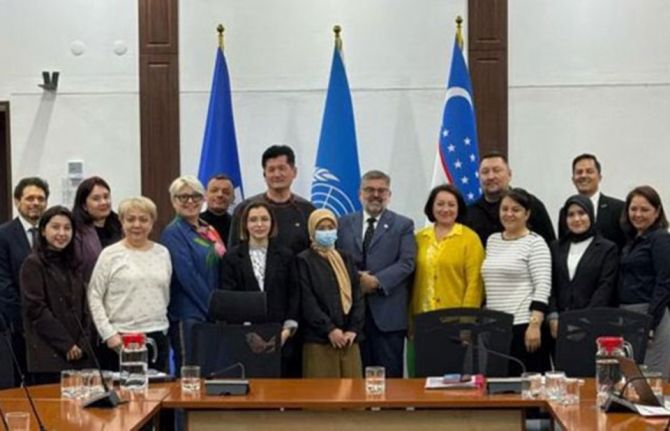
In Tashkent, mid-March 2026, the United Nations in Uzbekistan convened the first Joint UN–Government Steering Committee meeting on the new United Nations Sustainable Development Cooperation Framework (UNSDCF) 2026–2030. The meeting discussed priority areas for joint action, including the sustainability of the HIV response.
As Uzbekistan undergoes rapid social and economic transformation, the public health sector is no exception.