

Press Release
UNAIDS calls on African leaders to resource the HIV response, protect human rights, and seize the opportunity of new innovations to end AIDS
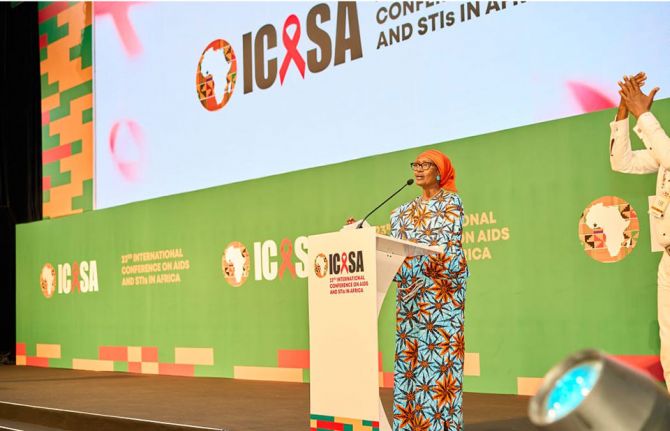
10 December 2025 10 December 2025The Executive Director of UNAIDS Winnie Byanyima made the call during the African AIDS conference ICASA in Accra, Ghana saying “ending AIDS is a political choice”
ACCRA/GENEVA, 10 December 2025—African leaders can put the continent back on track to end AIDS by 2030 by choosing to resource the HIV response, protect human rights, and seize the opportunity of new innovations was the strong message brought by UNAIDS to the 23rd International Conference on AIDS and STIs in Africa (ICASA).
“Ours is the continent with the highest HIV burden in the world—we are only 19% of the world’s population, but we make up 65% of the total number of people living with HIV globally,” said Ms Byanyima. “More than half of the people waiting for treatment live here on this continent. More than half of all the new HIV infections every year happen here in Africa. Yet we have the science, the tools, the knowledge that’s needed to end AIDS. AIDS is no longer a medical challenge. Ending AIDS is a political choice.”
A sudden, rapid acceleration of cuts to international HIV financing, alongside spiralling debt burdens and a regression of human rights, is threatening fragile progress in reducing AIDS deaths and HIV infections – with HIV prevention and community-led services worst hit.
Addressing leaders at the conference, Ms Byanyima said that Africa was not being beaten down by the decline in foreign assistance, “Our continent is moving steadily towards more sustainable, inclusive, and domestically-financed HIV responses,”
UNAIDS is supporting governments to mobilise more domestic resources of HIV, developing roadmaps to move towards more sustainable HIV financing, urging international partners to support debt relief for health, and calling for regional initiatives – including the Accra Reset and African Union Roadmap to 2030 – to move from planning to implementation.
UNAIDS warned African leaders that the determined, organized and well-funded backlash against human rights and gender equality is pushing people further away from life-saving HIV services. The number of countries criminalising same-sex relationships has increased this year for the first time since UNAIDS began reporting.
“These laws are not African in origin, they are colonial-era imports, which are now reinforced by global ideological movements,” said Ms Byanyima. “To protect people’s health, we must protect their rights. There’s no choice there. This is at the heart of our belief, our African values, Ubuntu, which means “I am because we are.”
UNAIDS highlighted the potential of new long-acting HIV medicines to spark a HIV prevention revolution, to mirror the HIV treatment revolution of the last 30 years. This includes long-acting injectable PrEP, which prevents transmission with injections as little as twice a year. Ms Byanyima called on producers – particularly lenacapavir producer Gilead - to do more to enable access, including licensing generic production in sub-Saharan Africa and in Latin America. She urged African governments and international partners to invest in getting long-acting PrEP to all those who need it.
In the longer term, UNAIDS is calling for governments to invest in regional manufacturing and innovation. Ms Byanyima praised the Global Fund for procuring a first-line HIV treatment produced in Kenya which is now saving lives in Mozambique, and welcomed the Global Coalition for Local and Regional Production, Innovation and Equitable Access, launched under Brazil’s G20 Presidency to overcome unequal access to health technologies that often drive disease.
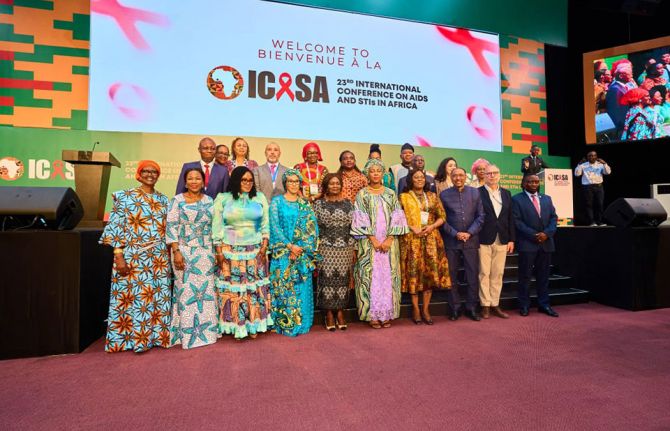
ICASA, the International Conference on AIDS and STI’s in Africa, is a biannual conference which was held this year in Ghana’s capital Accra between 3-8 December. ICASA brought together stakeholders from multilateral institutions, scientists, governments and community-led organizations to establish ways forward and keep the momentum to end AIDS by 2030 across the African continent.