

Press Release
New Global AIDS Strategy and Transition Working Group adopted at UNAIDS’ 57th Board meeting
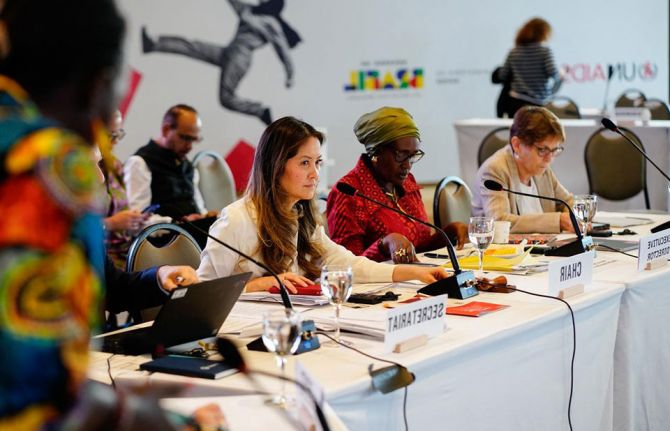
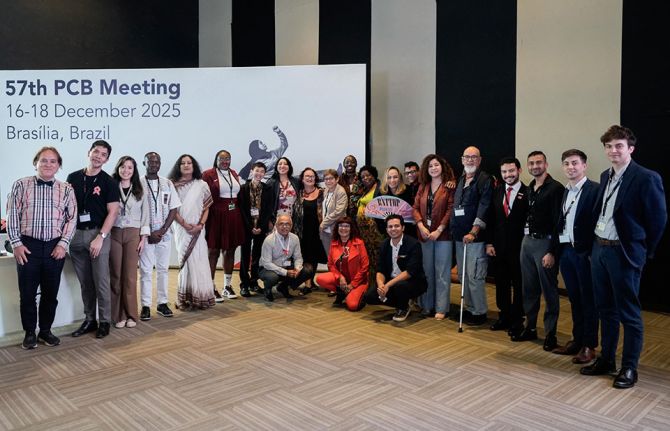
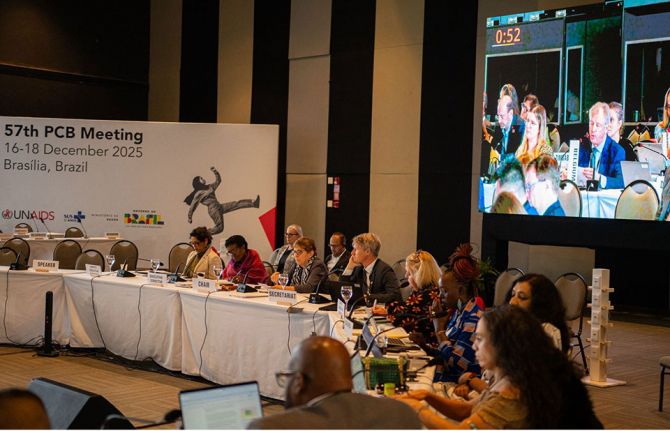
19 December 2025 19 December 2025BRASILIA/GENEVA, 19 December 2025—The 57th Programme Coordinating Board (PCB) meeting concluded in Brazil this week at a time of severe disruptions to the HIV response in many countries and to the work of the UNAIDS Joint Programme. In this context, the Board adopted a new Global AIDS Strategy 2026-2031 for the world, “United to End AIDS."
“Inaction is not an option. If we stall and fail to reach the targets laid out in the Strategy, 3.3 million more people will be newly infected by 2030. We cannot allow that,” said Winnie Byanyima, Executive Director of UNAIDS.
During the three-day meeting, board members approved establishing a PCB Working Group to develop a plan and timeline for UNAIDS’ transition and integration into the UN system. The group will ensure meaningful engagement of all relevant constituencies – civil society, governments, Cosponsors, and other partners in-line with the UN80 initiative. “One of our key tasks through the Global AIDS Strategy, the transition of UNAIDS, and UN80 more broadly is to better understand how we can effectively encourage the international community to re-engage,” said Amina J. Mohammed, Deputy Secretary General of the United Nations. “Lives, dignity and hard-won progress are still on the line. UNAIDS has shown what collective action can achieve. This legacy must be protected.”
Throughout the meeting, PCB members and observers expressed deep appreciation for the critical role UNAIDS plays in the HIV response and UNAIDS staff. They spoke with conviction about what dedication means for governments and communities around the world.
“Brazil has reaffirmed, as a central government priority, the elimination of socially determined diseases, including the AIDS epidemic,” said Mariangela Simao, Brazil’s Vice Minister for Health Surveillance and Environment. “This agenda is grounded in our Unified Health System - universal, comprehensive and free of charge - which guarantees prevention, diagnosis and treatment across a country of continental scale and deep regional diversity,” she said.
“We cannot afford to backtrack when we made the promise to the most vulnerable,” said Erica Schouten, Ambassador of the Kingdom of the Netherlands to the United Nations. "We also cannot walk away at the very moment that the HIV response needs global solidarity more than ever.”
A sentiment echoed by the North America NGO delegate. “The inclusion of NGO voices in UNAIDS is not symbolic, it is foundational to the strength and legitimacy of the Joint Programme,” said Shamin Mohamed Jr. “A premature sunset of international coordination and support is a set-back. If we do things too soon, people’s lives will end too soon as well.”
The board recognized that UNDP, UNFPA, UNHCR, UNICEF, UNODC, and WHO will be lead Cosponsors and ILO, UNESCO, UN Women, WFP and the World Bank will be affiliate Cosponsors.
The Strategy and the 2030 targets will inform the United Nations General Assembly High-Level Meeting on AIDS and the Political Declaration on HIV/AIDS in 2026.
UNAIDS thanked its many donors for their steady support and 2025 contributions, including: Australia, Belgium/Flanders, Canada, Denmark, Germany, Ireland, Japan, Luxembourg, The Netherlands, Norway, Monaco, Spain and the United Kingdom.
The meeting’s thematic session on long-acting retrovirals– both for prevention and treatment – demonstrated how they can accelerate progress toward ending AIDS. With political will, financing, community leadership and partnerships, such medicines can transform the response, close the access gaps, and reduce new infections dramatically.
The 57th PCB was chaired by Brazil and going forward, the Board elected The Netherlands as Chair, the Philippines as Vice-Chair and Kenya as Rapporteur for 2026. The Report to the Board by the UNAIDS Executive Director, and the reports for each agenda item and the PCB’s decisions can be found here.The 58th meeting of the PCB will take place in Geneva on the 30th of June to the 2nd of July 2026.
UNAIDS
The Joint United Nations Programme on HIV/AIDS (UNAIDS) leads and inspires the world to achieve its shared vision of zero new HIV infections, zero discrimination and zero AIDS-related deaths. UNAIDS unites the efforts of 11 UN organizations—UNHCR, UNICEF, WFP, UNDP, UNFPA, UNODC, UN Women, ILO, UNESCO, WHO and the World Bank—and works closely with global and national partners towards ending the AIDS epidemic by 2030 as part of the Sustainable Development Goals. Learn more at unaids.org and connect with us on Facebook, Twitter, Instagram and YouTube.