Feature Story
Innovative financing for development the goal of new I-8 Group
20 May 2009
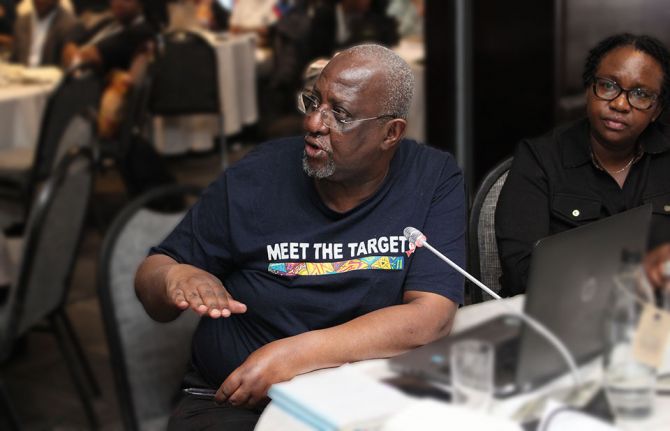
20 May 2009 20 May 2009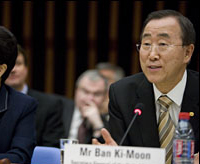 UN Secretary-General is in Geneva this weeking attending the World Health Assembly. Credit: WHO
As global economic slowdown threatens to negatively affect those already most vulnerable to poverty, the achievement of the Millennium Development Goals (MDGs) around the world will require a change of scale in the implementation of innovative financing mechanisms for development.
To address this challenge, Dr Philippe Douste-Blazy, Special Advisor to the Secretary-General of the United Nations in charge of Innovative Financing, proposed the creation of a group which brings together eight finance initiatives, United Nations agencies and representatives of civil society.
The I-8 Group for the Millennium Development Goals held its first meeting in Geneva on 19 May 2009. The Secretary-General of the United Nations Mr Ban Ki-moon addressed the opening session, as did Dr Margaret Chan, Director-General of the World Health Organization (WHO) and Mr Michel Sidibé, Executive Director of UNAIDS.
We urgently need to strengthen and scale up existing innovative mechanisms, and explore new ones. This meeting will create a regular network of consultation, coordination and mutual reinforcement among innovative financing efforts worldwide.
The Secretary-General of the United Nations, Mr Ban Ki-moon
The current economic crisis, according to UN Secretary-General Ban Ki-moon, makes innovative financing all the more important.
“We urgently need to strengthen and scale up existing innovative mechanisms, and explore new ones,” said the Secretary-General in his opening remarks. “This meeting will create a regular network of consultation, coordination and mutual reinforcement among innovative financing efforts worldwide.”
If we are going to reach the Millennium Development Goals, we must avoid duplication, resist competition, and put people at the centre
Michel Sidibé, Executive Director of UNAIDS
Mr Michel Sidibé spoke of how the I-8 or "innovative eight" could help bridge the gap between development needs and resources committed and build a more just, equitable and healthy world. He also reminded participants of the human aspect of the challenge: “If we are going to reach the Millennium Development Goals, we must avoid duplication, resist competition, and put people at the centre,” said Mr Sidibé.
A panel discussion on innovative financing mechanisms was moderated by Dr Patrice Debré, French Ambassador for the fight against HIV/AIDS and communicable diseases at the French Ministry of Foreign and European Affairs.
The I-8 Group for the Millennium Development Goals includes the following finance mechanisms:
- The International Finance Facility for Immunization (IFFIm), created to support the Global Alliance for Vaccines and Immunizations (GAVI)
- UNITAID
- The Advance Market Commitments for vaccines
- The “Debt 2 Health” initiative of the Global Fund to Fight AIDS, Tuberculosis and Malaria
- (PRODUCT) RED
- The Responsible Social Investment initiative of the Agence Française de Développement (AFD)
- The use of revenues from the Carbon Market
- Millennium Foundation for Innovative Finance for Health
The objectives of the first meeting of the informal network included agreement on a common framework for future information sharing, an exchange of experiences, and the development of a joint message on the consequences of the economic and financial crisis for the developing world.
The aim of I-8 is to share experiences, work on one common set of messages to reinforce the current initiative from the High-Level Taskforce on Innovative International Financing for Health Systems and the Leading Group on Solidarity Levies to fund Development, prepare the ground for new initiatives, and coordinate the channelling of resources in order to achieve maximum impact on the ground. Through this it is hoped that future initiatives, whether new ideas or the extension of existing initiatives, can be implemented as quickly and successfully as possible.
The event took place during the sixty-second World Health Assembly which runs in Geneva until 22 May 2009.
Right Hand Content
Feature Story
Sixty-second World Health Assembly to be dominated by A(H1N1)
18 May 2009
18 May 2009 18 May 2009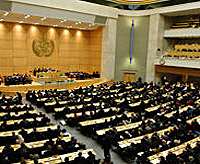
Photo (60th WHA)
Credit WHO/Peter Williams
This year’s World Health Assembly is set to focus considerable attention on the widespread outbreak of influenza A(H1N1), as Health Ministers and officials of more than 190 countries gather in Geneva from 18-22 May to discuss the most effective responses to the potential pandemic, including preparedness, access to vaccines and sharing of influenza viruses.
According to the latest World Health Organization (WHO) statistics, there are now 39 countries reporting a cumulative total of 8480 cases of A(H1N1) (17 May update). The virus represents a serious and growing health threat. WHO Director-General Dr Margaret Chan has called for “global solidarity” in the face of this unpredictable threat and the sixty-second World Health Assembly will provide an opportunity for such solidarity.
The World Health Assembly, convened by the Director-General of the World Health Organization, will also follow its broad remit to review progress and set new priorities for the WHO. Other issues to be examined will include primary health care and health system strengthening; exploring the social determinants of health and monitoring the achievement of the health-related Millennium Development Goals. There will also be room for the discussion of the programme budget for the next two years and internal management matters.
A key element of the meeting is the consideration of the revised version of the Medium-term strategic plan 2008-2013 which has 13 objectives including the reduction of the health, social and economic burden of communicable disease; mitigating the health consequences of emergencies, disasters, crises and conflicts; ensuring improved access, quality and use of medical products and technologies, and challenging the spread of AIDS, tuberculosis and malaria.
Delegates hope to build on the success of previous meetings. For example, in 2008 the assembly endorsed a public health, innovation and intellectual property strategy which promoted new approaches to drug research and development and championed the removal of barriers, enhancing access to medicines, especially for less developed nations. The gathering also adopted a resolution urging Member States to take decisive action to address the health impacts of climate change.
It is clear that the World Health Assembly is expected to explore a complex array of issues that transcend the sphere of health, touching on and interconnecting with a broad range of other sectors with the aim of mounting an effective challenge to global health threats.
During the week, UNAIDS Executive Director Michel Sidibé will participate in a range of side events including meetings with national ministers of health from around the world.
Right Hand Content
Cosponsors:
Feature stories:
Sixty-first World Health Assembly (19 May 2009)
Influenza A (H1N1) and HIV infection (01 May 2009)
Multimedia:
View photo gallery of opening day of World Health Asembly
External links:
Complete documentation for the sixty-second World Health Assembly
Key issues for the World Health Assembly 2009
International Health Regulations
Primary health care
Social determinants of health
Millennium Development Goals (MDGs)
Considerations on influenza A(H1N1) and HIV infection - WHO guidance note
More on influenza A(H1N1)

Feature Story
International Day against Homophobia
14 May 2009
14 May 2009 14 May 2009
Homophobia and criminalization of consensual adult sexual behaviour represent major barriers to effective responses to HIV.
By signing the 2006 United Nations Political Declaration on HIV/AIDS, governments committed to removing legal barriers and passing laws to protect vulnerable populations. However, over 80 countries still criminalize consensual same sex acts among adults.
It is against this repressive context that communities worldwide celebrate the International Day Against Homophobia each 17 May, which marks the anniversary of the World Health Organization’s decision to remove homosexuality from its list of mental disorders in 1990. Therefore, 17 May is an opportunity to highlight once again the urgent need for joint efforts to reduce and end discrimination, violence and criminalization based on sexual orientation.
Homophobia and criminalization of consensual adult sexual behaviour represent major barriers to effective responses to HIV. Such responses depend on the protection of the dignity and rights of all people affected by HIV, including their right and ability to organize and educate their communities, advocate on their behalf, and access HIV prevention and treatment services.
“The decision to criminalize same sex relations is a serious setback to the AIDS response and to the rights of those affected by the law,” said Michel Sidibé, Executive Director of UNAIDS. “As these discriminatory laws can drive people underground, they will have a negative impact both on the delivery of HIV prevention programmes and on access to treatment for those living with HIV.”
Evidence shows that protection of the rights of men who have sex with men, lesbians and transgenders, both in law and practice, combined with scaled-up HIV programming to address their HIV and health needs are necessary and complementary components for a successful response to the epidemic.
UNAIDS urges all governments to take steps to eliminate stigma and discrimination faced by men who have sex with men, lesbians and transgenders and create social and legal environments that ensure respect for human rights and universal access to HIV prevention, treatment, care and support.
“There is no place for homophobia. Universal access to HIV prevention, treatment, care and support must be accessible to all people in need—including men who have sex with men,” said UNAIDS Executive Director Michel Sidibé.
Countries that have non-discrimination laws against men who have sex with men, injecting drug users and sex workers have achieved higher rates of coverage of HIV prevention efforts.
Right Hand Content
Feature stories:
Anti-homophobia campaign to end discrimination in Latin America (16 May 2009)
Hidden HIV epidemic amongst MSM in Eastern Europe and Central Asia (26 January 2009)
China to tackle HIV indidence amongst MSM (16 January 2009)
HIV prevention hampered by homophobia (13 January 2009)
ICASA 2008: Men who have sex with men and HIV in Africa (07 December 2008)
MSM and the global HIV epidemic (31 July 2008)
Strengthening work with MSM in Africa (23 May 2008)
International Day against Homophobia (16 May 2008)
International Day against Homophobia 2007 (17 May 2007)
Press centre:
AIDS responses failing men who have sex with men and transgender populations (15 May 2009)
Statement by Mr Michel Sidibé, Executive Director of UNAIDS, on occasion of the International Day Against Homophobia, 17 May (15 May 2009)
UNAIDS expresses concern over decision by Burundian National Assembly to criminalize same sex relations (27 April 2009)
UNAIDS welcomes the release of nine men in Senegal imprisoned for their sexual orientation (20 April 2009)
UNAIDS and broad coalition working towards the release of nine men who have sex with men in Senegal who have been convicted and imprisoned (15 January 2009)
Criminalization of sexual behavior and transmission of HIV hampering AIDS responses (27 November 2008)
Multimedia:

 UNAIDS delivers a strong message at the 23 TEDDY Award in Berlin

Feature Story
Influenza A(H1N1) and HIV infection
01 May 2009
01 May 2009 01 May 2009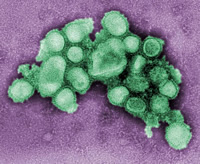 "Swine influenza"
Credit: C. S. Goldsmith and A. Balish, CDC
There are many questions concerning the potential impact of emerging influenza A(H1N1)* on people living with HIV, as they are more susceptible to opportunistic infections.
There is no documented information on clinical interactions between HIV and influenza A(H1N1) virus, whose transmission, incubation period and clinical manifestations have generally been similar to those of seasonal influenza viruses. Although there are inadequate data to predict the impact of a possible human influenza pandemic on people living with HIV, interactions between HIV and A(H1N1) influenza could be significant. Country preparedness plans for influenza should address the needs of people living with HIV, and national AIDS plans, especially in high HIV prevalence countries, should consider public health action required in case of pandemic influenza.
The World Health Organization has prepared a guidance note to assist countries and health workers in understanding the relevant risks and taking appropriate measures.
*As of 30 April 2009, WHO refers to the new influenza virus as influenza A(H1N1).
Right Hand Content
Related
Feature Story
Joint action for results: UNAIDS outcome framework, 2009 – 2011
22 April 2009
22 April 2009 22 April 2009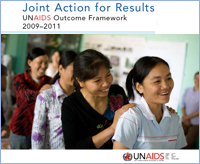
The HIV organizational landscape has evolved and grown more complex over the past decade. UNAIDS, donors and civil society, including networks of people living with HIV, have rightly demanded greater clarity on the relationships between needs, financing, activities and outcomes. Also demanded is greater specificity about the role of UNAIDS and the Secretariat within the wider constellation of actors.
This Outcome Framework, which builds upon the UNAIDS Strategic Framework (2007–2011), will guide future investment and hold the Secretariat and the Cosponsors accountable for making the resources of the UN work for results in countries. It affirms the UNAIDS Secretariat and Cosponsors to leverage our respective organizational mandates and resources to work collectively to deliver results.
Joint action for results: UNAIDS outcome framework, 2009 – 2011 (pdf, 388 Kb)
Joint action for results: UNAIDS outcome framewor
Cosponsors:
Office of the United Nations High Commissioner for Refugees (UNHCR)
United Nations Children's Fund (UNICEF)
World Food Programme (WFP)
United Nations Development Programme (UNDP)
United Nations Population Fund (UNFPA)
United Nations Office on Drugs and Crime (UNODC)
International Labour Organization (ILO)
United Nations Educational, Scientific and Cultural Organization (UNESCO)
World Health Organization (WHO)
World Bank
Publications:
Joint action for results: UNAIDS outcome framework, 2009 – 2011 (pdf, 388 Kb)
Related
Feature Story
New policy brief on disability and HIV
08 April 2009
08 April 2009 08 April 2009
The new policy brief explores the links between HIV and disability and makes recommendations for policy change.
Credit: WHO/Asis Senyal
An estimated 650 million people, or 10% of the world’s population, have a disability. Although people with disabilities are found within the populations at higher risk of exposure to HIV, not much attention has been paid to the relationship between HIV and disability.
For this reason, the Joint United Nations Programme on HIV/AIDS (UNAIDS), the World Health Organization (WHO) and the United Nations Office of the High Commissioner for Human Rights (UNOHCHR) have collaborated on a policy brief that explores the links between HIV and disability and makes recommendations for policy change.
This policy brief discusses the actions needed to increase the participation of persons with disabilities in the HIV response and ensure they have access to HIV services which are both tailored to their diverse needs and equal to the services available to others in the community.
Evidence shows that people with disabilities are at the same or greater risk of HIV infection as non-disabled people. Due to insufficient access to appropriate HIV prevention and support services, persons with disabilities may engage in behaviours which place them at risk of HIV infection, such as unprotected heterosexual or male-to-male sex (including in the context of sex work) and injecting drug use.
The policy brief states that a large percentage of persons with disabilities experience sexual assault or abuse during their lifetime, with women and girls, persons with intellectual impairments and those in specialized institutions, schools or hospitals being at particularly high risk. There is also evidence that in some cultures, persons with disabilities are raped in the belief that this will “cure” an HIV-positive individual.
Persons with disabilities may not benefit fully from HIV and related sexual and reproductive health services because services offered at clinics, hospitals and in other locations may be physically inaccessible, lack sign language facilities or fail to provide information in alternative formats such as Braille, audio or plain language. Also, service providers may lack knowledge about disability issues, or have misinformed or stigmatizing attitudes towards persons with disabilities.
As stated in the 2006 Convention on the Rights of Persons with Disabilities, persons with disabilities have the right to participate in decisions which affect their lives, and should be fully involved in the design, implementation and evaluation of HIV policies and programmes. This is the best way of ensuring these policies and programmes are responsive to their needs.
The policy brief on Disability and HIV calls for HIV services to be inclusive of persons with disabilities. It makes recommendations to governments, civil society and international agencies to eliminate physical, information and communication, economic and attitudinal barriers not only to increases access to HIV programmes, but to assist people in accessing broader health and social services.
Right HAnd Content
Cosponsors:
Feature stories:
Disability and HIV in Jamaica (08 September 2008)
Publications:
Policy brief: Disability and HIV (pdf, 207 Kb)
Related
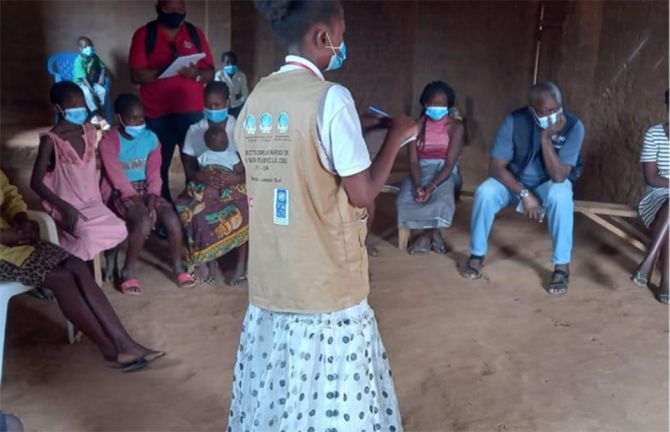
 Towards a life of dignity for people living with disabilities
15 February 2022
Feature Story
UNAIDS Committee of Cosponsoring Organizations meet
06 April 2009
06 April 2009 06 April 2009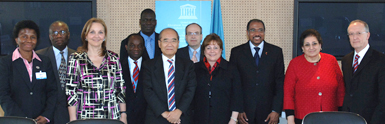
(from left): Joy Phumaphi, Vice President and Head of the Human Development Network, World Bank; Arnauld Akodjenou, Director, Division of Operational Services, UNHCR; Josette Sheeran, Executive Director, WFP; Anarfi Asamoa-Baah, Deputy Director General, WHO; Assane Diop, Executive Director, Social Protection Sector, ILO; Koichiro Matsuura, Director General, UNESCO; Ad Melkert, Administrator ad-interim, UNDP; Ann M. Veneman, Executive Director, UNICEF; Michel Sidibé, Executive Director, UNAIDS; Thoraya Ahmed Obaid, Executive Director, UNFPA; Antonio Maria Costa, Executive Director, UNODC. Paris, 3 April 2009,
The Joint United Nations Programme on HIV/AIDS (UNAIDS) brings together the efforts and resources of ten UN system organizations in the AIDS response. The UNAIDS Committee of Cosponsoring Organizations (CCO) serves as the forum for these Cosponsors to meet on a regular basis to consider matters of major importance to UNAIDS, and to provide input from the Cosponsoring organizations into the policies and strategies of UNAIDS.
On 3 April 2009, the CCO held their first meeting since the appointment of UNAIDS Executive Director Michel Sidibé.
The CCO expressed their full support for “universal access” which Mr Sidibé has outlined as the top priority for UNAIDS as well as the other priority areas of focus which will be set out in the new UNAIDS outcome framework currently being finalized with Cosponsors.
The meeting provided an excellent opportunity to share ideas on supporting countries in achieving their universal access goals. The need for UNAIDS to advocate for an evidence informed AIDS response that is grounded in human rights was accepted by all. Equally important was the need for accountability and results.
The CCO also endorsed the general directions of the 2010-2011 Unified Budget and Workplan including the key priorities and the allocation of resources between the Cosponsors, the Secretariat and Interagency activities. The Secretariat will now work with the Global Coordinators of the Cosponsors to finalize the UBW for the June 2009 meeting of the Programme Coordinating Board.
UNAIDS Committee of Cosponsoring Organizations (CCO)
The CCO comprises representatives from the ten UNAIDS Cosponsors and the UNAIDS Secretariat. It meets twice a year and each Cosponsor rotates as chair of the committee annually, on 1 July.
Right Hand Side
Cosponsors:
Office of the United Nations High Commissioner for Refugees (UNHCR)
United Nations Children's Fund (UNICEF)
World Food Programme (WFP)
United Nations Development Programme (UNDP)
United Nations Population Fund (UNFPA)
United Nations Office on Drugs and Crime (UNODC)
International Labour Organization (ILO)
United Nations Educational, Scientific and Cultural Organization (UNESCO)
World Health Organization (WHO)
World Bank
Related
 Keeping up the momentum in the global AIDS response
24 April 2019
 Malawi launches its health situation room
12 April 2019
 Learning lessons on evaluation
02 April 2019
Feature Story
Call for global action on the threat of drug-resistant tuberculosis
03 April 2009
03 April 2009 03 April 2009
Dr. Bernhard Schwartländer, UNAIDS Country Director for China, chaired a session on TB/HIV at the meeting.
Ministers from the 27 countries with the highest burden of multi-drug resistant and extensively drug-resistant tuberculosis (M/XDR-TB) have jointly endorsed a Call for Action on TB control and care to urgently address this alarming threat. The meeting in Beijing, China, on 1-3 April 2009, was organized by the World Health Organization (WHO), the Ministry of Health of the People's Republic of China and the Bill & Melinda Gates Foundation.
The two main aims of the meeting were to build consensus and political commitment globally and in countries with high levels of M/XDR-TB, and to act immediately to scale up the prevention and management of drug resistant tuberculosis. This will include developing five year national strategic plans, embedded within national TB and health sector plans.
The Call for Action, endorsed on the first day, recognizes the serious threat that this type of TB poses to people living with HIV and draws attention to the actions required to scale-up M/XDR-TB prevention, control and care. Countries are asked to identify the groups most vulnerable to, and at risk of, drug resistant TB and its impact, including people living with the virus, drug users, prisoners, migrant populations and other marginalized groups and to ensure that services to prevent and treat M/XDR-TB are targeted to meet their needs.
Among the recommendations was a call for governments and partners to strengthen efforts to mobilize more funding to finance care and control of the diseases and increase investments in the research and development of new TB diagnostics, medicines and vaccines effective in people living with HIV.
Drug resistant TB and HIV
The 33 million people living with HIV around the world are especially vulnerable to the impact of M/XDR-TB, a drug-resistant form of tuberculosis. They are at increased risk of contracting such types of TB and experiencing serious side effects and drug interactions when second-line drugs are taken with antiretroviral therapy. They are also at much higher risk of dying if affected by M/XDR-TB.
During a session chaired by UNAIDS Country Director for China, Dr Bernhard Schwartländer, the meeting discussed in detail how to strengthen TB/HIV collaboration. Participants agreed that the HIV community has to take greater responsibility for preventing, diagnosing and treating TB among people living with HIV. Michel Sidibe, Executive Director of UNAIDS, has recently stressed UNAIDS commitment and has made ‘stopping people living with HIV from dying of TB’ an organizational priority.
In line with this, Dr Brad Hersh of the WHO HIV/AIDS department stressed the need for TB and HIV programmes to work more closely together to gain efficiencies in these times of economic crisis. Better TB/HIV collaboration has the additional advantage of helping to overcome common health system barriers to successful programme implementation such as laboratory strengthening, quality assured drug supplies, and monitoring and evaluation.
Cindy Kelemi from the Botswana Network on Ethics, Law and HIV/AIDS (BONELA) urged participants to ensure that investment in HIV prevention, treatment and care was not cut as a result of the economic downturn as this would worsen the epidemic of drug resistant TB.
Affected communities are a highly valuable resource in the response and should be engaged in the planning, implementation and monitoring of activities to control and treat M/XDR-TB. Such a participatory approach is also critical in addressing the rising stigma and discrimination around TB, and to further protect the human rights of individuals affected by the disease. This need for community involvement and inclusion of people affected by TB was highlighted by South Africa’s Minister of Health, Ms Barbara Hogan.
More information about the meeting and the Call for Action can be accessed at http://www.who.int/tb_beijingmeeting/en/index.html
Note: Multi-drug resistant TB (MDR-TB) is tuberculosis that is resistant to at least Rifampicin and Isoniazid, the two most powerful anti-tuberculosis drugs. Extensively drug- resistant TB (XDR-TB) is MDR-TB that is also resistant to at least two out of the three classes of second line TB medicines.
Right Side Content
Cosponsors:
Partners:
Bill and Melinda Gates Foundation
Stop TB Partnership
Botswana Network on Ethics, Law and HIV/AIDS (BONELA)
Feature stories:
Call for fully funded Global Fund to fight AIDS, Tuberculosis and Malaria (31 March 2009)
UNAIDS Executive Director meets with TB Programme Managers, TB civil society (26 March 2009)
Need for scale up in integrated TB and HIV screening to address linked epidemics (24 March 2009)
ICASA 2008: Collaborative TB and HIV activities essential (03 December 2008)
World Lung Health experts discuss TB and HIV (15 October 2008)
TB deaths rise in people living with HIV (17 March 2008)
MDR-TB more common in people living with HIV (28 February 2008)
Publications:
Feature Story
El Salvador: Ministerial decree to reduce homophobia in health services
03 April 2009
03 April 2009 03 April 2009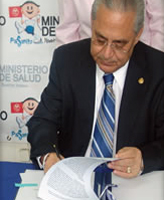 Dr. Guillermo Maza, Minister of Health of El Salvador signing the ministerial decree on 5th March 2009.
The Ministry of Public Health and Social Assistance of El Salvador approved, as part of its National Plan on HIV prevention, a set of actions to reduce homophobia and any type of discrimination based on sexual orientation in the health services.
In its 2008 country progress report El Salvador identified human rights violations as a major barrier to an effective response to the AIDS epidemic. The ministerial decree signed on 5th March 2009 by the Minister of Health Dr. Guillermo Maza, guarantees access to health services and respect of human rights to men who have sex with men, transgender, transvestites and lesbians.
The ministerial order states that all public health services such as hospitals, health clinics, etc. and their staff must facilitate, promote and support actions to eradicate discrimination based on sexual orientation. The decree also calls for all health institutions in the country to report back on the actions taken to reduce homophobia and discrimination.
This ministerial decree reflects the fundamental principle of respect for the human rights of all those who suffer from stigma and discrimination and it reaffirms the spirit of the universal access to HIV prevention, treatment, care and support under a human rights frame.
César Antonio Nuñez, UNAIDS Director Regional Support Team for Latin America
“This ministerial decree reflects the fundamental principle of respect for the human rights of all those who suffer from stigma and discrimination and it reaffirms the spirit of the universal access to HIV prevention, treatment, care and support under a human rights frame,” said César Antonio Nuñez UNAIDS Director Regional Support Team for Latin America.
The decree also encourages multilateral cooperation agencies and International financing institutions to provide funds and technical support directed to effectively respond against discrimination.
According to UNAIDS, El Salvador has an HIV prevalence rate of 17.8% amongst men who have sex with men (MSM).
Aside from the individual pain homophobic attitudes inflict, the continuing stigma attached to same-sex relations is complicating the task of slowing the spread of HIV in the Latin America region in general where sex between men is a leading mode of HIV transmission according to national reports. Stigma and homophobia increase the isolation of gays, bisexuals and transgender people making them more reluctant to come forward, get advice and access HIV services such as treatment, testing and counseling.
By signing the ministerial decree, El Salvador builds on the country’s commitment to seriously expand efforts to address stigma and discrimination in health settings which will facilitate the intake of HIV services by one of the key populations at higher risk of HIV infection
Right Side Content
Feature stories:
The President of El Salvador meets with UNAIDS Executive Director (11 June 2008)
Lions Club International signs Central America agreement with UNAIDS and UNICEF (10 March 2008)
External links:
Ministry of Health of El Salvador (in Spanish)
Feature Story
Need for scale up in integrated TB and HIV screening to address linked epidemics
24 March 2009
24 March 2009 24 March 2009Although it is mostly preventable and curable, tuberculosis (TB) is one of the leading causes of death among people living with HIV globally. Of the 33 million people who are living with HIV, only 20% of know their status, and only a tiny fraction, 2% in 2007, were screened for TB according to the World Health Organization’s annual report on global TB control launched today.
HIV is dramatically fuelling the TB epidemic in sub-Saharan Africa, where up to 80% of TB patients are co-infected with HIV according to the report. A respiratory infection that spreads like the common cold, TB exploits an immune system already weakened by HIV.
“We have to stop people living with HIV from dying of tuberculosis,” said Mr Michel Sidibe, Executive Director of UNAIDS. “Universal access to HIV prevention, treatment, care and support must include TB prevention, diagnosis and treatment. When HIV and TB services are combined, they save lives.”
"We have to stop people living with HIV from dying of tuberculosis. Universal access to HIV prevention, treatment, care and support must include TB prevention, diagnosis and treatment. When HIV and TB services are combined, they save lives."
Mr Michel Sidibe, Executive Director of UNAIDS
Global Tuberculosis Control 2009 provides an up-to-date assessment of the TB epidemic and progress in controlling the disease. It notes that globally only 16% of TB patients know their HIV status and so the majority of HIV-positive TB patients do not know that they are living with HIV and are not accessing HIV treatment.
However, there has been progress in this area with increased HIV testing among people being treated for TB, especially in Africa. In 2004, just 4% of TB patients in the region were tested for HIV; in 2007 that number rose to 37%, and in some countries (Kenya, Lesotho, Malawi, Rwanda and Swaziland) over 70% of all TB patients know their HIV status.
Because of increased testing for HIV among TB patients, more people are getting appropriate treatment though the numbers still remain a small fraction of those in need. In 2007, 200 000 HIV-positive TB patients were enrolled on co-trimoxazole treatment to prevent opportunistic infections and 100 000 were on antiretroviral therapy.
Need for integrated TB and HIV services
For many years efforts to tackle TB and HIV have been largely separate, despite the overlapping epidemiology. Improved collaboration between TB and HIV programmes will lead to more effective prevention and treatment of TB among people living with HIV and to significant public health gains.
The release of the report today coincides with World TB Day and a 1500-strong gathering at the 3rd Stop TB Partners’ Forum in Rio.
Click on the image to start video
Need for scale up in integrated TB and HIV screening to address linked epidemics
Cosponsors:
Partners:
Feature stories:
ICASA 2008: Collaborative TB and HIV activities essential (03 Dec 2008)
First HIV/TB Global Leaders Forum (09 Jun 2008)
Together against TB and HIV (23 Mar 2007)
UNAIDS interviews UN Special Envoy to Stop TB (21 Mar 2007)
Press centre:
HIV-related TB deaths higher than past estimates (24 March 2009)
External links:
3rd Stop TB Partner's Forum, Rio de Janeiro, Brazil, 23 - 25 March 2009