Documents
How many people living with HIV access treatment?
15 December 2016
A triangulation of data to verify the UNAIDS global estimate of people accessing antiretroviral therapy at the end of 2015
Documents
Ending the AIDS epidemic for adolescents, with adolescents
31 December 2016
A practical guide to meaningfully engage adolescents in the AIDS response
Documents
UNAIDS and the Global Fund — Investing in the future through partnership
05 December 2016
The global commitment to ending the AIDS epidemic represents an unparalleled opportunity to end one of the most devastating modern-day health challenges. Over the past three decades, historic progress has transformed the AIDS response. More than 18 million people globally are receiving life-saving HIV treatment, and the world is on track to eliminate mother-to-child transmission of HIV. However, more than 2 million people are newly infected with HIV annually and, in 2015, more than a million people died from HIV-related causes. Strategic partnerships such as that of UNAIDS and the Global Fund to Fight AIDS, Tuberculosis and Malaria (the Global Fund) are vital if we are to Fast-Track the AIDS response to end AIDS as a public health threat by 2030.

Documents
Invest in HIV prevention
15 November 2015
Quarter for HIV Prevention (#quarter4HIVprevention) is a campaign to recapture imagination and hope for HIV prevention. It provides prevention choices for people at risk, and—most importantly—protects them from HIV infection. Most importantly, it leaves no one behind. Let us invest in HIV prevention; let us get to zero new HIV infections.
Documents
UNAIDS Strategy 2016-2021
10 August 2015
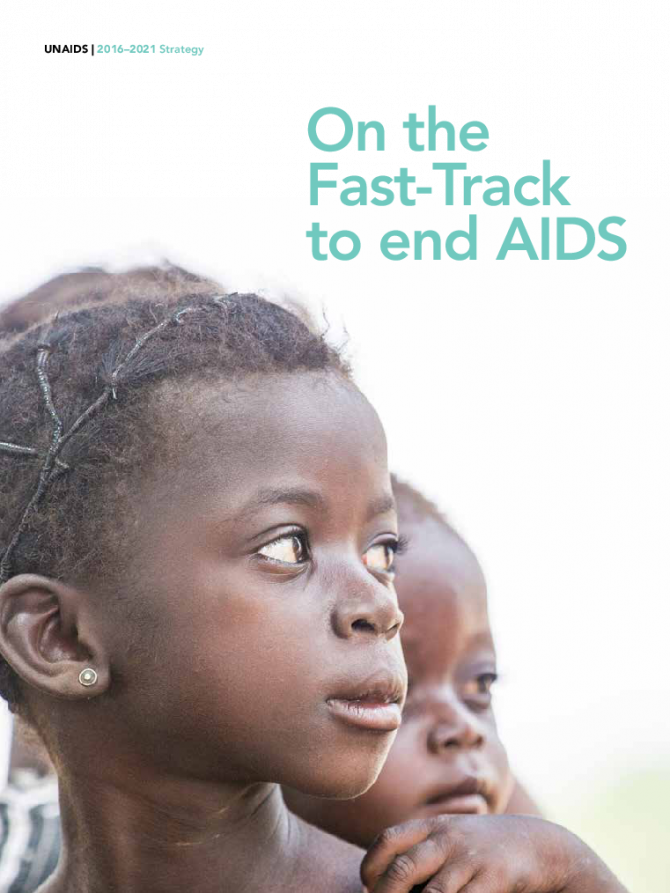
The UNAIDS 2016–2021 Strategy is a bold call to action to get on the Fast-Track and reach people being left behind. It is an urgent call to front-load investments. It is a call to reach the 90–90–90 treatment targets, to close the testing gap and to protect the health of the 22 million people living with HIV who are still not accessing treatment. It is a call to redress the deplorably low treatment coverage for children living with HIV.
Documents
90–90–90 - An ambitious treatment target to help end the AIDS epidemic
01 January 2017
Documents
Methods for deriving UNAIDS estimates
15 September 2016

Documents
Social protection: advancing the response to HIV
01 June 2015
The 10 case studies presented in this document clearly demonstrate that social protection works for HIV prevention, treatment, care and support. In particular, they show how social protection benefits the AIDS response through increased access to HIV services for all people including the most marginalized and excluded in society.* The studies also demonstrate that carefully constructed and well-managed social protection programmes have the power to support people who are hardest to reach.

Documents
HPV, HIV and cervical cancer: leveraging synergies to save women’s lives
20 July 2016
This report presents recent scientific evidence about the links between HIV, HPV and cervical cancer, and it supplies relevant epidemiological, screening, vaccination and innovation data. Ultimately, its goal is to (a) promote synergies between HIV and cervical cancer prevention programmes, (b) make the case for integrating cervical cancer prevention into existing HIV treatment and prevention programmes, (c) explain the opportunities for women’s health that exist in coordinating HIV and cervical cancer prevention, and (d) advance prevention and treatment literacy among affected populations.