

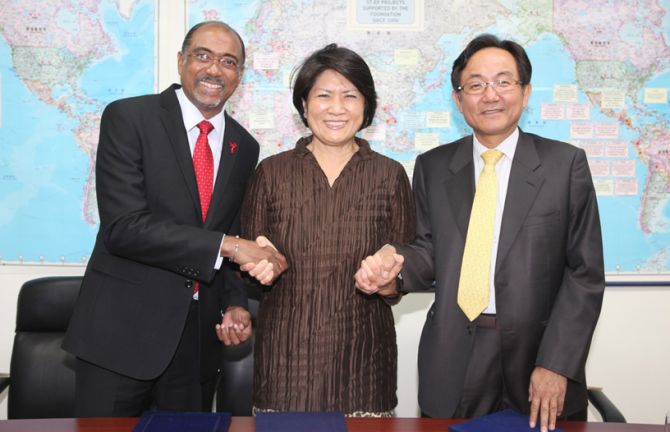
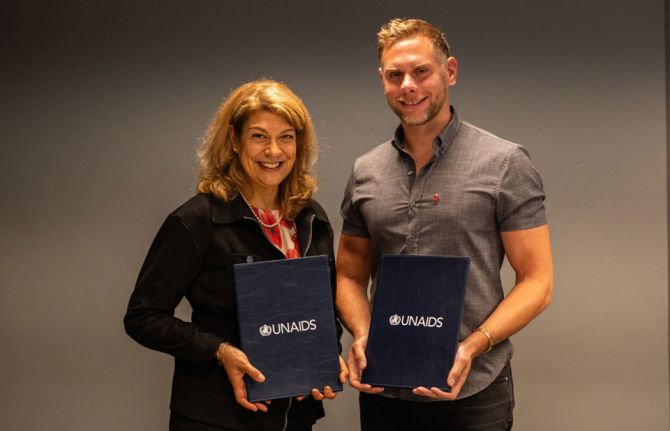
At the signing ceremony, Executive Director of UNAIDS Michel Sidibé discussed the importance of education with Ambassador Dho Young-shim, Chairperson of the UNWTO ST-EP Foundation and MDG Advocacy Group Member, and Professor Myongsei Sohn, Dean of the Graduate School of Public Health at Yonsei University in Seoul.
Feature Story
Putting education first
31 October 2013
31 October 2013 31 October 2013UNAIDS has signed a new Memorandum of Understanding with the United Nations World Tourism Organization Sustainable Tourism – Eliminating Poverty Foundation (UNWTO ST-EP Foundation).
UNAIDS and the UNWTO ST-EP Foundation will work with the Republic of Korea’s Yonsei University to support the UN MDG Thank You Small Library Initiative.
The Thank You Small Library initiative establishes small libraries in communities where children do not have access to reading and studying facilities. The main purpose is to provide both educational and entertainment opportunities through the enjoyment of reading.
One of the first shared projects will be to produce a children’s book focused on children living with HIV.
At the signing ceremony, Executive Director of UNAIDS Michel Sidibé discussed the importance of education with Ambassador Dho Young-shim, Chairperson of the UNWTO ST-EP Foundation and MDG Advocacy Group Member, and Professor Myongsei Sohn, Dean of the Graduate School of Public Health at Yonsei University in Seoul.
Quotes
Children have the right to read and the right to learn. Education holds the key to a brighter future for children everywhere.

Dr Raisa Bogatyreva, Minister of Health of Ukraine; and Michel Sidibé, UNAIDS Executive Director. Kiev, 23 October 2013.
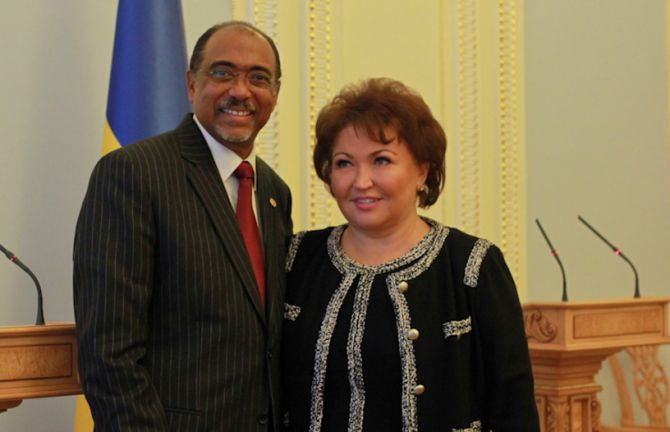
UNAIDS Executive Director Michel Sidibé (left) met with Dr Tatiana Bahteeva, Head of the Health Committee of the Ukrainian Parliament. Kiev, 23 October 2013.
Feature Story
UNAIDS Executive Director in Ukraine
23 October 2013
23 October 2013 23 October 2013The Executive Director of UNAIDS Michel Sidibé congratulated Ukraine for being the first country in Eastern Europe to reduce new HIV infections between 2001 and 2012. On October 23, the first day of his two-day official visit to Ukraine, Mr Sidibé met separately with the Head of the Health Committee of the Ukrainian Parliament Tatiana Bahteeva and the Minister of Health Raisa Bogatyreva.
In his meeting with Dr Bogatyreva, Mr Sidibé thanked her for her personal role in leading the national AIDS response and in securing the government’s strong commitment to scaling-up HIV treatment and life-saving prevention services, including comprehensive harm reduction and opioid substitution therapy for drug users. They also discussed the importance of the new National AIDS programme for 2014-2018.
The National AIDS programme is expected to be endorsed by the Parliament of Ukraine in the coming months and was also an important theme in Mr Sidibé’s meeting with Dr Bahteeva. The Programme contains a number of ambitious goals, including the significant scaling up of antiretroviral treatment for people living with HIV and a major increase in government funding.
Mr Sidibé expressed the hope that the country will sustain and build on the recent progress and ensure the long term sustainability of HIV services in Ukraine by taking full national ownership of the HIV response.
Ukraine is experiencing one of the most severe HIV epidemics in Eastern Europe, the region of the world which continues to have the largest increase in HIV incidence.
Quotes
"Ukraine has a window of opportunity to halt and reverse the AIDS epidemic and reach an AIDS-free generation. I know that with the country’s current engaged political leadership, we will reach these goals."
"Ukraine's new National AIDS Programme (2014-2018) will be the opportunity to leverage our national leadership so that Ukraine serves as a model of national mobilization on AIDS for other countries in Eastern Europe and the Commonwealth of Independent States."
"We are not consoled by our progress and we must redouble our efforts so that people will not fear coming forward to be tested for HIV or to access life-saving services for HIV prevention, treatment and support."

Feature Story
New publication addresses human rights challenges in the Caribbean
23 October 2013
23 October 2013 23 October 2013
Co-editors Sir George Alleyne and Professor Rose-Marie Belle Antoine at the launch of the publication in Port of Spain, Trinidad and Tobago, 22 October 2013. Credit: UNAIDS
A book exploring the challenges and legal stumbling blocks to overcoming stigma and discrimination in the Caribbean was launched on 22 October in Port-of-Spain, the capital of Trinidad and Tobago. Legal and Policy Perspectives on HIV and Human Rights in the Caribbean was co-edited by former United Nations Special Envoy on HIV for the Caribbean, Sir George Alleyne and law professor, Rose-Marie Belle Antoine. The publication includes contributions from a range of experts who participated in a high-level symposium convened by UNAIDS, the Pan Caribbean Partnership against HIV and AIDS (PANCAP) and the University of the West Indies (UWI) in 2010.
The book highlights issues surrounding discriminatory laws and policies in the region. It also provides academics and policy-makers with options for removing laws that limit people’s right to health, freedom of movement and equal access to housing, education and work.
Sir George stressed one of the key recommendations of the book—challenging discriminatory laws in courts—could be an effective process for their removal. “The only countries in the Western Hemisphere that have laws criminalizing homosexual sex in private are in the Caribbean,” he said. “The possibility of changing that by appealing to the constitution is virtually zero. It has to be done through litigation.”
In 2013, one of the irrationalities we are living with is stigma based on HIV status, sexual behaviour and sexual orientation.
UNAIDS Caribbean Regional Support Team Director, Ernest Massiah
Sir George also applauded the UWI Rights Advocacy Project which aims to promote human rights, equality and social justice in the Caribbean by participating in human rights litigation.
Current UN Special Envoy on HIV and AIDS for the Caribbean, Edward Greene called the book “a launch pad—which will help the region’s progress toward ensuring equal rights and protection for all its people.”
UNAIDS provides technical support to the Caribbean Coalition for Social Justice (CCSJ), which provides legal counsel and financial aid to people who have experienced discrimination. UNAIDS is also working with countries to address stigma issues associated with sexual orientation and sexuality. It is developing a database on changes in public attitudes and its effect on electoral politics. Within the justice system it supports sensitivity training for court officers and police officers. UNAIDS will shortly release the findings of a new survey, the Caribbean Men’s Internet Survey (CARIMIS), which surveyed more than 3500 men who have sex with men in the Caribbean.
UNAIDS Caribbean Regional Support Team Director, Ernest Massiah attended the book launch and welcomed its publication. “In 2013, one of the irrationalities we are living with is stigma based on HIV status, sexual behaviour and sexual orientation,” he said.
External links
External links

Jeffrey Webb, President of the North, Central America, and Caribbean Association Football (CONCACAF), was awarded the prestigious 2013 UNAIDS “Protect the Goal” Special Award for the Diaspora. Cayman Islands, 21 October 2013. Credit: UNAIDS
Feature Story
UNAIDS announces President of CONCACAF as first recipient of the “Protect the Goal” Award for the Diaspora
20 October 2013
20 October 2013 20 October 2013The President of the North, Central America, and Caribbean Association Football (CONCACAF), Jeffrey Webb, will be the recipient of the 2013 UNAIDS “Protect the Goal” Special Award for the Diaspora. The announcement was made during the opening of the 2013 CONCACAF Sports Summit taking place in the Cayman Island.
The “Protect the Goal” Award ceremony will take place on 15 January 2014 in Dakar, Senegal during the fourth Pan-African Youth Leadership Summit. Mr Webb will be honored for his exceptional work in using sport to advocate for social development.
The “Protect the Goal” campaign aims to raise awareness of HIV and mobilize young people to commit to HIV prevention. The special award highlights the value of football as a tool for social change. It emphasizes the importance of social responsibility and features individuals and organizations that play an important role in promoting social good and advocacy for HIV awareness and prevention through sport.
Quotes
CONCACAF is committed to working with the popularity of football to effect positive change in society. Advocacy for HIV prevention efforts in the community both in our region and the world is a vital part of that mission. We are proud that our commitment in this area has been recognized.
Related links
Related links
External links
External links
Feature Story
Brazil pioneers treatment for everyone
18 October 2013
18 October 2013 18 October 2013
100 000 more Brazilians living with HIV expected to benefit from proposed new prevention as treatment protocol
Some 100 000 more people living with HIV in Brazil are set to receive life-saving antiretroviral therapy (ART) under a major new initiative that will offer early treatment to all HIV-positive adults. It is estimated that between 430 000 and 520 000 people are living with HIV in Brazil — just over 300 000 of which are currently accessing treatment.
The initiative will not only enable more people living with HIV to stay alive and well, it is also part of the government’s efforts to harness the preventative impact of antiretroviral therapy to stop new HIV infections. Antiretroviral therapy is a powerful HIV prevention option as studies have shown that it can reduce the risk of transmitting the virus to a sexual partner by up to 96%.
According to Minister of Health Alexandre Padilha, the proposal put forward in Clinical protocol and therapeutic guidelines for managing HIV infection in adults cements Brazil’s leadership in the global AIDS response. “We are resuming a leading role in the response to the AIDS epidemic in the world. Currently, only two countries — the United States and France — recommend the use of early treatment,” he maintained. Fábio Mesquita, Director of the Department of STDs, AIDS and Viral Hepatitis, added, “Brazil will be the first developing country to adopt the policy of treatment as prevention.”
Key populations at the heart of new protocol
It is hoped that the new initiative will help to stem the advance of the virus, particularly among people most affected by HIV such as young men who have sex with men, sex workers, the transgender community and injecting drug users. For example, for men who have sex with men the estimated HIV prevalence is over 10%, more than 20 times higher than in the general population.
Reaching all people with life-saving services is high on Mr Padilha’s agenda. “We need to use all the available measures to reduce transmission, and the new protocol’s proposals should create a positive impact on the reduction of transmission of the HIV virus in these populations,” he said.
We are resuming a leading role in the response to the AIDS epidemic in the world. Currently, only two countries — the United States and France — recommend the use of early treatment.
Brazil’s Minister of Health Alexandre Padilha
The Clinical Protocol document also sets out ways in which to clearly define and simplify treatment regimens, while strengthening adherence and the long-term effectiveness of antiretrovirals. There are plans to introduce a combined fixed dose, a 3-in-1 medication, as the preferred first-line regimen. This treatment is scheduled to be available in 2014.
"Brazil is once again showing bold leadership in the response to AIDS — and is doing so in an open and inclusive manner, through public consultation,” said UNAIDS Country Coordinator Georgiana Braga-Orillard. “The initiative will improve the lives of people living with HIV and reduce deaths due to AIDS across the country.”
The report is now under public consultation until 5 November and will be finalized before the end of the year.
A complete text of the proposed new protocol is available at: www.saude.gov.br/consultapublica
Partners
Partners
Publications

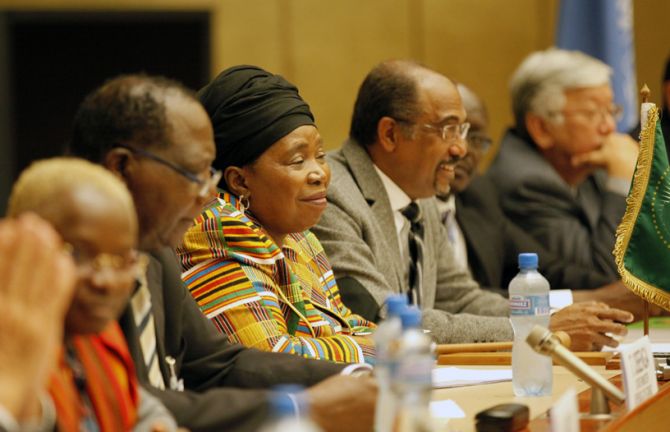
(Centre left) Chairperson of the African Union Commission Dr Nkosazana Dlamini-Zuma and (centre right) UNAIDS Executive Director Michel Sidibé and other panellists attending 50th anniversary celebrations of the Organization of the African Unity/African Union in Geneva, Switzerland.
Feature Story
Fifty years of African unity celebrated in Geneva
16 October 2013
16 October 2013 16 October 2013The Chairperson of the African Union Commission Dr Nkosazana Dlamini-Zuma inaugurated celebrations marking the 50th anniversary of the founding of the Organization of African Unity (OAU) at the Palais des Nations in Geneva, Switzerland. 2013 is being called the Year of Pan-Africanism and African Renaissance and Heads of State and Government in Africa are remembering the achievements of the OAU and its successor the African Union. Dr Dlamini-Zuma spoke about the importance of everyone participating in the year-long celebrations both in Africa and as part of the African diaspora. She said the event in Geneva was a moment to reflect on the past and even more importantly on the future.
The high-level participants of the day-long forum included ministers from Africa, representatives of international organizations and business leaders. UNAIDS Executive Director Michel Sidibé moderated a high-level panel on development in Africa. Participants spoke of the challenges the continent faces which range from food security to unemployment to conflict and they pointed to a need for innovation and a new paradigm. International singer and activist Angélique Kidjo also participated in the panel and spoke about the rights of African women.
Quotes
Africa today is rising from being a scar on the conscience of the world as we were once called to a continent which is home to 6 of the world’s 10 fastest growing economies and one which is making steady progress with a sense of common destiny and priorities.
It is a moment to reflect on what we have achieved and what we need to do together to build a more inclusive society. Thirty years ago, nobody thought we could make a breakthrough on HIV. We have moved from despair to hope. In sub-Saharan Africa new HIV infections have declined by 38% since 2001.
African women are the backbone of Africa. Girls must be allowed to dream, to be educated and to choose their own destiny.
Related

Feature Story
Belgium launches robust national HIV plan
16 October 2013
16 October 2013 16 October 2013
UNAIDS Executive Director Michel Sidibé expressed his gratitude for Queen Mathilde’s unprecedented commitment to the global AIDS response.
Belgium has taken a substantial step forward in its AIDS response this week with the launch of its first and much-anticipated National Strategic Plan on HIV. The plan was endorsed at the very highest level, with Queen Mathilde joining a number of top-ranking Belgian ministers and UNAIDS Executive Director Michel Sidibé to oversee the 15 October launch.
The 2014-2019 strategic plan has three central pillars: HIV prevention; testing and treatment; and care and support. It addresses a context in which more than a thousand new HIV infections are being reported each year. The plan prioritizes most affected populations including men who have sex with men and migrant workers. Despite relatively low numbers of people living with HIV in Belgium—the AIDS epidemic remains a concern as the rate of new HIV infections has not declined in recent years.
Far-reaching, multi-year and multi-sectoral, the plan was developed through a highly consultative process with the engagement of a range of actors including people living with HIV, key populations, medical professionals, community activists and national authorities. UNAIDS was also involved in its development.
At the launch Mr Sidibé commended Belgium’s efforts in its commitment to the AIDS response and noted that the pioneering plan represented an ambitious model for other European countries, especially with its focus on key populations.
We have the responsibility for this plan to be more than just a great achievement – it should be a starting point. A starting point for political action we will lead all together, by joining forces, with all partners assembled around one same cause.
Laurette Onkelinx, Vice-Prime Minister of Belgium
“This is an example of how a successful AIDS Plan should be designed—centred around people focused on preventing new HIV infections and comprehensive access to a full package of HIV services, particularly for the most vulnerable in society,” said Mr Sidibé. “I’m sure that once fully implemented the plan will enable Belgium to push its epidemic into rapid decline.”
Following the launch Mr Sidibé had further discussions with Laurette Onkelinx Vice-Prime Minister of Belgium and the federal government’s Minister of Social Affairs and Public Health. During the meeting they discussed how best to address the challenges of ensuring the right to health for men who have sex with men, as well as migrant workers and refugees. Ms Onkelinx stressed Belgium’s political commitment to supporting vulnerable populations.
“We have the responsibility for this plan to be more than just a great achievement – it should be a starting point,” said Ms Onkelinx. “A starting point for political action we will lead all together, by joining forces, with all partners assembled around one same cause”.
During his visit Mr Sidibé also met Queen Mathilde who has made the issue of HIV and children a personal priority and has endorsed the Global Plan towards the Elimination of New HIV Infections among Children by 2015 and Keeping Their Mothers Alive. Mr Sidibé expressed his gratitude for the Queen’s unprecedented commitment to the global AIDS response.
As well as taking full ownership for its domestic response to HIV, Belgium continues to play a key role in the international AIDS response. Playing an active role as member of UNAIDS Programme Coordinating Board, earlier this year Belgium renewed its financial pledge to UNAIDS for 2013, 2014 and 2015 for an overall amount of EUR 14.52 million to support UNAIDS’ efforts in helping countries reach their HIV targets. This contribution places Belgium again among UNAIDS top 10 donors.
To further discussions around shared ideas on priorities and ways forward for the post-2015 development agenda Mr Sidibé participated in a bilateral consultation on HIV with the Belgian Federal Government.
Related
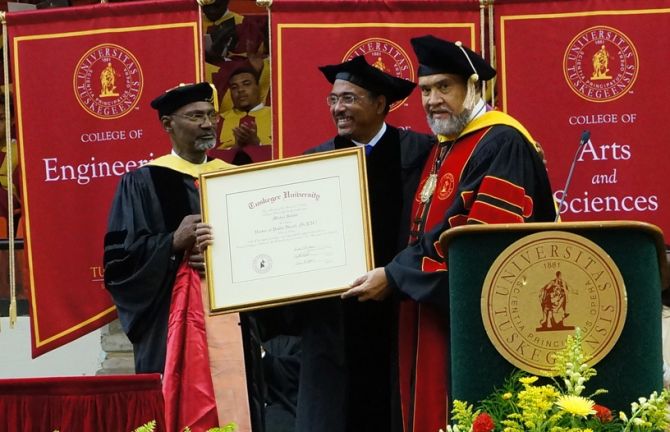
In awarding Mr Sidibé (centre) the doctorate, University President Gilbert L Rochon (right) encouraged Mr Sidibé, through his leadership of UNAIDS and his new role as Tuskegee Alma Mater, to strengthen the university’s bridge with the United Nations and African countries to explore new breakthroughs in youth leadership, research and development, and public health. Tuskegee, Alabama, USA, 13 October 2013. Credit: UNAIDS
Feature Story
Michel Sidibé receives honorary degree from Tuskegee University
15 October 2013
15 October 2013 15 October 2013UNAIDS Executive Director Michel Sidibé has been awarded the Degree of Doctor of Public Health (Honoris Causa) from Tuskegee University in Alabama – one of the oldest and well known historically black colleges in the United States. The degree was awarded in recognition of Mr Sidibé’s leadership in the international AIDS response.
Mr Sidibé received the honour while attending the University’s Annual Scholarship Convocation on 13 October 2013 as the keynote speaker. In his remarks, Mr Sidibe spoke about the parallels between the American civil rights struggle for justice and equality and the AIDS response, which promotes human rights and dignity for communities affected by the epidemic. He highlighted that in the United States, African Americans account for an estimated 44% of all new HIV infections among adults and adolescents, although representing only about 13% of the US population.
In awarding Mr Sidibe the doctorate, University President Gilbert L Rochon encouraged Mr Sidibe, through his leadership of UNAIDS and his new role as Tuskegee Alma Mater, to strengthen the university’s bridge with the United Nations and African countries to explore new breakthroughs in youth leadership, research and development, and public health.
Tuskegee University is a renowned historically black university. Established in 1881 by Booker T. Washington, Tuskegee’s campus has been designated as a National Historic Site. Tuskegee University’s National Center for Bioethics in Research and Health Care is the first bioethics center in the United States devoted to exploring research and medical treatment of the African American community and other underserved populations.
Quotes
With Michel Sidibé’s vision of zero new HIV infections, zero discrimination, and zero AIDS-related deaths, the global AIDS response has moved from desperation to hope.
I am humbled and inspired to receive this profound honour from Tuskegee University - a legendary institution for excellence in research and the fight for equality.
Partners
Partners
Related


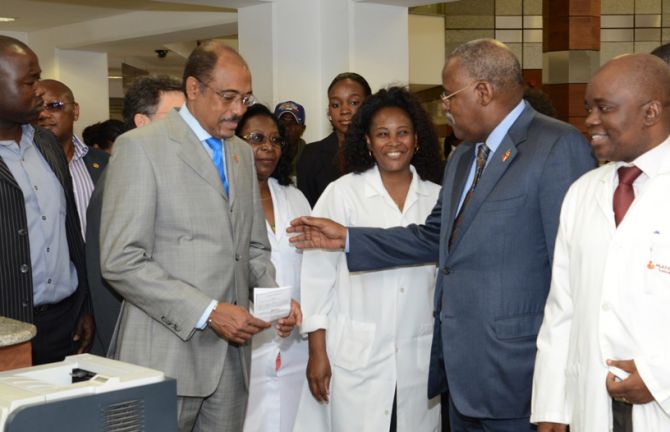
UNAIDS Executive Director Michel Sidibé visiting the Lucrecia Paim Maternity Hospital, one of Angola’s model clinics in providing access to antiretroviral therapy for pregnant women living with HIV, in Luanda on 8 October 2013. Credit: UNAIDS
Feature Story
Angolan government commits to ensuring all children are born free of HIV
09 October 2013
09 October 2013 09 October 2013The Lucrecia Paim Maternity Hospital is one of Angola’s model clinics in providing access to antiretroviral therapy for pregnant women living with HIV to prevent the transmission of the virus to their babies. The Executive Director of UNAIDS Michel Sidibé visited the facility in Luanda on 8 October and called for greater efforts in reaching all pregnant women living with HIV and ensuring that all babies are born free of HIV in Angola. This came after several Angolan ministers made a strong commitment to scaling-up prevention of mother-to-child transmission of HIV (PMTCT) and treatment services.
Angola is one of 22 priority countries included in the Global Plan towards the elimination of new HIV infections among children by 2015 and keeping their mothers alive. While data from the Angolan government shows the percentage of pregnant women testing for HIV increased by 55% between 2009 and 2012, Angola is the only priority country where the number of new infections among children increased between 2009 and 2012.
Mr Sidibé met jointly with the ministers of Health, Education, Women, Defence, Youth and Sports, and Social Affairs and encouraged a multi-sectorial leadership to rapidly expand Angola’s response to HIV. The ministers committed to scaling-up HIV programmes to ensure all babies are born free of HIV and people living with HIV have access to treatment in Angola.
During his official two-day visit to Angola, Mr Sidibé also met with representatives of civil society and the private sector to discuss the challenges and opportunities in the Angolan AIDS response.
Quotes
AIDS is more than a health issue. It is about justice, about gender and inequalities. It will take all of the government sectors to accelerate the AIDS response to make sure that no babies in Angola are born with HIV and that all Angolans have access to treatment.
The Government of Angola is ready to accelerate implementation of a national plan with the objective to reach zero new HIV infections among children by 2015.
This maternity hospital provides excellent care for women living with HIV. I delivered my first baby, who was born HIV-free at this hospital and I am here today on a follow-up visit for my second pregnancy.
Our objective goes beyond the philanthropic aspect of the work. We see our efforts on HIV and AIDS to combine human solidarity and a return on our investment so that our employees remain healthy and productive.
Related

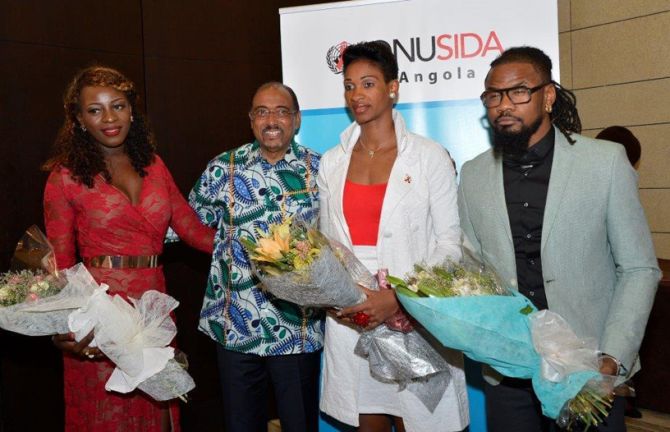
(L to R) Titica, UNAIDS Goodwill Ambassador for Angola; Michel Sidibé, UNAIDS Executive Director; Nacissela Mauricio, former UNAIDS Goodwill Ambassador for Angola and professional women's basketball player; and C4 Pedro, UNAIDS Goodwill Ambassador for Angola.
Feature Story
UNAIDS appoints Angolan music icons, C4 Pedro and Titica as National Goodwill Ambassadors
08 October 2013
08 October 2013 08 October 2013The Executive Director of UNAIDS, Michel Sidibé has appointed two popular Angolan musicians C4 Pedro and Titica as National Goodwill Ambassadors on 7 October at a press event held in Luanda, Angola. The two musicians will help raise awareness on issues relating to HIV prevention and treatment, especially among young people in Angola.
Pedro Lisboa Santos, commonly known by his stage name C4 Pedro is a dynamic Angolan performer, composer and producer. He started his music career with his brother Lil Sain’t in Belgium, where he lived for 10 years. After returning to Angola in 2009, he released two successful albums that made him a household name in Angola.
C4 Pedro has been involved in community outreach activities and as UNAIDS National Goodwill Ambassador, he will focus on encouraging young people to know their HIV status and be advocates for a healthy lifestyle.
Titica is a pop star favourite in Angola. Her first album entitled “Ground” was a hit not only in Angola but was also brought to the international stage in countries such as Brazil, Germany, Mozambique, South Africa, and Spain. A transgender person, Titica has been affected by stigma and discrimination and she hopes she can turn her experience into a positive message to change attitudes in Angola.
The HIV epidemic remains a public health challenge in Angola. In 2012, an estimated 28 000 new HIV infections occurred in the country compared to 19 000 in 2001. Young people, particularly young women are most vulnerable to HIV. In the last decade, the number of young people living with HIV increased by more than 60% – from 20 000 in 2001 to 33 000 in 2012. The number of young women living with HIV was almost double the number of young men living with HIV in 2012.
Quotes
Music is a powerful platform for engaging with young people. I am thrilled that such outstanding performers like C4 Pedro and Titica have joined UNAIDS to push for change. I am sure their voices will stir Angola’s young people to lead in HIV prevention.
It is an honour to be a Goodwill Ambassador for UNAIDS. Reaching young people with my music and the right message is my contribution to reducing the impact of AIDS on Angola.
I have been beaten and stoned for who I am. I have suffered so much humiliation but I am ready to lead by example and help overcome stigma and discrimination in my country and beyond.