

Feature Story
Jamaica takes measures to ensure the sustainability of its response to HIV
07 October 2013
07 October 2013 07 October 2013
Hard-won gains against the HIV epidemic in Jamaica could be at stake due to national budgetary constraints and the country’s increasing HIV treatment costs, a study shows. As a result, the Jamaican government has taken steps to enhance the planning and efficiency of its national AIDS programme.
“Since 2004, with the introduction of antiretroviral treatment, AIDS-related deaths in Jamaica have dropped by 41% and mother-to-child transmission of HIV has fallen from 25% in 2004 to below 5% in 2011,” said Health Minister, Fenton Ferguson. “Jamaica is on the way to success and we can’t have it derailed.”
With support from the World Bank and UNAIDS, the country conducted a landmark study on the financial sustainability of its AIDS response. The study projected that the annual cost of Jamaica’s HIV programme may double by 2030. It also reported that Jamaica’s ability to increase domestic spending for HIV is limited by its high levels of public debt—the country is classified by the World Bank as an upper middle income country, however, the island has a debt-to-GDP ratio of 140%. The country’s agreements with major partners including the Global Fund to Fight AIDS, Tuberculosis and Malaria, the World Bank and the United States Government, are set to expire over the next two years.
Since 2004, with the introduction of antiretroviral treatment, AIDS-related deaths in Jamaica have dropped by 41% and mother-to-child transmission of HIV has fallen from 25% in 2004 to below 5% in 2011. Jamaica is on the way to success and we can’t have it derailed.
Fenton Ferguson, Health Minister of Jamaica
According to Dr Ferguson the work has already begun. The UNAIDS investment approach was used to develop strategies to help the country’s HIV response survive and succeed.
For example, Jamaica has re-focussed its National Strategic Plan, with a strong emphasis on the needs of key populations at higher risk of infection, including men who have sex with men, sex workers and people who use drugs. It has also announced the establishment of an authority which joins the Family Planning Board with parts of the HIV Programme to lower administrative costs. The country is also exploring regional opportunities to lower the prices of antiretroviral medicines.
UNAIDS Country Coordinator, Dr Pierre Somse, commended the Ministry of Health and the Ministry of Planning and Finance for jointly addressing the financial sustainability issues surrounding the HIV response. “HIV is being dealt with as a development issue by the Government of Jamaica within the context of the country’s 2030 national development plan,” said Dr Somse. “The HIV response continues to enjoy the highest level of political commitment across political parties,” he added.
In the 2013/2014 fiscal year, the Government increased its share of HIV spending, however to facilitate the implementation of the new strategies the Health Minister has called for “a more gradual transition from international funding”.
Multimedia
Multimedia
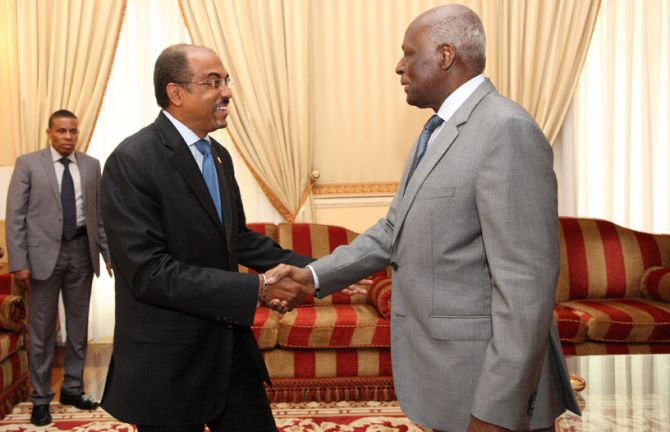
UNAIDS Executive Director Michel Sidibé shaking hands with President of Angola José Eduardo dos Santos. Luanda, Angola, 7 October 2013.
Feature Story
President dos Santos promises to redouble efforts on Angola’s HIV response
07 October 2013
07 October 2013 07 October 2013The President of Angola José Eduardo dos Santos said his country is committed to stopping new HIV infections among children and improving access to HIV treatment. He made the commitment during a meeting with UNAIDS Executive Director Michel Sidibé on 7 October in Angola’s capital of Luanda.
Since the 27-year civil war ended in 2002, Angola has moved swiftly to become one of the fastest growing economies in the world and the government is gradually rebuilding its public infrastructure
Mr Sidibé congratulated the President on his leadership and engagement in the peaceful and economic transformation of Angola and called on him to take on the twin challenges of ensuring all babies are born free of HIV and ensuring all Angolans living with HIV have access to lifesaving antiretroviral treatment.
Angola is one of the few countries in Africa where new HIV infections and AIDS-related deaths have risen in the last ten years. New HIV infections increased from 19 000 in 2011 to 28 000 in 2012 – a 47% increase. AIDS-related deaths rose from 8 400 in 2001 to 13 000 in 2012. Antiretroviral treatment coverage for adults and children is also very low in Angola. Only 15% of eligible children and 48% of adults had access to treatment in 2012 under 2010 guidelines from the World Health Organization.
Quotes
I am a pragmatic leader and what I need is a business plan with two clear actions for 2015: to make sure that no baby is born with HIV and every Angolan living with HIV has access to treatment. Angola still has a long road ahead to overcome the HIV epidemic but we will do it together.
Angola has come a long way to become one of the fastest growing economies in the world. Under the strong leadership of President dos Santos this country can build on this gain to halt and reverse its HIV epidemic.

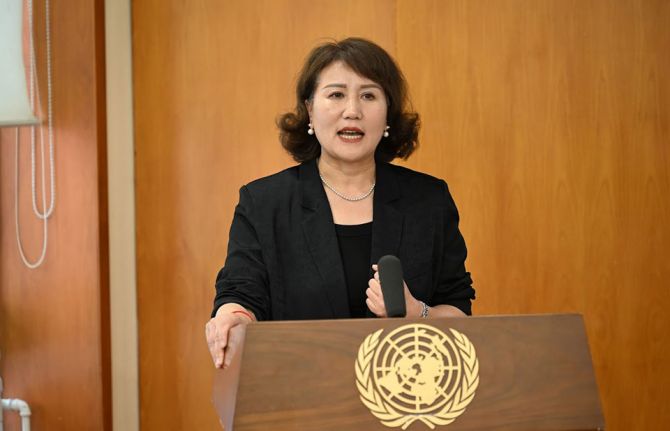
UNAIDS Deputy Executive Director, Programme, Luiz Loures speaking at the opening of the First International Federation of Gynecology and Obstetrics (FIGO) Africa Regional Conference. Addis Ababa, Ethiopia, 2 October 2013. Credit: UNAIDS
Feature Story
Women’s health communities critical to reducing maternal and child mortality in Africa
05 October 2013
05 October 2013 05 October 2013Obstetricians and gynecologists, ministers, public health specialists and civil society organizations convened in Addis Ababa, Ethiopia from 2-5 October at the First International Federation of Gynecology and Obstetrics (FIGO) Africa Regional Conference to discuss ways of improving maternal and child health in Africa.
Speaking at the opening, UNAIDS Deputy Executive Director, Programme, Luiz Loures highlighted the link between HIV and maternal and child health. He called for women’s health and HIV communities to closely work together to increase access to life-saving health services to reach the most marginalized in society. He also stressed the need to uphold the sexual and reproductive rights of women living with HIV.
In sub-Saharan Africa, women are more likely to be living with HIV than men, accounting for 58% of the 22.1 million adults who were living with HIV in the region in 2012. Young women are particularly at risk of HIV infection–– around 28% of all new adult HIV infections in sub-Saharan Africa are among young women between the ages of 15-24. HIV is also a leading cause of death among women of reproductive age and has a major impact on child health and mortality, mainly through the transmission of HIV from mother to child.
Dr Loures congratulated FIGO on its visionary and bold work on women’s sexual and reproductive rights. He also underscored UNAIDS commitment to strengthening its collaboration with FIGO to raise political visibility and engage women’s networks on HIV and sexual and reproductive rights issues to reduce AIDS related maternal and child mortality.
Quotes
Human rights must be at the centre of our practice as everyone has a right to live. Our primary commitment as physicians is to save lives.
FIGO looks forward to active collaboration with UNAIDS to ensure the protection of the rights of women living with HIV regarding access to their services in the health sector.
Ethiopia has made excellent progress towards achieving the millennium development goals on maternal and child health and we are grateful for the assistance from our partners, such as FIGO and UNAIDS.
Related links
Related links
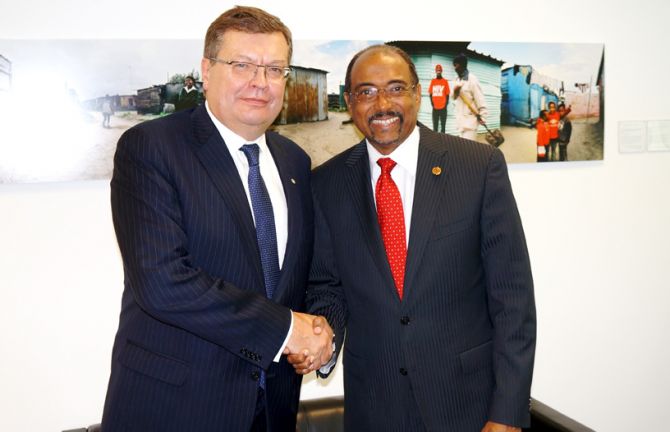
H.E. Kostyantyn Gryshchenko, Vice Prime Minister of Ukraine shaking hands with UNAIDS Executive Director Michel Sidibé. Geneva, 2 October 2013. Credit: UNAIDS
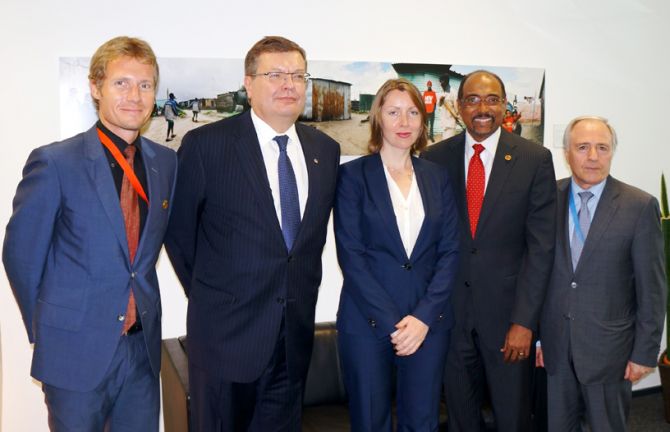
Morten Ussing, Chief, GMA, UNAIDS; H.E. Kostyantyn Gryshchenko, Vice Prime Minister of Ukraine; Lena Andrienko, Attache, Permanent Mission of Ukraine in Geneva; UNAIDS Executive Director Michel Sidibé; and H.E. Mykola Maimeskul, Ambassador and Permanent Representative of Ukraine in Geneva. Geneva, 2 October 2013. Credit: UNAIDS
Feature Story
UNAIDS welcomes Vice Prime Minister of Ukraine for official visit to UNAIDS headquarters in Geneva
03 October 2013
03 October 2013 03 October 2013UNAIDS Executive Director Michel Sidibé welcomed the Vice Prime Minister of Ukraine, Kostyantyn Gryshchenko to UNAIDS Headquarters in Geneva. During their bilateral meeting, they reviewed Ukraine’s impressive progress in its national AIDS response.
The country has nearly doubled the number of people accessing HIV treatment in the last year—now reaching more than 40 000 people. Vice Prime Minister Gryshchenko conveyed his appreciation to UNAIDS, the Global Fund to Fight AIDS, Tuberculosis and Malaria and national foundations for supporting the HIV response in Ukraine and expressed hope that Ukraine will advance this progress through the newly developed National AIDS Programme for 2014-2018.
The Vice Prime Minister also reiterated the invitation by the Government of Ukraine to Mr Sidibé to make his first official visit from 22 to 24 October 2013.
In October 2012, a high-level delegation of the UNAIDS Programme Coordinating Board (PCB) visited Ukraine to see first-hand the achievements in the national AIDS response. Ukraine will join as a new member of the PCB for a three-year term from 2014 to 2016.
Quotes
We are committed to work with UNAIDS to change social attitudes about HIV in Ukraine to reduce stigma, strengthen HIV prevention and ensure access to life-saving services.
Ukraine's newly developed National AIDS Programme for 2014-2018 can be a model of national mobilization and concrete results for other countries in Eastern Europe and the Commonwealth of Independent States.

Feature Story
President of South Sudan commits to strengthening the country’s response to HIV
02 October 2013
02 October 2013 02 October 2013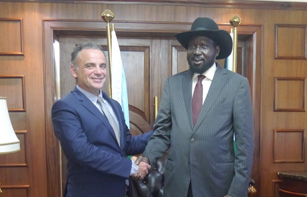
UNAIDS Deputy Executive Director, Programme, Luiz Loures shaking hands with the President of South Sudan, Salva Kiir Mayardi. Photo courtesy of South Sudan Presidency.
The President of South Sudan, Salva Kiir Mayardit has reaffirmed his commitment to expand HIV programmes in the country. During a meeting with UNAIDS Deputy Executive Director, Programme, Luiz Loures in South Sudan’s capital Juba, President Kiir said, "We won the battle for the independence of South Sudan. We will also win the war against HIV. I have made this my priority. I want to keep my people safe at all costs."
South Sudan gained independence from Sudan in 2011 following a 30-year civil war that claimed the lives of more than 2.5 million people. The country is now entering a challenging transition period––from war to peace and development.
For the past two years South Sudan, in collaboration with its development partners, has been working hard to build multi-sectorial institutions and infrastructure to provide basic public services, including education and health care.
“These efforts are a testament to the resilience of the South Sudanese people and a clear sign of their desire to achieve a viable independent state,” said Dr Loures commending the government for its commitment to creating a healthy and productive nation.
We won the battle for the independence of South Sudan. We will also win the war against HIV. I have made this my priority. I want to keep my people safe at all costs.
Salva Kiir Mayardit, President of South Sudan
Efforts are in particular need of scaling up in the country’s response to HIV. In 2012, an estimated 150 000 people were living with HIV in South Sudan and just 9% people who were eligible for treatment under the World Health Organization’s 2010 guidelines had access to lifesaving antiretroviral therapy. Only 13% of pregnant women living with HIV had access to services to prevent transmission of the virus to their child and AIDS-related deaths have almost doubled since 2001––from 6 900––to 13 000 in 2012.
The population of South Sudan is largely made up of young people. According to the World Bank, 51% of the population in the country are under the age of 18 and 72% are under the age of 30. President Kiir acknowledged the need to tailor HIV services to the needs of young people, “If they are left vulnerable, there will be no country,” he said.

UNAIDS Deputy Executive Director, Programme Dr Luiz Loures with United Nations Mission in the Republic of South Sudan peacekeepers at Bangladeshi Camp, UN Base Tomping on 30 September 2013. Credit: UNAIDS
Dr Loures emphasized the need to firmly engage the armed forces in the response to HIV. The South Sudanese army has been at the forefront of the national AIDS response having established an HIV Secretariat in 2006.
Dr Loures also addressed the United Nations peacekeeping mission troops deployed in South Sudan. He highlighted the responsibility that peacekeepers have in preventing gender-based violence and sexual exploitation in their operational zones––two key factors that exacerbate the spread of HIV in conflict and post-conflict settings, as outlined in the UN Security Council in Resolution 1983.
During his visit Dr Loures met with Ministers, representatives of the United Nations Secretary-General and development partners to take stock of the AIDS response in the world’s youngest nation. The discussions focused particularly on security, peacekeeping and HIV in a post-conflict zone.
Related links
Related links
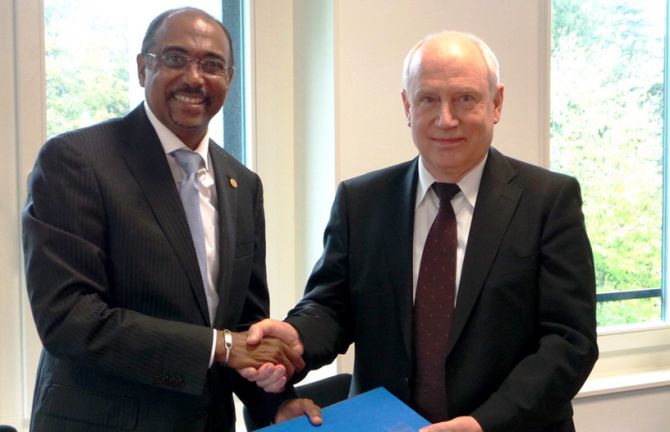
UNAIDS Executive Director Michel Sidibé and Sergey N. Lebedev, Chairperson of the Executive Committee of the Commonwealth of Independent States, shaking hands after signing MOU. Geneva, 30 September 2013. Credit: UNAIDS.
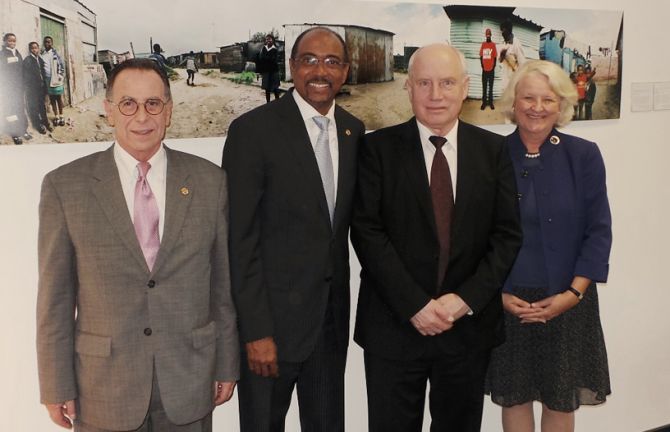
L to R: Jean-Elie Malkin, Director, Regional Support Team for Eastern Europe and Central Asia; Michel Sidibé, UNAIDS Executive Director; Sergey N. Lebedev, Chairperson of the Executive Committee of the Commonwealth of Independent States; and Jan Beagle, UNAIDS Deputy Executive Director, Management and Governance. Geneva, 30 September 2013. Credit: UNAIDS.
Feature Story
Renewing cooperation to scale up HIV responses in Eastern Europe and Central Asia
01 October 2013
01 October 2013 01 October 2013UNAIDS and the Executive Committee of the Commonwealth of Independent State (CIS) signed a Memorandum of Understanding on 30 September at UNAIDS Headquarters in Geneva. The agreement aims at intensifying the AIDS response in countries of the CIS in Eastern Europe and Central Asia—where the HIV epidemic continues to rise.
Signed by the Chairperson of the Executive Committee of the CIS, Sergey Lebedev and UNAIDS Executive Director, Michel Sidibé, the Memorandum will extend the collaboration between the parties. The collaboration was first initiated in 2001 when the CIS Council of Heads of States approved the first ‘Programme of urgent measures in response to AIDS’ and was advanced through the Action plan to strengthen cooperation in the field of development to achieve the Millennium Development Goal 6 in the region of Eastern Europe and Central Asia (12 October 2011).
The major fields of cooperation of this new memorandum include:
- to increase cooperation between governments and civil society organizations to scale up access to HIV services for people living with HIV;
- to share best practices in addressing challenges in the AIDS response;
- to foster CIS Member States involvement in international activities on AIDS;
- and to strengthen cooperation towards achieving the Millennium Development Goal 6—to halt and reverse the spread of HIV by 2015—in Eastern Europe and Central Asia.
The ceremony was attended by representatives of diplomatic missions of the CIS countries in Geneva, including the Ambassadors of Belarus and Turkmenistan, as well as senior UNAIDS staff from Geneva and the UNAIDS Regional Support Team in Moscow.
Established in 1991, the CIS promotes cooperation in political, economic, environmental, humanitarian, cultural and other domains between its Member States. It is made up of 11 countries including: Republic of Armenia, Republic of Azerbaijan, Republic of Belarus, Republic of Kazakhstan, Republic of Kyrgyzstan, Republic of Moldova, the Russian Federation, Republic of Tajikistan, Turkmenistan, Ukraine and the Republic of Uzbekistan.
Quotes
We will use this memorandum as a key tool to promote practical results between UNAIDS, the CIS Secretariat and its Member States to respond to HIV, which is on the rise in this CIS region.
HIV is a virus but the AIDS epidemic is a social and political epidemic that demands political leadership and commitment to make progress possible. UNAIDS is proud to be working with my friend Sergey Lebedev and the CIS on translating this agreement into results for the CIS countries facing growing HIV epidemics.
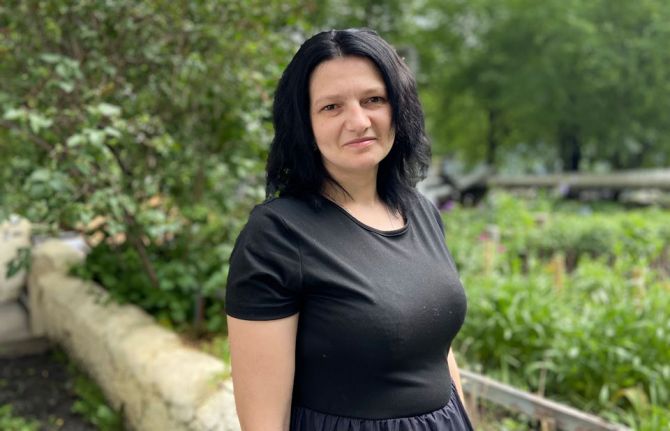
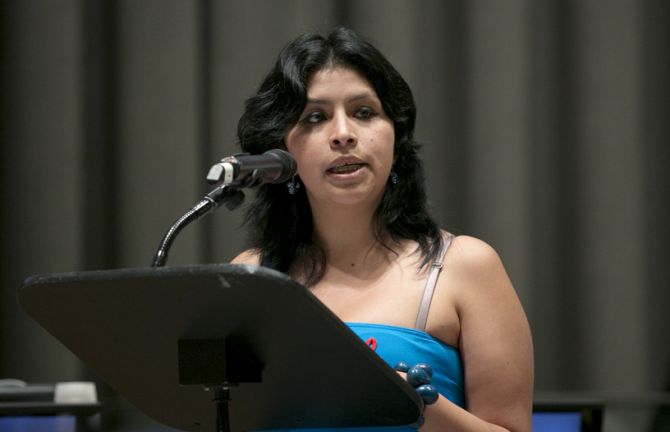
Barbara Martinez, of the Latin American and Caribbean Network of Young People living with HIV, addresses the opening of the special event, “Towards Achieving the Millennium Development Goals (MDGs)”, organized by the President of the General Assembly. 25 September 2013. UN, New York. Credit: UN Photo/Rick Bajornas
Feature Story
Young woman living with HIV urges international community not to drop guard on HIV
23 September 2013
23 September 2013 23 September 2013Barbara Martinez, a young Ecuadorian activist living with HIV, urged the international community not to drop its guard on HIV during her address at the 68th United Nations General Assembly special event on the Millennium Development Goals (MDGs). The event was convened to review progress towards the MDGs as well as to discuss the transition into the post-2015 development framework.
Ms Martinez stressed that integrated and concerted action was needed to reach the MDGs and urged the international community, civil society and people living with HIV to remain vigilant in achieving the goals originally set in the Millennium Declaration. She also called on world leaders to ensure HIV remains a high priority for the world in the post-2015 agenda.
According to Ms Martinez, the MDGs have helped countries make major advances in their responses to HIV. She went on to stress that the efforts towards these goals have greatly contributed to a major reduction in the number of children born with HIV and the dramatic increase in the number of people accessing HIV treatment.
As the only speaker representing civil society, Ms Martinez participated as a member of the Latin American and Caribbean Network of Young People Living with HIV (Y+LAC). Around 210 000 young people are currently living with HIV in Latin America and the Caribbean, with 34 000 new HIV infections among young people in 2012.
Quotes
When we invest in HIV, we also invest in sustainable development, which includes the eradication of poverty, good governance, social inclusion and gender equality.
External links
External links
Related

Feature Story
US Secretary of State John Kerry unveils new model for PEPFAR engagement
27 September 2013
27 September 2013 27 September 2013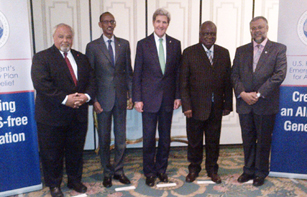
L to R: Ambassador Eric Goosby, US Global AIDS Coordinator; President of Rwanda, Paul Kagame; US Secretary of State, John Kerry; President of Namibia, Hifikepunye Pohamba; and South African Ambassador to the United States, Ebrahim Rasool. Credit: PEPFAR
The Secretary of State John Kerry unveiled a United States (US) plan to enter into Country Health Partnerships—a new model of collaborative work—with Namibia, Rwanda and South Africa. The announcement was made by Secretary Kerry during a high-level meeting he hosted on the margins of the 68th United Nations General Assembly.
The new initiative is intended to strengthen collaboration with selected country partner governments leading to greater and mutual accountability and long-term sustainability.
“The Country Health Partnerships are about shared responsibility, shared accountability, budget transparency, and a commitment to investing strategically based on what we’ve learned from improved data collection and analysis,” said Secretary Kerry. “South Africa, Rwanda, and Namibia are all on the front lines of these efforts.”
The meeting featured the participation of the President of Namibia, the President of Rwanda, the South African Ambassador to the United States and global health leaders including UNAIDS Executive Director, Michel Sidibé.
“To convene this meeting with key African heads of state and partners during the UN General Assembly sends a strong signal of the continued leadership and support of the US Government for the global AIDS response,” said Mr Sidibé. He also highlighted the continued commitment of UNAIDS to provide the strategic information and support for investment approaches that would help to ensure the success of the new partnerships.
During the roundtable, the Secretary of State also announced that the US will host the next Global Fund Replenishment Meeting in Washington, DC in December 2013. Secretary Kerry highlighted the strong commitment from other donors to support the successful replenishment of the Global Fund to fight AIDS, Tuberculosis and Malaria. Earlier this year, Germany, the Nordic Countries, France and the United Kingdom have already announced important contributions to the Global Fund for the 2014 – 2016 period to support countries in their response to HIV, tuberculosis and malaria.
Feature Story
Time to accelerate efforts to reach the health-related MDGs
23 September 2013
23 September 2013 23 September 2013On the occasion of the 68th General Assembly of the United Nations starting in New York on 24 September, WHO, UNFPA, UNAIDS, UNICEF and the UN Secretary General’s Special Envoy for Financing the Health MDGs and for Malaria released a joint statement calling for a final push to achieve the health-related MDGs and lay the foundations for a post-2015 world.
According to the statement, “Now is the moment to build on our remarkable success and insure that we actually meet the health MDGs in the time left to achieve them.”
statement
Statement:
Related
Feature Story
Crafting a new narrative on AIDS for the post 2015 agenda
23 September 2013
23 September 2013 23 September 2013
HRH Crown Princess of Norway, Mette-Marit (centre) and Pablo Aguilera, Director of HIV Young Leaders Fund participating in the interactive dialogue with key emerging leaders in the social good space on the topic of Creating a new narrative on AIDS for the post 2015 world – what role can the social good sector play? Credit: UNAIDS
Bloggers, HIV experts and emerging leaders in the social good arena from around the world met in New York to discuss how new technologies can be used to effectively respond to HIV and can help create a new narrative around AIDS for the post 2015 world.
The dialogue took place during a session held at the Mashable Social Good Summit, which is organized on the side-lines of the 68th session of the United Nations General Assembly. The aim of the Summit is to bring together global leaders to discuss an idea: the power of innovative thinking and technology to solve the world’s greatest challenges. This year’s main debates focused around finding innovative solutions for a world post-2015—when the Millennium Development Goals will come to an end.
Speaking at the event, UNAIDS Goodwill Ambassador Her Royal Highness Crown Princess Mette-Marit of Norway stressed the importance of keeping AIDS in the Post-2015 development framework and called on Member States to ensure young people have a seat at the discussion table.
“We need a new narrative on AIDS. One that projects hope and inspires action,” said the Crown Princess. “Young people demand to play a role in shaping and changing their world,” she added.
Participants identified social media as a primary tool to communicate the realities of young people living with HIV. Raising awareness among young people about how their peers live with the virus could help create a new social dialogue; one that challenges taboos and addresses stigma and discrimination.
“As a young person living with HIV, I can tell you it is very different now from what it was 15 or 20 years ago,” said Pablo Aguilera, Director of HIV Young Leaders Fund. “We need to craft a compelling new narrative about AIDS, based on the realities of today, to engage people in reaching the end of the epidemic.”
However, according to participants, any social media initiative addressing HIV must take into consideration the digital divide. They stressed that all initiatives must ensure that online tools are used for offline action.
One such project is ACT 2015 where Youth organizations and UNAIDS, with support from HRH Crown Princess, will aim to catalyze social action to inspire a new wave of activism in the AIDS response.
ACT 2015 will engage and support youth activists to host online and offline host forums in their local communities to jointly agree and advocate for a new progressive framework that addresses the real HIV and sexual and reproductive health needs of young people. The open forums will take place during the month of November 2013.