

Press Release
UNAIDS reports a 52% reduction in new HIV infections among children and a combined 33% reduction among adults and children since 2001
23 September 2013 23 September 2013World closing in on Millennium Development Goal 6, globally the AIDS epidemic has been halted and reversed—race is on to reach universal access to HIV treatment.
GENEVA, 23 September 2013—As world leaders prepare to meet at the United Nations General Assembly to review progress towards the Millennium Development Goals—a new report from the Joint United Nations Programme on HIV/AIDS (UNAIDS) shows dramatic acceleration towards reaching 2015 global targets on HIV.
New HIV infections among adults and children were estimated at 2.3 million in 2012, a 33% reduction since 2001. New HIV infections among children have been reduced to 260 000 in 2012, a reduction of 52% since 2001. AIDS-related deaths have also dropped by 30% since the peak in 2005 as access to antiretroviral treatment expands.
By the end of 2012, some 9.7 million people in low- and middle-income countries were accessing antiretroviral therapy, an increase of nearly 20% in just one year. In 2011, UN Member States agreed to a 2015 target of reaching 15 million people with HIV treatment. However, as countries scaled up their treatment coverage and as new evidence emerged showing the HIV prevention benefits of antiretroviral therapy, the World Health Organization set new HIV treatment guidelines, expanding the total number of people estimated to be in need of treatment by more than 10 million.
“Not only can we meet the 2015 target of 15 million people on HIV treatment—we must also go beyond and have the vision and commitment to ensure no one is left behind,” said Michel Sidibé, Executive Director of UNAIDS.
Significant results have also been achieved towards meeting the needs of tuberculosis (TB) patients living with HIV, as TB-related deaths among people living with HIV have declined by 36% since 2004.
Despite a flattening in donor funding for HIV, which has remained around the same as 2008 levels, domestic spending on HIV has increased, accounting for 53% of global HIV resources in 2012. The total global resources available for HIV in 2012 was estimated at US$ 18.9 billion, US$ 3-5 billion short of the US$ 22-24 billion estimated to be needed annually by 2015.
As well as outlining new global HIV estimates, the 2013 UNAIDS Report on the global AIDS epidemic reviews progress on ten specific targets which were set by United Nations Member States in the 2011 UN Political Declaration on HIV and AIDS.
The report finds that progress has been slow in ensuring the respect of human rights, securing access to HIV services for people most at risk of HIV infection, particularly people who use drugs, and in preventing violence against women and girls––a key factor in vulnerability to HIV. Gender inequality, punitive laws and discriminatory actions are continuing to hamper national responses to HIV and concerted efforts are needed to address these persistent obstacles to the scale up of HIV services for people most in need.
The 2013 UNAIDS Report on the global AIDS epidemic is available on line at unaids.org

Related information
Related information
Publications
Publications
Press centre
Download the printable version (PDF)
Press Release
Kaiser/UNAIDS study finds no real change in donor funding for HIV
23 September 2013 23 September 2013Donor disbursements in 2012 totalled US$ 7.86 billion
GENEVA/Washington D.C., 23 September 2013––As world leaders prepare to meet to review progress towards the Millennium Development Goals, a report from the Kaiser Family Foundation and the Joint United Nations Programme on HIV/AIDS (UNAIDS) evaluates international efforts to finance the response to the AIDS epidemic. The annual funding analysis finds donor governments disbursed US$ 7.86 billion toward the AIDS response in low-and middle-income countries in 2012, essentially unchanged from the US$ 7.63 billion level in 2011 after adjusting for inflation.
Overall, donor government funding for HIV has stayed at about the same level since 2008 - a plateau that followed a period of dramatic growth that saw donor nation support increase more than six-fold between 2002 and 2008. This flattening mirrors a similar trend in development assistance more generally, reflecting the economic and fiscal constraints of the post-financial-crisis period.
The United States government remains the largest donor to HIV efforts, contributing US$5 billion in 2012 towards the AIDS response in low-and middle-income countries and to the Global Fund, up slightly from the US$ 4.5 billion in 2011. The U.S. increase results from a quickened disbursement rate of previously approved funding.
"After years of sharp increases in donor government support which led to significant progress in the fight against the HIV epidemic, funding flattened after the worldwide recession and is likely to remain flat for the immediate future," said Kaiser Family Foundation President and CEO Drew Altman.
"We are at a critical moment in the AIDS response," said Luiz Loures, Deputy Executive Director, Programme, UNAIDS, "Scientific advances and new guidelines are providing opportunities to accelerate action and expand access to lifesaving HIV services. To take full advantage of these opportunities all efforts must be made to ensure the response to HIV is fully funded."
Five donor governments - Australia, Canada, Japan, Sweden, and the U.S. - reported increased total assistance for HIV in 2012, with U.S. assistance increasing by just more than US$ 500 million. Six decreased funding in 2012: Denmark, France, Ireland, the Netherlands, the U.K., and the European Commission. Three donor governments - Germany, Italy, and Norway - stayed constant in their support in 2012. The report found that the great majority, US$ 6 billion, of international HIV assistance is provided bilaterally.
The United States accounted for nearly two-thirds (63.9%) of disbursements from donor governments bilaterally and multilaterally. The United Kingdom was the second largest donor (10.2%), followed by France (4.8%), Germany (3.7%), and Japan (2.7%). When viewed as a share of national economies, Denmark provided the highest amount of resources for HIV in 2012, followed by the U.K, Sweden, the U.S., and Ireland.
The new report, produced as a partnership between the Kaiser Family Foundation and UNAIDS, provides the latest data available on donor funding based on data provided by governments.
This report is based on analysis of data of 24 donor government members of the Organization for Economic Co-operation and Development's Assistance Committee. It includes their combined bilateral assistance to low- and middle-income countries, and contributions to the Global Fund to Fight AIDS, Tuberculosis and Malaria, as well as to UNITAID.
Contact
UNAIDS GenevaSophie Barton-Knott
tel. +41 22 791 1697
bartonknotts@unaids.org
Kaiser Family Foundation
Katie Smith
tel. +1 202 347-5270
ksmith@kff.org
Publications
Press centre
Download the printable version (PDF)
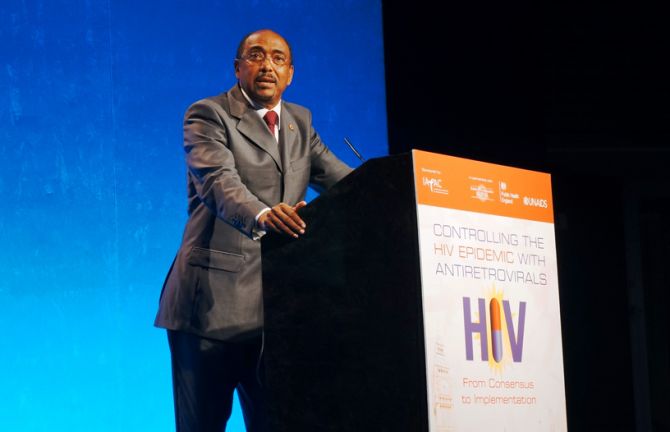
UNAIDS Executive Director, Michel Sidibé speaking at the opening of the summit Controlling the HIV Epidemic with Antiretrovirals: From Consensus to Implementation. 22 September 2013.
Feature Story
International momentum builds to expand access to antiretroviral therapy
23 September 2013
23 September 2013 23 September 2013HIV scientists, doctors, and health economists have gathered in London on 22-24 September to present the clinical and financial case for HIV treatment and other HIV prevention activities to achieve the 2015 global AIDS targets. Under the title Controlling the HIV Epidemic with Antiretrovirals: From Consensus to Implementation, more than 400 delegates considered data about how the latest HIV prevention programmes work.
The Summit was hosted by the International Association of Providers of AIDS Care (IAPAC) in partnership with the British HIV Association (BHIVA), Public Health England (PHE), and the Joint United Nations Programme on HIV/AIDS (UNAIDS).
Speaking at the opening, UNAIDS Executive Director, Michel Sidibé highlighted the importance of accelerating access to HIV treatment saying that HIV treatment should be available to everyone who needs it. Following the key note speech, high-level panel members discussed HIV treatment expansion; the importance of using data to expand programmes; the need to maximize impact with the resources available; and the need to empower communities to deliver HIV services.
Quotes
We have less than 1000 days to achieve our 2015 global target of reaching 15 million people with HIV treatment. Not only can we reach this goal but must go beyond it to ensure no one is left behind.
There is no question to continue business as usual. Even though the country is facing a problem of lack of resources, our President has decided to mobilize all available resources to sustain the AIDS response.
Treatment is prevention; treatment prevents people from becoming sick and prevents the spread of the virus.
People here [Zambia] have to start queuing at 3 AM to get a chance of receiving ARVs, without being sure whether they will get them. Only community members can provide assistance to people who will never go to a health facility. Time has come to make sure that everybody who needs treatment will get it.
We know enough about the science for treatment as prevention. It is now time to act.
Speeches
Feature Story
President Museveni commits to redouble efforts towards the national AIDS response in Uganda
23 September 2013
23 September 2013 23 September 2013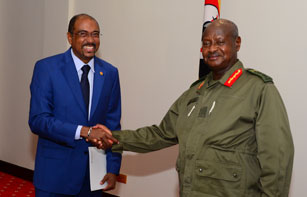
UNAIDS Executive Director Michel Sidibé met with President Yoweri Kaguta Museveni of Uganda at the State House in Entebbe. Photo courtesy of State House, Uganda.
The President of Uganda Yoweri Kaguta Museveni reaffirmed his country’s commitment to end the AIDS epidemic in a meeting with UNAIDS Executive Director, Michel Sidibé and UN Secretary General’s Special Envoy for HIV/AIDS in Africa, Dr Specioza Wandira Kazibwe. The meeting, held on 17 September at the State House in Entebbe, was an opportunity to review recent progress made in Uganda’s AIDS response.
“Under the leadership of President Museveni, Uganda is uniquely positioned to reassert its role and reputation as a success story of the AIDS response in Africa,” said Mr Sidibé.
In the late 1990’s, Uganda was internationally recognized as a success story in Africa, having reduced high HIV infection rates and extended access to life-saving treatment for people living with HIV. Between 2006 and 2011, however, there were signs that its earlier success had fallen by the way-side with new HIV infections on the rise.
New HIV infections in Uganda increased from 120 000 in 2005 to 160 000 in 2011 with a slight decrease in 2012—an estimated 140 000 new HIV infections were recorded last year.
In 2012-2013, Uganda made breakthrough progress by scaling-up its national, evidence-based response to HIV. In 2012 alone 193 000 people living with HIV were newly enrolled in the national treatment programme. The Ugandan Ministry of Health is also expanding its HIV prevention strategy to reduce the number of new HIV infections in Uganda.
Under the leadership of President Museveni, Uganda is uniquely positioned to reassert its role and reputation as a success story of the AIDS response in Africa,
UNAIDS Executive Director Michel Sidibé
Demonstrating his commitment to the AIDS response, President Museveni committed to address the upcoming high-level event on Millennium Development Goal 6 and HIV treatment organized by UNAIDS on the side-lines of the United Nations General Assembly, which will be held on 23 September 2013.
As part of the official visit, Mr Sidibé and Dr Kazibwe joined the Ugandan Minister of Local Government, Hon Adolf Mwesige during a meeting with local leaders from 112 Districts in the country. They urged the district authorities to accelerate their efforts to ensure that integrated health care services are available for people living with HIV in their communities.
“Uganda’s constitution says sovereignty is with the people and elected leaders are servants of the people,” said Dr Kazibwe, “The people who elected you are crying out to you to make sure that resources are mobilized to improve delivery of services for HIV and health at the district level,” she added.
In his two-day official visit to Uganda, Mr Sidibé also met with the Speaker of the Ugandan Parliament, Members of Parliament from the Committee on HIV/AIDS, and representatives from civil society and private sector organizations. Issues discussed included the need to ensure social equity and the respect for human rights of key population at higher risk of HIV infection; the regional production of HIV medicines; and the importance of increasing domestic resources to sustain the national AIDS response.
Feature Story
The First Lady of Uganda rolls out next phase of campaign to stop new HIV infections among children
17 September 2013
17 September 2013 17 September 2013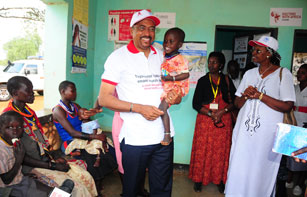
UNAIDS Executive Director and First Lady of Uganda met with mothers at a health centre in Nadunget, Uganda, 16 September 2013. Credit: UNAIDS
The First Lady of Uganda, Janet K Museveni, showed her commitment to stopping new HIV infections in children by bringing a national campaign to Karamoja, one of the most disadvantaged regions of her country. She launched the Elimination of Mother-to-Child- Transmission of HIV (eMTCT) Campaign in Moroto, a city in the north eastern region on 16 September.
The campaign is part of the government’s push to prevent new HIV infections among children by promoting an antiretroviral therapy (ART) regimen where all pregnant women living with HIV are provided ART for life. This is consistent with the 2013 World Health Organization guidelines which recommend that ART be initiated in certain populations including pregnant and breast-feeding women in resource limited settings.
Speaking at the launch, the First Lady who is also the Cabinet Minister for Karamoja Affairs said “Sadly, 65 babies are born with HIV every day in Uganda. We must give appropriate, life-saving messages if we are going to reverse this trend.”
The Minister of Health of Uganda, the UNAIDS Executive Director and other high-level dignitaries attended the launch. Uganda was recognized as a leader in Africa’s HIV response and was one of the first four developing countries in the world to provide people living with HIV with access to life-saving treatment. But in recent years, the country’s HIV response has lost some momentum. According to government figures, an estimated 140 000 new HIV infections occurred in 2012, compared to 120 000 in 2005.
There are signs Uganda is revitalizing its AIDS response. New infections among children declined from 27 000 in 2009 to 15 000 in 2012—a 49% drop. The number of women accessing prevention of mother-to-child-transmission of HIV (PMTCT) services in the country also increased rapidly from 45% in 2011 to 73% 2012.
UNAIDS Executive Director Michel Sidibé applauded the First Lady for her personal commitment to bringing HIV treatment and care services to women in poor and marginalized communities.
“Uganda brought hope to millions of people. It showed the word that AIDS can be overcome and Africans can have access to treatment. This hope was built on courage, strong leadership and partnership,” said Mr Sidibé. “Uganda needs to bring back the courage and commitment of its early days to finish the job and have a generation born free from HIV.”
The First Lady and Mr Sidibé met with two couples, who shared their experience as parents living with HIV. “Thanks to the treatment and advice I got from the health centre I gave birth to a baby born HIV free. That baby is now two years old.” said Angella Nate, who has been living with HIV for the past last six years. “I tell everyone my story because I want all mothers to see their children grow up healthy and get the same chance in life as everybody else.”
The UNAIDS Executive Director will continue with his official visit to Uganda on 17 September, meeting with civil society groups, district level government leaders and the country’s president.
Feature Story
UN study in Asia and the Pacific reports high levels of violence against women and girls
16 September 2013
16 September 2013 16 September 2013
A new study focusing on men’s use of violence against women found that more than half of the 10 000 men interviewed reported using physical or sexual violence against a female partner. Nearly a quarter of the men interviewed reported perpetrating rape against a woman or girl.
The UN multi-country study entitled Why do some men use violence against women and how can we prevent it? was launched in Bangkok, Thailand on 10 September 2013.
Conducted in six countries in Asia and the Pacific—Bangladesh, Cambodia, China, Indonesia, Sri Lanka and Papua New Guinea—the study explores the prevalence of men’s use of violence against women in surveyed sites, and shows what factors make men more or less likely to use violence. The report also makes important recommendations to prevent violence against women.
“Prevention is crucial because of the high prevalence of men’s use of violence found across the study sites,” said James Lang, Programme Coordinator, Partners for Prevention. “It is also achievable because the findings indicate that the majority of factors associated with men’s use of violence can be changed,” he added.
Prevention is crucial because of the high prevalence of men’s use of violence found across the study sites. It is also achievable because the findings indicate that the majority of factors associated with men’s use of violence can be changed.
James Lang, Programme Coordinator, Partners for Prevention
The report highlights that, among respondents who admitted using violence against women, many began such violence perpetration at early ages. “We need to start working with younger boys and girls than we have in the past,” said Emma Fulu, Research Specialist for Partners for Prevention. “We also need laws and policies that clearly express that violence against women is never acceptable,” added Ms Fulu.
Findings of the study provide important evidence and guidance for efforts to eliminate gender inequalities and gender-based violence and increase the capacity of women and girls to protect themselves from HIV.
The World Health Organization reports that forced sex, violence and/or fear of violence can limit the possibility of women to negotiate safe sex and to protect themselves from HIV transmission. Research from the Asia Pacific region suggests that violence is a risk factor for HIV where women living with HIV are more likely to report a history of intimate partner violence than women who are not.
“These findings provide significant insights to help better adapt programmes and initiatives in Asia and the Pacific to reduce gender-based violence and help increase the protection of women and girls from HIV infection,” said Steven Kraus, Director of the UNAIDS Regional Support Team for Asia and the Pacific.
The study was conducted by Partners for Prevention, a UN Development Programme (UNDP), UN Population Fund (UNFPA), UN Women and UN Volunteers regional joint programme. The study asked men about their use and experiences of violence, attitudes and practices, childhood, sexuality, family life and health.
Publications
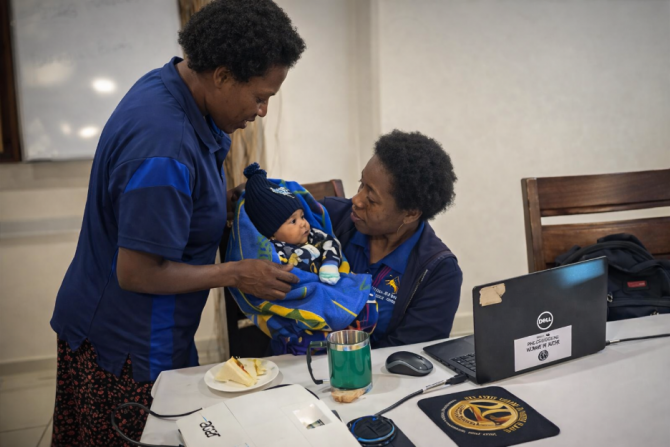
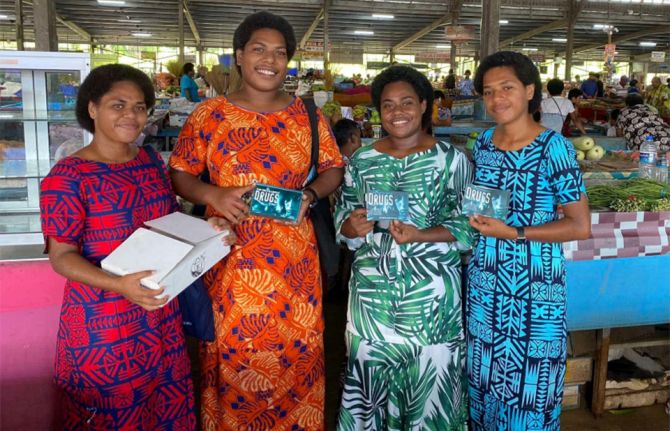
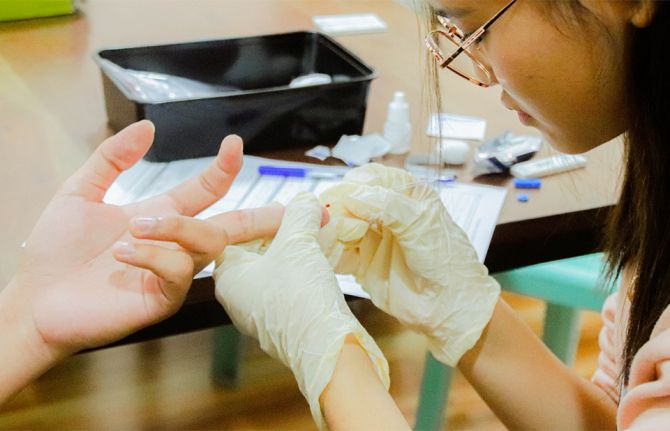
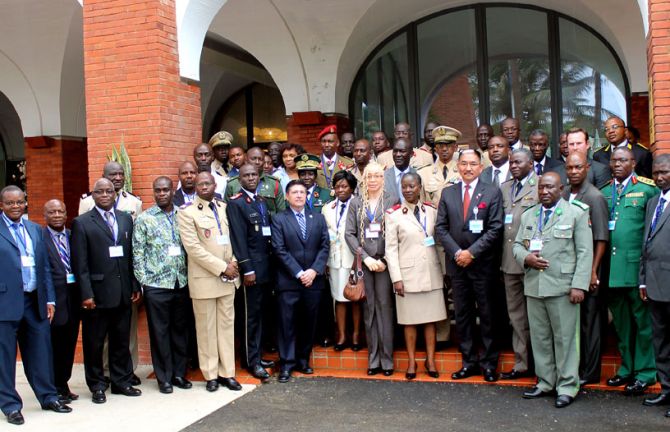
Meeting of the West and Central Africa Military Network for AIDS Control (REMAFOC) held in Dakar, Senegal from 2-4 September 2013.
Feature Story
Call for scale up of HIV prevention programmes for military and security forces in West and Central Africa
16 September 2013
16 September 2013 16 September 2013High-level military representatives from 19 countries in West and Central Africa have called on governments to scale up HIV prevention programmes specific for military and security forces to reduce new HIV infections and sexual gender-based violence in conflict and post conflict areas in the region.
The call was made during a meeting of the West and Central Africa Military Network for AIDS Control (REMAFOC) held in Dakar, Senegal from 2-4 September 2013. Established in December 2008 with support from UNAIDS, REMAFOC aims to coordinate the response to HIV among military forces in the region—by promoting collaboration and knowledge exchange between the armed forces of 22 West and Central Africa Members States.
During the meeting, members of the REMAFOC and representatives from UNAIDS, DPKO, UNFPA and the US Department of Defence discussed progress made in the implementation of the United Nation Security Council Resolution 1983 on HIV and security in conflict and post conflict situations. Resolution 1983 identifies sexual and gender-based violence as a specific risk of HIV infection for women and girls.
Participants at the meeting shared best practice activities from countries in conflict or post conflict situations including Côte d’Ivoire, Liberia and the Democratic Republic of Congo. Activities range from training women’s organizations on how to refer victims of sexual violence to health care services to training trainers from the armed and security forces as well as prison and immigration services on HIV prevention.
REMAFOC Member States agreed to develop, in collaboration with the US Department of Defence, a common position paper on HIV and security to scale-up the implementation of Resolution 1983 in the region.
Quotes
Militaries, at the highest level, understood very early that HIV is not only a public health problem but also a threat to national security and have shown their firm commitment and leadership in establishing HIV units within armed forces structures.
As REMAFOC, we have the responsibility to ensure that our officers are strong and healthy. We must collectively ensure that there is zero new transmission of HIV, zero AIDS-related deaths and zero stigma and discrimination.

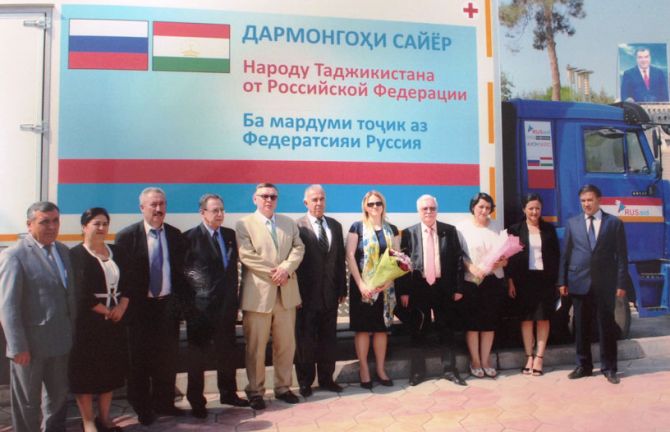
At the launch, a Russian-made mobile clinic and diagnostic centre was presented to the Government of the Khatlon Region.
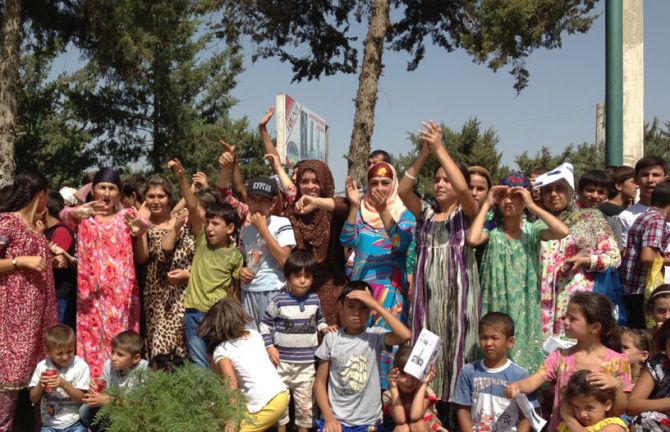
Local citizens in the city of Kurgan-Tube during the public launch of the Technical Assistance Programme in Tajikistan.
Feature Story
Technical Assistance Programme for Countries of Eastern Europe and Central Asia in Combating Infectious Diseases launched in Tajikistan
12 September 2013
12 September 2013 12 September 2013The national launch of the Technical Assistance Programme for Countries of Eastern Europe and Central Asia in Combating Infectious Diseases took place in the Tajikistani city of Kurgan-Tube, in the Khatlon Region on 10 September 2013.
The Technical Assistance Programme, supported by a three-year grant of US$ 16.5 million from the Russian Government, aims to strengthen health systems, ensure better epidemiological surveillance of HIV, and promote the scale up of HIV prevention programmes among key populations at higher risk in Armenia, Kyrgyzstan, Tajikistan, and Uzbekistan.
The Programme is supported by the contribution of the Russian Government as a leading partner for health and development in countries of the Commonwealth of Independent States, and is being implemented by UNAIDS, in partnership with the non-governmental organization 'AIDS Infoshare'.
The launch was attended by representatives of the Russian Presidential Administration, the Russian Ministry of Foreign Affairs, the Ministry of Health of Tajikistan, the Government of the Khatlon Region, the City of Kurgan-Tube, the Ministry of Health of Armenia, as well as representatives from UNAIDS, 'AIDS Infoshare' and civil society organizations from Russia and Tajikistan.
The HIV epidemic in Tajikistan, affects mainly people who use drugs and now the number of new HIV infections is growing among people migrating abroad for work. Knowledge about HIV prevention remains limited among migrant workers and access to HIV services are not widely available upon their return as most live in rural and hard to reach regions of the country.
At the launch, a Russian-made mobile clinic and diagnostic centre was presented to the Government of the Khatlon Region. Equipped with the latest in medical equipment and diagnostic systems, the clinic will provide populations at higher risk of HIV infection in the Khatlon Region with access to integrated HIV testing, counselling and other forms of medical diagnostics and treatment.
Quotes
Through this programme Tajikistan will reach the communities most at risk of HIV infection and will break the trajectory of the epidemic.
The people of Tajikistan are very grateful for the timely, generous support of the Russian Government in this important programme.
This initiative is a new level of cooperation in the positive history of economic and cultural relations between the people of the Russian Federation and the people of the Republic of Tajikistan.
Russia considers this to be a model of donor aid effectiveness that will be promoted during Russia's Presidency of the G8.
Migration should never be a barrier to access quality health services or learn one's HIV status. This mobile clinic will bring the latest HIV information and medical technology to communities in Tajikistan that are most at risk of HIV infection.
Related
 Women, HIV, and war: a triple burden
12 September 2025
 Displacement and HIV: doubly vulnerable in Ukraine
11 August 2025
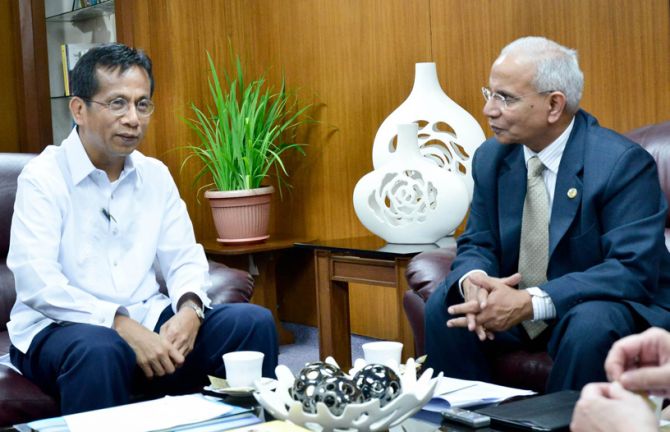
Mr Prasada Rao, UN Secretary General's Special Envoy on HIV/AIDS for Asia and the Pacific (right) with Hon. Arsenio M. Balisacan, Director-General of the Philippine National Economic and Development Authority (NEDA). Credit: UNAIDS
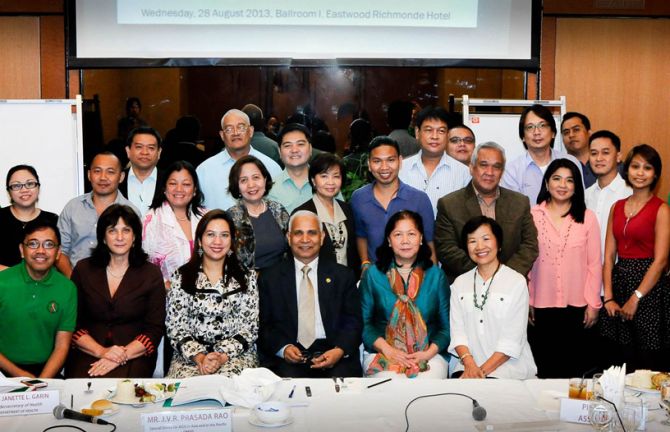
Mr JVR Prasada Rao, UN Secretary General's Special Envoy on HIV and AIDS for Asia and the Pacific, with the members of Philippine National AIDS Council (PNAC) Executive Committee.
Feature Story
UN Secretary General’s Special Envoy for AIDS in Asia Pacific advocates for rapid action to address increasing numbers of new HIV infections in the Philippines
11 September 2013
11 September 2013 11 September 2013The United Nations Secretary Generals’ Special Envoy on AIDS in Asia and the Pacific Prasada Rao visited the Philippines at the end of August to advocate for a scaled up response to HIV in the country.
After more than 20 years of low rates of new HIV infections, the Philippines is now seeing an increase in the number of new HIV infections among key populations at high risk in certain geographical sites. For example, the HIV prevalence among people who use drugs in Cebu—one of the most populated areas in the country—went form 0.6% to 53% between 2009-2011. Similarly, the HIV prevalence among men who have sex with men in 2011 was as high as 6% in Quezon City and 5% in Cebu—the HIV prevalence among the general population in the country was less than 0.1%. According to the Philippines Department of Health, there has been a 523% increase in new cases compared to 2008.
Speaking at the Executive Committee Meeting of the Philippine National AIDS Council (PNAC) Mr Rao urged increased leadership and rapid action to stem the spread of the epidemic. He also noted that policies, plans, antiretroviral treatment and HIV prevention technologies are all available and within reach to ensure progress on reversing current trends.
During a meeting with Socio-economic Planning Secretary Arsenio Balisacan, who also heads the government’s National Economic and Development Authority, Mr Rao emphasized the need for greater government investment on HIV, noting that current prevention investments of US$ 8 million - US$ 10 million per year fall short of the estimated need of at least US$ 40 million per year.
Secretary Balisacan agreed that investing now in HIV prevention will lead to savings in HIV treatment costs in the future and shared that both he and the President of the Philippines, Benigno C. Aquino III, have requested the Health Secretary to present a ‘prevention strategy’ for the Health agenda, including the issue of HIV.
Quotes
We must raise awareness about the risk of increased epidemic spread if proper response measures are not adopted immediately. There is also a need to agree on high priority areas to allocate resources with a definite focus on key populations at highest risk.
We are seeing a fast and furious increase in HIV infections. We need to prioritize and to scale up the response in a more coordinated manner. What’s important is that our government, whether national or local, should lead in the response and be able to accept the fact that we need to do something and we have to do it fast.
Feature Story
Experts meet on advancing access to HIV treatment
10 September 2013
10 September 2013 10 September 2013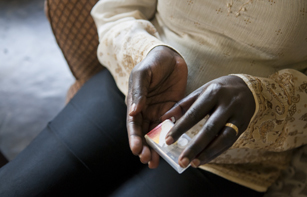
At the end of 2012, 9.7 million people worldwide had access to antiretroviral (ARV) therapy in low- and middle-income countries. Credit: UNAIDS
Experts call for increased access to life-saving HIV treatment. The call, made during a meeting held in New York on 4-5 September, follows the recommendations made last year by the independent Global Commission on HIV and the Law on improving access to HIV treatment.
The Global Commission’s landmark report recommended a new intellectual property framework for pharmaceuticals that would meet urgent public health needs while safeguarding the rights of inventors.
“While intellectual property protections are intended to provide an incentive for innovation, the evidence shows that excessive protection hinders access to affordable HIV treatment and other essential medicines,” Helen Clark, UN Development Programme (UNDP) Administrator told participants at the meeting convened by UNDP and UNAIDS. “Access to affordable, quality-assured pharmaceutical products remains an urgent priority for achieving the MDGs and improving health and development outcomes for poor and marginalized populations,” added Ms Clark.
At the end of 2012, 9.7 million people worldwide had access to antiretroviral (ARV) therapy in low- and middle-income countries, compared to just 300 000 people 10 years earlier. However, UNAIDS and the World Health Organisation estimate that another 16 million people are eligible to HIV treatment but lack access to it.
“We need solutions to increase access to life-saving HIV treatment and the recommendations of the Global Commission clearly outline how a people-centred approach can help ensure no one is left behind,” said Michel Sidibé, UNAIDS Executive Director.
While intellectual property protections are intended to provide an incentive for innovation, the evidence shows that excessive protection hinders access to affordable HIV treatment and other essential medicines.
Helen Clark, UN Development Programme Administrator
The World Trade Organization's (WTO) Agreement on Trade Related Aspects of Intellectual Property Rights, known as TRIPS, requires countries to abide to high intellectual property standards, including patent criteria that grant pharmaceutical companies long-term monopolies on medicines. When the TRIPS treaty was signed in 1994, it included terms that allow poor countries to produce or import cheaper medicines under specific circumstances. However, external pressure from wealthier countries has often prevented the application of such special clauses.
“The real crux of the Commission’s Recommendations was for a new intellectual property regime for pharmaceutical products – it is not enough to tweak the existing system,” said J.V.R. Prasada Rao, former Commissioner.
Talks at the meeting focused on strategies, tactics, and timelines to confront the growing need for HIV treatment, including how to make intellectual property laws work better for low-and middle-income countries. Next steps are under discussion.
“We should be encouraged that this meeting comes at a pivotal time when we are discussing the post-2015 development agenda, which presents us with significant opportunities,” said Michael Kirby, former Commissioner.