Feature Story
Commission on Narcotic Drugs adopts resolution on scaled up HIV prevention among people who use drugs
28 March 2011
28 March 2011 28 March 2011
United Nations in Vienna
Credit: UN
The fifty-fourth session of the United Nations Commission on Narcotic Drugs (CND) has adopted a resolution on Achieving zero new infections of HIV amongst injecting and other drug users.
The CND noted the 2011-2015 UNAIDS Strategy which promotes the objectives of achieving zero new HIV infections, zero AIDS-related deaths and zero stigma and discrimination. UNODC was requested to continue providing advice and guidance on effective measures to scale up HIV prevention for people who use drugs, and on how to reduce stigma and discrimination.
The Commission also reaffirmed the central importance of civil society as a key partner in the global response to HIV, including to achieving the vision of zero new HIV infections. Member States were urged to ensure their political commitment to the HIV response, by highest level participation in the UN General Assembly High Level Meeting on AIDS which will take place in New York 8-10 June 2011.
A statement was delivered to the CND on behalf of UNAIDS by Michael Bartos, Team Leader, Strategy Support and Evaluation. UNAIDS’ strategy goal of preventing all new HIV infections among people who use drugs was highlighted. “Despite major gaps in programme efforts directed to this goal, real country results in preventing HIV transmission among drug users suggest that where programmes are delivered at scale, achieving this ambitious goal is possible.”
HIV and injecting drug use
Globally, there are an estimated three million people who inject drugs also living with HIV—with nearly 13 million more at risk of HIV infection. While access to HIV prevention services, including harm-reduction programmes has increased, in 2009 the median coverage of HIV prevention services was 32%.
Commission on Narcotic Drugs
The Economic and Social Council established the Commission on Narcotic Drugs (CND) in 1946 as the central policy-making body of the United Nations in drug-related matters. CND enables Member States to analyse the global drug situation, provide follow-up to the General Assembly and to take measures at the global level within its scope of action. It also monitors the implementation of the three international drug control conventions and is empowered to consider all matters pertaining to the aim of the conventions, including the scheduling of substances to be brought under international control.
External links
External links
Publications
Publications
Related

Feature Story
New framework to eliminate transmission of HIV from mothers to their babies
28 March 2011
28 March 2011 28 March 2011
(from left) Helen Jackson, UNAIDS, Senior HIV Prevention Adviser, ESA; Elhadj As Sy, UNICEF Regional Director for Eastern and Southern Africa (ESA); Tigest Ketsela, Director, Family and Reproductive Health, World Health Organization (WHO), Africa Region; Michael Klaus, Regional Chief of Communication, UNICEF ESARO.
The elimination of mother-to-child transmission of HIV in Eastern and Southern Africa has come a step closer with the endorsement of a new regional framework following a three-day consultation in Nairobi, Kenya earlier this month.
The consultation brought together government representatives from 15 high-burden countries[i], civil society organizations and donors. They were joined by the UN Children’s Fund (UNICEF), the Joint United Nations Programme on HIV/AIDS (UNAIDS), the World Health Organization (WHO) and the UN Population Fund (UNFPA).
In 2009 some 370,000 young children were newly infected with HIV. It was noted that although the scale of the problem of mother-to-child transmission of HIV cannot be underestimated, there is much that can be done. According to Elhadj As Sy, UNICEF Regional Director for Eastern and Southern Africa, “We now have the leadership at all levels to bring this number down. We know what works. Now is the time to act and make a difference. An AIDS-free generation by 2015 is possible.”
Championing both new and existing interventions
Partners endorsed the UNAIDS call for the virtual elimination of mother-to-child transmission of HIV by 2015 and adherence to the new WHO guidelines that recommend giving pregnant women and new mothers a combination of three antiretroviral drugs. They also pledged to vigorously pursue all four components of the internationally agreed UN strategy to dramatically reduce mother-to-child transmission.
There was an acknowledgement that a different approach is needed if the elimination target is to be achieved. A series of priority actions—which include enhanced support for existing programmes and strategies to implement new ones—were defined:
- Improving coverage access and use of services
- Strengthening the quality of existing interventions
- Integrating efforts to prevent mother-to-child transmission into routine antenatal and reproductive health services
- Making paediatric HIV care a routine part of child health services
- Promoting health systems development
- Improving measurement of programme performance and impact assessment
- Engaging communities more fully
The partners also agreed to work on ensuring that all pregnant women and their partners are counselled and tested during their first antenatal care visit.
Room for optimism
If countries continue rapid scale up of quality, comprehensive PMTCT service access, the goal of elimination of HIV transmission from mother to infants by 2015 can be achieved
Helen Jackson, Senior HIV Prevention Advisor for UNAIDS in Eastern and Southern Africa
Although many pregnant women are still falling through the treatment coverage net, in recent years scaled up prevention of vertical transmission efforts have been effective. According to UNAIDS 2010 estimates, in southern Africa in 2009 an estimated 130,000 infants were newly infected, more than 30% fewer than in 2004. In Botswana, Namibia, South Africa and Swaziland treatment coverage has reached more than 80%[ii]. Given these figures, and the possibility that they can be achieved across the region, participants in the consultation expressed optimism.
“If countries continue rapid scale up of quality, comprehensive PMTCT service access, the goal of elimination of HIV transmission from mother to infants by 2015 can be achieved,” said Helen Jackson, Senior HIV Prevention Advisor for UNAIDS in Eastern and Southern Africa. “We have joined forces to make sure this happens.”
[i] South Africa, Mozambique, Uganda, United Republic of Tanzania, Kenya, Zambia, Malawi, Zimbabwe, Ethiopia, Angola, Burundi, Lesotho, Botswana, Rwanda, Swaziland and Namibia.
[ii] Ibid
Related

Feature Story
Treatment 2.0: Translating concept into practice to overcome the HIV epidemic
24 March 2011
24 March 2011 24 March 2011
How to translate the concept of Treatment 2.0 into practice was the topic of discussion at a seminar organized by UNAIDS and WHO on 18 March at the UNAIDS Headquarters in Geneva.
How to translate the concept of Treatment 2.0 into practice was the topic of discussion at a seminar co-organized by UNAIDS and the World Health Organization (WHO) on 18 March at UNAIDS Headquarters in Geneva. Staff members from both organizations participated in the event together with colleagues from the Global Fund, the International AIDS Society and UNITAID.
“We need to find innovative solutions to overcome the HIV epidemic,” said Dr Bernhard Schwartländer, UNAIDS Director of Evidence, Strategy and Results Department and the seminar’s organizer. “Innovation to improve treatment regimens but also innovation in the way we approach the AIDS response.”
Treatment 2.0 is a concept launched in November 2010 by UNAIDS and WHO that calls for a radically simplified treatment platform. Its viability and implementation at country level will determine the level of success in the response to HIV in the coming years.
Craig McClure, Senior Adviser on Treatment 2.0 at WHO and Mariangela Simao, UNAIDS Chief, Prevention, Vulnerability and Rights, jointly presented on “Catalyzing the Next Phase of Treatment”. They outlined the five pillars on which the Treatment 2.0 initiative is based: optimizing drug regimens, simplifying laboratory platforms for diagnosis and monitoring; reducing costs; adapting delivery systems and mobilizing communities.
We need to find innovative solutions to overcome the HIV epidemic. Innovation to improve treatment regimes but also innovation in the way we approach the AIDS response
Bernhard Schwartländer, UNAIDS Director of Evidence, Strategy and Results Department
Mr McClure recognized that, while some of the innovations in drugs and diagnostics are years away, there are many actions that countries can take now to simplify treatment and make it more efficient,. For example, choosing to purchase one-pill-per-day fixed dose drug combinations, legal reform to use TRIPS flexibilities to reduce costs, integrating HIV treatment with prevention services and other areas of health care where appropriate and involving communities more intensively in designing and delivering HIV services.
On this topic, David Barr from the International Treatment Preparedness Coalition gave specific examples that show how involving communities in managing treatment programmes can improve treatment access and adherence. Community approaches shall also reduce the burden faced by health systems in trying to absorb the number of people newly put on treatment.
Another advantage of scaling up community-based service delivery is that communities can better reach and engage key affected populations. “Community-based approaches have demonstrated to improve the ability of populations at higher risk of HIV to access HIV services and to benefit from antiretroviral therapy and prevent new infections,” said Mr Barr.
Providing a perspective from Latin America, Dr Massimo Ghidinelli, Regional HIV Adviser at the Pan American Health Organization (PAHO) discussed some of the critical issues faced in that region. The need to optimize drug regimens, diagnosis and monitoring tools as well as lowering costs and improving treatment delivery systems were identified as major challenges.
According to UNAIDS, the new treatment approach could also reduce new HIV infections by up to one million annually if countries provide antiretroviral therapy to all people in need. “We cannot treat ourselves out of this epidemic,” said Dr Schwartländer. “But reaching all eligible with effective therapies will not only safe millions of lives, but significantly reduce the number of new infections through lowering the viral load in people living with HIV.”
External links
External links
Publications
Publications
Related

Feature Story
From isolation to integration: Rwandan project transforms women’s lives
24 March 2011
24 March 2011 24 March 2011
Joy Ndugutse, co-founder of Gahaya Links, showed UNAIDS Executive Director Michel Sidibé a selection of handicrafts produced by women in Rwanda for the North American market.
In 2004, two sisters in Rwanda started a “trade-not-aid” initiative that produces high-end handicrafts. From a humble beginning with just 20 artisans in the remote village of Gitarama, Gahaya Links has since expanded its network to more than 5000 weavers nation-wide.
Most of the employees at Gahaya Links are women who lost husbands and children in the 1994 Rwandan genocide. Many are HIV-positive. The income earned through their work ensures they can provide food, education, and healthcare for their families.
“This is development in practice,” said UNAIDS Executive Director Michel Sidibé during a visit to the Gahaya Links head office in Kigali on Tuesday. “It is a success story for restoring the dignity of people living with HIV,” he added. In a guided tour of the project, Mr Sidibé saw first-hand the range of handicrafts on offer, including brightly-coloured woven baskets and crocheted glass-beaded necklaces.
Gahaya Links organizes sessions on HIV prevention for its employees and teams with national partners and health centres to ensure that women have access to antiretroviral treatment and care. The programme fosters an environment of support, cooperation and mutual trust for people living with HIV.
Joy Ndugutse, co-founder of Gahaya Links, told Mr Sidibé that the project transforms the lives of women living with HIV. “These women are now stronger and more confident,” she said, adding that many others could benefit from such support.
Gahaya Links collaborates closely with Same Sky, a New York-based company founded by social entrepreneur Francine Le Frak that markets the Rwandan handicrafts for a North American market. Proceeds are reinvested into expanding the business to other world regions and employing more women artisans.
PrePex: A potential new tool for HIV prevention
While in Kigali, Mr Sidibé visited the Nyamata hospital, a public facility serving a population of approximately 300 000 people. The hospital was chosen as a site for a safety study of a new, non-surgical method of male circumcision called “PrePex.”
“The most interesting thing about PrePex is that it doesn’t require going to the operating theatre,” said Dr. Agnes Binagwaho Permanent Secretary in the Ministry of Health of Rwanda. “It can be done from any clean environment. It is also cost-effective and does not require highly trained staff—any well-trained person can do it,” she added.
Studies have shown that adult male circumcision reduces the risk of HIV transmission from women to men by about 60%. Existing techniques for male circumcision require highly trained health professionals and surgical settings.
During his tour of the hospital, Mr Sidibé commended health authorities in Rwanda for their work on this groundbreaking study. “PrePex marks a revolution in the framework of accelerating HIV prevention,” he said. If larger studies confirm that PrePex is safe and effective, PrePex could be approved as a medical device that would triple the number of male circumcisions that health facilities conduct daily.
Related
Feature Story
Viet Nam takes stronger action on gender and HIV
24 March 2011
24 March 2011 24 March 2011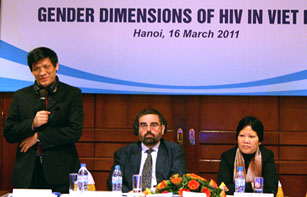
Dr. Nguyen Thanh Long, Director General of the Viet Nam Authority for AIDS Control discussed gender mainstreaming in the next National Strategy on HIV
Nguyen Thi Hien, from Viet Nam’s northern province of Bac Ninh, contracted HIV from her husband. “My husband told me when we started our relationship that he had sex with sex workers and injected drugs in the past, but I did not know then what the implications were for me,” she said.
Ms Nguyen Thi, now a peer educator of the Bright Futures network of people living with HIV, said most of the women she meets are widows of men who injected drugs and who only found out their HIV status after their husbands died of an AIDS-related illness.
According to the Viet Nam Authority for AIDS Control (VAAC), in 2010 women accounted for up to 30% of the total registered HIV infections in Viet Nam, while before 2005 women made up less than 15%.
The epidemic in Viet Nam is still mainly concentrated among men who inject drugs. However, this change in the ratio of newly reported HIV cases may reflect an increase in HIV transmission from men with high risk behaviours to their wives or regular female sexual partners in Viet Nam.
The Government of Viet Nam has made firm commitments to develop a comprehensive response to HIV, as well as to prioritize gender equality within the country’s socio-economic development strategy.
We need to mainstream gender issues in each of the three pillars of the next strategy including HIV prevention, treatment and care, and impact mitigation
Dr Nguyen Thanh Long, Director General of the Viet Nam Authority for AIDS Control
To support this, the government and major stakeholders, including civil society and people living with HIV, came together to discuss ways to improve the gender responsiveness of the 2011-2020 National Strategy on HIV/AIDS Prevention and Control. “We need to mainstream gender issues in each of the three pillars of the next strategy including HIV prevention, treatment and care, and impact mitigation,” said Dr Nguyen Thanh Long, Director General of the Viet Nam Authority for AIDS Control (VAAC).
Technical experts from UN Women and UNAIDS joined the discussions on 14-17 March. Participants identified areas of the national HIV response that should better respond to the specific needs of women and men at higher risk of infection. These include men and women who inject drugs, female and male sex workers and women whose intimate partners engage in high-risk behaviour. One area to explore is how the rapid scale up of methadone maintenance therapy—a priority for the next phase of the HIV response—could offer opportunities to better protect the HIV-negative sexual partners of drug users; for example, by providing people taking methadone with services to prevent sexual transmission of HIV.
“I have seen good signals of an engendered HIV strategy for Viet Nam,” said Suzette Mitchell, UN Women Country Representative. “Viet Nam has strong political commitment to address gender issues; and civil society is very engaged, providing many good ideas for gender mainstreaming in the strategy,” she added.
A 2010 United Nations-supported analysis of the current strategy for Viet Nam’s HIV response highlighted the need for more data to better understand the gender dynamics of the epidemic. In particular, the analysis identified a need for more information on how economic reform and social changes have different impacts on men and women and make them vulnerable to HIV.
“Gender issues need to be specifically addressed in the baseline analysis for the strategy and gender sensitive indicators need to be developed,” stressed Dr Long.
With intensified action to place gender issues at the centre of the national AIDS strategy, Viet Nam joins increasing efforts across Asia-Pacific to address this aspect of the AIDS response in the region.
“Viet Nam is showing extraordinary leadership on this issue,” said Jane Wilson, UNAIDS Gender Advisor from the UNAIDS Regional Support Team. “The agreement to engender the National Strategic Plan will have significant impact in making the AIDS response more effective and is an example of progressive action in the region on gender.”
Related
Press Release
President Kagame fully engaged in UN General Assembly High Level Meeting on AIDS
24 March 2011 24 March 2011Rwandan President will work with fellow leaders to shape the future of the AIDS and development agenda
Geneva, 24 March 2011—In partnership with UNAIDS, the President of Rwanda, Paul Kagame will lead a Heads of State event on HIV and broader development issues at the United Nations General Assembly High Level meeting on AIDS in June.
"Extraordinary efforts are needed to achieve results in global health and development, in order to transform the lives of our citizens,” said President Kagame. “As leaders, we will need to be innovative in our approach to these defining issues of our time."
The announcement came following a meeting with the Executive Director of UNAIDS, Michel Sidibé who was on an official visit to Rwanda to further collaboration in the response to HIV.
“President Kagame is a visionary and a highly respected world leader,” said Mr Sidibé. “He has been pivotal in turning Rwanda’s AIDS epidemic around. The experience and leadership he will bring to the High Level Meeting discussions in June will be instrumental in bringing AIDS out of isolation and greater country ownership.”
Since President Kagame took up leadership in 2000, HIV prevalence has almost halved and the number of people newly infected with HIV reduced by around 25%.
The Heads of State session will focus on areas such as integrating HIV into broader health and development issues and shared responsibility in responding to the epidemic. Major announcements will include a Pan-African vision for country ownership.
The special event will take place during the High Level Meeting on AIDS from 8-10 June 2011 where leaders will gather to shape the future of AIDS, health and development.
Press centre
Download the printable version (PDF)
Feature Story
Strategies for “getting to zero” and stopping new HIV infections among injecting drug users discussed as Commission on Narcotic Drugs opens in Vienna
23 March 2011
23 March 2011 23 March 2011
Participants at the discussion “Getting to Zero” – Achieving zero new HIV infections for injecting drug users hosted by the Permanent Representative of the United Kingdom to the United Nations in Vienna, Ambassador Simon Smith on 21 March 2011.
Globally, there are an estimated three million people who inject drugs also living with HIV—with nearly 13 million more at risk of HIV infection. While access to HIV prevention services, including harm-reduction programmes has increased, in 2009 the median coverage of HIV prevention services was 32%.
High-level experts gathered for a round table on “Getting to Zero” – Achieving zero new HIV infections for injecting drug users, in Vienna Austria on 21 March 2011. The event took place on the opening day of the fifty-fourth session of the Commission on Narcotic Drugs (CND) which runs in the city until 25 March 2011. It was convened by UNAIDS and hosted by the Permanent Representative of the United Kingdom to the United Nations in Vienna, Ambassador Simon Smith.
Dr Paul De Lay, Deputy Executive Director, Programme at UNAIDS presented the joint programme’s 2011-2015 strategy, Getting to zero. One of the medium-term goals of the strategy is to prevent all new HIV infections among people who use drugs by 2015. He outlined an approach to delivering results that is both “effective and cost efficient.”
UNAIDS calls for comprehensive, evidence-informed and human-rights-based programmes to be accessible to all people who inject drugs. These include opioid substitution programmes, sterile needle and syringe access and better alignment of law enforcement and public health approaches. To illustrate how this approach can be cost effective, Dr De Lay cited the example of Ukraine where needle and syringe programmes are estimated to cost less than $100 per HIV infection averted. Another programme element required is increasing uptake of antiretroviral therapy for people who use drugs and are living with HIV.
A DFID/World Bank Impact Assessment in Viet Nam that explores the impact of harm reduction efforts was presented by DFID representative Mr Will Niblett. The assessment showed clearly that programmes which were implemented at sufficient scale—for example, distributing at least 200 needles and syringes per drug user per year—had a major impact on reducing HIV incidence. The assessed impact was found not only in relation to the drug-using population which was the direct beneficiary of programmes, but also to incidence rates in the whole population as onward transmission is reduced.
Participants debated the challenges to stopping HIV infections among injecting drug users. Solutions were explored including creating enabling environments, funding community responses and scaling up to ensure optimum coverage and quality programming.
Representatives from both government and civil society and from all regions concluded that concerted efforts to reach the Strategy's goal need to foster more active community responses, address barriers to scale up, and involve both the justice and policing sectors as key partners. Mr Christian Kroll, UNODC Global Coordinator for HIV/AIDS joined Dr De Lay in giving the closing remarks.
Commission on Narcotic Drugs
The Economic and Social Council established the Commission on Narcotic Drugs (CND) in 1946 as the central policy-making body of the United Nations in drug-related matters. CND enables Member States to analyse the global drug situation, provide follow-up to the General Assembly and to take measures at the global level within its scope of action. It also monitors the implementation of the three international drug control conventions and is empowered to consider all matters pertaining to the aim of the conventions, including the scheduling of substances to be brought under international control.
External links
Presentations
Presentations
- “Getting to Zero” UNAIDS 2011-2015 strategy. Presented by Dr Paul De Lay, UNAIDS Deputy Executive Director, Programme. Vienna, 21 March 2011.
Publications
Publications

Feature Story
Call for increased commitment to meet the goal of diagnosing and treating one million people with multidrug-resistant tuberculosis between 2011 and 2015
23 March 2011
23 March 2011 23 March 2011A version of this story also appears at www.who.int.

Credit: WHO
To mark World TB Day, the World Health Organization (WHO), the Global Fund to Fight AIDS, Tuberculosis and Malaria and the Stop TB Partnership are calling on world leaders to step up their commitment and contributions to meet the goal of diagnosing and treating one million people with multidrug-resistant tuberculosis (MDR-TB) between 2011 and 2015.
WHO has released a report, Towards universal access to diagnosis and treatment of MDR-TB and XDR-TB by 2015, which presents progress in the MDR-TB response in the countries with the highest burden of drug-resistant TB. "Many countries have made progress, but despite the recent scale-up in efforts, the world needs to do much more to get care to all MDR-TB patients who need it," says Dr Margaret Chan, WHO Director-General. "We cannot allow MDR-TB to spread unchecked."
The risk of leaving multidrug-resistant tuberculosis untreated
Leaving MDR-TB untreated increases the risk of spread of drug resistant strains of TB. WHO estimates there will be more than 2 million new cases of MDR-TB between 2011 and 2015.
Treatment programmes
Programmes financed by the Global Fund and that follow WHO treatment standards are expected to diagnose and treat about 200 000 people for MDR-TB by 2015, a fourfold increase from those 50 000 patients who are currently undergoing treatment.
Many countries have made progress, but despite the recent scale-up in efforts, the world needs to do much more to get care to all MDR-TB patients who need it
Dr Margaret Chan, WHO Director-General
It is anticipated that the Global Fund will provide 84% of all international investments in TB in 2011. However, both domestic and international resources need to be scaled up to cope with MDR-TB if progress in the response to TB is to be maintained.
“MDR-TB is a threat to all countries as it is difficult and expensive to treat. Unless we make an extraordinary effort to tackle this problem our ability to finance and secure continued progress against TB in general will be threatened” says Professor Michel Kazatchkine, Executive Director of the Global Fund.
Time to step up commitments
According to Dr Jorge Sampaio, the UN Secretary-General's Special Envoy to Stop TB, "It is time for countries with rapidly growing economies and a heavy burden of MDR-TB to step up their commitment and financing for their own MDR-TB programmes. Several have the capacity to show new leadership on south-south cooperation and aid to neighbouring countries that are also affected."
Since 2009, the 23 countries most heavily affected by TB drug resistance have nearly doubled their budgets for MDR-TB. According to the Global Fund, from 2002 to 2010, they have financed TB programmes around the world that have provided treatment to 7.7 million people and saved the lives of 4.1 million.
"The Global Fund's success can be measured in the number of lives that have been saved through care provided by the TB programmes it finances," says Dr Lucica Ditiu, Executive Secretary of the Stop TB Partnership. "Every TB patient should have access to proper care...To reach a million people with effective care for MDR-TB over the next five years, we will need to work closely with all partners, especially with affected communities."
MDR-TB is a form of TB that fails to respond to standard first-line drugs. In 2009, WHO reported that 9.4 million people became ill with TB and 1.7 million died, including 380 000 people with HIV-associated TB. There were some 440 000 cases of MDR-TB and 150 000 deaths in 2008, the latest year for which estimates are available.
External links
Related
Feature Story
UNAIDS and Flanders renew cooperation agreement with emphasis on HIV prevention
22 March 2011
22 March 2011 22 March 2011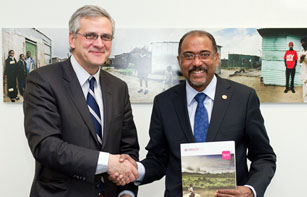
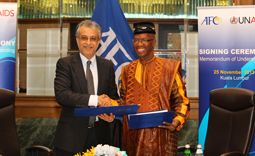
Minister-President and Minister for Economy, Foreign Policy, Agriculture and Rural Policy Kris Peeters (left) and UNAIDS Executive Director Michel Sidibé (right) signing the renewed cooperation agreement. Geneva, 22 March 2011. Credit: UNAIDS
UNAIDS and Flanders renewed their multi-year agreement of cooperation on 22 March 2011 during an official visit from a Flemish delegation to the UNAIDS headquarters in Geneva.
“Today’s agreement emphasizes the strong and reliable engagement and commitment of Flanders in the global AIDS response, especially during this time of financial constraints,” said UNAIDS Executive Director Michel Sidibé.
The Flemish delegation was headed by the Minister-President and Minister for Economy, Foreign Policy, Agriculture and Rural Policy, Mr Kris Peeters, the Minister for Finance, Budget, Work, Town and Country Planning and Sport, Mr Philippe Muyters and the Permanent Representative of Belgium in Geneva, H.E. Ambassador François Roux.
Today’s agreement emphasizes the strong and reliable engagement and commitment of Flanders in the global AIDS response, especially in times of financial constraints
UNAIDS Executive Director Michel Sidibé
The new agreement for the period of 2011-2014 will focus on strengthening HIV prevention efforts mainly in southern Africa countries. The agreement also reflects Flanders’ decision to move away from funding individual projects to a broader programmatic approach.
During the visit, UNAIDS Executive Director shared the UNAIDS’ strategy for 2011-2015. Mr Sidibé also highlighted the importance of the forthcoming UN General Assembly High Level Meeting on AIDS to renew commitments towards the global AIDS response.
Related

Feature Story
Churches called to task on preventing and reducing the impact of sexual violence
21 March 2011
21 March 2011 21 March 2011
UNAIDS Executive Director Michel Sidibé and the Archbishop of Canterbury commit to closer collaboration in preventing and reducing the impact of sexual violence and HIV.
Credit: Clive Mear / Tearfund.
The findings from recent research on the role of the church in responding to sexual violence have been presented at an event in London organised jointly by Tearfund, Christian AID and the Anglican Communion.
The report, Silent No More, which was commissioned by the Christian relief and development agency Tearfund, is a self-critical look at the way in which churches have responded to sexual violence in three African countries that have been or are still facing conflict.
The findings of the report show that too often churches have remained silent and failed to care and stand up for people on the margins of society––particularly people affected by sexual violence. It unveiled that although sexual violence is endemic to many countries the scale and impact largely remain hidden. It also criticised the church for deepening the impact of sexual violence through silence and reinforcing stigma and discrimination.
“It is of the first importance that churches and all communities of faith continue to hold before the world’s eyes the absolute priority for justice and dignity for all,” said the Archbishop of Canterbury, Dr Rowan Williams. “We need to equip people to become agents of change and agents of hope. I hope this is the beginning of the church being what it ought to be and should be.”
UN statistics show that in some countries as many as one in three women are beaten, coerced into sex or otherwise abused in their lifetimes. This renders women particularly vulnerable to the risk of HIV infection by denying them the means to protect themselves against HIV.
Women and girls are most affected by sexual violence and are most vulnerable to HIV. UNAIDS will work closely with faith-based organizations to ensure the dignity and protection of women and girls
UNAIDS Executive Director, Michel Sidibé
Speaking at the conference, UNAIDS Executive Director, Michel Sidibé said, “Women and girls are most affected by sexual violence and are most vulnerable to HIV. UNAIDS will work closely with faith-based organizations to ensure the dignity and protection of women and girls.”
Key recommendations from the report call for the church to realise its potential in preventing and reducing the impact of sexual violence. The recommendations outline the importance of challenging the prevalence of sexual violence and ask churches to demonstrate compassion and care for people affected by sexual violence. They also urge aid agencies, governments and donors to recognize the potential of the church and to work together against sexual violence.
UNAIDS has called zero tolerance for gender-based violence. In 2009 UNAIDS launched an Agenda for Women and Girls and HIV which is currently being rolled out across the globe. The Agenda outlines the need to accelerate country-level action to transform the way in which gender inequality and the rights of women and girls are addressed through the AIDS response.