

Feature Story
World AIDS Day 2007
30 November 2007
30 November 2007 30 November 2007
2007 World AIDS Day events
This year's World AIDS Day theme – leadership – reminds us that, from government leaders to individuals, we all have a leadership role to play in the AIDS response and we are all accountable for the promises made. On 1 December UNAIDS participated in events around the globe to commemorate this special day of remembrance and hope.
View UNAIDS in action on World AIDS day in the special photo gallery

UNAIDS Executive Director marks World AIDS Day
In Mexico, UNAIDS Executive Director Dr Peter Piot joined government and civil society representatives and people living with HIV to commemorate World AIDS Day 2007. Throughout the events, Dr Piot underlined the importance of continued leadership on AIDS issues. “Sustaining leadership and accelerating action on AIDS… requires us all to focus on AIDS every day of the year,” he said in his statement marking the Day.
Read UNAIDS Executive Director's speech ( es )
View photo gallery
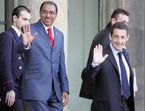
UNAIDS joins French President at World AIDS Day gathering
On World AIDS Day 2007, UNAIDS Deputy Executive Director Michel Sidibe joined governmental and civil society representatives at a meeting with the President of France, Nicolas Sarkozy, to discuss AIDS and the global response, and to mark the International Day. The meeting provided a key opportunity for UNAIDS and civil society to brief the French President on the global AIDS epidemic and for discussions on critical issues including universal access to treatment and the situation for women and girls within the AIDS response.
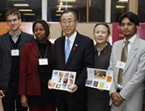
UN Secretary-General opens UN Plus exhibition
In observance of World AIDS Day 2007, Secretary-General Ban Ki-moon and his wife Yoo Soon-taek opened a photographic exhibition entitled "UN Plus" at the United Nations headquarters in New York with the members of UNPlus - the UN System HIV Positive Staff Group.
Read more
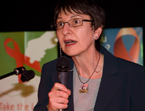
Geneva's candlelight march
In Geneva, UNAIDS Deputy Executive Director Deborah Landey joined other representatives from the UN family, missions, people living with HIV, faith communities and civil society groups, in a candlelight march to commemorate World AIDS Day and to celebrate the leaders and communities worldwide who are setting example, taking initiative and helping the world to keep its promise to act on AIDS. During the march, Geneva’s famous ‘jet d’eau’ turned red to mark the international day.
View photo gallery
World AIDS Day - Statements
On 1 December, people around the world commemorate World AIDS Day. This year, World AIDS Day focuses on ‘leadership’, the theme set by the World AIDS Campaign under the five-year slogan “Stop AIDS, Keep the Promise”. Marking the day, the United Nations Secretary General, the Executive Director of UNAIDS and UNAIDS cosponsors and key partners speak out in special World AIDS Day statements.
Read statements
AIDS Perspectives 2007 - DVD
The UNAIDS/Face of AIDS DVD AIDS Perspectives 2007 is a seven minute collection of stories from around the world focusing on efforts taking place to respond to AIDS. Linking to the 2007 World AIDS Day theme of ‘Leadership’, the film focuses on young people and the work they are doing to lead the AIDS response into future. The film contains clips from Cambodia, USA, Mexico, the Russian Federation, Botswana and India.
View DVD - AIDS Perspectives 2007

Credit: UNICEF video
Roger Federer speaks out on World AIDS Day
Roger Federer, the Association of Tennis Professionals world number-one tennis player and UNICEF Goodwill Ambassador, took a break from his whirlwind schedule of tournaments, grand slams and public appearances to record a video message raising awareness about AIDS.
Read more

Leading cricketers show support for World Aids Day
As part of the partnership between the International Cricket Council and UNAIDS, many of the world’s leading cricketers will show their support for people living with HIV when they wear red ribbons in international matches taking place on 1st and 2nd December.
Read more

MTV launches ‘Staying Alive’ website
MTV Networks International has re-launched www.staying-alive.org, the online portal for the company’s Staying Alive campaign. With the site, Staying Alive—the world’s biggest youth focused HIV prevention campaign—provides young people with a unique platform to exchange views on life, love and relationships while also accessing vital information on HIV prevention.
Read more
World AIDS Day 2007
Statements:
Read UN Secretary-General's statement on World AIDS Day ( en | fr | es | ru | ar | ch )
Read UNAIDS Executive Director's statement on World AIDS Day ( en | fr | es | ru )
Read all statements
Links:
World AIDS Campaign
UN Chronicle - World AIDS Day
Cosponsors on World AIDS Day
Related
Feature Story
AIDS focus at U.S. Evangelical Summit
29 November 2007
29 November 2007 29 November 2007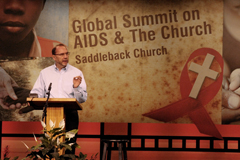
UNAIDS Executive Director Dr Piot, called on
religious leaders to scale up efforts to promote
tolerance: to denounce discrimination and violence
based on gender, sexual orientation or social status,
and to eradicate the stigma around AIDS.
UNAIDS Executive Director Dr. Peter Piot spoke at the Saddleback Church Global AIDS Summit in Lake Forest, California. Dr Piot noted the unique and important role in the global AIDS response of religious groups of all kinds, which provide HIV treatment, care and support in some of the remotest parts of the world.
He called on religious leaders to scale up efforts to promote tolerance: to denounce discrimination and violence based on gender, sexual orientation or social status, and to eradicate the stigma around AIDS. He encouraged them to reach out to groups who are marginalized by society and as a result at greater risk of HIV infection.
"A quarter century into the AIDS response, it is time to take stock of the progress we've made, and consolidate and scale up what's working," said Dr Piot. "It is also time to recognize that all of us can, and must, do more, if we are to get ahead of the epidemic."
Leadership was an important theme of the summit, and was the focus of speeches from Dr Piot and United States Global AIDS Coordinator Ambassador Mark Dybul who spoke in a session called ‘Excellence in Global Leadership’. Also speaking on the topic were leaders from the Organization of African First Ladies Against AIDS – Her Excellency, Mrs. Jeannette Kagame, First Lady of Rwanda and Her Excellency, Mrs. Maureen Mwanawasa, First Lady of Zambia.
The Saddleback Summit was organized by Saddleback Church founder Rick Warren and his wife Kay Warren, Executive Director of the church’s AIDS initiative, as an avenue for attendees to learn more about AIDS and coordinate their efforts to address the disease. The summit is taking place from November 28-30. A youth summit is scheduled to follow on December 1.
Links:
Read press release
Visit the Saddleback conference web site
Related
 A tribute to Maeve Kennedy Townsend McKean
09 April 2020
 Keeping up the momentum in the global AIDS response
24 April 2019
 Malawi launches its health situation room
12 April 2019
Feature Story
MTV launches ‘Staying Alive’ website
29 November 2007
29 November 2007 29 November 2007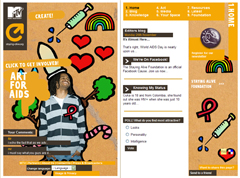 MTV's Staying Alive web site provides young
people with a unique platform to exchange views
on life, love and relationships while also accessing
vital information on HIV prevention.
MTV Networks International today (Thursday 29 November) announced the re-launch of http://www.staying-alive.org/, the online portal for the company’s Staying Alive campaign. With the site, Staying Alive—the world’s biggest youth focused HIV prevention campaign—provides young people with a unique platform to exchange views on life, love and relationships while also accessing vital information on HIV prevention.
Multi-platinum selling artists including Kanye West and Nelly Furtado are among a host of celebrities who share their personal stories and offer life-saving advice exclusively on MTV’S Staying Alive website. Nelly Furtado encourages women to carry their own condoms, as she reveals she was 26 when she bought her first pack of condoms.
Digital technologies, particularly the internet, are increasingly integrated into young people’s lives across the globe, transforming how they communicate with each other. These platforms are providing opportunities for young people to find critical life-saving information on HIV.
Some 33 million people are now connected to the internet in Africa - a continent where 22.5 million people, two-thirds of the world’s population living with HIV, live. Since 2001, internet use in South America has grown by over 374%, and by 832% across the Caribbean, both areas that are heavily affected by AIDS.
“The internet is one of the most effective ways of getting out education messages to young people. It’s a vital resource in the fight against the spread of HIV,” said Georgia Arnold, Head of Public Affairs for MTV Networks International. “Young people continue to be disproportionately affected by HIV. Of the 5,800 adults infected every day 40% are young people aged 15-24 years old ”.
Much of its content for the Staying Alive web site will be generated by young people around the world through audio, video and still pictures. In one vlog, Natalia Cales, a native of South Carolina, USA, shares her experience of caring for a mother during her last months living with HIV, while in China, Yongshi Deng unveils the shocking levels of ignorance among youth who believe HIV is only in Africa or among gay men in the USA.
A host of artists appear on the website in support, including: Enrique Iglesias, Kelly Rowland, Macy Gray, Sum 41, James Blunt, Wayne Wonder, Good Charlotte and MIMS among others and will appear on MTV channels worldwide to promote staying-alive.org.
The site is available in English, French, Arabic, Chinese, Dutch, German, Italian, Japanese, Polish, Portuguese, Russian, Serbian and Spanish.
MTV’s Staying Alive is a multimedia global HIV prevention campaign to challenge AIDS-related stigma and discrimination. The UNAIDS Secretariat and UNFPA have partnered with MTV, providing funding and technical assistance on key AIDS issues. UNICEF and the World Bank also provide support.
Links:

Feature Story
AIDS, nutrition and food security
29 November 2007
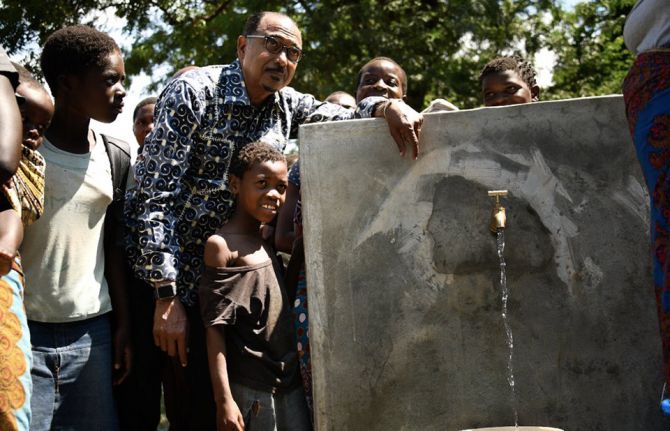
29 November 2007 29 November 2007In advance of World AIDS Day, UNAIDS cosponsor organizations the World Food Programme and the World Bank have released reports focusing on AIDS, nutrition, and food security.
Hunger and Health – the World Food Programme
In Rome, Italy, the World Food Programme (WFP) launched their ‘Hunger and Health’ report – the second in a series launched in 2006 with Hunger and Learning—which highlights the vital link between food assistance and effective antiretroviral treatment in developing countries. At the launch, the UN Secretary General’s Special Envoy for Africa, Elizabeth Mataka, gave a special statement, where she underlined that “ Inequitable access to food may force people to engage in risky behaviour that can lead to their being infected with HIV. And if people can’t get hold of enough food, the efficacy of anti-retroviral treatment is seriously undermined.”
Read more on WFP's publication 'Hunger and Health'
Read Elizabeth Mataka's statement
“HIV/AIDS, Nutrition and Food Security: What We Can Do’ – the World Bank
The World Bank and partners launched the ‘HIV/AIDS, Nutrition and Food Security: What We Can Do’ report— a synthesis of existing international technical guidance on AIDS, nutrition, and food security, which is a valuable contribution to efforts that support the integration of nutrition and AIDS projects and programmes.
Read more on the World Bank's publication "HIV/AIDS, Nutrition, and Food Security: What We Can Do"
Related

Feature Story
World AIDS Day 2007 - Statements
28 November 2007
28 November 2007 28 November 2007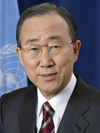 |
United Nations Secretary General message on World AIDS Day, 1 December 2007 The theme of this World AIDS Day is leadership. Without it, we will never get ahead of the epidemic. (...) Today, I call for renewed leadership in eradicating stigma associated with HIV. I applaud the brave individuals who live openly with HIV, who advocate tirelessly for the rights of the HIV-positive, who educate others about AIDS. Read the UN Secretary General's message ( en | es | fr | ru | ar | ch ) |
|
|
|
 |
UNAIDS Executive Director, Dr. Peter Piot on World AIDS Day, 1 December 2007 Today, millions of people around the globe are marking the 20th World AIDS Day. For some, this may be the only day in the year they think about AIDS. For many, however, AIDS is part of daily life. Read the UNAIDS Executive Director's message ( en | es | fr | ru ) |
|
|
|
 |
The World Food Program, on World AIDS Day, 1 December 2007 As communities gather to mark World AIDS Day, and governments take stock of the progress towards achieving the Millennium Development Goals, the United Nations World Food Programme (WFP) is urging that more attention be paid to the fundamental connection between hunger and health, which lies at the heart of the pandemic. Read the full statement |
|
|
|
 |
Director-General of UNESCO, Mr Koïchiro Matsuura, on World AIDS Day, 1 December 2007 This year, World AIDS Day is dedicated to the theme of ‘leadership’. It is a theme that recognizes the need for a strategic vision, for focused and sustained action, for empowerment and motivation, and for accountability. |
|
|
|
 |
United Nations Development Programme, on World AIDS Day, 1 December 2007 The World AIDS Campaign has selected “leadership” as the 2007 World AIDS Read the full statement ( en | fr | es ) |
|
|
|
 |
International Labour Organization, on World AIDS Day, 1 December 2007 Today the World AIDS Campaign calls on us to focus on the role of leadership in keeping the promise to stop AIDS. (...) The ILO’s engagement is founded on our globally endorsed goal of promoting Decent Work - based on rights at work including freedom from discrimination, expansion of employment opportunities, social protection for all and social dialogue. Read the full statement ( en | fr | es ) |
|
|
|
 |
Thoraya Ahmed Obaid, UN Under-Secretary-General, UNFPA Executive Director on World AIDS Day, 1 December 2007 Today, on World AIDS Day, we are called upon to be leaders in the fight against AIDS. Where there is strong and committed leadership, the response is more effective. Read the full statement ( en | fr | es | ar ) |
|
|
|
 |
The Global Coalition on Women and AIDS, on World AIDS Day, 1 December 2007 On this World AIDS Day, the Global Coalition on Women and AIDS remembers the women whose lives have been touched by the epidemic -- women living with HIV, women who have lost their spouses, children, family members and friends to AIDS, caregivers both young and old, women and girls who find themselves distant from the halls of power, but who nonetheless are powerful leaders in their own families and communities. Read the full statement |
|
|
|
 |
United Nations High Commissioner for Human Rights, Louise Arbour on World AIDS Day, 1 December 2007 This year, as we mark World AIDS Day, we do so in a world where 6,800 HIV infections are occurring and 5,700 people are dying of AIDS daily. An individual's survival prospects frequently hinge upon his or her place of birth, residence and socio-economic status. This is both an affront to human dignity and a challenge to leadership at global, national and local levels. |
|
|
|
 |
General Secretary of the International Confederation of Trade Unions, Guy Ryder, on World AIDS Day, 1 December 2007 Twenty-five years into the AIDS pandemic we have seen many promising breakthroughs over the years. Like peeling back the skin of an onion, the trade unions, who have taken leadership in the workplace approach on HIV-AIDS in many countries, have found that devising the right response to AIDS often reveals another layer. By increasing prevention and access to AIDS treatment, the years of neglect of health care systems and the deteriorating conditions for health care workers have been made all too clear. Strengthening health care systems is a priority challenge that must be taken up, but this is no time for band-aid solutions. One thing is certain-it makes little sense to offer solutions to the pandemic without improving the health care system including the conditions for its workers. |
|
|
|
 |
Gaetano, UNAIDS Special Representative on World AIDS Day, 1 December 2007
Today, World AIDS Day, we are asking our leaders to ‘keep the promise’ and ‘stop AIDS.’ We are asking them to honor their political commitments made publicly; we are pushing them to come as close as they can to universal access to prevention, treatment and care by 2010. But as we demand that our political leaders keep their promises, we - you and I - must make the same demands of ourselves. We must make a personal promise to be actively engaged in the AIDS response by preventing any new HIV infections - that is the only way AIDS will stop. We can begin realizing this promise by knowing our HIV status. Remember to keep the promise because stopping AIDS starts with you and me. |
|
|
|
 |
Mary Fisher, UNAIDS Special Representative on World AIDS Day, 1 December 2007 We have enough science to find and treat AIDS. We have the medical knowledge we need to keep people alive. Nonetheless, on World AIDS Day 2007, tens of millions of people are dying, 17 million children have been orphaned -- and the numbers climb by the hour. How is this possible when we have enough science to stop it? It is possible because the world’s leaders have not turned their full power on arresting this pandemic. On World AIDS Day, if you would join with me, I’d ask you to do two things. Lend your support to the HIV/AIDS caregivers – the dedicated women and men who carry the orphans, rescue the dying and protect those not yet infected. And make your voice heard in the halls of power, calling our leaders to redouble their efforts. |
|
|
|
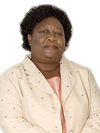 |
Elizabeth Mataka, UN Special envoy on AIDS in Africa, on World AIDS Day, 1 December 2007 Today, on the 20th World AIDS Day, we are again beseeching leadership to ‘Stop AIDS and keep the promise.’ We asked them to do so last year, and we are asking them to do so again. Although much has been done since the last World AIDS Day, AIDS clearly has not stopped. Stopping AIDS is the ultimate measure of progress in the AIDS response, but we must remember that it is not the only one. |
|
|
|
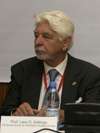 |
Prof Lars O. Kallings, UN Special envoy on HIV/AIDS in Europe, on World AIDS Day, 1 December 2007 Social cohesion is key to HIV prevention and treatment; no nation will be able to control the epidemic without a common feeling of mutual respect between individuals and communities – as well as between authorities and citizens. Solidarity is a hallmark of the maturity of a society. Let us work against discrimination and stigmatization and we will conquer HIV! |
|
|
|
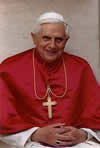 |
His Holiness Benedict XVI, Pope on World AIDS Day, 1 December 2007 "December 1 marks World AIDS Day. I remain spiritually close to everyone suffering from this terrible sickness, and to their families, especially those who have lost a loved one. To everyone I give assurances of my prayers. Furthermore, I wish to exhort all people of good will to increase their efforts to halt the spread of the HIV virus, to combat the disdain which is often directed towards people who are affected by it, and to care for the sick, especially those who are still children." |
|
|
|
 |
The Archbishop of Canterbury on World AIDS Day, 1 December 2007 The churches have not always challenged as they should the stigma that is attached to HIV and Aids in many countries. They have failed to say that those living with HIV and Aids are God’s beloved children, with dignity, liberty and freedom. What is owed to them is what is owed to any human being made in God’s image, and the more we are trapped by thoughts and images about stigma, the less we shall be able to respond effectively. |
|
|
|
 |
Caritas Internationalis on World AIDS Day, 1 December 2007 Religious leaders can, should, and do exercise a leadership role by facilitating accurate information and by promoting responsible behaviour to prevent the further spread of HIV, by giving leadership on providing health, social, and pastoral service to people affected by or vulnerable to the pandemic, and making tangible efforts to eliminate the irrational fear, stigma, and discrimination resulting from this global health challenge. |
Related
Feature Story
International consultation on Islam and AIDS
28 November 2007
28 November 2007 28 November 2007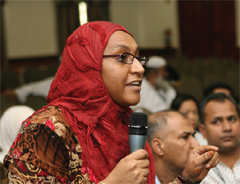
The conference brings together Islamic scholars,
AIDS practitioners and people living with HIV to
help generate and develop practical responses to
AIDS by the Islamic community.
Photo credit: Islamic Relief
“UNAIDS welcomes the involvement of Islamic religious leaders and scholars in the response to AIDS,” said UNAIDS Director of Partnerships and External Relations Elhadj As Sy during the plenary address of the ‘Islam and AIDS’ conference taking place in Johannesburg, South Africa, from 26 – 30 November. “The key messages of this conference are to halt the spread of HIV, care for the sick and eliminate stigma and discrimination faced by people living with HIV,” he added.
Hosted by Islamic Relief Worldwide, the conference brings together Islamic scholars from a diverse range of Islamic traditions, AIDS practitioners and people living with HIV to help generate and develop practical responses to AIDS by the Islamic community. “The conference aims to develop and subsequently apply approaches to AIDS which are both effective and Islamically sound. These approaches will be jointly developed and will be based on Islamic teachings of trust, respect and other examples of good practice. They will also build upon existing Muslim and interfaith declarations related to AIDS,” said the organizers.
Declarations of intent will be issued by each of the conference participants, stipulating what participants will do to contribute to addressing AIDS and to dealing with its consequences for individuals and communities.
Links:
Visit the official web site of the conference

Feature Story
First Global Parliamentary Meeting on AIDS
28 November 2007
28 November 2007 28 November 2007

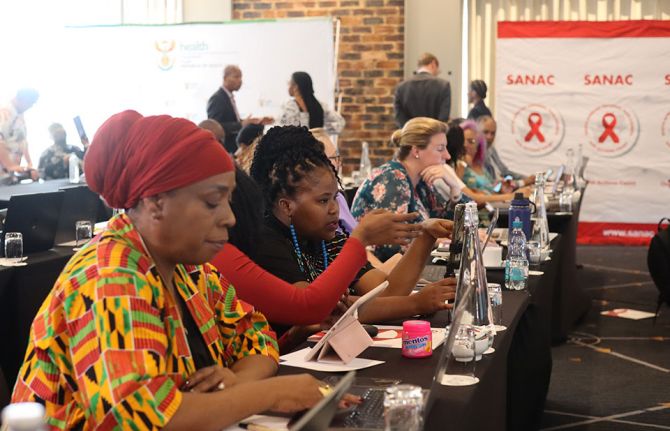
Michel Sidibe, UNAIDS Deputy Executive Director,
highlights the important role of parliamentarians
at the opening ceremonies of the First Global
Parliamentary Meeting on AIDS .
Photo credit: UNAIDS
The First Global Parliamentary Meeting on AIDS was opened on Wednesday 28 November in Manila by Mr Manny Villar, President of the Senate of the Philippines.
Around 200 participants from around the world are attending the three-day meeting which has been organized by the Inter-Parliamentary Union in cooperation with the Senate of the Philippines and in close collaboration with the United Nations Development Programme and the Secretariat of the Joint United Nations Programme on HIV/AIDS (UNAIDS).
It is the first time that Parliaments from all over the world have been convened to jointly discuss the part they have to play in responding to the AIDS epidemic. The main aim of the event is to enhance the commitment and collaboration of Parliaments worldwide as crucial stakeholders in the AIDS response.
During his opening address, UNAIDS Deputy Executive Director, Michel Sidibe highlighted the important role parliamentarians have to play in the global response to the epidemic, “As Parliamentarians you are opinion-leaders and decision-makers. What you say matters. You can encourage informed debate. You can address prejudice and misconceptions. You can lead by example,” he said.
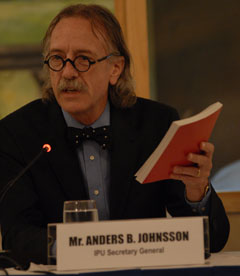
Michel Anders B. Johnsson, Secretary General of
the Inter-Parliamentary Union, presents “The
Handbook on Taking Action”.
Photo credit: UNAIDS
The meeting is being held ahead of World AIDS Day (1 December) under the main theme of ‘Leadership’. In addition, five sub-themes will be discussed in plenary sessions or panel discussions; stigma and discrimination; affordability of drugs; vulnerable groups; legalization and criminalization issues; and budgeting.
A range of keynote speakers have been invited to contribute to the sessions including Dr Nafis Sadik, UN Secretary-General’s Special Envoy on AIDS for Asia and the Pacific, Mr Marcel van Soest, Executive Director of the World AIDS Campaign and Justice Michael Kirby, from the High Court of Australia.
One of the highlights of the meeting will be the launch of a handbook for Parliamentarians entitled, ‘Taking action against HIV’. The handbook will serve as both a call to action for parliamentary leadership and a reference book that parliamentarians and their staff may consult for information and guidance on specific issues in relation to the AIDS response.
Links:
Download final conclusions
Read press release
Read UNAIDS Deputy Executive Director's statement
Download Taking action against HIV - A handbook for parliamentarians
Read also - Brazil shares best AIDS practice with parliamentarians (29 June 2007)
Feature Story
UN Special Envoy speaks out on violence against women
26 November 2007
26 November 2007 26 November 2007
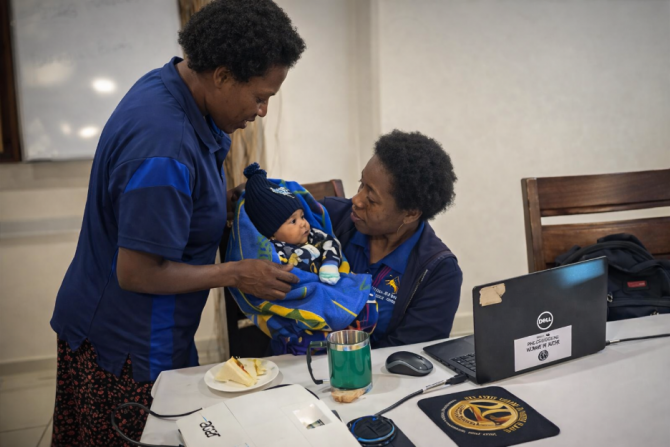
Approximately 60% of HIV adults living with HIV in
sub-Saharan Africa are women.
Photo credit: UNAIDS/L.Taylor
In a special statement to mark International Day Against Violence Against Women and the start of the annual ‘16 days of Activism Against Gender Violence’ (November 25), the UN Secretary General’s Special Envoy on AIDS for Africa, Elizabeth Mataka, asks ‘ when it comes to women, why are we so slow to act?’
“I have been reflecting on exactly what ‘violence’ in the violence against women means. The more I thought about the subject, the more I realized that violence now has many shapes and colours, it has transcended the violence of physical, sexual and psychological assault, touched down on political and economic harm and now moved into the space of complicity by silence,” Ms Mataka said.
Highlighting the recent epidemiological data released by UNAIDS and WHO, Ms Mataka underlined that approximately 60% of HIV adults living with HIV in sub-Saharan Africa are women. “This information, I am aware, is not new – women in our region have for many years been what has been coined ‘the face of the epidemic’ - but what this new data has done is brought home the realization that nothing, nothing has changed for women. When it comes to women, why are we so slow to act? “ she said.
“With statistics such as these, we are facing a critical emergency, we are rapidly moving towards an Africa without women. Allowing this to happen is violence against women. You may not conduct a physical assault, but being silent is being complicit and non-action is now a violent act,” she added.
The 16 Days of Activism Against Gender Violence is an international campaign that was started by the Center for Women's Global Leadership (CWGL) in 1991. The 16 Days runs from November 25, International Day Against Violence Against Women to December 10, International Human Rights Day to symbolically link violence against women and human rights and to emphasize that such violence is a violation of human rights.
This 16-day period also highlights other significant dates including December 1— World AIDS Day.
Links:
Read the full statement by Elizabeth Mataka
Read more on International Day Against Violence Against Women on the UNIFEM web site
Related
Feature Story
AIDS on the agenda at Commonwealth Heads meeting
26 November 2007
26 November 2007 26 November 2007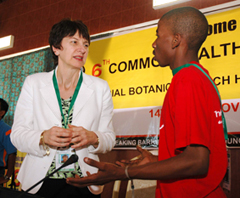
UNAIDS Deputy Executive Director Ms Deborah
Landey talking with the Commonwealth Youth
Delegate from Botswana Thata Kebadire. Entebbe
Uganda.17 November 2007.
The need to further engage young people in the AIDS response was a key element of discussion at the recent Commonwealth Heads of Governments Meeting (GHOGM), which took place in Kampala, Uganda.
UNAIDS Deputy Executive Director Deborah Landey joined Uganda AIDS Commission Director General Dr David Kihumuro Apuuli and youth representatives Johnah Josiah of Kenya and Mobafa Baker of Trinidad in a plenary session at the meeting, focusing on the health of young people. During her intervention, Ms Landey discussed the importance of engaging young people in the HIV response.
The Commonwealth Heads of Government Meeting is a biennial meeting convening representatives from 53 member states. The commitment to young people played a significant part in this year’s meeting, which was officially opened by the Head of the Commonwealth, Her Majesty Queen Elizabeth II.
Deborah Landey took part in the meeting as part of a country visit to Uganda where she also met with various leaders in Uganda’s AIDS response from government and civil society.
Links:
Read UNAIDS Deputy Executive Director's speech
View photo gallery of UNAIDS Deputy Executive Director's visit
Visit the CHOGM 2007 Uganda Web site
Related
Feature Story
International consultation on AIDS estimates: Recommendations
16 November 2007
16 November 2007 16 November 2007An International Consultation on AIDS Epidemiological Estimates, convened jointly by the UNAIDS Secretariat and WHO, was held on 14-15 November 2007 in Geneva, Switzerland. The meeting brought together more than 30 technical experts and country epidemiologists from around the world to review the current processes and methodologies used by UNAIDS and WHO to produce HIV estimates at the country, regional and global level.
The consultation recognised that the new set of draft UNAIDS/WHO country estimates for 2007 is based on the best available data and methodologies.
The meeting participants made a number of recommendations for future improvements. These included:
- Independent scientific review of the estimation process and methodologies should take place on a regular basis, involving experts who have not been directly implicated in the production of the methodologies and the estimates;
- Countries should be encouraged to collect data of better quality and representativeness and increased assistance should be provided to countries. Data should come from a range of sources, such as sentinel surveillance sites, as well as population-based surveys, though careful consideration must be given to the strengths and limitations of each data source (for example non response bias in surveys). Surveillance of most at risk populations, such as sex workers, injecting drug users and men who have sex with men, must be strengthened to try to reach more accurate estimates of population sizes and HIV prevalence;
- Country ownership should continue to be a key feature of HIV surveillance and data collection, with training involving a wide range of stakeholders including local epidemiologists, civil society and government representatives;
- Surveillance should be integral to the design, implementation and evaluation of HIV programmes in country. UNAIDS and WHO should build capacity of country counterparts to analyse surveillance data leading to an improved understanding of the dynamics of the epidemic and how programmatic resources might be best used; and
- Special studies may be required to assess aspects such as AIDS-specific mortality rates and the quality and coverage of treatment resources.
The UNAIDS secretariat and WHO will release the global 2007 HIV estimates on 21 November 2007 in time for World AIDS Day. UNAIDS and WHO will continue to work with experts and country counterparts to systematically review the methods used to derive HIV estimates and ensure they reflect up to date scientific evidence and research.
Links:
Read more on the process behind AIDS estimates
Read more on the International consultation on AIDS estimates
Related
 Transgender sex workers face frequent abuse
29 March 2022