

Feature Story
UNAIDS to receive additional funding from UK
21 August 2009
21 August 2009 21 August 2009
UNAIDS and its cosponsor UNFPA have been ranked as best performers in a recent assessment of four UN agencies, including UNDP and WHO, conducted by UK’s Department for International Development (DFID). As a result, both organizations will receive full additional funding to further support projects on the ground.
Announcing the results of the assessment, International Development Secretary Douglas Alexander underlined his firm commitment to rewarding results and reforms that make the UN more efficient and effective. The four agencies were assessed against a range of challenging targets and awarded an overall score which determined levels of additional funding.
UNAIDS has been allocated a 100% additional payment of £1.03 million. This is on top of the £10 million core funding the organization receives from the UK.
Joint action for results
The HIV organizational landscape has evolved and grown more complex over the past decade. UNAIDS, donors and civil society, including networks of people living with HIV, have rightly demanded greater clarity on the relationships between needs, financing, activities and outcomes.
In April 2009, UNAIDS and its cosponsors published the UNAIDS Outcome Framework 2009-2011 which, built upon the UNAIDS Strategic Framework (2007–2011), will guide future investment and hold the Secretariat and the Cosponsors accountable for making the resources of the UN work for results in countries. The framework affirms the UNAIDS Secretariat and Cosponsors to leverage their respective organizational mandates and resources to work collectively to deliver results.
Under the Outcome Framework for the period 2009–2011, UNAIDS will focus its efforts on achieving results in nine priority areas:
- Reduce sexual transmission of HIV
- Prevent mothers from dying and babies from becoming infected with HIV
- Ensure that people living with HIV receive treatment
- Prevent people living with HIV from dying of tuberculosis
- Protect drug users from becoming infected with HIV
- Remove punitive laws, policies, practices, stigma and discrimination that block effective responses to AIDS
- Stop violence against women and girls
- Empower young people to protect themselves from HIV
- Enhance social protection for people affected by HIV
The realization of these priority areas will accelerate the achievement of universal access to HIV prevention, treatment, care and support as well as contributing to the attainment of the Millennium Development Goals.
UNAIDS to receive additional funding from UK
External links:
Publications:
Joint action for results: UNAIDS outcome framework, 2009 – 2011 (pdf, 388 Kb)
Feature Story
Injecting drug users take central role in anti-stigma film
10 August 2009
10 August 2009 10 August 2009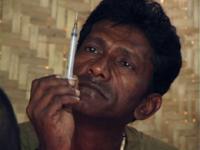
A frame from the film Suee (Needle), unveiled during the satellite session, ‘Reforming treatment environments – How to make compulsory drug treatment HIV friendly’ at ICAAP09.
The lives of injecting drug users and the HIV-related stigma and discrimination they face was one focus of the IX International Congress on AIDS in Asia and the Pacific as the film Suee (Needle) was launched by Response Beyond Borders, the Asian consortium on drug use HIV, AIDS and poverty.
Unveiled during the satellite session, ‘Reforming treatment environments – How to make compulsory drug treatment HIV friendly’, the film gives a voice to this vulnerable group with anti-stigma messages conveyed by the injecting drug users themselves. It was directed by award-winning Indian movie director, author and screen-writer, Sai Paranjpye, who set out to present an uncompromising insight into a world where HIV prevalence is disproportionately high.
Ms Paranjpye, a Cannes Film Festival award winner, worked closely with injecting drug users on Suee and spent time interviewing them on location and involving them as actors in the film. They ‘own’ the project as much as is practically possible. She also consulted a full range of partners and obtained feed back on the script and other help from NGOs working in HIV prevention with injecting drug users, especially Sharan in Delhi and Sankalp in Mumbia. She also received input from the International Center for Research on Women and World Bank teams, among others.
Suee explores a number of areas in the lives of injecting drug users including treatment, care, peer and community support, rehabilitation and the workplace. It is intended to convey messages of hope and not to trigger reactions of pity or fear; empowering the audience by raising awareness and presenting facts in a non-judgmental way. Made for general consumption, the film can also be used in youth campaigns, providing education and information for young people to help prevent HIV and reduce both risk and vulnerability.
The film emerged from the South Asia Region Development Marketplace (SAR DM), an initiative spearheaded by the World Bank. It consists of a competitive grants programme that identifies and supports small scale projects demonstrating an innovative approach to reducing HIV stigma and discrimination in the region. 26 civil society organisations from across South Asia won grants of US$ 40,000 each to bring their ideas to fruition.
Ms Paranjpye has used her SAR DM award to produce not only the Suee film but another, called “The sound of the horn”, which deals with truck drivers.
Stigma and discrimination are seen as major barriers to scaling up HIV prevention services in the region. They marginalise those living with the virus and contribute to their social isolation and rejection. They also discourage vulnerable groups from accessing HIV treatment, care and support services.
It is hoped that Suee, once widely disseminated, will take its place among a range of interventions helping to reduce stigma and discrimination against South Asia’s injecting drug users.
The film was selected by the screening committee of the Congress and will be shown again on August 11.
Note: Partners and sponsors of the South Asia Region Development Marketplace include: UNAIDS, UNICEF, UNODC, UNDP, the Global Fund, the Government of Norway, the International Center for Research on Women, the International Finance Corporation, and the Swedish International Development Cooperation Agency (SIDA)
Injecting drug users take central role in anti-st
IX International Congress on AIDS in Asia and the Pacific
South Asia Region Development Marketplace
Cosponsors:
World Bank
United Nations Children’s Fund
United Nations Office on Drugs and Crime
United Nations Development Programme
Partners:
Sankalp Rehabilitation Trust
Sharan
International Center for Research on Women
The Global Fund to Fight AIDS, Tuberculosis and Malaria
International Finance Corporation
Swedish International Development Cooperation Agency
Feature stories:
Migrant workers and HIV vulnerability in South Asian and South East Asian countries (18 may 2009)
'Never abandon, never give up’: ILO film helps China’s migrant workers challenge AIDS stigma (30 April 2009)
International Harm Reduction conference opens in Bangkok (20 April 2009)
OPINION: HIV and drugs: two epidemics - one combined strategy (20 April 2009)
‘Love and Relationships’: Film festival in Cambodia addresses HIV prevention (06 April 2009)
UNODC and Iran sign agreements to reduce vulnerability of women and Afghan refugees to drugs and HIV (24 March 2009)
Injecting drug use and HIV: Interview with UNAIDS Team Leader, Prevention, Care and Support team (11 march 2009)
OPINION: Silence on harm reduction not an option (11 March 2009)
Related
Feature Story
More needs to be done to help young people most at risk of HIV infection
10 August 2009
10 August 2009 10 August 2009
Credit: UNAIDS/O.O'Hanlon
In general, HIV prevention services in the Asia region are currently not reaching young people who are most at risk of infection, which include those who inject drugs, who engage in unprotected male to male sex and those involved in sex work and their clients. In order to address this situation the Asia Pacific Regional UN Coordination Group on Most at Risk Young People hosted a symposium at the IX International Congress on AIDS in Asia and the Pacific.
According to epidemic models presented in the 2008 AIDS in Asia Commission report, over 95% of all new HIV infections in the Asia region occur among such most at risk young populations. However, over 90% of resources for young people as a group are spent on low-risk youth, who represent less than 5% of infections.
Entitled "HIV prevention and most at risk young people", the event was sponsored jointly by UNFPA, UNICEF, UNESCO, UNAIDS, UNDP, WHO and is supported by 7Sisters, the Coalition of Asia Pacific Regional Networks on HIV/AIDS. It examined, among other issues, how the specific needs of most at risk young people should be addressed, what works and what doesn't and how partnerships between youth, NGOs and government can be strengthened.
The symposium discussed the nexus of unsafe sexual behaviours among most at risk young people where a number of such practices coexist in the same environment. Sex work, drug use and unprotected sex with multiple partners can all occur in the same social network. Therefore, participants looked at an approach which addresses a multiplicity of needs, meshing and coordinating previously implemented programmes and ensuring a youth-friendly approach.
A comprehensive, evidence-informed response, it was argued, requires firm commitment from donors and governments to address the specific needs of most at risk young people, and an examination of the contexts in which these risks occur. The engagement of this group in developing the policies, programmes and processes that directly affect and benefit them is seen as a prerequisite. Young people played an active and central role in this event as the practical aspect of exactly how to get youth involved in decision making was explored.
Specific objectives of the meeting also included promoting awareness among policy makers and programme planners on the urgent need for HIV prevention for most at risk young people and encouraging increased collection, analysis and use of data on this key group to support advocacy efforts and inform budget allocation priorities. Sharing experience of programming in this area, both positive and not so positive, was on the agenda too.
Among those taking part in the event were the UNFPA's Deputy Executive Director (Programme), Purnima Mane. UNESCO’s Jan de Lind van Wijngaarden, and UNICEF’s Margaret Sheehan spoke on behalf of the Asia Pacific Regional UN Coordination Group on Most at Risk Young People. James Chau, member of the AIDS2031 initiative, UNAIDS Goodwill Ambassador and Chinese television presenter facilitated the panel discussion. The panel also involved representatives of the medical profession, NGOs, health ministries and representatives of young people involved in sex work, drug use and male to male sex.
More needs to be done to help young people most a
IX International Congress on AIDS in Asia and the Pacific
Cosponsors:
Partners:
7Sisters, the Coalition of Asia Pacific Regional Networks on HIV/AIDS
Feature stories:
International Harm Reduction conference opens in Bangkok (20 April 2009)
OPINION: HIV and drugs: two epidemics - one combined strategy (20 April 2009)
Swing and Sisters: HIV outreach to sex workers in Thailand (19 March 2009)
Injecting drug use and HIV: Interview with UNAIDS Team Leader, Prevention, Care and Support team (11 march 2009)
OPINION: Silence on harm reduction not an option (11 March 2009)
Spotlight: men who have sex with men and HIV (16 February 2009)
Hidden HIV epidemic amongst MSM in Eastern Europe and Central Asia (26 January 2009)
HIV prevention hampered by homophobia (13 January 2009)
Publications:
UNAIDS Action Framework: Universal Access for Men who have Sex with Men and Transgender People (pdf, 323 Kb.)
Framework for monitoring and evaluating prevention programmes for most-at-risk-populations (pdf, 1.49 Mb.)
Policy Brief: HIV and Sex between men (pdf, 277 Kb.)
Feature Story
UNAIDS Cosponsors out in force for 9th ICAAP
09 August 2009
09 August 2009 09 August 2009
The 10 UNAIDS Cosponsors are presenting a strong showing as thousands of delegates converge in Bali, Indonesia, to share ideas, knowledge, best practices, lessons learned and research findings at the 9th International Congress on AIDS in Asia and the Pacific (ICAAP).
The Cosponsors are an integral part of the UN’s response to the global AIDS epidemic and UNAIDS brings together their efforts and resources.
Echoing the Congress theme, ‘Empowering people - strengthening networks’, the Cosponsors are organising and presenting symposia, skills-building workshops and satellite meetings drawing together a number of participants from a range of disciplines with the aim of helping to build and nurture partnerships to bolster the AIDS response in the region.
A number of events are joint Cosponsor initiatives. For example, the Symposium on ‘HIV prevention and most at risk young people’, taking place on 10 August, is sponsored by UNFPA, UNICEF, UNESCO, UNDP, WHO and UNAIDS. The symposium, hosted by the Asia Pacific Regional UN Coordination Group on Most at Risk Young People, is designed to look at the specific needs of this population which is, in general, not being reached by HIV prevention services. This includes injecting drug users, men who have sex with men and sex workers and their clients. Representatives from these groups will also take part in the panel discussion –one further example of how Cosponsor ICAAP activities are designed to involve key populations.
Other examples of Cosponsor activities include UNDP, ILO and UNAIDS (with the Joint United Nations Initiative on Mobility and HIV/AIDS in South East Asia) collaborating on a joint symposium on 12 August entitled, ‘The Impact of the Financial Crisis on Labour Migration and HIV’ in which they will bring their respective expertise to bear on this pressing international issue. UNHCR, along with UNAIDS, is hosting a satellite session on 12 August called ‘Opportunities and challenges in addressing HIV amongst diverse humanitarian populations’. WFP will use a satellite session on 11 August to explore the vital role of nutrition and food security for people living with HIV and will, along with its partners, look at ‘Models for integrating nutrition and food security into HIV care, support and treatment in the Asia Region: Opportunities and challenges’.
The World Bank is also championing the screening, on 10 August, of the film, Suee (Needle) by Cannes Film Festival award winner, Sai Paranjpye, which deals with the lives of injecting drug users and the anti-AIDS stigma they face. The film emerged from the South Asia Region Development Marketplace, a grant programme spearheaded by the Bank and supported by a range of partners including UNAIDS, UNICEF, UNODC and UNDP.
There is an extremely broad range of other Cosponsor activities taking place over the five days of the Congress and a number of these events will be highlighted on the UNAIDS website as the ICAAP progresses.
UNAIDS and its ten Cosponsors work to provide technical support to countries to assist them in the implementation of their national AIDS plans. A ‘division of labour’ guides the technical support provided to enhance coordination, avoid duplication and provide the best assistance available. Each of the Cosponsor organizations leads in at least one technical area. These organizations are:
Office of the United Nations High Commissioner for Refugees (UNHCR)
United Nations Children's Fund (UNICEF)
United Nations Development Programme (UNDP)
United Nations Population Fund (UNFPA)
United Nations Office on Drugs and Crime (UNODC)
International Labour Organization (ILO)
United Nations Educational, Scientific and Cultural Organization (UNESCO)
Feature Story
A new blog for the development community: Conversations for a Better World
06 August 2009
06 August 2009 06 August 2009A new shared blog for the development community
The burning issues in the world today demand discussions among the whole UN family and the development community. This is why the UNFPA, the United Nations Population Fund, is launching a series called Conversations for a Better World. It is based on the idea that if the AIDS epidemic and other key development issues are to be dealt with effectively, greater attention has to be paid to population dynamics and reproductive health. The idea is to activate informed discussion and debate.
We know that many visitors to the UNAIDS website are very knowledgeable about AIDS and poverty, and we encourage them to register and share their opinions and insights. That’s what ‘Conversations’ is all about.
Neil Ford, chief of the Media and Communications Branch of UNFPA
Conversations for a Better World is a shared blog, where people can express and exchange ideas and opinions on development issues. Each month the blog will have an editorial focus on one major topic.
“Poverty and AIDS: What really drives the epidemic?” is the conversation topic that launches 6 August and includes various opinion pieces and blog-posts related to the complicated relationship between lack of access to resources and HIV. The previous conversation topic was “Women and the Economic Crisis.”
Conversations for a Better World is based on ‘the power of we’: the idea that when it comes to addressing complex challenges, collective wisdom is called for. Anyone can contribute by uploading personal stories, relevant photos or videos and comments or opinion pieces.
“We’re hoping to engage discussion from experts as well as people who are directly impacted by these issues,” said Neil Ford, chief of the Media and Communications Branch of UNFPA. “We know that many visitors to the UNAIDS website are very knowledgeable about AIDS and poverty, and we encourage them to register and share their opinions and insights. That’s what ‘Conversations’ is all about.”
- Not afraid to be provocative, subsequent Conversation topics will pose a number of questions over the coming year. These will include:
- September 2009: Young People and Times of Change: Talking about life, love and sexuality
- October 2009: Motherhood and Human Rights: Do all pregnant women have the right to live?
- November 2009: Population Dynamics and Climate Change: Who’s at the centre of the storm?
- December 2009: Sexual Violence and Progress: What are the real costs?
- January 2010: Women and Hunger: Who feeds the family, and how?
- February 2010: Migration and Prosperity: What’s fair?
You are invited to share your opinion. Start by going to www.conversationsforabetterworld.com Then, feel free to register and join the conversation!
A new blog for the development community: Convers
Cosponsors:
Feature stories:
UNFPA: Bringing HIV services directly to communities in Côte d'Ivoire (21 April 2008)
External links:
Conversations for a Better World
Contact:
Alvaro Serrano,
serrano@unfpa.org
Ida Jeng Christensen,
ichristensen@unfpa.org
Publications:
Sexual & reproductive health and HIV linkages: Evidence review and recommendations (2009) (pdf, 785 Kb.)
Gateways to integration: Case study from Haiti. To raise awareness of the pressing need for more widespread linkages between sexual and reproductive health and HIV (2008) (pdf, 562.7 Kb.)


Feature Story
UNAIDS Task Team develops effective tools to help young people tackle HIV
05 June 2009
05 June 2009 05 June 2009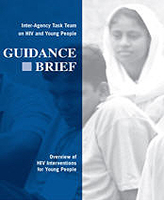
The seven Guidance Briefs on young people and HIV help strengthen the response to the epidemic among this key group
In 2007, around 40% of new infections were in the 15-24 age group and more than 5 million youth are living with the virus, around 60% of whom are girls.
Empowering young people to protect themselves from HIV is one of the eight priority focus areas for UNAIDS and its Cosponsors under the Joint action for results: UNAIDS outcome framework 2009-2011.
In order to give young people the urgent attention they need, a series of seven Guidance Briefs has been developed by the UNAIDS Inter-Agency Task Team (IATT) on HIV and Young People.
[A]s of 2007 only 40% of young men and 36% of young women had accurate knowledge about HIV, showing that even basic HIV awareness programmes have had inadequate reach…. It is essential that we sustain efforts being made as well as scale up the response.
Purnima Mane, UNFPA Deputy Executive Director and Michel Sidibé, UNAIDS Executive Director
The Task Team, convened by UNFPA, intends the Briefs to be used to guide staff, governments, donors and civil society on how to develop and implement an effective response to HIV among young people. Their needs, although reflecting those of the general population to a degree, are also very specific. In the foreword to the series Purnima Mane, UNFPA Deputy Executive Director and Michel Sidibé, UNAIDS Executive Director remark that there is still a long way to go in ensuring young people have access to knowledge.
They contend that despite a global commitment to ensure that 95% of youth have HIV-related information, education, services and life skills by 2010, “[A]s of 2007 only 40% of young men and 36% of young women had accurate knowledge about HIV, showing that even basic HIV awareness programmes have had inadequate reach…. It is essential that we sustain efforts being made as well as scale up the response.”
The needs of young people can often be overlooked during policy development as youth tend to lack a voice when it comes to decision-making around interventions designed for them. The briefs argue, based on global evidence, that their engagement in the development of HIV prevention programmes is not only desirable but “critical to programme success”.

Courtesy of UNFPA
The fourth Guidance Brief in the series, for example, which concentrates on community-based interventions, shows exactly how young people can become engaged in HIV prevention and really make a difference. In Ecuador transgendered youth in the Frontiers Prevention Project developed their own programme to mobilize their peers, who belong to a most-at-risk group, to address the epidemic. The Brief reports that they later formed the country’s first transgender non-governmental organization, demanding health services, challenging discrimination and promoting their human rights. Young people in Zambia are also shown to be getting involved, as they deliver care and support to people living with HIV in their communities.
The series includes an overview which highlights four key areas of action that focus on alleviating the effects of the epidemic on young people:
- Information to acquire knowledge
- Opportunities to develop life skills
- Age-appropriate health services
- The creation of a safe and supportive environment.
These must all be provided simultaneously, through behaviour change communication strategies, if interventions are to be successful.
The remaining Briefs examine most-at-risk young people and youth in a variety of settings; humanitarian emergencies, community based initiatives, in the health sector, the education sector and in the workplace. Again, the centrality and importance of young people in defining their own role in tackling HIV is demonstrated. The final Brief, concentrating on the workplace, reports that the ILO and its partners in Rwanda organized a youth consultation aimed at finding out their concerns and needs and working out a joint response. The young people said that opportunities for decent work and HIV prevention were “two sides of the same coin”. From this November 2007 meeting, the ‘Kigali call to action’ emerged, which includes measures to promote youth employment and challenge HIV.
The series is not designed to provide a one size fits all “blueprint” for every country to follow. The Task Team hopes that the Guidance Briefs, by presenting a raft of evidence-informed interventions, will encourage partners to explore what works for them in trying to ensure an HIV-free future generation - with young people helping to chart the way forward.
The UNAIDS Inter-Agency Task Team (IATT) on HIV and Young People was created in 2001 and is made of the UNAIDS Secretariat, the 10 UNAIDS Cosponsors, youth and civil society groups, research institutions and donors.
UNAIDS Task Team develops effective tools to help
The UNAIDS Inter-Agency Task Team (IATT) on HIV and Young People: Guidance Briefs:
Introduction and foreword
Overview of HIV Interventions for Young People
HIV Interventions for Most-at-risk Young People
HIV Interventions for Young People in Humanitarian Emergencies
Community-based HIV interventions for Young People
HIV Interventions for Young People in the Education Sector
HIV Interventions for Young People in the Health Sector
HIV Interventions for Young People in the Workplace
Key populations:
Cosponsors:
Feature stories:
HIV response and the education sector: UNESCO Best practice series (04 May 2009)
Prevention programming for young people (18 June 2007)
Publications:
Joint action for results: UNAIDS outcome framework 2009-2011 (pdf, 432 Kb.)
Preventing HIV/AIDS in young people: Evidence from developing countries on what works (2006) (pdf, 562.5 Kb.)
Young people and HIV: Hope for tomorrow (2004) (pdf, 1.09 Mb.)
Feature Story
Joint action for results: UNAIDS outcome framework, 2009 – 2011
22 April 2009
22 April 2009 22 April 2009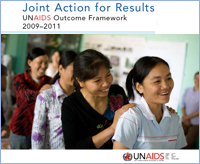
The HIV organizational landscape has evolved and grown more complex over the past decade. UNAIDS, donors and civil society, including networks of people living with HIV, have rightly demanded greater clarity on the relationships between needs, financing, activities and outcomes. Also demanded is greater specificity about the role of UNAIDS and the Secretariat within the wider constellation of actors.
This Outcome Framework, which builds upon the UNAIDS Strategic Framework (2007–2011), will guide future investment and hold the Secretariat and the Cosponsors accountable for making the resources of the UN work for results in countries. It affirms the UNAIDS Secretariat and Cosponsors to leverage our respective organizational mandates and resources to work collectively to deliver results.
Joint action for results: UNAIDS outcome framework, 2009 – 2011 (pdf, 388 Kb)
Joint action for results: UNAIDS outcome framewor
Cosponsors:
Office of the United Nations High Commissioner for Refugees (UNHCR)
United Nations Children's Fund (UNICEF)
World Food Programme (WFP)
United Nations Development Programme (UNDP)
United Nations Population Fund (UNFPA)
United Nations Office on Drugs and Crime (UNODC)
International Labour Organization (ILO)
United Nations Educational, Scientific and Cultural Organization (UNESCO)
World Health Organization (WHO)
World Bank
Publications:
Joint action for results: UNAIDS outcome framework, 2009 – 2011 (pdf, 388 Kb)
Related
Feature Story
UNAIDS Committee of Cosponsoring Organizations meet
06 April 2009
06 April 2009 06 April 2009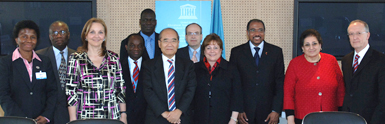
(from left): Joy Phumaphi, Vice President and Head of the Human Development Network, World Bank; Arnauld Akodjenou, Director, Division of Operational Services, UNHCR; Josette Sheeran, Executive Director, WFP; Anarfi Asamoa-Baah, Deputy Director General, WHO; Assane Diop, Executive Director, Social Protection Sector, ILO; Koichiro Matsuura, Director General, UNESCO; Ad Melkert, Administrator ad-interim, UNDP; Ann M. Veneman, Executive Director, UNICEF; Michel Sidibé, Executive Director, UNAIDS; Thoraya Ahmed Obaid, Executive Director, UNFPA; Antonio Maria Costa, Executive Director, UNODC. Paris, 3 April 2009,
The Joint United Nations Programme on HIV/AIDS (UNAIDS) brings together the efforts and resources of ten UN system organizations in the AIDS response. The UNAIDS Committee of Cosponsoring Organizations (CCO) serves as the forum for these Cosponsors to meet on a regular basis to consider matters of major importance to UNAIDS, and to provide input from the Cosponsoring organizations into the policies and strategies of UNAIDS.
On 3 April 2009, the CCO held their first meeting since the appointment of UNAIDS Executive Director Michel Sidibé.
The CCO expressed their full support for “universal access” which Mr Sidibé has outlined as the top priority for UNAIDS as well as the other priority areas of focus which will be set out in the new UNAIDS outcome framework currently being finalized with Cosponsors.
The meeting provided an excellent opportunity to share ideas on supporting countries in achieving their universal access goals. The need for UNAIDS to advocate for an evidence informed AIDS response that is grounded in human rights was accepted by all. Equally important was the need for accountability and results.
The CCO also endorsed the general directions of the 2010-2011 Unified Budget and Workplan including the key priorities and the allocation of resources between the Cosponsors, the Secretariat and Interagency activities. The Secretariat will now work with the Global Coordinators of the Cosponsors to finalize the UBW for the June 2009 meeting of the Programme Coordinating Board.
UNAIDS Committee of Cosponsoring Organizations (CCO)
The CCO comprises representatives from the ten UNAIDS Cosponsors and the UNAIDS Secretariat. It meets twice a year and each Cosponsor rotates as chair of the committee annually, on 1 July.
Right Hand Side
Cosponsors:
Office of the United Nations High Commissioner for Refugees (UNHCR)
United Nations Children's Fund (UNICEF)
World Food Programme (WFP)
United Nations Development Programme (UNDP)
United Nations Population Fund (UNFPA)
United Nations Office on Drugs and Crime (UNODC)
International Labour Organization (ILO)
United Nations Educational, Scientific and Cultural Organization (UNESCO)
World Health Organization (WHO)
World Bank
Related
 Keeping up the momentum in the global AIDS response
24 April 2019
 Malawi launches its health situation room
12 April 2019
 Learning lessons on evaluation
02 April 2019
Feature Story
Forum seeks to engage men and boys in goal of achieving gender equality
31 March 2009
31 March 2009 31 March 2009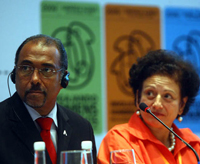 (from left) Mr Michel Sidibé, UNAIDS executive director and Brazil’s Minister of Policies for Women Nilcéa Freire at the opening of Engaging Men Symposium, 30 March 2009.
 Credit: UNAIDS/D.Ramalho
A global symposium on engaging men and boys in achieving gender equality is taking place this week in Rio de Janeiro, Brazil. Addressing the opening ceremony last night, UNAIDS Executive Director Mr Michel Sidibé spoke of the need for all to “work over the long term to end the social acceptance of violence against women and the gender inequality that underpins it.”
“We must engage with men and boys to promote awareness of the need for a “new masculinity,” continued Mr Sidibé.
The event was opened by Brazil’s Minister of Policies for Women, Ms Nilcea Freire. Other speakers at opening ceremony included: UNIFEM Executive Director, Ms Inés Alberdi; UNFPA Deputy Executive Director, Ms Purnima Mane; Ambassador of Canada to Brazil, Mr Paul Hunt; World Health Organization Department of Gender, Women and Health, Coordinator, Peju Olukoya; and UNDP Resident Representative and UN Resident Coordinator, Ms Kim Bolduc.
Three over-arching themes of “men and violence”; “men and health”; and “men and care-giving” will be covered during the conference. Yesterday, before opening the symposium, the Executive Director of UNAIDS Michel Sidibé joined the Brazilian Minister of Women’s Policies, Ms Nilcéa Freire, in inaugurating the first centre in Brazil that focuses on rehabilitating men who abuse women. Located in Nova Iguaçu, a municipality in Rio de Janeiro, the centre will place emphasis on education programmes to put a end to domestic violence. Ten other such centres are planned for throughout the country.
Gender and HIV
We must all work over the long term to end the social acceptance of violence against women and the gender inequality that underpins it
Michel Sidibé, Executive Director, UNAIDS
Gender comprises widely held beliefs, expectations and practices within a society that define ‘masculine’ and ‘feminine’ attributes, behaviours and roles and responsibilities. Given that gender constructions are relational – one sex defined in contrast to the other, the organizers of the Rio symposium believe that men and women must both be involved in the goal of achieving gender equality. Work with men is seen as a vital component, together with, rather than apart from, work to empower women and girls.
Gender norms in many societies may dictate that women and girls are less equal than men in the home, workplace and in negotiating sex. In some societies concepts about masculinity may reinforce a belief that men should seek multiple sexual partners or take risks. These norms work against HIV prevention messages that support protection measures and fidelity. Some notions of masculinity also condone violence against women, or lead to homophobia, which results in stigmatization of men who have sex with men, making these men more likely to hide their sexual behaviour and less likely to access HIV services.
Violence and HIV
According to a 2006 report by United Nations Secretary-General at least one out of every three women around the world has been beaten, coerced into sex, or otherwise abused in her lifetime, with the abuser usually someone known to her.
In the context of HIV, men’s use of physical or sexual violence against women, or the threat of violence increases women’s vulnerability to the disease by making it difficult or impossible to negotiate safer sex and condom use. It can also stop women from accessing HIV prevention, care and treatment services. Women may also avoid HIV testing due to fears of violence and abandonment in a resulting discovery of HIV-positive status.
Moving forward
This week’s Symposium will include dialogue sessions with representatives of the women’s rights movements and other social justice movements. Skills-building workshops to build capacity of participants in designing, implementing and evaluating behaviour change advocacy and community mobilization strategies and also working with young children and teenagers in achieving gender equality.
The participants hope to develop a “Call to Action” for governments to implement policy that engages men and boys in gender equality. Engaging men and boys in achieving gender equality will combine presentations of best practices, skills building workshops, and dialogues between representatives of non-governmental organizations, policymakers, and researchers. It runs until 3 April.
Right Hand Content
Cosponsors:
Partners:
Global Coalition on Women and AIDS
UNIFEM Gender and AIDS
Speeches:
Read speech to Opening of the Global Symposium: Engaging Men and Boys in Achieving Gender Equality by Michel Sidibé, Executive Director, UNAIDS (30 March 2009)
Feature stories:
Commission on the Status of Women opens with call for action to achieve universal access and gender equality (02 March 2009)
External links:
Engaging men and boys in achieving gender equality
MenEngage
Feature Story
Barber Shops and Beauty Salons promote HIV education in Guyana
26 March 2009
26 March 2009 26 March 2009This story was first published on UNFPA.org
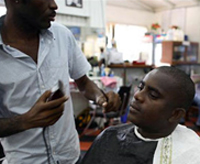
Clients at Kevin's Reflextions have an opportunity to talk about HIV.
Credit: Carina Wint
Barber shops across Georgetown, Guyana, are buzzing with chatter about the latest trends, community happenings, neighbourhood gossip and now, ways to protect young people from AIDS. The United Nations Population Fund (UNFPA), in collaboration with UNAIDS Secretariat, has identified barber shops and beauty salons as information hubs, and is using them to spread the word about HIV prevention.
The project involves the training of shop staff to answer simple HIV-related questions, pass out informational material, dispense both male and female condoms to clients – and even provide on-site counselling and testing. As a result, young people in Guyana are given access to information and resources not readily available elsewhere in their communities. And this is important because their small country (population 751, 223) has one of the highest HIV prevalence levels in the region: about 1.6 per cent for pregnant women, according to UNAIDS. Among sex workers, prevalence rises up to 26.6 per cent.
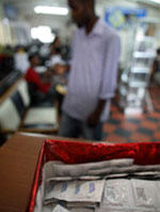
Male and female condoms are available at selected hair salons.
Credit: Carina Wint
Juanita Huburn, a customer at DJ’s Magic Fingers, a hair salon that participates in the programme, described Guyanese society as “closed” when it comes to issues regarding sexuality. “You do not talk about sex, they just say you should not have sex, but this is not realistic,” she said.
Shops and salons were chosen based on their location in malls, parks, popular attractions, or low-income communities. Owners who opened their doors to the project got added marketing exposure for their small businesses and were provided with incentives, such as access to promotional materials. “Shops were informed how their companies would be promoted through the project, and the economic value of participating,” said UNFPA Guyana Liaison Officer, Patrice La Fleur “They would most importantly provide safe places to discuss sexuality and the prevention of HIV.”
Shops were informed how their companies would be promoted through the project, and the economic value of participating. They would most importantly provide safe places to discuss sexuality and the prevention of HIV.
UNFPA Guyana Liaison Officer, Patrice La Fleur
Once the locations were identified, two employees from each shop were sent for training on basic HIV education and prevention means. They were also taught to properly monitor the project and introduced to safe practices within the context of their own work (for example, ensuring the sterility of hair cutting machines, razors, needles for stitching and weaving, manicure and pedicure implements, and tattooing and body piercing equipment).
In addition to training participants about sexual and reproductive health and gender issues, the project also focuses on building life skills such as communication, healthy relationships, and leadership. “Participants expressed personal gains in their quality of relationships with friends, family, and clients,” said UNFPA Programme Officer, Babsie Giddings who monitors the project.

DJ's Magic Fingers hair salon is another venue for building awareness of HIV prevention.
Credit: Carina Wint
Since the programme was put in place businesses report a steady boost in clientele and more shops have come on board. “Business has increased about 5 per cent since we joined this programme,” said Kevin John, owner of the Barber Shop Kevin’s Reflections. He believes it may be partly because people know his salon equipment is sanitized. Currently over 7000 male and 400 female condoms are distributed monthly by requests in the shops and salons.
Work on the project was initiated last year through efforts of the UN Country Theme Group and it has been fully funded by UNAIDS. Also collaborating on the project is a local NGO, Youth Challenge Guyana.
UNFPA provides continuous support with regular follow-ups and monitoring for participating barber shops and salons. The project aims to afford some 2000 young people access to information, skills, services and supplies they can use to protect their health.
Right Hand Content
Cosponsors:
Feature stories:
Condoms and HIV prevention: Position statement by UNAIDS, UNFPA and WHO (19 March 2009)
Challenging violence against women a key task for newly launched Caribbean Coalition on Women, Girls and AIDS (06 March 2009)
More prevention focus needed for the Caribbean to sharpen its response to HIV (22 December 2008)
Publications:
Keeping Score II: A progress report towards universal access to prevention, treatment, care and support in the Caribbean (pdf, 2,87 Mb)