

Press Release
UNAIDS Board calls on UNAIDS to support countries in setting revised national targets for antiretroviral treatment access
20 December 2013 20 December 2013GENEVA, 20 December 2013—The governing body of UNAIDS––the Programme Coordinating Board—has concluded its three-day meeting in Geneva. The Board called on UNAIDS to support on-going country and international processes to set revised national targets for universal access to HIV treatment.
The Board called on Member States to expand access to antiretroviral therapy by implementing the 2013 World Health Organization guidelines on access to treatment. They also stressed the importance of ensuring that acceleration of access to HIV treatment, including addressing the barriers to treatment access, is factored into all stages of HIV and health planning. In addition to support with national treatment target setting, the Board requested support from UNAIDS in reducing the price of medicines, technical support and capacity development.
During the meeting, which took place from 17-19 December, Board members highlighted the importance of intensifying efforts in the AIDS response beyond 2015 and emphasised that ending AIDS must have a prime position in the post-2015 agenda.
In his opening address, the Executive Director of UNAIDS Michel Sidibé echoed the importance of keeping focused on ending AIDS. “Ending AIDS will be a global achievement of historic dimensions,” said Mr Sidibé. “Not only will millions of lives be saved, but ending AIDS will drive better health, poverty and equity outcomes for the entire human family.”
UNAIDS was also requested to intensify coordinated technical support to governments, civil society, and key populations, and to further support countries in the roll-out of the New Funding Model of the Global Fund to Fight AIDS, TB and Malaria.
The meeting concluded with a full-day thematic segment on HIV, adolescents and youth where young people led sessions on prevention, testing and treatment and explored ideas, experiences and solutions with the Board members about the shape and scope of meaningful HIV programmes for young people.
Participants and observers from UN Member States, international organizations, civil society and non-governmental organizations attended the meeting, which was chaired by India. The Board elected Australia as Chair and Zimbabwe as Vice Chair for 2014.
UNAIDS Executive Director’s report to the Board, decisions, recommendations and conclusions from the meeting can be found at unaids.org.
Press centre
Download the printable version (PDF)
Côte d’Ivoire takes bold step into the global AIDS arena
Feature Story
Côte d’Ivoire takes bolder step into the global AIDS arena
18 December 2013
18 December 2013 18 December 2013In a strong demonstration of commitment to the global response to HIV and to UNAIDS, the President of Côte d’Ivoire Alassane Ouattara has announced that Côte d’Ivoire will donate US$ 1 million to support UNAIDS work in helping countries to achieve the targets set out in the 2011 Political Declaration on HIV and AIDS.
"I have decided to donate US$ 1 million to UNAIDS because I believe in a society with zero new HIV infections, zero discrimination and zero AIDS-related deaths," said President Ouattara during the meeting of Côte d’Ivoire’s National AIDS Council.
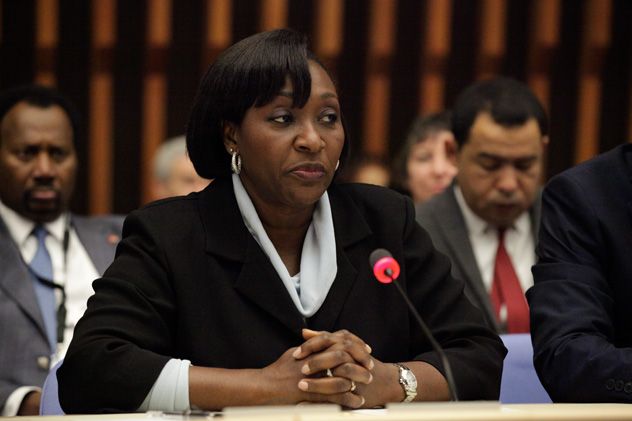
The contribution was confirmed by the Minister of Health Côte d’Ivoire Raymonde Goudou Coffie who was representing Côte d’Ivoire at UNAIDS Programme Coordinating Board meeting in Geneva. "I am delighted to be at the UNAIDS Board and to announce our contribution of US$ 1 million for its essential work and as a sign of shared responsibility," said Ms Coffie.
“This contribution to UNAIDS makes Côte d’Ivoire the first African country to become one of UNAIDS 20 most important donors,” said Michel Sidibé, Executive Director of UNAIDS.
Côte d’Ivoire joins the Republic of the Congo and Senegal in becoming the first African countries to financially contribute to UNAIDS.
Related
Press Release
UNAIDS and the hotel InterContinental Genève launch a new campaign to ensure all children are born HIV-free
16 December 2013 16 December 2013The campaign, ‘Where history is made,’ invites guests to make history and make a pledge for an AIDS-free generation
GENEVA, 16 December 2013—UNAIDS and the hotel InterContinental Genève have come together in a public-private partnership to advance efforts to ensure that all children can be born free from HIV, that their mothers have access to life-saving medicines and that all children living with HIV can lead healthy lives.
Countries have committed to eliminating new HIV infections among children by 2015. Although great progress has been made—with new HIV infections among children having been reduced by 53% since 2001—there is still a major push needed to help countries reach their goals. In 2013, just 28% of children in need of treatment had access.
“By keeping children free from HIV we are not only saving lives, we are investing in a healthier future for generations to come,” said Michel Sidibé, Executive Director of UNAIDS. “I am honoured that the hotel InterContinental Genève is partnering with us to provide more people with the opportunity to join our efforts in making an AIDS-free generation possible.”
One of the first initiatives of the joint partnership is the launch of a campaign to raise both awareness and funds for an AIDS-free generation. The campaign, Where history is made, launched at a special event held at the hotel on 16 December, invites guests to make history and a pledge for an AIDS-free generation. Hotel staff will play an integral role with AIDS-awareness training and will be able to share information with guests about the importance of keeping children free from HIV. Hotel guests will be able to join the campaign by making a donation as they check out or when they visit the hotel restaurant or bar.
“The hotel has a longstanding history and relationship with the UN in Geneva, and we are excited to have formed this partnership with UNAIDS,” said the General Manager of the hotel InterContinental Genève, Jürgen Baumhoff.
The hotel InterContinental Genève is an important landmark in Geneva, standing at the intersection of the city and the United Nations. In 2014 the hotel will mark its 50th anniversary over which time it has welcomed world leaders and played host to the historic brokering of deals and forging of partnerships. The campaign between UNAIDS and the hotel InterContinental Genève is part of the hotel’s 50-year celebrations and captures the essence of this major milestone by joining efforts to achieve an AIDS-free generation.
“Building healthier societies begins with children,” said UNAIDS International Goodwill Ambassador and internationally acclaimed musician Toumani Diabaté who performed at the special launch event. “We can all be part of history by making sure that women living with HIV and their children have access to HIV, prevention, treatment and care services.”
Press centre
Download the printable version (PDF)
Press Release
New report from FCAA and UNAIDS shows little change in philanthropic funding for HIV in recent years
10 December 2013 10 December 2013Report includes new information from 40 funders based outside the U.S. and Europe
WASHINGTON D.C., CAPE TOWN, GENEVA, 10 December 2013—A new report by Funders Concerned About AIDS (FCAA), supported by UNAIDS, showed that 5.4% or US$ 0.5 billion of total international funding available for HIV in low- and middle-income countries was from philanthropic sources. Globally in 2012, US$ 636 million came from private donors. The report, which was launched today at the FCAA 2013 AIDS Philanthropy Summit and the 17th International Conference on AIDS and STIs in Africa, also shows that philanthropic funding has remained essentially flat (a less than 1% increase) since 2011.
This slight growth is largely due to the addition of 40 funders, new to the report, based outside of the U.S. and Western and Central Europe. Excluding funding from these organizations, philanthropy from U.S.- and E.U.-based organizations decreased by US$33 million, or 5% from 2011. Overall total philanthropic funding has remained at roughly the same level since 2007, and continues to be strongly influenced by the world’s largest HIV/AIDS philanthropic donor, the Bill & Melinda Gates Foundation (Gates Foundation). Forecasts in both the U.S. and Europe suggest that private AIDS funding is unlikely to increase in 2013.
“We’re thrilled to highlight the work and impact of 40 new potential partners in the philanthropic response to HIV/AIDS,” said John Barnes, Executive Director, FCAA. “However, the inclusion of these new funding sources in the report masks a troubling decline among U.S.- and E.U.-based organizations. A ‘slow and steady’ approach will not bring the needed resources to bear to meet the current challenges of the AIDS response.”
Other Key Findings:
- Funding from U.S.-based philanthropies totaled US$ 467 million in 2012, decreasing 3% from 2011. Seven top funders – including the Gates Foundation (which represented half of total U.S.-based disbursements), experienced significant decreases (US$ 1m-US$ 18mil) due to reported yearly fluctuations in grantmaking cycles and shifts in funding to other health areas.
- Among E.U-based philanthropies, the 2012 total reached $147 million, decreasing 6% from 2011. This continues a now 3-year gradual decline since 2009. While the majority of E.U.-based funders decreased funding between 2011 and 2012, some of this was the result of yearly fluctuations in the grantmaking cycles, or a strategy review process, rather than a shift away from funding for HIV.
- New for 2013, FCAA conducted research to identify HIV philanthropic funders based outside of the U.S. and the Western and Central Europe. Surveys and additional research generated data from 40 funders in 13 countries, totaling approximately $38 million in AIDS philanthropy in 2012.
“There is a strong sentiment of global solidarity around advancing the AIDS response to reach an AIDS-free generation,” said Luiz Loures, Deputy Executive Director, Programme, UNAIDS. “UNAIDS continues to urge all partners to look for innovative ways of ensuring increased and sustainable sources of funding to allow us to reach everyone in need with lifesaving HIV services.”
The report was released amidst news that funding for the AIDS response in low- and middle-income countries from donor governments totaled $7.86 billion in 2012, remaining essentially unchanged since 2008. According to UNAIDS the total resources available for HIV reached US$ 18.9 billion in 2012, $3-5 billion short of what is needed to meet the global target of $22-24 billion. UNAIDS’ Investment Framework to guide more efficient use of resources shows that 4.2 million new HIV infections and 1.9 million HIV-related deaths could be averted, and 15 million people could access HIV treatment, if funding is scaled up to US$ 24 billion by 2015.
While philanthropic aid provided to low- and middle-income countries only represents approximately 5% of all international funding for the AIDS response, FCAA and UNAIDS emphasize that, in its independence, philanthropy has a catalytic role to play in the AIDS response. Philanthropic funding is often committed to addressing critical issues through advocacy and to supporting key populations such as men who have sex with men, people who inject drugs, and sex workers, that are often not covered by other sources of funding.
The FCAA annual resource tracking report, produced with support from UNAIDS, intends to inform stakeholders about the overall distribution and trends of global AIDS philanthropy. The financial data is largely sourced from surveys completed by funders, with supplemental review of grants databases and funders’ grants lists. Data was obtained for close to 300 organizations that are believed to represent the substantial majority of global private HIV/AIDS philanthropy.
Download Global Philanthropic Support to Address HIV/AIDS in 2012 at http://www.fcaaids.org/resourcetracking
Contact
UNAIDS GenevaSophie Barton-Knott
tel. +41 22 791 1697
bartonknotts@unaids.org
FCAA
Sarah Hamilton
tel. +1 509 336 9240
sarah@fcaaids.org
Press centre
Download the printable version (PDF)
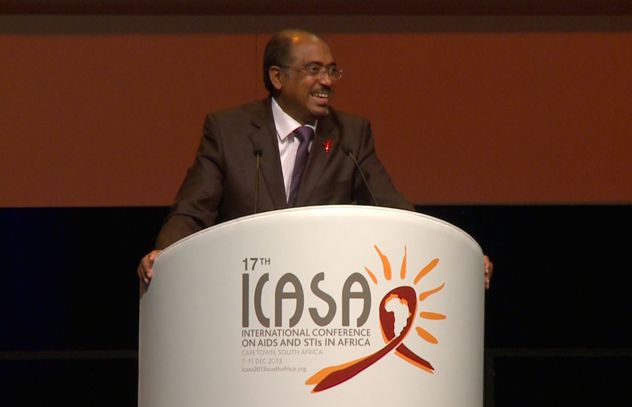
UNAIDS Executive Director Michel Sidibé speaking at the opening of the XVII International Conference on AIDS and Sexually Transmitted Infections in Africa (ICASA). 07 December 2013. Cape Town, South Africa.
Feature Story
Africa’s largest AIDS conference opens in Cape Town
08 December 2013
08 December 2013 08 December 2013Delegates from across the world gathered in Cape Town, South Africa on 6 December for the start of the XVII International Conference on AIDS and Sexually Transmitted Infections in Africa (ICASA). The five-day conference is being held on a sombre note as the world mourns the death of Nelson Mandela, who is considered Africa’s greatest statesman.
The Deputy President of South Africa, Kgalema Motlanthe welcomed participants to his country and paid tribute to Former President Nelson Mandela, saying “We will miss his larger than life figure, his statesmanship, his common touch, contagious humour and unbending resolve to see through a dream of a better life for all humanity.” He then went on to talk about the huge progress made in the AIDS response and said, “Investment in good health should be considered as a development imperative in and of itself.”
The theme of the five-day conference is “Now more than ever: targeting zero” and it was selected to stress the progress that has been made across Africa in scaling up HIV treatment but also the need to redouble efforts to prevent new HIV infections. More than 5 000 representatives of political, multilateral and civil society groups, as well as scientists, young people and activists are attending the conference.
Speakers at the opening ceremony included: UNAIDS Executive Director Michel Sidibé, the First Lady of Zambia Christine Kaseba-Sata, the celebrated singer and activist and UNAIDS International Goodwill Ambassador, Annie Lennox, the Acting Global AIDS Coordinator of the President’s Emergency Plan for the AIDS Relief, Deborah von Zinkselnagel, Professor Robert Soudré, President of the Society for AIDS in Africa, Professor Ian Sanne, CEO of Right to Care and Cyriaque Ako, Health Specialist for African Men for Sexual Health and Rights (AMSHeR).
The inauguration ceremony also featured cultural performances by African stars including the first prominent transgender artist from Angola; Titica who is UNAIDS National Goodwill Ambassador. Earlier, Ms Lennox and Mr Sidibé opened the cultural community village which features information booths, handicrafts made by people living with HIV and community groups.
Quotes
“Africa should not be afraid of calling for the end of AIDS by achieving our dream of the three zeros as a separate goal on the Post-2015 development agenda because AIDS is still an unfinished business. I believe that by 2030 we can end AIDS. Yes, HIV may be with us into the future until we achieve a cure or a vaccine but the disease that HIV causes need not be with us.”
“The subordination of African women creates vulnerability to HIV infection through economic dependency, lack of assets, and lack of protection against the views and exploitation.”
“It is time for leaders across the African continent and leaders everywhere to commit to taking concrete action to stop violence against women and children, by implementing the policies which effect change.”
Representing civil society at the opening, Mr Ako said the people most exposed to HIV are the most exposed to legal condemnation and he added “I am here as a gay man living with HIV. My community told me to say our issues are not properly addressed.”
Speech
Multimedia
Related
 Keeping up the momentum in the global AIDS response
24 April 2019
 Malawi launches its health situation room
12 April 2019
 Learning lessons on evaluation
02 April 2019
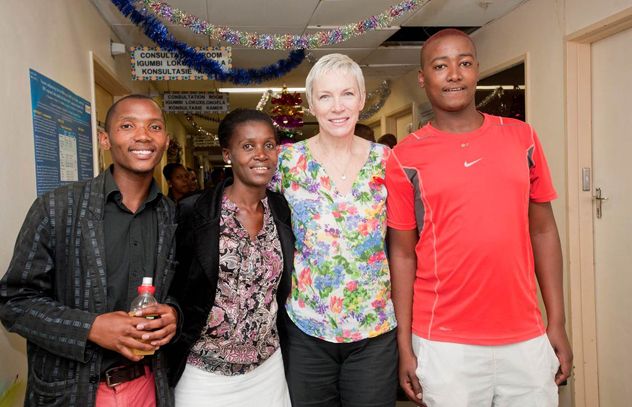
Annie Lennox, UNAIDS International Goodwill Ambassador with young people at KID CRU at Tygerberg Children’s Hospital in Cape Town, South Africa on December 6 2013. Credit: UNAIDS/ Rodger Bosch
Feature Story
UNAIDS Goodwill Ambassador Annie Lennox pays tribute to Nelson Mandela during visit to South Africa
07 December 2013
07 December 2013 07 December 2013UNAIDS International Goodwill Ambassador Annie Lennox is in South Africa to highlight the progress and challenges in the AIDS response. During her site visits, she paid tribute to Former President Nelson Mandela.
Ms Lennox learned about the benefits of early HIV treatment in preventing paediatric AIDS during a visit to the Children’s Infectious Diseases Clinical Research Unit (KID CRU) at the Tygerberg Children’s Hospital. She met with patients and their families and watched a performance by a community group singing a eulogy dedicated to President Mandela.
At the Desmond Tutu HIV Foundation Youth Centre in the Masiphumelele community, Ms Lennox witnessed how a safe environment tailored to the needs of young people can change lives. The centre provides youth-friendly health services as well as education and entertainment. Ms Lennox spoke with young mothers about their challenges and dreams and listened to a rousing recording by a group of teenagers.
The field visits were particularly significant and symbolic to Ms Lennox because almost exactly ten years ago she resolved to bring attention to the HIV epidemic after her first very moving encounter with President Mandela.
In her role as UNAIDS International Goodwill Ambassador, Ms Lennox will attend the 17th International conference on AIDS and STIs in Africa (ICASA) and speak at several high level events. The five day conference, which opens on 7 December, will be attended by UNAIDS Executive Director Michel Sidibé along with around 7 000 of the world’s leading scientists, policy makers, activists and people living with HIV.
Quotes
“Nelson Mandela is one of the most significant historical, political and social figures in terms of transformative change that the planet has ever seen. As such his passing leaves a tremendous void.
Before leaving public office he stated " It's in your hands", challenging us all to engage with the urgent issues of human rights and social justice. If we want to enjoy and sustain the legacy he has given South Africa and the world, then we need to be proactive as opposed to indifferent".
“The Desmond Tutu HIV Foundation Youth Centre helps youth to be confident and to recognize talents that they never knew they had."
Multimedia
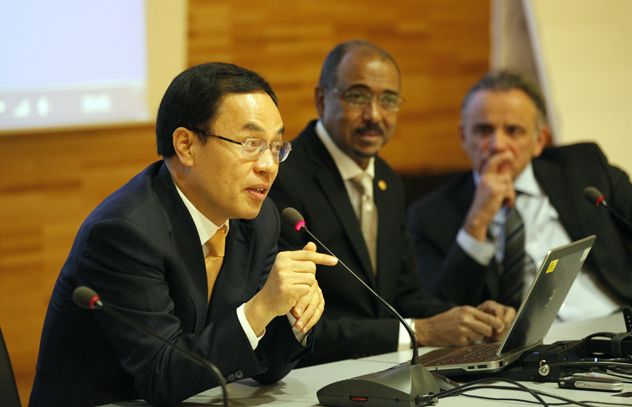
Mr Li, who is also the Vice Chairman of the All-China Federation of Industry & Commerce, was hosted by UNAIDS Executive Director Michel Sidibé on 12 November.
Feature Story
Chairman of Hanergy Holding Group stresses China’s private sector role in the AIDS response
05 December 2013
05 December 2013 05 December 2013The significant role that China’s private sector can play in the AIDS response was emphasized during a recent visit to UNAIDS Geneva headquarters by Li Hejun, Chairman of Hanergy Holding Group, a leading multinational clean energy company.
Mr Li, who is also the Vice Chairman of the All-China Federation of Industry & Commerce, was hosted by UNAIDS Executive Director Michel Sidibé on 12 November. The two leaders had a wide-ranging discussion about how best to reinforce and extend the involvement of the private sector in an effective response to HIV. They also spoke about the future of global social responsibility.
Hanergy also hosts the China Red Ribbon Foundation. In addition, Mr Li expressed his willingness to actively enhance his company’s commitment to the AIDS response and cooperate with UNAIDS in the field of international health and development.
Quotes
"In addition to promoting business development in the area of clean energy, Hanergy is committed to actively contribute to the AIDS response. We will undertake a leading role in the areas of global social responsibility for local communities in China and Africa."
"Chairman Li Hejun is an inspiring example of the private sector’s unique global role in helping to end the AIDS epidemic."
Resources
Resources
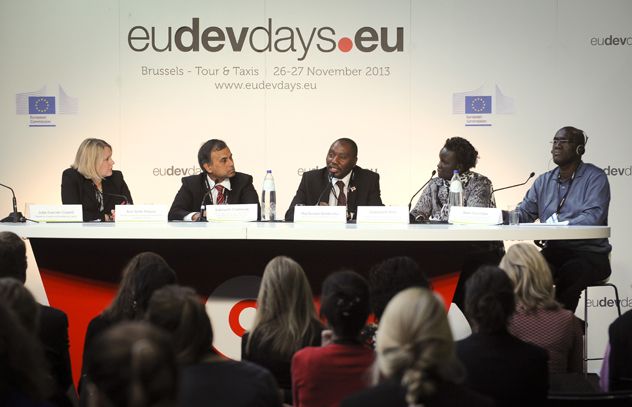
Consultation on the future of HIV, health and development held in Brussels.
Feature Story
Leveraging the transformative potential of the AIDS response as a force for social justice, equity and global health post-2015
04 December 2013
04 December 2013 04 December 2013A consultation on the future of HIV, health and development took place during the European Development Days held from 27-28 November in Brussels. The consultation was part of the regional dialogues series organized by The UNAIDS and Lancet Commission: Defeating AIDS – Advancing global health.
The main message emerging from the meeting was the need to leverage the experience of the AIDS response as a transformative force for social justice, equity and global health post-2015. Participants stressed the importance of putting marginalized and vulnerable communities at the centre of the HIV responses and integrate HIV, health and human rights in development responses after 2015.
Participants
Moderated by Member of the European Parliament Michael Cashman, the panel comprised Jacquelyne Alesi, Programmes Director, Network of Young People Living with HIV/AIDS in Uganda; Ann-Sofie Nilsson, Director-General for International Development Cooperation, Sweden; Siddharth Chatterjee, Chief Diplomat at the International Federation of the Red Cross and Red Crescent Societies; MacDonald Sembereka, Special Adviser to the President of Malawi and Baba Gumbala, International HIV/AIDS Alliance. The session was attended by members of parliament from Africa, European development actors, civil society, academics, government representatives and others.
Outcomes
The main issues discussed will be conveyed to the Chairs of the Commission’s three Working Groups, whose final papers will form the recommendation of the UNAIDS-Lancet Commission, to be published in The Lancet in 2014.
Quotes
"Youth represent the inter-generational nature of families – they connect to older generations and are a pathway to the future. Investing in young people is the sensible thing to do to ensure sustainable health outcomes."
"To reach zero, we need to change our attitude towards AIDS and people living with HIV. We must fight stigma and discrimination, ensure comprehensive sexuality education and guarantee the meaningful participation and involvement of young people and people living with HIV in all aspects of decision making."
"We need a more simple architecture which is focusing on health instead of diseases, but we also need to keep what works. The AIDS response has contributed significantly to the current architecture by including the human rights perspective on health, the strong engagement of civil society, the demand for accountability, and the multi-sectorial response."
"We, as donors and governments, multi-laterals, parliamentarians and civil society, need to make the case for AIDS, health and human rights to be prominently positioned in the post-2015 agenda. It is essential that we want to preserve and leverage the transformative force of the AIDS response and advance social justice and global health in the post-2015 agenda. It is a matter of life and death – and rights!"
"Ending AIDS can only be realized if governments take action to address the barriers of stigma and discrimination that prevent people from accessing the treatment and care they need."
Related



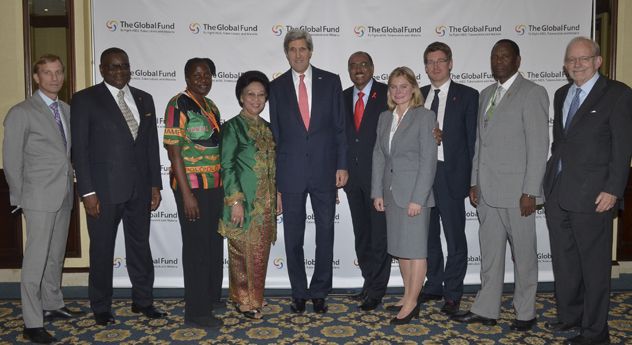
UNAIDS Executive Director Michel Sidibé, standing in the picture next to United States Secretary of State John Kerry, said “Solidarity, tolerance and results are the hallmarks of global leadership on AIDS. President Obama’s unfaltering commitment increases the chances we will realize an AIDS-free generation in our lifetimes." Credit: Gettyimages
Feature Story
US shows bold, unwavering commitment to AIDS response
03 December 2013
03 December 2013 03 December 2013As world leaders gather in the United States to pledge their commitment to the Global Fund to Fight AIDS, Tuberculosis and Malaria’s (Global Fund) replenishment conference, UNAIDS is calling for a successful outcome to ensure that no-one is left behind.
The United States is hosting the important replenishment conference which will secure financing for the Global Fund’s AIDS, TB and malaria programmes from 2014 to 2016. Ahead of the meeting, United States President Barack Obama welcomed global leaders to a special event at the White House in Washington DC.
During the event the President announced that the US has met—and in some cases exceeded—the targets set for the President's Emergency Plan for AIDS Relief (PEPFAR). The targets, set in 2011, included ensuring access to antiretroviral therapy for 6 million people living with HIV. President Obama announced that the US is currently supporting 6.7 million people in gaining access to lifesaving treatment.
As the host country, President Obama also called on other world leaders to fully support global efforts to end the AIDS epidemic and stated the US will give US$ 1 to match every US$ 2 pledged to the Global Fund by other donors over the next three years (up to US$ 5 billion).
Quotes
"The United States of America will remain the global leader in the fight against HIV. We will stand with you every step of this journey until we reach the day that we know is possible, when all men and women can protect themselves from infection; a day when all people with HIV have access to the treatments that extend their lives; the day when there are no new babies being born with HIV, and when we achieve, at long last, what was once hard to imagine—and that’s an AIDS-free generation."
"Greater commitments from our partners to the Global Fund should give greater confidence…I am extremely encouraged by the increased investments from the United Kingdom, Denmark, Norway, Sweden and Canada, as well as from Germany and France. All of them are extending their high levels of commitment. If everybody steps up we will do even more to meet this challenge."
"Solidarity, tolerance and results are the hallmarks of global leadership on AIDS. President Obama’s unfaltering commitment increases the chances we will realize an AIDS-free generation in our lifetimes."
Press Release
UNAIDS and Daw Aung San Suu Kyi launch #zerodiscrimination campaign in Australia
01 December 2013 01 December 2013New international day for Zero Discrimination announced
Melbourne, 1 December 2013—On the occasion of World AIDS Day 2013, the United Nations Joint Programme on HIV/AIDS (UNAIDS) and Nobel Peace Prize Winner and UNAIDS Global Advocate for Zero Discrimination Daw Aung San Suu Kyi are launching the #zerodiscrimination campaign calling for a global transformation. The initiative will launch the new Zero Discrimination Day on 1 March 2014, adopting the butterfly as the transformative symbol for zero discrimination.
“I believe in a world where everyone can flower and blossom. We can all make a difference by reaching out and letting people lead a life of dignity irrespective of who they are,” said Daw Aung San Suu Kyi. “I invite everyone to Open up, Reach out and end discrimination.”
Daw Aung San Suu Kyi and UNAIDS Executive Director Michel Sidibé announced the Zero Discrimination campaign during a World AIDS Day event in Melbourne, Australia.
“As communities and individuals we must continue to take action to reduce transmission of HIV and ensure that people living with HIV can participate fully in the life of the community, free from stigma and discrimination,” said Australia's Minister for Health, the Hon Peter Dutton.
“We recognize that getting to zero new HIV infections and zero AIDS-related deaths will be impossible without striving towards zero discrimination,” said Mr Sidibé. “On Zero Discrimination Day, we will celebrate the rights of everyone to live a full and productive life with dignity”.
Discrimination can affect people in many ways in their lives.
For the AIDS response, discrimination towards people living with HIV and key populations at higher risk of HIV is a major obstacle to expanding access to HIV services. Country surveys found that 1 in 7 people living with HIV have reportedly been denied access to healthcare and more than 1 in 10 people living with HIV have been refused employment because of their HIV status.
Daw Aung San Suu Kyi has taped a public service announcement (PSA) with the message “Open up, Reach out. Together we can reach zero discrimination.” Through the PSA, a campaign web page and social media outreach, the campaign asks people around the world to join the conversation and take action.
The initial phase of the initiative will continue until December 10 – International Human Rights Day and will then build momentum in the month leading up to the new Zero Discrimination Day.
|
In 2012, an estimated: 35.3 million [32.2 million – 38.8 million] people globally were living with HIV 2.3 million [1.9 million – 2.7 million] people became newly infected with HIV 1.6 million [1.4 million – 1.9 million] people died from AIDS-related illnesses |
Press centre
Download the printable version (PDF)