

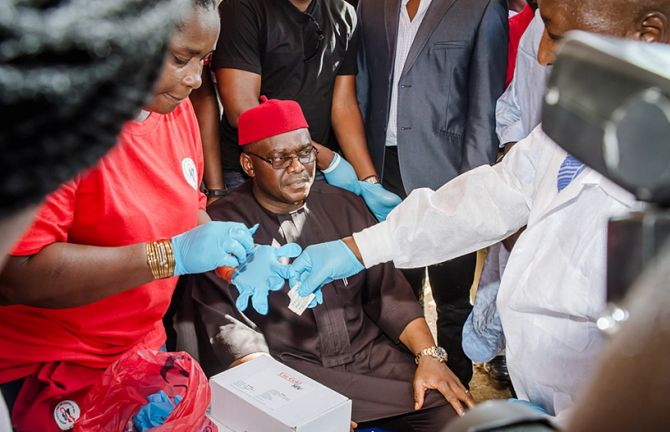
A new national initiative to test 30 million people for HIV in 2014 was launched at an event held in the Bwari state of Nigeria by the Federal Minister of Health Professor Onyebuchi Chukwu. The Minister of Health led by example and took a HIV test to kick-start the HIV testing campaign.
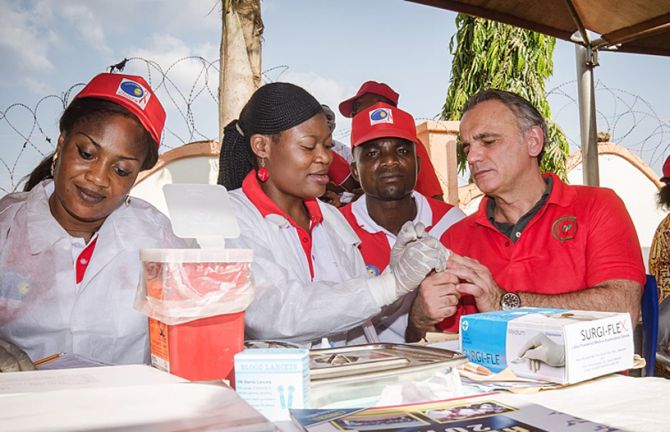
Dr Luiz Loures, Deputy Executive Director, UNAIDS said “The end of the AIDS epidemic starts with knowing your HIV status and accessing HIV services.”
Feature Story
President Goodluck Jonathan urges all Nigerians to “Take Charge” and take an HIV Test
01 December 2013
01 December 2013 01 December 2013In a World AIDS Day statement, H.E. Goodluck Jonathan, President of the Federal Republic of Nigeria announced his Government’s plan to step up the country’s AIDS response with his leadership and commitment. “No Nigerian should be allowed to die of AIDS, they must take charge and take an HIV test,” said President Jonathan.
A new national initiative to test 30 million people for HIV in 2014 was launched at an event held in the Bwari state of Nigeria by the Federal Minister of Health Professor Onyebuchi Chukwu. According to Nigerian government more than 80% of men and women in Nigeria report to never have been tested for HIV. The Minister of Health led by example and took an HIV test to kick-start the HIV testing campaign. He was joined by UNAIDS Deputy Executive Director Dr Luiz Loures, and the UNAIDS Country Coordinator for Nigeria Dr Bilali Camara who also took the test to mark UNAIDS support to this landmark campaign.
Dr Loures conveyed his assurances of the full support of UNAIDS and the entire UN family to President Goodluck Jonathan and the Government of Nigeria in the implementation of the Presidential Comprehensive Response Plan to respond to AIDS which was launched earlier this year
Quotes
"No Nigerian should be allowed to die of AIDS, they must take charge and take an HIV test."
"The Presidential Comprehensive Response Plan is a priority for the Government of Nigeria."
"The end of the AIDS epidemic starts with knowing your HIV status and accessing HIV services."

Press Release
More than 850,000 infants saved from HIV since 2005, but alarming trends seen among adolescents
29 November 2013 29 November 2013UNICEF report shows that new infections among adolescents could be halved by 2020 with targeted and increased investment
NEW YORK, 29 November 2013 – A new report released today by UNICEF shows great progress has been made to prevent mother-to-child transmission of HIV, with more than 850,000 new childhood infections averted between 2005 and 2012 in low- and middle-income countries.
However, the new 2013 Stocktaking Report on Children and AIDS raises the alarm on adolescents, citing the need for increased global and national efforts to address HIV and AIDS among this vulnerable age group.
AIDS-related deaths amongst adolescents between the ages of 10 and 19 increased by 50 per cent between 2005 and 2012, rising from 71,000 to 110,000, in stark contrast to progress made in preventing mother-to-child transmission. There were approximately 2.1 million adolescents living with HIV in 2012.
With additional funding and increased investment in innovation, many of the challenges could be overcome, the report says.
A new analysis featured in the report shows that by increasing investment in high-impact interventions to about US$5.5 billion by 2014, 2 million adolescents, particularly girls, could avoid becoming infected by 2020. Investments in 2010 were US$3.8 billion.
“If high-impact interventions are scaled up using an integrated approach, we can halve the number of new infections among adolescents by 2020,” said UNICEF Executive Director Anthony Lake. “It’s a matter of reaching the most vulnerable adolescents with effective programmes – urgently.”
High-impact interventions include condoms, antiretroviral treatment, prevention of mother-to-child transmission, voluntary medical male circumcision, communications for behaviour change, and targeted approaches for at-risk and marginalized populations. This is in addition to investments in other sectors such as education, social protection and welfare, and strengthening health systems.
In contrast to adolescents, progress has been impressive in the area of preventing new HIV infections among infants. Some 260,000 children were newly infected with HIV in 2012, compared to 540,000 in 2005.
“This report reminds us that an AIDS-free generation is one in which all children are born free of HIV and remain so––from birth and throughout their lives––and it means access to treatment for all children living with HIV,” said Michel Sidibe, Executive Director of UNAIDS. “It also reminds us that women’s health and well-being should be at the centre of the AIDS response. I have no doubt that we will achieve these goals.”
Thanks to new, simplified life-long antiretroviral treatment (known as Option B+), there is a greater opportunity to effectively treat women living with HIV and to prevent the transmission of the virus to their babies during pregnancy, delivery, and through breastfeeding. This treatment involves a daily one-pill regimen.
“These days, even if a pregnant woman is living with HIV, it doesn’t mean her baby must have the same fate, and it doesn’t mean she can’t lead a healthy life,” said Lake.
Some of the most remarkable successes were in high HIV burden countries in sub-Saharan Africa. New infections among infants declined between 2009 and 2012 by 76 per cent in Ghana, 58 per cent in Namibia, 55 per cent in Zimbabwe, 52 per cent in Malawi and Botswana, and 50 per cent in Zambia and Ethiopia.
The new report also emphasizes that for an AIDS-free generation to become a reality, more children living with HIV should receive antiretroviral treatment. Only 34 per cent of children living with HIV in low- and middle-income countries received the treatment they needed in 2012, compared to 64 per cent of adults. As a result, an estimated 210,000 children died from AIDS-related illnesses in 2012.
Innovations and new ways of working are making testing and treatment more accessible, effective and efficient. One example is the use of mobile phones in Zambia and Malawi to quickly deliver HIV test results. This has allowed mothers to receive diagnoses for their babies much faster than through results delivered by hand.
The challenge now is to apply the knowledge that already exists, continue to focus on the most vulnerable and marginalized children and adolescents, and pursue new opportunities and innovations—while using finite resources as efficiently and effectively as possible.
“The world now has the experience and the tools to achieve an AIDS-free generation. Children should be the first to benefit from our successes in defeating HIV, and the last to suffer when we fall short,” said Lake.
The report will be available at www.childrenandaids.org
Attention broadcasters: Video news stories and b-roll from Botswana, Ivory Coast, and Malawi are available at http://weshare.unicef.org/mediaresources
Note for Editors:
- About the simplified life-long antiretroviral treatment (Option B+):
UNICEF is supporting countries as they transition to the new simplified life-long antiretroviral therapy (Option B+) for all pregnant women living with HIV. The new treatment is in the form of one pill, taken once a day (compared to the previous treatment of up to six pills per day).This treatment can be provided at the community level, at local primary care facilities. It keeps mothers healthier, as they continue taking it even after giving birth, through breastfeeding and beyond. Malawi was a pioneer in offering the Option B+ treatment in 2011, resulting in massive expansion of the treatment coverage for both pregnant and breastfeeding women living with HIV. By June 2013, 13 of the 22 Global Plan priority countries had adopted the same policy of offering life-long treatment.
- About the Stocktaking Reports:
Stocktaking reports on Children and AIDS are the flagship publications of the Unite for Children, Unite against AIDS campaign. UNICEF leads the production of these publications as part of its commitment to the Joint United Nations Programme on HIV/AIDS (UNAIDS), in collaboration with UNAIDS and the other 10 UNAIDS co-sponsors. The new ‘Children and AIDS: Sixth Stocktaking Report’ is the first of its kind since 2010.
About UNAIDS
The Joint United Nations Programme on HIV/AIDS (UNAIDS) leads and inspires the world to achieve its shared vision of zero new HIV infections, zero discrimination and zero AIDS-related deaths. UNAIDS unites the efforts of 11 UN organizations—UNHCR, UNICEF, WFP, UNDP, UNFPA, UNODC, UN Women, ILO, UNESCO, WHO and the World Bank—and works closely with global and national partners to maximize results for the AIDS response. Learn more at unaids.org and connect with us on Facebook and Twitter.
About UNICEF
UNICEF promotes the rights and wellbeing of every child, in everything we do. Together with our partners, we work in 190 countries and territories to translate that commitment into practical action, focusing special effort on reaching the most vulnerable and excluded children, to the benefit of all children, everywhere. For more information about UNICEF and its work visit: www.unicef.org Follow us on Twitter and Facebook
For further information, please contact:
Rita Ann Wallace, UNICEF Media New York, tel: + 1 212 326 7586, rwallace@unicef.org
Iman Morooka, UNICEF Strategic Communications, New York, tel: + 1 212 326 7211, imorooka@unicef.org
Sophie Barton-Knott, UNAIDS Geneva, tel: +41 22 791 1697, bartonknotts@unaids.org
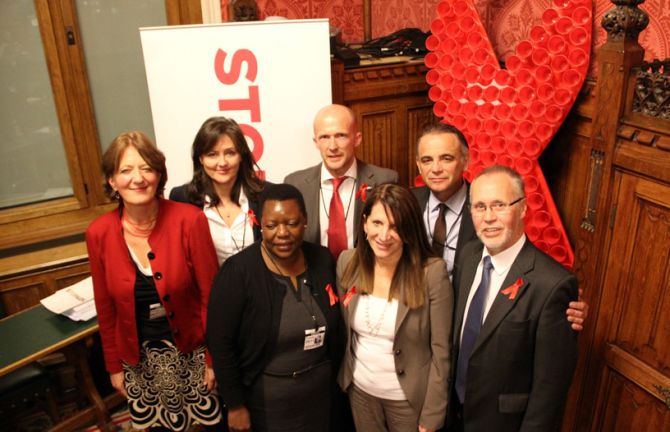
Marijke Wijnroks, Chief of Staff, Global Fund; Anne Aslett, Executive Director, Elton John Aids Foundation; Nik Hartley, Chief Executive Officer, Restless Development; Luiz Loures, Deputy Executive Director, Programme, UNAIDS; ‘Emma’, a national from Zimbabwe; Lynne Featherstone, Parliamentary Under Secretary of State of the UK Department for International Development; and Hon. Russell Brown MP, Vice Chair, All Party Parliamentary Group on HIV and AIDS. Credit: STOPAIDS
Feature Story
United Kingdom's Department for International Development announces a 50% increase in its annual contribution to UNAIDS
29 November 2013
29 November 2013 29 November 2013The United Kingdom's Department for International Development has announced a 50% increase in its annual contribution to UNAIDS, from £10 million to £15 million for 2013 and 2014. The announcement was made by Lynne Featherstone, UK Parliamentary Under-Secretary of State at an event on the UK’s International Response to AIDS. The event was co-organized by the All Party Parliamentary Group on HIV and AIDS and STOPAIDS to commemorate World AIDS Day.
Minister Featherstone emphasized the leadership of UNAIDS and its critical role in the global response to AIDS. She also stressed the need to continue efforts to prevent stigma and discrimination of all kinds.
Speaking at the event, UNAIDS Deputy Executive Director, Programme, Luiz Loures congratulated the UK on its commitment to the AIDS response and welcomed the UK's support and confidence in the work of UNAIDS. Dr Loures emphasized the need to ensure that no one is left behind in the response to HIV.
During the event, held in London in the House of Commons and chaired by Russell Brown MP, a review of the UK’s position paper on HIV in the developing world was launched followed by a discussion with Anne Aslett, CEO of the Elton John AIDS Foundation, Marijke Wijnroks, Chief of Staff at the Global Fund to Fight AIDS, TB and Malaria and Nik Hartley, CEO of Restless Development.
Quotes
"The UK government is committed to achieving the UN’s vision of zero new HIV infections; zero discrimination and zero AIDS-related deaths. Ensuring better integration of HIV within wider health systems, supporting key affected populations and making sure that women and girls are central to the HIV response are vital if we are to help people live longer healthier and more productive lives"
"Although the end of AIDS is in sight, it is not in sight for everybody, our job is to ensure that no one is left behind because he is a gay man or a migrant or an African child"
Related

Feature Story
Know your HIV status: First European testing week takes off
27 November 2013
27 November 2013 27 November 2013All over Europe partners in the AIDS response are coming together to spearhead the continent’s first ever HIV testing week. From 22 to 29 November healthcare organisations and professionals, civil society activists and policy makers in more than 50 countries are promoting HIV testing to ensure that more people get to know their HIV status.
The theme for the week, taking place in the run-up to World AIDS Day on 1 December, is Talk HIV. Test HIV. This is intended to encourage greater and more open dialogue about the socioeconomic benefits of HIV testing for individuals, communities and societies as a whole.
Organisers hope that people will take the opportunity to get tested for HIV. Long term goals also include encouraging healthcare professionals to offer HIV tests as part of routine care in appropriate settings and supporting community organisations in making HIV tests more widely available.
Currently an estimated one in three people living with HIV in Europe is unaware of their status, which has serious implications for both further HIV prevention and treatment. A recent study among 85 000 HIV-positive people on the continent found that more than half were diagnosed at a late stage, with around a third having advanced disease. Late diagnosis—and the delayed access to HIV treatment associated with it—is linked to an increased likelihood of dying from AIDS-related illness.
Quotes
"Ensuring universal access to HIV testing can save lives and reduce HIV transmission. Efforts like the European testing week are extremely important in expanding access to HIV testing and treatment services. Promoting HIV testing is a first step towards ensuring 15 million people have access to HIV treatment by 2015."
Related links
Related


The premiere issue with Olympic Gold medalist Kayla Harrison on the cover features 50 heroes who have also helped halt sexual violence against children.
Feature Story
Introducing Safe, a new digital magazine focused on ending sexual violence
26 November 2013
26 November 2013 26 November 2013This week to commemorate the 16 Days of Activism Against Gender Violence, Safe magazine featured UNAIDS Executive Director Michel Sidibé as one of 50 global heroes who is stopping sexual violence against children. The magazine cites Mr Sidibé leadership in raising awareness about the intersection of HIV and sexual violence.
Safe magazine is supported by Together for Girls—a public-private partnership focused on ending violence against children, particularly sexual violence against girls—and is the first digital magazine designed to help stop sexual violence around the world. The magazine shares stories of survivors of childhood sexual abuse and offers tips on how readers can protect themselves and their children. It also highlights how individuals, NGOs, national governments and communities are working to stop violence.
“In the last year and a half, we’ve seen an uproar against sexual violence like never before,” says Together for Girls Director Michele Moloney-Kitts. “From Delhi to Steubenville, it’s been incredibly encouraging to see unprecedented responses to cases of sexual abuse.”
The premiere issue with Olympic Gold medalist Kayla Harrison on the cover features 50 heroes—from government leaders to media moguls, scientific researchers to queens, survivors to rappers—who have also helped halt sexual violence against children. The list includes survivor and advocate Somaly Mam; former U.S. Secretary of State Hillary Clinton; author and activist Eve Ensler; actress Jane Fonda; and UNICEF Deputy Executive Director of Programmes Geeta Rao Gupta.
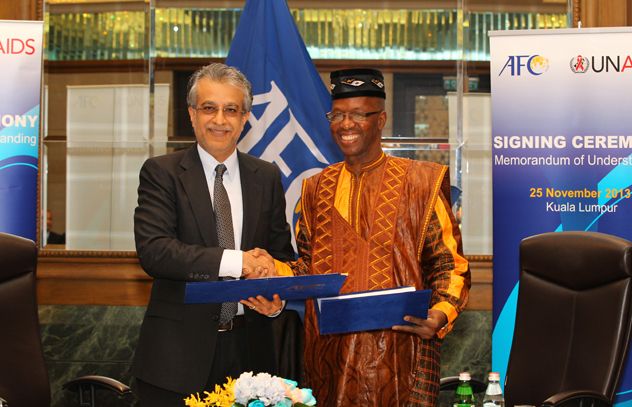
AFC President Shaikh Salman bin Ebrahim Al Khalifa (left) and Senior Adviser to the UNAIDS Executive Director Djibril Diallo signing the cooperation agreement. Credit: AFC
Feature Story
Asian Football Confederation and UNAIDS team-up to raise awareness of HIV
26 November 2013
26 November 2013 26 November 2013The Asian Football Confederation (AFC) and UNAIDS are teaming up with young people for the AIDS response. A new Memorandum of Understanding was signed on 25 November. The agreement was signed on the sidelines of the AFC’s 2013 Annual Awards by AFC President Shaikh Salman bin Ebrahim Al Khalifa and Senior Adviser to the UNAIDS Executive Director Djibril Diallo.
Through this cooperation agreement, UNAIDS and the AFC will carry out joint activities in selected competitions organized by the governing body of Asian football in support of the UNAIDS “Protect the Goal” campaign.The new initiative will enhance awareness of HIV, improve access to HIV prevention and treatment, and work to eliminate HIV-related stigma and discrimination during football games and associated events ahead of the 2014 FIFA World Cup in Brazil.
Quotes
"On the eve of World AIDS Day, we are keen to join forces with UNAIDS to reach out to millions of young people in Asia with high-impact HIV protection messages."
"Through the sport of football, we can reach millions of people with a simple message demonstrating the importance of HIV protection and the value added of team work in the global AIDS response"
Related


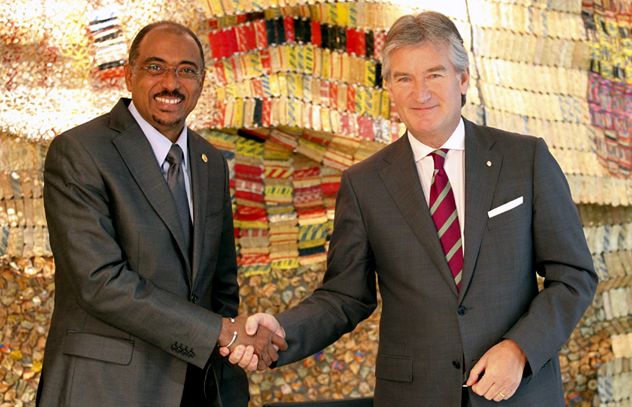
The Memorandum of Understanding was signed at a ceremony on the 21 November at UNAIDS headquarters in Geneva.
Feature Story
Hotel InterContinental Genève and UNAIDS join forces
21 November 2013
21 November 2013 21 November 2013UNAIDS and the hotel InterContinental Genève are entering into a new partnership. The collaboration comes as the landmark Geneva hotel will celebrate its 50th anniversary.
The Memorandum of Understanding was signed at a ceremony on the 21 November at UNAIDS headquarters in Geneva. During the ceremony, UNAIDS Executive Director, Michel Sidibé discussed the importance of the active involvement of the private sector in the response to HIV with the General Manager of the hotel InterContinental Genève, Jürgen Baumhoff.
The public-private partnership will focus on a number of issues including ensuring children are born free from HIV and that their mothers can continue with antiretroviral therapy. Another important aspect is ensuring children living with HIV have timely access to life-saving treatment.
One of the first initiatives of the joint partnership will be the launch of a campaign to raise awareness and funds for an AIDS-free generation. The campaign will be launched on 16 December 2013.
Quotes
The InterContinental Genève is celebrating 50 years starting in January 2014, and as part of our commitment to the UN and World Community, we are delighted to contribute to making a difference to tackling the global societal challenge in support of the elimination of new HIV infections among children, which is one of the key areas of work of the UN community in this city. We are excited to start working with UNAIDS and are determined to galvanize further support for this important cause.
UNAIDS is delighted to embark on this new partnership. We’re honoured to be celebrating the 50 year anniversary of the InterContinental Genève together and by combining our efforts we will accelerate progress in achieving an AIDS free generation.



Many of the 57,000 runners taking part in the marathon and ‘fun-walk’ events, wore Get to Zero HIV t-shirts and hats, and carried banners promoting the theme.
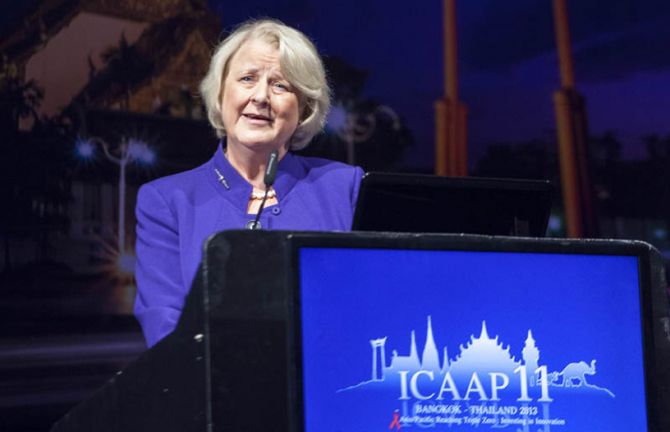
Addressing delegates at the opening ceremony, UNAIDS Deputy Executive Director Jan Beagle called for greater innovation and focus in region’s response to HIV.
Feature Story
ICAAP11 highlights need for innovation, investment and focus in Asia and the Pacific
21 November 2013
21 November 2013 21 November 2013Nearly 4000 delegates from more than 80 countries gathered in Bangkok, Thailand, this week, for the 11th International Congress on AIDS in Asia and the Pacific (ICAAP11). The Congress opened officially on 19 November. Building on UNAIDS vision of zero new HIV infections, zero discrimination and zero AIDS-related deaths, the theme for this year’s ICAAP is Triple Zero – Investing in Innovation.
Opening the Congress on behalf of the Prime Minister of Thailand, Yingluck Shinawatra, Thailand’s Minister of Health, Dr Pradit Sintavanarong underlined the opportunities presented by the four-day event to drive progress towards the end of the AIDS epidemic in the region.
“We can only achieve this by integrating the preventive effects of antiretroviral therapy, focusing our efforts both geographically and demographically, and by normalizing HIV among the general population and, importantly, among key populations,” he said.
“Action now will pay off in the future,” he added, emphasizing the need for effective investments in areas where they will have most impact.
Addressing delegates at the opening ceremony, UNAIDS Deputy Executive Director Jan Beagle called for greater innovation and focus in region’s response to HIV. “The annual number of new infections has remained largely unchanged over the past five years, and emerging epidemics are evident in a number of countries in the region,” said Ms Beagle.
Ms Beagle spoke about the important linkages between HIV and other development goals. “Experience has shown that AIDS is an entry point to advance broader issues of human rights, redistribution of opportunity and social justice for all. The AIDS response is a pathfinder for transformative development,” said Ms Beagle.
The opening ceremony of the conference saw representatives from the communities of people living with HIV, sex workers, transgender people, people who inject drugs and men who have sex with men voice their hopes and expectations for the congress through performance art. “Through the performance we wanted to send the message that we are trying to put faces to the epidemic. We are the people behind the data, and this is where the focus should be,” said Mehrdad Pourzaki who works with Youth LEAD, the regional network for young key populations at higher risk.
Fragile gains in Asia and the Pacific
On the opening day of the Congress, UNAIDS launched the 2013 HIV in Asia and the Pacific report. The report shows that while important gains have been made in the region’s response, the pace of progress is too slow and significant challenges remain.
According to the report, an estimated 4.9 million [3.7–6.3 million] people were living with HIV in Asia and the Pacific in 2012. Regionally, numbers of new HIV infections have fallen by 26% since 2001, with a number of countries reducing infections by over 50% in that time. However, the overall number of new HIV infections across the region has remained largely unchanged in the past five years.
The number of people accessing antiretroviral treatment in the region rose to 1.25 million people by the end of 2012. But the rate of increase in access to treatment has slowed in recent years.
Get to Zero HIV: Run for a reason
Echoing the messages and themes from ICAAP11, several key events took place during the days leading up to the conference. For the Bangkok Marathon, Thailand’s largest sporting event, official sponsor Standard Chartered Bank Thailand teamed up with UNAIDS Asia and the Pacific to promote HIV awareness under the theme Run for a Reason: Get to Zero HIV. Many of the 57,000 runners taking part in the marathon and ‘fun-walk’ events, wore Get to Zero HIV t-shirts and hats, and carried banners promoting the theme. UNAIDS Deputy-Executive Director Jan Beagle officially started a number of the race events accompanied by CEO and President of Standard Chartered Thailand Bank Ms Lyn Kok and dignitaries from the National Jogging Association of Thailand.
Publications
Publications

Lyn Kok, President and CEO of Standard Charter Bank (Thailand); Annmaree O’Keeffe from Lowy Institute; and Hon Justice Michael Kirby, Chair of the UN Commission of Inquiry on North Korea and Commissioner UNAIDS-Lancet Commission.
Feature Story
UNAIDS-Lancet Commission Asia-Pacific dialogue calls for renewed leadership
21 November 2013
21 November 2013 21 November 2013The second in a series of regional dialogues organized by the UNAIDS and Lancet Commission: Defeating AIDS - Advancing global health was held on 19 November in Bangkok. The need for a new approach to leadership on AIDS in the post-2015 era was the main message emerging from the dialogue.
The aim of the dialogue, which took place during the 11th International Congress on AIDS in Asia and the Pacific, was to gather regional perspectives on AIDS in the post-2015 agenda for inclusion in the work of the Commission.
Participants
UNAIDS Deputy Executive Director, Jan Beagle; James Chau, National UNAIDS Goodwill Ambassador for China; Hon Justice Michael Kirby, Chair of the UN Commission of Inquiry on North Korea and Commissioner UNAIDS-Lancet Commission; Dr Prasada Rao, United Nations Secretary-General’s Special Envoy for AIDS in Asia and the Pacific; Lyn Kok, President and CEO of Standard Charter Bank (Thailand) as well as parliamentarians, activists, people living with HIV, young people, corporate leaders, academia, and representatives of the UN system and other international organizations.
Key messages
- The need for a new approach to leadership on AIDS in the post-2015 era
- The importance of mobilizing broader partnerships, including with the private sector, to build on the momentum of the AIDS response.
- The need to build on lessons learnt in the response to HIV to strengthen the broader sustainable development agenda.
- Dignity, social justice and equity––essential to the post-2015 framework.
Outcomes
The outcomes of these dialogues will help inform the recommendations of the UNAIDS and Lancet Commission to be presented in 2014.
Additional regional, think tank and civil society dialogues are planned over the coming weeks: Civil society organizations in Eastern and Southern Africa (25 November); Europe (27 November), as part of the European Development Days; a think tank dialogue at the Institute of Global Governance, University College London (2 December); Caribbean (4 December); Latin America (4 December); Africa (7 December) and Eastern Europe-Central Asia (13 December). The first regional dialogue was held in Addis Ababa on 3 November.
Quotes
"We are at a pivotal time in the AIDS response. The Asia-Pacific region in particular is at a critical juncture. The region is making important progress towards reaching global AIDS targets, but the pace of progress is too slow and significant challenges remain. Business as usual will mean that the region will not meet the targets."
"We are not at Zero and there is a lot of getting to do… but in getting to zero we need to get AIDS back in people’s imagination – whether it resonates in their imagination in terms of the right to health and dignity or as a global public good; we need more action and fewer words."
"As we move into 2015 and beyond, it is imperative that the private sector and international advocacy organizations embark on a joint journey, playing to their unique skills, to keep AIDS on top of people’s mind. As not addressing the health impact, discrimination and stigma that exists will ultimately affect the productivity and economic strength of businesses and countries. Joining the call to 'Defeat AIDS and advance global health' is the responsible thing for businesses to do for their employees and society at large."
"The AIDS response has provided me an excellent platform to discuss transgender issues and has opened doors to a range of decision makers to address our issues. We need a strong AIDS response to continue to serve this function in the post-2015 period."
Press Release
Ahead of World AIDS Day 2013 UNAIDS reports sustained progress in the AIDS response
20 November 2013 20 November 2013Renewed commitment needed in Eastern Europe and Central Asia, the Middle East and North Africa and for key populations.
GENEVA, 20 November 2013—Accelerated progress has been reported in most parts of the world. However, there are worrying signs that some regions and countries are not on track to meet global targets and commitments on HIV.
The Joint United Nations Programme on HIV/AIDS (UNAIDS) reports that new HIV infections have been on the rise in Eastern Europe and Central Asia by 13% since 2006. The Middle East and North Africa has seen a doubling of new HIV infections since 2001.
In many cases stalled progress is due to inadequate access to essential HIV services. Key populations including men who have sex with men, people who use drugs, transgender people and sex workers are often blocked from accessing life-saving services.
“Every person counts,” said Michel Sidibé, Executive Director of UNAIDS. “If we are going to keep our pledge of leaving no one behind—we have to make sure HIV services reach everyone in need.”
Investments focused on reaching key populations have not kept pace. Funding for HIV prevention services for men who have sex with men is especially limited in East Asia, the Middle East and North Africa, and across sub-Saharan Africa. Investments lag in a number of countries where HIV prevalence among people who inject drugs is high. Ten countries in which HIV prevalence among people who inject drugs exceeds 10%, allocate less than 5% of HIV spending to harm reduction programmes. Notwithstanding sex workers’ disproportionate risk of acquiring HIV, prevention programmes for sex workers account for a meagre share of HIV prevention funding globally.
While much work needs to be done in Eastern Europe, for the first time in 2012, Ukraine has reported a decline in the number of newly identified HIV cases, representing a new turning point for the country. There are an estimated 200 000 people living with HIV in Ukraine. At 21.5%, HIV prevalence is highest among people who inject drugs.
However, by working together, the Ukrainian government and civil society organizations are striving to provide essential HIV services to support key populations, using evidence to guide investments and programmes. In 2011, Ukraine also amended its AIDS law which now guarantees harm reduction services for people who inject drugs, confidentiality of HIV status for people living with HIV and removal of HIV-related travel restrictions.
More attention needed for children and adults aged 50 and over
In priority countries, only three in 10 children receive HIV treatment under 2010 WHO treatment guidelines. Children living with HIV continue to experience persistent treatment gaps. In 2012, 647 000 children under 15 years of age were receiving antiretroviral treatment. HIV treatment coverage for children (34% (31-39%)) remained half of coverage for adults 64% (61-69%)) in 2012 under the old guidelines.
“We have seen tremendous political commitment and results to reduce mother-to-child transmission of HIV—but we are failing the children who become infected,” added Mr Sidibé. “We urgently need better diagnostic tools and child-friendly medicines—irrespective of the market size.”
Although the number of children receiving antiretroviral therapy in 2012 increased by 14% in comparison to 2011, the pace of scale-up was substantially slower than for adults (a 21% increase). The failure to expand access in many settings to early infant diagnosis is an important reason explaining why HIV treatment coverage remains much lower for children than for adults. In three priority countries, Chad, Democratic Republic of the Congo and Malawi, coverage of less than 5% was reported for early infant diagnostic services in 2012.
An increasingly significant trend in the global HIV epidemic is the growing number of people aged 50 years and older, who are living with HIV. Worldwide, an estimated 3.6 [3.2–3.9] million people aged 50 years and older are living with HIV. This “aging” of the HIV epidemic is mainly due to three factors: the success of antiretroviral therapy in prolonging the lives of people living with HIV; decreasing HIV incidence among younger adults shifting the disease burden to older ages; and the often-unmeasured, and thus often overlooked, fact that people aged 50 years and older exhibit many of the risk behaviours also found among younger people.
Global AIDS data
New HIV infections among adults and children were estimated at 2.3 million in 2012, a 33% reduction since 2001. New HIV infections among children have been reduced to 260 000 in 2012, a reduction of 52% since 2001. AIDS-related deaths have also dropped by 30% since the peak in 2005 as access to antiretroviral treatment expands.
By the end of 2012, some 9.7 million people in low- and middle-income countries were accessing antiretroviral therapy, an increase of nearly 20% in just one year. In 2011, UN Member States agreed to a 2015 target of reaching 15 million people with HIV treatment. However, as countries scaled up their treatment coverage and as new evidence emerged showing the HIV prevention benefits of antiretroviral therapy, the World Health Organization set new HIV treatment guidelines, expanding the total number of people estimated to be in need of treatment by more than 10 million.
Significant results have also been achieved towards meeting the needs of tuberculosis (TB) patients living with HIV, as TB-related deaths among people living with HIV have declined by 36% since 2004.
Despite a flattening in donor funding for HIV, which has remained around the same as 2008 levels, domestic spending on HIV has increased, accounting for 53% of global HIV resources in 2012. The total global resources available for HIV in 2012 was estimated at US$ 18.9 billion, US$ 3-5 billion short of the US$ 22-24 billion estimated to be needed annually by 2015.
|
In 2012, an estimated: 35.3 million [32.2 million – 38.8 million] people globally were living with HIV 2.3 million [1.9 million – 2.7 million] people became newly infected with HIV 1.6 million [1.4 million – 1.9 million] people died from AIDS-related illnesses |