Feature Story
Niger’s First Lady commits to stopping new HIV infections in children
28 March 2013
28 March 2013 28 March 2013
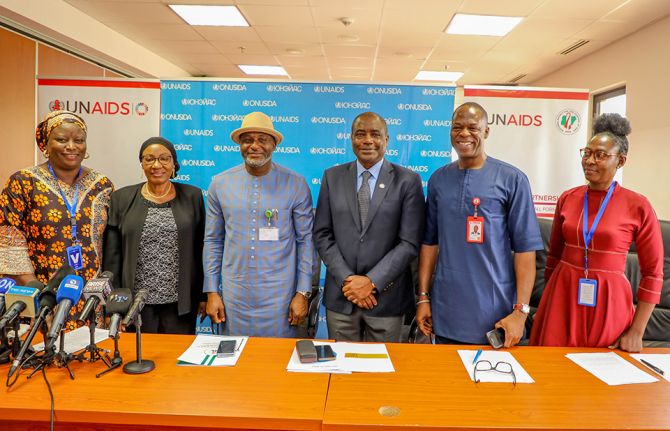
First Lady of Niger Aïssata Issoufou Mahamadou (next to UNAIDS Executive Director Michel Sidibé) launching her foundation to promote development through health, education and poverty reduction. Niamey, Niger, 28 March 2013.
Credit: UNAIDS/D.D.Abdoulaye
The First Lady of Niger, Aïssata Issoufou Mahamadou, promised to use her influence to greatly expand prevention of mother to child transmission (PMTCT) services in her country. She made her commitment during the official launch of her foundation, “Guri, for a better life,” on 28 March in Niamey, Niger. UNAIDS Executive Director Michel Sidibé was among the leaders and eminent personalities who participated in the inauguration.
Niger has made progress in its HIV response. Between 2001 and 2011, the rate of new HIV infections was reduced by almost 30%. Niger estimates that there were a little over 6000 new HIV infections in 2011. However, the country is struggling to improve its HIV services. In 2011 less than 40% of people living with HIV in need of antiretroviral drugs had access. Only 30% of pregnant women living with HIV had access to treatment to prevent transmission of HIV to their children.
In her speech during the inauguration, the First Lady said, “Guri, for a better life is the fruit of a big dream to see Niger become a haven of peace and joy for women and children.”
The First Lady’s foundation is dedicated to promoting development in Niger through health, education and poverty reduction. The country is struggling with the world’s highest fertility rate with 7.6 children born per woman in 2012. Malnutrition contributes to more than half of all deaths of children under five.
Currently in Niger, 99% of funding for HIV programming is dependent on foreign sources. Mr Sidibé urged the government to increase the share of domestic funding on the AIDS response and applauded efforts that had already been made. In Niger in 2011, the budget for HIV programming was US$ 14 million in 2010, an increase of 7.4% compared to the previous year. PMTCT represented only 2.6% of the total government budget, but rose to 16.9% in 2011.
Mr Sidibé said, “Niger has made incredible progress in reversing the AIDS epidemic and expanding coverage of HIV services for pregnant women living with HIV.”

UNAIDS Executive Director met with President of Niger, Mahamadou Issoufou and urged him to support the production of ARVs in Africa.
Credit: UNAIDS/D.D.Abdoulaye
The UNAIDS Executive Director met with President of Niger, Mahamadou Issoufou and urged him to support the production of ARVs in Africa. Like most other countries in Africa, Niger relies on imports for its ARVs. Currently African countries import 80% of ARVs, primarily from India.
Mr Sidibé said, “I am counting on your leadership to position Africa in the post 2015 agenda with a strategic vision and to promote the local production of ARVs in Africa.”
The President said, “I am convinced like you that the production of medicine locally is essential.”
The inauguration took place with the First Ladies of Swaziland, Nigeria and Chad who are all members of the Organization of African First Ladies against HIV/AIDS (OAFLA). The First Ladies are committed to using their influence to improve the lives of vulnerable families through advocacy, and mobilization of resources.

Feature Story
UNAIDS Executive Director calls on Côte d'Ivoire to redouble HIV response efforts
27 March 2013
27 March 2013 27 March 2013
UNAIDS Executive Director, Michel Sidibé and Côte d’Ivoire Prime Minister Daniel Kablan Duncan (right). Credit: UNAIDS/Basil Zoma
UNAIDS Executive Director Michel Sidibé urged the Côte d'Ivoire government to intensify its efforts in the HIV response. Mr Sidibé wrapped up a two-day official visit to the country on 27 March.
Côte d'Ivoire estimates that there were 17 000 new HIV infections in 2011 and it estimates that 3.7% of the population were living with HIV that same year, which is the second highest HIV prevalence in West Africa. Less than 50% of people in need of antiretroviral (ARV) treatment are accessing it.
During a meeting with Prime Minister Daniel Kablan Duncan, Mr Sidibé pointed out that half of all women living with HIV in Côte d'Ivoire have no access to HIV treatment and stressed the need for the government to do more to stop new HIV infections in children.
Mr Sidibé congratulated the government for mobilizing US$ 8 million in additional funding for the HIV response through a tax on tobacco and air travel, but he said the country must still share more of the responsibility for funding its HIV programming. Currently, the country depends on external funding for 90% of its HIV response and has a funding gap of US$ 247 million.
Prime Minister Duncan said that President Alassane Ouattara’s strategy for making health a top national priority includes the main principles for conducting reform of the health sector. He said that his government has been implementing for nearly a year a policy of free health care for pregnant women and children under five years old and that the government intends to introduce universal health coverage this year.
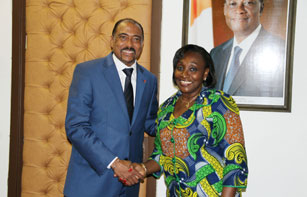
UNAIDS Executive Director Michel Sidibé and Minister of Health of Côte d’Ivoire Raymonde Goudou Coffie.
The Prime Minister acknowledged the need to ensure the availability of essential medicine. Currently 80% of ARVs are imported from outside of Africa, primarily from India. Prime Minister Duncan said that his country had started talks with India on the possibility of producing ARVs in Côte d'Ivoire.
Mr Sidibé also met with the Minister of Health Raymonde Goudou Coffie who said that government had increased 24% of its budget on health and was fully committed to restoring the country’s health system. In talks with the Minister of Justice Gnenema Coulibaly, Mr Sidibé raised his concerns regarding an increase in post-conflict sexual violence following a recent civil war in Côte d'Ivoire and advocated for advancing the implementation of a resolution on ending sexual violence.
Related
Feature Story
African leaders call for greater industrialization of an emerging Africa
26 March 2013
26 March 2013 26 March 2013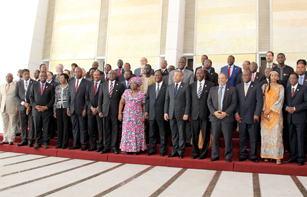
African ministers and other leaders at the opening of the Annual Meeting of the ECA Conference of African Ministers of Finance, Planning and Economic Development and AU Conference of Ministers of Economy and Finance in Abidjan, Cote d’Ivoire, 25 March 2013.
Credit: UNAIDS/Basil Zoma.
African Ministers of Finance and other leaders have agreed that the continent needs to shift from a reliance on exports of primary commodities to greater industrialization in order to accelerate the continent’s development. 800 ministers, experts and representatives of the United Nations met at the Annual Meeting of the Economic Commission for Africa (ECA) Conference of African Ministers of Finance, Planning and Economic Development and Africa Union (AU) Conference of Ministers of Economy and Finance. The conference on ”Industrialization for an Emerging Africa.” opened in Abidjan, Cote d’Ivoire on 25 March.
The President of Côte d’Ivoire, Alassane Ouattara, who chaired the opening ceremony, said that "political stability, the stability of the macroeconomic framework and infrastructure quality are necessary for the industrialization of African countries." He also noted that his country has chosen to industrialize and diversify its economy.
Africa has experienced remarkable growth in recent years. Conference speakers pointed to the continent’s growth rate of 5% in 2012 compared to 2% for the global economy.
The Chairperson of the African Union Commission Nkosazana Dlamini Zuma said, “Industrialization is not a luxury for the region but a necessity,” and pointed out that “in spite of significant progress in some areas, challenges and opportunities remain.”
Some of the challenges include a number of non-tariff barriers to trade. The Executive Secretary of the United Nations ECA, Carlos Lopes also pointed to “the chronic instability that characterizes the African continent in contrast to Asia.” He said, “There is no doubt that Africa requires structural transformation and not structural adjustment. Industrialization is absolutely indispensable to this objective.”
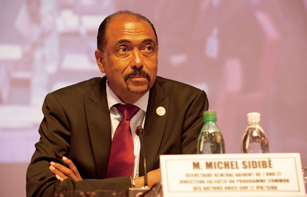
UNAIDS Executive Director, Michel Sidibé participating at the Annual Meeting of the ECA Conference of African Ministers of Finance, Planning and Economic Development and AU Conference of Ministers of Economy and Finance in Abidjan, Cote d’Ivoire, 25 March 2013.
Credit: UNAIDS/Basil Zoma.
UNAIDS Executive Director, Michel Sidibé participated in the conference and he stressed that Africa has a unique opportunity to develop its pharmaceutical industry. Currently Africa is highly dependent on foreign medicines, importing 70% of its drugs. Mr Sidibé said, “Africa must change its approach, its paradigm and production strategy.”
Africa imports 80% of antiretroviral medicines. This heavy reliance on external markets represents a serious health risk to Africa, as evidence suggests that many leading Asian pharmaceutical companies are shifting their focus to the more lucrative markets of the West to be replaced by companies who may not have the same quality credentials. Local production can result in many benefits including: greater product quality assurance, shorter supply chains and fewer stock-outs and the production of drugs for diseases that affect Africa that the rest of the world does not supply.
Mr Sidibé said that to encourage the development of a pharmaceutical industry in Africa the next step was to equip public and private stakeholders with key strategic information to attract funding. A new partnership among the African Union Commission, UNAIDS and other partners is seeking to redress this gap in strategic information through the establishment of the Pharmaceutical Market Data Initiative.
The annual meeting continues until 26 March.

Feature Story
High-level delegation commits to tackle the deadly epidemics of TB and HIV in Southern Africa
22 March 2013
22 March 2013 22 March 2013
L to R: UNAIDS Executive Director, Michel Sidibé and Dr Barnabas Sibusiso Dlamini, Prime Minister of Swaziland.
Credit: UNAIDS/J.Matas
Despite being one of the smallest countries in Africa, Swaziland has the highest percentage of people living with HIV anywhere in the world. More than a quarter of its adult population are living with the virus. Yet the people of Swaziland are facing not just one, but two deadly epidemics which intertwined are wreaking havoc throughout not only Swaziland but the whole of the sub-Saharan African region. Those epidemics are tuberculosis (TB) and HIV.
More than three-quarters of people who have TB in Swaziland are also living with HIV and an estimated 16 000 Swazis develop life-threatening, active TB disease every year. The combination of the two epidemics has made TB the leading cause of death in people living with HIV as the TB bacteria accelerates the progression of HIV infection to AIDS, weakening the body’s immune system until it can no longer fight disease.
But Swaziland is also determined to stop the epidemics in their tracks.
This week Swaziland played host to a powerful delegation of health leaders and experts committed to ending the dual epidemics of TB and HIV across the region. Convened by the Ministers of Health of both Swaziland and South Africa, supported by the Stop TB Partnership the meeting brought together brilliant minds and solid expertise to find ways of accelerating action to end the TB and TB/HIV co-epidemics in the countries of the Southern Africa Development Community (SADC).
“This is our last chance to put Africa back on track to achieve TB and HIV related targets,” said Dr Sibusiso Dlamini, Prime Minister of Swaziland stressing that progress towards the goal of reducing TB deaths in people living with HIV by 50% by 2015, set in the 2011 United Nations General Assembly Political Declaration on HIV and AIDS, was not moving fast enough.
Recognizing the importance of the challenge, Aaron Motsoaledi, Minister of Health of South Africa spurred participants to action, “You don’t set out to climb Everest expecting to fail,” he said. “We must set out expecting to succeed, no matter the size of the challenge ahead. Olympic athletes often come from far behind to win the race, we can do the same.”
The Everest he was referring to was the strong declaration of commitment which came out of the meeting––the ‘Swaziland Statement’. The statement highlights the determination of each of the partners to significantly cut TB/HIV related deaths over the next 1000 days and reach the 2015 goals.
“We need to lift up our expectations and raise our financial and technical contributions to realise the commitments we made to reduce the impacts of TB,” said Dr Lucica Dittu, Executive Secretary of the Stop TB Partnership.
Important commitments outlined in the statement include the full integration of TB and HIV services, new partnerships with non-traditional partners, a reinforcement of programmes and services and new and innovative methods of financing the response to the two diseases.
“A thousand people living with HIV die every day of TB on the African continent, this is unacceptable,” said UNAIDS Executive Director Michel Sidibé. “This initiative brings momentum, commitment and renewed energy which will produce results and improve the lives of millions of people across the region.”
UNAIDS pledged to continue working closely with its partners including the Stop TB Partnership and the Global Fund to Fight AIDS, Tuberculosis and Malaria to ensure that everyone living with both HIV and active TB is able to start HIV treatment; that everyone in TB care is offered an HIV test; and that everyone in HIV care is offered screening for TB.
statement
Related information
Feature Story
Swaziland launches a new national framework to eliminate new HIV infections among children by 2015
22 March 2013
22 March 2013 22 March 2013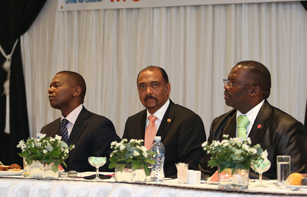
L to R: Dr Simon Zwane, Director of Health Services of Swaziland, Michel Sidibé, UNAIDS Executive Director, Benedict Xaba, Minister of Health Swaziland. Credit: UNAIDS/J.Matas
UNAIDS Executive Director Michel Sidibé joined Swaziland’s Minster of Health, Benedict Xaba to launch a new National Framework to stop new HIV infections among children by 2015 and keep their mothers alive.
Swaziland has dramatically scaled up services to prevent new HIV infections among children in the country reaching more than 90% coverage in 2012.
"The framework will allow us to continue strengthening national programmes to realize our goal of eliminating new HIV infections among children,” said Mr Xaba. “An HIV-free generation is doable in Swaziland,” he added.
The Framework—developed with technical support from UNAIDS, UNICEF, UNFPA and WHO— is divided into four programme areas including HIV prevention, integration of family planning services, improvement of labour and delivery care, and provision of comprehensive antiretroviral treatment.
Health centers providing services to prevent new HIV infections among children expanded from only three in 2003 to more than 150 in 2010. The percentage of pregnant women living with HIV receiving antiretroviral treatment (ART) rose from 57% in 2009 to 86% in 2011, according to government data.
“Our science and political will have reached a point where countries no longer allow children to be born with HIV in Africa,” said UNAIDS Executive Director Michel Sidibé. “With the launch of this new, bold framework, I am confident that Swaziland will reach an AIDS free Generation by 2015.”
The new Swaziland Framework also identifies crucial socio-cultural and economic factors that increase the vulnerability of women to HIV. It proposes scaling-up of various activities, including the increase of male involvement; integration of HIV testing with antenatal care; improving the quality of services provided to HIV positive women and their exposed infants; and social and behaviour change communication to create a supportive community environment.
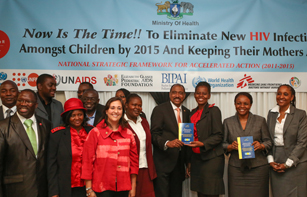
Launch of the new National Framework to stop new HIV infections among children by 2015 and keep their mothers alive. Ezulwini, Swaziland. 22 March 2013. Credit: UNAIDS/J.Matas
“Today is a day for both celebration and commitment,” said Ambassador Makila James, United States Ambassador to Swaziland. “We should celebrate the effort that went into developing this strategic document, but we must also commit ourselves to fully implementing the critical, life-saving interventions of the framework.”
Despite encouraging progress, 67% of maternal deaths in Swaziland are still attributed to HIV—the leading contributor of maternal and child mortality in the country. The country also has one of the highest levels of HIV among pregnant women.
Swaziland is one of the 22 priority countries highlighted in the Global Plan towards the elimination of new HIV infection among children by 2015 and keeping their mothers alive that was launched in June 2011. The Global Plan calls for urgent strategic and programmatic scale-up to achieve the target of reducing the rate of mother-to-child transmission of HIV to less than 2% by 2015.
Press Statement
UNAIDS welcomes UK’s strong commitment to development aid
21 March 2013 21 March 2013In 2013 UK will meet its target to spend 0.7% of its national income on international development
GENEVA, 21 March 2013—The Joint United Nations Programme on HIV/AIDS (UNAIDS) welcomes the announcement made by the Rt Hon George Osborne, MP, Chancellor of the Exchequer, that the United Kingdom will meet its target of spending 0.7% of gross domestic product on international development this year.
“The UK is once again demonstrating its steadfast leadership,” said Michel Sidibé, Executive Director of UNAIDS. “Even in times of global economic difficulty it shows they have the interests of the world’s poorest and most vulnerable people at the forefront and UNAIDS looks forward to continuing our close collaboration.”
The UK is an integral partner in the response to HIV and has made the UNAIDS vision of getting to zero a priority. The UK has shown particular commitment to focused investments in Africa to reduce new HIV infections, stop HIV infections in children, address TB––the leading cause of death among people living with HIV, strengthen human rights, tackle stigma and invest in scientific research.
The UK will be the first member of the G8 to meet the target of 0.7% of gross domestic product which was pledged by United Nations Member States more than 40 years ago in a 1970 UN General Assembly Resolution. This makes the UK the sixth country to meet or exceed the 0.7% target joining only Denmark, Luxembourg, the Netherlands, Norway and Sweden.
The Prime Minister of the UK, David Cameron, serves as co-chair to the United Nations Secretary-General’s high-level panel of eminent persons on the post-2015 development agenda.
Press centre
Download the printable version (PDF)
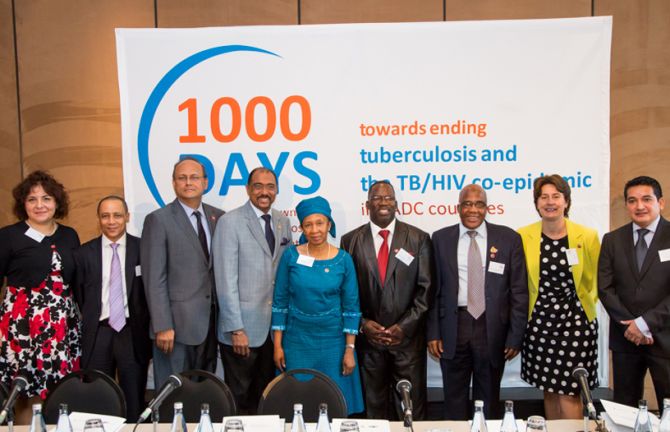
L to R: Dr Lucica Ditiu, Executive Secretary of Stop TB Partnership; Mike Teke, Vice President, Chamber of Mines South Africa; Dr Asad Alam, World Bank Country Director for South Africa, Lesotho, Bostwana, Swaziland and Namibia; Michel Sidibé, UNAIDS Executive Director; Dr Mphu Ramatlapeng, Vice Chair of Board, Global Fund to Fight TB, HIV and Malaria; Benedict Xaba, Minister of Health of Kingdom of Swaziland; Arnold Motsoaledi, Minister of Health of South Africa; Sarah Dunn, Head of Southern Africa, UK Department for International Development (DfID); Dr Erick Ventura, Chief of Mission – South Africa, International Organisation of Migration.
Credit: StopTBPartnership/M. Turner
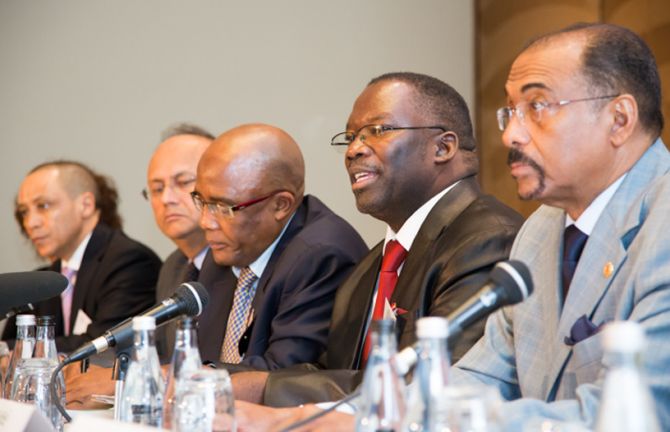
The Minister of Health of Swaziland Benedict Xaba speaking at the press conference that unveiled a new initiative to accelerate progress against tuberculosis and HIV. Johannesburg, South Africa on 20 March 2013.
Credit: StopTBPartnership/M. Turner
Feature Story
UNAIDS and other health organizations support new TB and HIV initiative in Africa
20 March 2013
20 March 2013 20 March 2013UNAIDS Executive Director Michel Sidibé joined health leaders from Africa and other international organizations to support a new push to accelerate progress against tuberculosis and HIV. The initiative was unveiled at a press briefing in Johannesburg, South Africa on 20 March and will be formerly launched on 21 March in Mbabane, Swaziland.
The initiative includes a package of new investments worth more than US $120 million which will be used to expedite progress against TB and HIV in the next 1000 days. The initiatvie will work with South African Development Community (SADC) countries to achieve the international targets of cutting deaths from TB and HIV-associated TB by half by 2015.
Mr Sidibé and other health leaders will sign the Swaziland Statement in Mbabane at tomorrow’s formal launch of the initiative.
Quotes
TB and HIV have combined together in the SADC region in a perfect storm and what we need to mobilize is an emergency response to this storm.
We must prioritise action in the hot spots, and one of the hottest of these is TB in the mining industry. The new partnerships that we are witnessing today between government, the corporate sector and global agencies can and must drive our renewed effort in the next 1000 days.
We have the power to stop TB and HIV in their tracks. We must adopt Zero tolerance for parallel systems for TB and HIV. If we don’t close the funding gap and focus on HIV and TB hotspots, sub-Saharan Africa could face a worsening disaster of HIV and drug resistant TB.
We have 1000 days to achieve the international targets of 50% reductions in TB mortality and TB/HIV deaths by 2015. Together, we are building momentum towards ending the TB and TB/HIV co-epidemic in SADC.
Press release
Reletad information
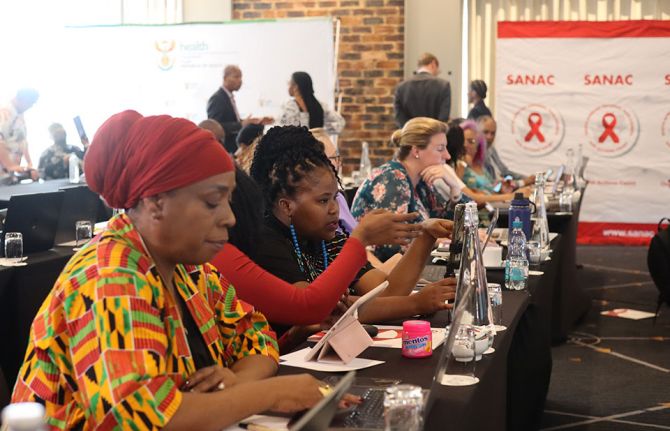
The first global forum of francophone women took place in Paris on 20 March 2013.
Feature Story
First global forum of francophone women promotes women’s rights
20 March 2013
20 March 2013 20 March 2013More than 400 women dedicated to guarantee the respect of the fundamental rights of women, their access to school and education, gender equality or the representation of women in politics gathered in Paris on 20 March for the first global forum of francophone women.
The forum was an opportunity to share experiences and find ways to promote the rights of women and to ensure gender equality in the francophone countries. Participants developed an action plan which will be submitted to the President of the Republic of France and Secretary General of the Francophonie.
During the meeting, UNAIDS presented a new report entitled 5 actions for women and HIV in La Francophonie, which outlines 5 actions to meet the challenges that women and girls face and support them as partners in the response to AIDS.
Quotes
We cannot accept and we will not accept anything that limits women's access to health and education. We cannot accept and we will not accept that women can be victims of sexual violence. Freedom, equality and the dignity of women are a universal cause.
There are several reasons why women and girls are vulnerable to AIDS, including gender inequality, violence and the violation of their sexual and reproductive rights. Societies can change through the empowerment of women and girls in social, economic and political spheres and by involving them as partners and leaders in the AIDS response. The measures proposed in this report contribute to the health and better future of women and girls in the francophone world. Let’s make it a reality.
Men and women are addressing these challenges with a common interest. Through an equitable and effective participation, women from Member States of the International Organization of the Francophonie can use their own skills and resources to achieve the common goals of zero new HIV infections, zero discrimination and zero AIDS-related deaths.
Publications
Feature Story
Massive development gains in the South is improving the economic, social and health prospects for millions, says Human Development Report
14 March 2013
14 March 2013 14 March 2013
The countries of the South are shifting the global power balance with massive strides in economic growth, poverty reduction, education and health.
The world is changing rapidly with developing nations spearheading global economic growth, impressive poverty reduction and the rise of a healthier, better educated middle class, says the UN Development Programme’s (UNDP) Human Development Report 2013.
According to the publication, The Rise of the South: Human Progress in a Diverse World, this rise is “unprecedented in its speed and scale. Never in history have the living conditions and prospects of so many people changed so dramatically and so fast.”
The momentum of such achievements in poverty reduction, education, income and tackling health issues like HIV, is increasing. It can be seen as an overdue “global rebalancing” with new actors “shaping the development landscape” and gaining in political and economic influence.
There has been notably rapid progress in more than 40 countries of the South—traditionally referred to as developing nations—whose advancement has been markedly better than expected, the report notes. Coming from all continents and ranging widely in size, they include: Bangladesh, Brazil, Chile, China, Ghana, India, Mexico, Rwanda, Uganda and Vietnam. Uganda, for example, through a series of economic, health, education and social measures, has managed to halve extreme poverty before the Millennium Development Goal deadline of 2015. It fell from 56% in 1992-93 to 25% in 2009-10.
The rise of the South is unprecedented in its speed and scale. Never in history have the living conditions and prospects of so many people changed so dramatically and so fast.
Human development report 2013
The report was launched in Mexico City on March 14 by the UNDP’s Administrator Helen Clark and Mexican President Enrique Peña Nieto. As well as an extensive analysis of original research, it also contains an updated Human Development Index which measures the progress of nations in terms of health, education and income. In addition, the publication contains data on the critical gender aspect of development in its Gender Inequality Index which shows that despite serious inequities persisting, there has been progress in equality almost everywhere.
As with general development, the pace of success in the AIDS response is quickening in an unprecedented way. The 2012 UNAIDS global report showed that the rate of infection across 25 low- and middle-income countries has been cut by half.
The accelerated development of the South is critical to the success of the global AIDS response as the most heavily burdened countries are low-and middle income. UNAIDS maintains that getting to zero new infections, zero discrimination and zero AIDS-related deaths will need advances not only in the sphere of health and HIV but in terms of poverty reduction, education, gender equality and enhanced life opportunities
Feature Story
Former UNAIDS Executive Director Dr Peter Piot wins prestigious Africa Health Prize
13 March 2013
13 March 2013 13 March 2013
Dr Peter Piot, Director of the London School of Hygiene and Tropical Medicine and former UNAIDS Executive Director.
Credit: UNAIDS
The Japanese Government announced on 13 March that it was awarding the Second Hideyo Noguchi Africa prize to Dr Peter Piot, Director of the London School of Hygiene and Tropical Medicine in London, U.K. and former UNAIDS Executive Director and Dr Alex Godwin Coutinho, Executive Director of the Infectious Disease Institute, Makerere University in Kampala, Uganda.
The prize honours medical researchers and practitioners with outstanding achievements in the fields of medical research and medical services in Africa. Dr Piot received the prize for his pivotal research on viruses and diseases endemic to much of the African continent, including HIV and Ebola. The prize honours Dr Hideyo Noguchi who is remembered for his efforts to discover a vaccine for yellow fever in Africa.
While we have collectively achieved many successes, infectious diseases are far from under control, particularly in sub-Saharan Africa. New pathogens will continue to emerge, and we must sustain local and global efforts for many years to come.
Dr Peter Piot, Director of the London School of Hygiene and Tropical Medicine and former UNAIDS Executive Director
The cabinet office of the Government of Japan said that the prize is a clear testimony to Japan’s efforts to be “at the forefront of global health issues with a particular focus on Africa. It is with great joy that we welcome these new laureates who embody the spirit of the Prize.”
Dr Piot was Executive Director of UNAIDS from its creation in 1995 until the end of 2008.Under his leadership the organization became the chief advocate for worldwide action against AIDS. The Government of Japan recognized Dr Piot’s role in bringing the AIDS epidemic to the forefront of global attention, raising international commitments to its funding and building scientifically grounded responses to its control and treatment.
“I am deeply honoured and grateful to have been considered for this award. Dr Noguchi holds a special place in the history of medical research and was in many ways a pioneer of what we now call global health,” said Dr Piot. “While we have collectively achieved many successes, infectious diseases are far from under control, particularly in sub-Saharan Africa. New pathogens will continue to emerge, and we must sustain local and global efforts for many years to come.”
Dr Coutinho received the award for his pioneering efforts in expanding access to live-saving treatment for people living with HIV. He is known as a compassionate clinician who treated thousands of HIV patients at a time when there was a lot of stigma and fear.
Japan has been a supporter of the global AIDS response and an important partner of UNAIDS. The Prime Minister of Japan, Shinzo Abe will formally award the Second Hideyo Noguchi Africa prize to Dr Piot and Dr Godwin on 1 June during the 5th Tokyo International Conference on African Development which will take place in Yokohama, Japan.