Feature Story
HIV high on the agenda at the fifty-sixth session of the Commission on Narcotic Drugs
12 March 2013
12 March 2013 12 March 2013
In wide-ranging opening remarks to the current session of the Commission on Narcotic Drugs in Vienna, the Executive Director of the UN Office on Drugs and Crime (UNODC) Yury Fedotov placed HIV and drug use at the heart of the global agenda.
“HIV transmission through injecting drug use continues to be one of the main unresolved challenges of the international community. Widespread stigma, discrimination and lack of access to evidence-informed HIV services are among the key challenges,” he said.
Addressing the gathering of more than 1 000 representatives of Member States and civil society, he suggested that despite “notable progress” in increasing access to HIV services for people who inject drugs, there is still a long way to go.
In an apparent nod to the post-2015 development agenda Mr Fedotov put the challenge of the epidemic within the context of a health and rights-based prism: “[H]uman rights and public health considerations must be at the core of the international response to drug use and HIV,” he maintained.
HIV transmission through injecting drug use continues to be one of the main unresolved challenges of the international community. Widespread stigma, discrimination and lack of access to evidence-informed HIV services are among the key challenges.
Executive Director of the UN Office on Drugs and Crime, Yury Fedotov
The global challenge to this pressing issue has been gaining momentum. Through the June 2011 United Nations General Assembly Political Declaration on HIV and AIDS, the world is committed to halving the number of drug users who acquire HIV by 2015.
According to UNAIDS, harm reduction strategies are key to prevent new HIV infections among people who use drugs. A comprehensive, evidence-informed package requires: needle and syringe programmes, opioid substitution therapy, HIV testing and counselling, antiretroviral therapy and condom programmes for people who use drugs and their sexual partners. It also entails prevention and treatment of sexually transmitted infections, tuberculosis and hepatitis as well as information, education and communication materials intended specifically for people who use drugs.
This stigmatized population bears a very heavy burden of the virus, which is often transmitted through the use of unsterilized needles. UNAIDS’ global report 2012 contains some sobering statistics. In 49 countries HIV prevalence among people who inject drugs is at least 22 times higher than among the population as a whole and in 11 countries their level of infection is more than 50 times higher.
A very large number of individuals are affected. According to the 2012 UNODC World Drug Report, an estimated 15 to 16 million people, in 151 countries, inject drugs. A 2008 global study showed that 3 million were living with HIV. In several countries—notably in Eastern Europe and Central Asia, one of two regions where the number of new infections is increasing—the AIDS epidemic is being driven by unsafe injecting drug use.
People who use drugs are much less likely to be reached by HIV-related services, such as testing. HIV-positive women who use drugs do not access programmes to prevent their children being born with the virus as often as other women. Surveys in capital cities reveal that drug users also report lower condom use than men who have sex with men or sex workers.
At the fifty-sixth session of the Commission on Narcotic, which is running from 11-15 March, drug use and HIV will be addressed through a number of channels, including a draft resolution calling for the intensification of efforts to reduce HIV to attain the targets of the 2011 Political Declaration on HIV and AIDS.
On Tuesday a side-event will explore the opportunities and challenges facing women who use drugs and how to make care and support services more gender-responsive. The meeting will be chaired by UNODC Director, Division for Operations and Global Coordinator for HIV/AIDS, Aldo Lale-Demoz. Michel Kazatchkine, the United Nations Secretary-General’s Special Envoy for AIDS in Eastern Europe and Central Asia, is scheduled to attend the event as a special guest.
The Commission on Narcotic Drugs is the United Nations central policy-making body mandated to deal with a broad range of drug-related issues.
External links
External links
Feature Story
Special event at the Commission on the Status of Women seeks to accelerate zero-tolerance towards gender-based violence through the AIDS response
12 March 2013
12 March 2013 12 March 2013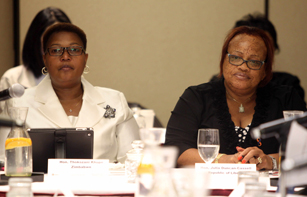
Co-chaires Hon Thokozani Khupe, Deputy Prime Minister of Zimbabwe (left) and Hon Julia Duncan-Cassell, Minister of Gender and Development of Liberia at the High Level Consultation Accelerating Zero-Tolerance to Gender based violence through the HIV response. New York City on March 9, 2013. Credit: UNAIDS/M. Taamallah
How much progress has the global AIDS response made in ensuring that women and girls live their lives free from violence? What are the next steps needed to strengthen the challenge to gender-based violence and its links to HIV? These critical questions dominated a high level consultation which took place in New York on 9 March during the 57th session of the Commission on the Status of Women (CSW).
Convened by UNAIDS and UN Women, and cosponsored by the Government of Ireland, the UN Development Programme and the UN Population Fund the consultation brought together key civil society activists, United Nations organizations and government representatives.
Co-chaired by Hon Thokozani Khupe, Deputy Prime Minister of Zimbabwe and Hon Julia Duncan-Cassell, Minister of Gender and Development of Liberia, the consultation took the priority theme of the CSW: elimination and prevention of all forms of violence against women and girls as a springboard to find ways to accelerate the attainment of Millennium Development Goals 3 (promoting gender equality) and 6 (halting HIV). Participants also discussed how to position HIV and gender-based violence on the post-2015 development agenda.
“The post-2015 agenda must be seen as finishing the last mile,” said Thokozani Khupe, Deputy Prime Minister of Zimbabwe. “We must see the things that are unfinished and try to tackle them differently,” she added.
The birth of a child is commonly the happiest day in a woman’s life. But in certain countries, the day a child is born from a mother with HIV, is the day when she dies or she starts to face discrimination
Jennifer Gatsi, Namibia Women’s Health Coalition
Gender based violence is a global epidemic, and it is the most brutal manifestation of gender inequality. According to UNAIDS, at least one in three women is beaten, coerced into sex or otherwise abused by an intimate partner in the course of her lifetime. In some countries, up to 45% of girls under the age of 15 report their first sexual experience as forced.
“Violence is not inevitable,” said Charlotte Watts from the London School of Hygiene and Tropical Medicine. “Even if figures are shocking, we should be inspired by them to work and address them.”
Tackling violence against women and girls is key if their vulnerability to the HIV is to be reduced. Women can be forced to have unwanted and unprotected sex and they can face violence if they reveal that they are living with HIV. Research in South Africa has shown that young women subjected to intimate partner violence are 12% more likely to become infected with HIV. Married women in India who experience both physical and sexual violence from their partners are three times more likely to be living with HIV than women not subjected to attacks at all. Cases of coerced sterilizations and abortions undertaken on women living with HIV without their informed consent are widespread and documented in many countries.
Representatives of civil society shared community perspectives of how HIV and gender-based violence are intimately linked. Jennifer Gatsi, from the Namibia Women’s Health Coalition, stressed the negative consequences suffered by women living with HIV.

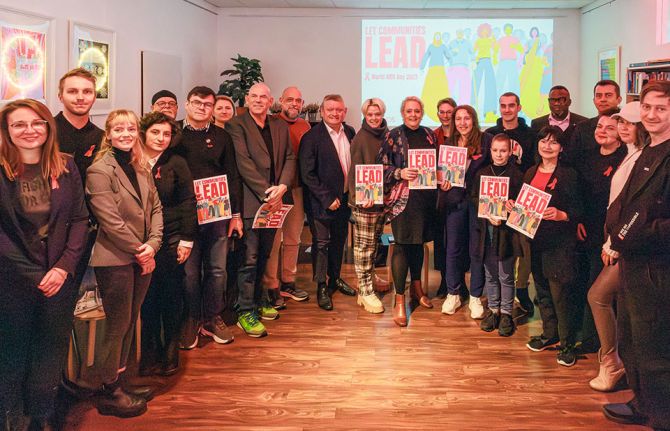
Group photo of the participants at the High Level Consultation Accelerating Zero-Tolerance to Gender based violence through the HIV response. New York City on March 9, 2013.
Credit: UNAIDS/M. Taamallah
“The birth of a child is commonly the happiest day in a woman’s life,” said Ms Gatsi. “But in certain countries, the day a child is born from a mother with HIV, is the day when she dies or she starts to face discrimination.”
The consultation discussed the fact that, despite the extent and consequences of gender- based violence and its role in fuelling the HIV epidemic, it too often goes unaddressed and unpunished. It was noted that nothing less than working for social transformation of gender relations, including economic and legal empowerment of women, can bring about the changes needed to help them to stay safe.
According to the UNAIDS Director, Rights, Gender and Community Mobilization, Mariangela Simao, making real strides against gender-based violence is a core goal for effective HIV responses, as reflected in the UNAIDS Strategy 2011-1015.
Lynn Collins, a UNFPA HIV advisor who moderated a panel at the event said, "We at UNFPA have welcomed this opportunity to bring together a range of voices, united in the call to end violence in all its heinous forms through education and other means of empowerment, legal reform and redress, and rights-based sexual and reproductive health and HIV services."
The Commission on the Status of Women, which meets annually, is one of the main global policy-making bodies committed to gender equality and the advancement of women. This year’s meeting is taking place from March 4-15.
External links
External links
Feature Story
Sierra Leone’s President says gender is a development issue on International Women’s Day
08 March 2013
08 March 2013 08 March 2013
UNAIDS Executive Director Michel Sidibé with the Minister of Health, Miatta Kargbo. Credit: UNAIDS
Sierra Leone’s President Ernest Bai Koroma stressed his commitment to increasing women’s participation in his government during an event on 8 March, celebrating International Women’s Day in Freetown, Sierra Leone. He said that the many appointments of women to high positions his government has sent “a clear message that discrimination against women no longer has a place in Sierra Leone.”
He said, “My government will enact legislation for a 30% quota for women’s participation in governance pretty soon. Gender is not just a social issue but also a development issue. And so we recognize the fact that men and women have to work side by side to achieve sustainable development.”
UNAIDS Executive Director, Michel Sidibé participated in the event which aimed to draw international attention to the active involvement of women in Sierra Leone’s socio-economic development through the President’s Agenda for Change. Dr Kandeh Yumkella, UNIDO Director General and Cherie Blair, head of the Cherie Blair Foundation for Women also attended the event.
Gender is not just a social issue but also a development issue. And so we recognize the fact that men and women have to work side by side to achieve sustainable development.
Sierra Leone’s President Ernest Bai Koroma
Mr Michel Sidibé praised the President for his remarkable leadership and said “Sierra Leone’s transformative agenda is geared towards the creation of social justice”. But he added, “if Sierra Leone wants a sustainable agenda, it must put women on the forefront of its reform agenda”.
During the Women’s Day celebrations, the government of Sierra Leone and the Global Fund to Fight AIDS, Tuberculosis and Malaria concluded a new funding agreement, providing US$ 55 million for HIV screening, prevention and treatment in Sierra Leone. The agreement was signed in Freetown by UNAIDS Executive Director Michel Sidibé on behalf of the Executive Director of the Global Fund, Dr Mark Dybul and the Minister of Health of Sierra Leone, Miatta Kargbo.

Sierra Leone’s President Ernest Bai Koroma stressed his commitment to increasing women’s participation in his government during an event on 8 March, celebrating International Women’s Day in Freetown, Sierra Leone.
Credit: UNAIDS
“President Ernest Bai Koroma is helping to transform the UNAIDS vision of Zero new HIV infections, Zero discrimination and Zero AIDS-related deaths into a reality for Sierra Leone,” said Mr Sidibé.
He urged the President to harness this same commitment to stopping gender-based violence—a risk factor for HIV among women in Sierra Leone and challenged the authorities to do everything possible to end practices like child and sexual trafficking.
A representative of the Woman Coalition on Health and HIV said “Women further seek increased and meaningful involvement of women especially women living with HIV in all spheres of the national response.”
In Sierra Leone, efforts to prevent new HIV infections among children have been strengthened and coverage and access of services for the prevention of mother to child transmission of HIV is now at 74%.
Credit: UNAIDS
Feature Story
UNAIDS Director for Eastern and Southern Africa appointed Ambassador for Girl Child Education Fund
08 March 2013
08 March 2013 08 March 2013The International Council of Nurses (ICN) and the Florence Nightingale International Foundation (FNIF) have appointed UNAIDS Director for Eastern and Southern Africa Dr Sheila Tlou as Ambassador for the ICN/FNIF Girl Child Education Fund. Her new role as GCEF Ambassador will include promoting the importance of educating girls and raising the profile of the GCEF as a spokesperson in international spheres of nursing, health, education, gender and development.
Founded in 2006, the ICN/FNIF Girl Child Education Fund (GCEF) supports the primary and secondary schooling of girls under the age of 18 in developing countries whose nurse parent or parents have died, paying for fees, uniforms, shoes and books. The GCEF is currently supporting 155 girls in four countries in sub-Saharan Africa: Kenya, Swaziland, Uganda and Zambia.
Quotes
I am delighted to be championing the GCEF and proud to be associated with the International Council of Nurses in this noble cause. Opening the doors to education for girls and women leads to better health for them and their communities, increased demand and realization of sexual and reproductive health and rights, reduced infant and maternal mortality, and increased economic and social development. It is above all the right thing to do.
Dr Tlou is an excellent choice for Ambassador to the Girl Child Education Fund, given her deep commitment to the promotion of gender equity, and her experience with the work of nurses in Southern Africa.
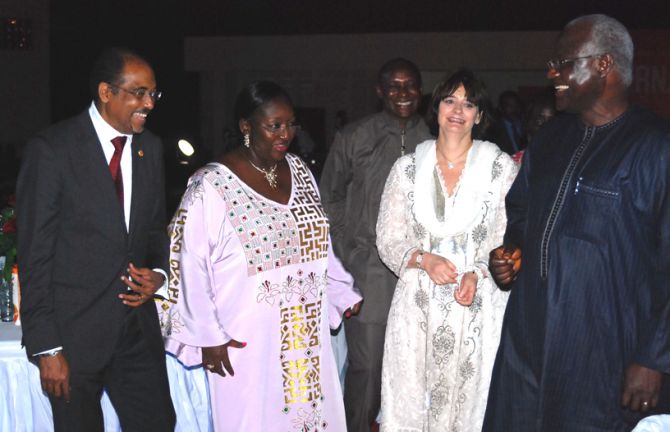
L to R: UNAIDS Executive Director, Michel Sidibé, the First Lady of Sierra Leone, Alice Sia Nyama Koroma, Cherie Blair, Head of Cherie Blair Foundation for Women and the President of Sierra Leone Ernest Bai Koroma. Credit: UNAIDS.
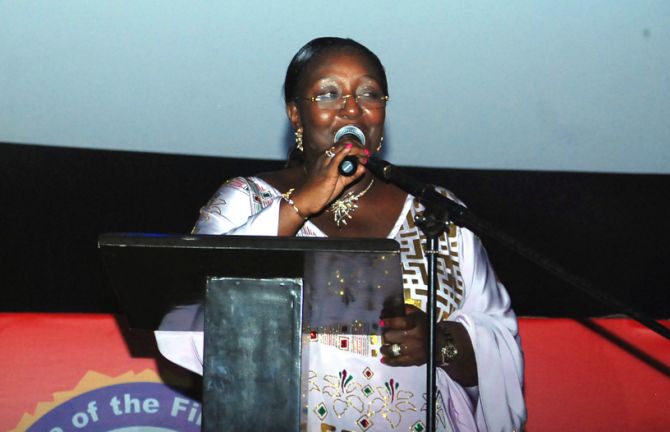
First Lady of Sierra Leone, Sia Nyama Koroma presenting her project “the Women’s Initiative for Safer Health” (WISH). Freetown, Sierra Leone. 07 March 2013. Credit: UNAIDS
Feature Story
The First Lady of Sierra Leone highlights her country’s efforts on stopping new HIV infections in children
08 March 2013
08 March 2013 08 March 2013On 7 March, the eve of International Women's Day, Sierra Leone’s First Lady Alice Sia Nyama Koroma hosted a dinner in Freetown, where efforts to improve health services for women and children were showcased. The First Lady recently launched a campaign towards eliminating new HIV infections among children in partnership with UNAIDS, Voice of Women and the National AIDS Control Programme.
Michel Sidibé, UNAIDS Executive Director, joined the high level delegation along with Cherie Blair, head of the Cherie Blair Foundation for Women and Dr Kandeh Yumkella, UNIDO Director General.
The First Lady presented her project “the Women’s Initiative for Safer Health” (WISH), which aims to reduce child and maternal mortality by improving access to health facilities and training health workers. A documentary was also screened on the efforts to eliminate new HIV infections in children and keeping mothers healthy.
Quotes
Today, we are celebrating our successes and challenges as women who are very vocal in the campaign for women’s empowerment. But as Oliver Twist would say, we are always asking for more. I would therefore use my profile as an African woman and my office to continue championing the cause of women because we believe women should be part of the decision-making process within the governance structure.
The First Lady is a model of compassion. Thanks to her leadership, Sierra Leone is on track to be the first country in West Africa to eliminate the transmission of HIV from mother to child by 2015.
Your leadership has shown the strength of soft power to promote important issues, such as ending mother to child transmission of HIV.
Feature Story
Continued investment into research and development for HIV treatment critical
07 March 2013
07 March 2013 07 March 2013
In a new UNAIDS funded report the Treatment Action Group (TAG) and AVAC have compiled information on investments into research and development for HIV treatment. The report was put together in a bid to analyse investment trends and highlight any gaps which may become apparent.
Despite having sent surveys to more than 170 institutions, just 41 funders reported their investments in this field of research. Information on investments from the private-sector proved particularly difficult to obtain with many private companies unable to impart funding details of their work in this highly competitive area.
What the report did unveil is that the institutions that responded to the survey invested more than US$ 2.6 billion in HIV treatment research and development in 2011 and that most of that funding came from public-sector funders. Funders from 18 countries reported, with the US National Institutes of Health responsible for 62% of the total reported amount in 2011.
The importance of continued investments to encourage innovation and develop better medicines—ones that have even less side effects and are more resilient to the development of resistance—is incredibly important as it could lead us to our collective goal of ending the epidemic
Bernhard Schwartlander, UNAIDS Director of Evidence, Innovation and Policy
“Investments into developing effective antiretroviral treatment has revolutionized our response to HIV and has saved millions of lives," said Bernhard Schwartlander, Director of Evidence, Innovation and Policy at UNAIDS. “The importance of continued investments to encourage innovation and develop better medicines—ones that have even less side effects and are more resilient to the development of resistance—is incredibly important as it could lead us to our collective goal of ending the epidemic."
The trends which became apparent from the data available were that public-sector funding had increased 6.8% from 2009 to 2010 and then subsequently decreased 1.2% from 2010 to 2011 due to the economic crisis. It also showed that the share of public-sector contribution to the total also decreased—from 75% in 2010 to 69% in 2011.
The report also unveiled encouraging news that the largest share of HIV treatment research and development funding, 52% or US$1.4 billion, was invested in developing new medicines. It also showed that simpler, more effective antiretroviral formulations are in the pipeline and that more effective diagnostic tools are moving towards the market. However, it stressed that ensuring that these life-saving tools become widely accessible will require further commitment to investments in HIV research and development.
External links
External links
Publications
Feature Story
High-Level Dialogue on Health in the Post-2015 Development Agenda concludes in Botswana
06 March 2013
06 March 2013 06 March 2013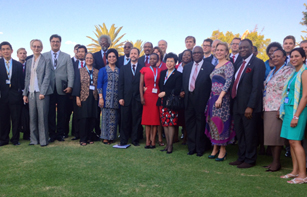
Participants at the high-level dialogue on health in the post-2015 development agenda. Gaborone, Botswana. 5-6 March 2013. Credit: UNAIDS
A High-Level Dialogue on health brought together representatives from governments, non-governmental organizations, academic and research institutions and the private sector to debate how to advance health priorities in the post-2015 development agenda. Co-convened by the Governments of Botswana, Sweden, UNICEF and WHO, the health thematic consultation took place in Gaborone, Botswana from 5-6 March 2013.
Opening the consultation, the President of Botswana Ian Khama highlighted the progress made by the country in its response to AIDS in the last 20 years and stressed that “health must remain a priority for Botswana and the world.”
UNAIDS Executive Director Michel Sidibé encouraged participants to seize the opportunity to adopt a bold, transformative vision and goals to guide global health in the post-2015 agenda. According to Mr Sidibé, “We need to completely rethink how global health will engage on issues from intellectual property to the production of essential medicines and the central role of countries and communities.” Reflecting on some of the lessons of the global AIDS response, Mr Sidibé said that “this is the opportunity to better leverage the role of private sector, technology, innovation, and unleash the potential of community activism to advance the future agenda for global health.”
We need to completely rethink how global health will engage on issues from intellectual property to the production of essential medicines and the central role of countries and communities.
UNAIDS Executive Director Michel Sidibé
Mr Sidibé also called for stronger attention to critical social enablers such as gender equality, human rights and equity. “Let us measure what we treasure,” said Mr Sidibé. “Health goals and indicators can help us track progress in these cross-cutting issues which are so important,” he added.
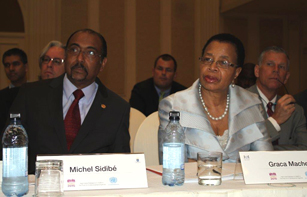
UNAIDS Executive Director Michel Sidibé and independent humanitarian expert Graça Machel at the high-level dialogue on health in the post-2015 development agenda. Gaborone, Botswana. 5-6 March 2013.
The outcomes of the consultation will guide and inform a report by the United Nations Secretary-General’s High-level Panel on the post-2015 development agenda which will be submitted to the Secretary-General in May 2013. Gunilla Carlson, Sweden’s Minister for International Development Cooperation and Graça Machel, an independent humanitarian expert also participated in the meeting. They are both members of the UN Secretary General’s High-level Panel to advise on the global development framework beyond 2015.
In July 2012, the Secretary-General launched his High-level Panel of Eminent Persons to provide guidance and recommendations on the post-2015 development agenda. The panel is co-chaired by the Presidents of Indonesia and Liberia and the Prime Minister of the United Kingdom and members include representatives from the private sector, academia, civil society and local authorities.
Related

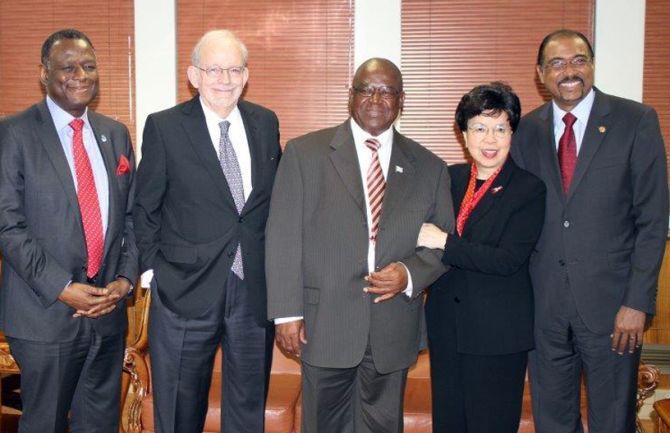
L to R: UNFPA Executive Director, Professor Babatunde Osotimehin, UNICEF Executive Director, Anthony Lake, Minister of Health of Botswana, Rev. Dr John Seakgosing, Director General of the World Health Organization, Dr Margaret Chan and UNAIDS Executive Director, Michel Sidibé. Credit: UNAIDS
Feature Story
United Nations agencies meet with President and government officials of Botswana ahead of High-Level Dialogue on Health
05 March 2013
05 March 2013 05 March 2013Ahead of the High-Level Dialogue on Health in the Post-2015 Development Agenda, held in Gaborone Botswana from 5-6 March 2013, four heads of United Nations agencies met with the President of Botswana, Ian Khama to discuss the meeting’s implications to global health.
President Khama said that his country strongly believed in investing in health and other social sectors as a way forward to economic and social development. The President stressed that despite competing priorities, governments should place human resources at the top of their national development agenda. Without a healthy population, all other priorities become void, he added.
In attendance the Director General of the World Health Organization, Dr Margaret Chan, UNICEF Executive Director, Anthony Lake, UNFPA Executive Director, Professor Babatunde Osotimehin and UNAIDS Executive Director, Michel Sidibé.
According to the 2012 UNAIDS Global Report, service coverage in Botswana to prevent new HIV infections among children reached 94% in 2011. Furthermore, by the end of 2011, more than 175 000 people were receiving antiretroviral treatment compared to 57% in 2004—more than 95% of people eligible.
Later in the day, they met with the Vice President of Botswana, Ponatshego Kedikilwe, Minister for Presidential Affairs and Public Administration, Mokgweetsi Masisi, Minister of Health, Rev. Dr John Seakgosing and Minister of Finance and Development Planning, Ontefetse Matambo.
Quotes
We are convening one of the milestone events in health development here not by coincidence. It is because Botswana's AIDS response has become a model for others.
Related
Press Statement
UNAIDS and UNICEF welcome news of a baby born with HIV who now as a toddler appears “functionally cured” through treatment
04 March 2013 04 March 2013And looks forward to further studies to see if findings can be replicated.
GENEVA, 4 March 2013—The Joint United Nations Programme on HIV/AIDS (UNAIDS) and UNICEF welcome a new case study, which found a baby treated with antiretroviral drugs in the first 30 hours of life and who continued on HIV treatment for 18 months appeared to be functionally cured.
The findings were presented today at the Conference on Retroviruses and Opportunistic Infections (CROI) in Atlanta, Georgia in the United States of America.
According to researchers the mother who was living with HIV at the time of birth had not received antiretroviral (ARV) medication or prenatal care. Researchers say that the child was born prematurely in July 2010 in the state of Mississippi. Due to the high risk of exposure to HIV, the researchers say the baby was started on a triple therapy regimen of antiretroviral drug 30 hours after birth and before proof of infection could be confirmed. The newborn’s HIV-positive status was subsequently confirmed through a highly sensitive polymerase chain reaction testing which was conducted on several occasions.
The case study stated that the baby was discharged from the hospital after one week and continued ARV treatment until 18 months of age, when for reasons that are unclear the treatment was discontinued. However, when the child was seen by medical professionals about a half a year later, blood samples revealed undetectable HIV levels and no HIV-specific antibodies.
If the findings are confirmed this would be the first well-documented case of an HIV-positive child who appears to have no detectable levels of the virus despite stopping HIV treatment.
“This news gives us great hope that a cure for HIV in children is possible and could bring us one step closer to an AIDS free generation,” said UNAIDS Executive Director Michel Sidibé. “This also underscores the need for research and innovation especially in the area of early diagnostics.”
In 2011, UNAIDS and its partners launched a Global plan for the elimination of new HIV infections among children by 2015 and keeping their mothers alive. Significant progress has been made and continued support and research is needed.
“While we wait for these results to be confirmed with further research, it is potentially great news,” said UNICEF Executive Director, Anthony Lake. “This case also demonstrates what we already know—it is vital to test newborn babies at risk as soon as possible.”
According to data from the World Health Organization and UNICEF only 28% of HIV-exposed babies were tested for HIV within six weeks of birth in 2010. Obstacles to early diagnosis and treatment include the high cost of diagnostics and difficulty of getting timely results and limited access to services and medicines. There were 330 000 children newly infected with HIV in 2011. At the end of 2011, 28% of children under the age of 15 living with HIV were on HIV treatment, compared to 54% of eligible adults.
Now two and a half year’s old, the toddler continues to thrive without antiretroviral therapy and has no identifiable levels of HIV. However, UNAIDS cautions that more studies need to be conducted to understand the outcomes and whether the current findings can be replicated.
Contact
UNAIDS GenevaSaya Oka
tel. +41 22 791 1552
okas@unaids.org
UNICEF
Sarah Crowe
tel. + 1 646 209 1590
scrowe@unicef.org
Multimedia
Multimedia
Press centre
Download the printable version (PDF)
Feature Story
Lessons from the AIDS response can shape new paradigm for development post-2015, Michel Sidibé tells UN Human Rights Council
01 March 2013
01 March 2013 01 March 2013
UNAIDS Executive Director, Michel Sidibé speaking at the 22nd session of the UN Human Rights Council on 28 February. Credit: UNAIDS
In a high-level address to the 22nd session of the UN Human Rights Council on 28 February, UNAIDS Executive Director, Michel Sidibé, stressed the crucial importance of viewing the AIDS epidemic through a human rights prism. The AIDS response, he said, is inextricably linked with the human rights agenda. If the world is to get to zero new infections, zero discrimination and zero AIDS-related deaths then ensuring rights, social justice, equity and gender equality is vital.
Mr Sidibé stressed that the AIDS response has paved the way for transformative progress across a broad range of rights, providing the engine for achieving the development goals. He noted that “critical lessons learned from the response to AIDS can help to ensure that the post-2015 development agenda puts human rights at its very center.” These lessons include promoting inclusion and participation; providing resources and political space for civil society to drive social change from within; and ensuring attention to the most marginalized.
Singling out the way the challenge to the epidemic has been a pathfinder to dealing with inequality, he spoke of the power of people living with HIV who have been the drivers of progress in the AIDS response. He called them “true human rights defenders fighting for their lives and for the lives of millions of others.”
Critical lessons learned from the AIDS response can help to ensure that the post-2015 development agenda puts human rights at its very centre.
UNAIDS Executive Director, Michel Sidibé
While recognizing that there has been progress made in the response to the epidemic, Mr Sidibé stressed that there is still much more to be done. He put special emphasis on the need to reduce the existing prejudice, discrimination, exclusion and criminalization of people living with HIV and to address the punitive approaches to the most vulnerable and at higher risk of infection such as sex workers, people who use drugs, men who have sex with men and transgender people.
“It is outrageous that in 2013, when we have all the tools to address this epidemic, more than 1.7 million people will die because they do not have access to treatment,” said Mr Sidibé. “It is human rights work we must do to end this epidemic—to reach all those in need of HIV prevention, treatment, care and support,” he added.
Mr Sidibé urged that the post-2015 development framework explicitly embrace the human rights framework, as well as a right-based approach to development. Referring to Council members as the world’s foremost leaders on human rights, Mr Sidibé told the Council, “Ending AIDS is a human rights legacy for us all. We can halt and reverse AIDS if we maintain our momentum and commitments through and after 2015.”

Established in 2006 to replace its predecessor, the Human Rights Council is mandated to promote universal respect for the protection of all human rights and to address situations where they are being violated. Credit: UNAIDS
The UNAIDS Executive Director joined other dignitaries in addressing the High Level Segment of the UN Human Rights Council session, including the German President Joachim Gauck and the Vice Presidents of Colombia and Iraq.
Established in 2006 to replace its predecessor—the Commission on Human Rights—the Human Rights Council is mandated to promote universal respect for the protection of all human rights and to address situations where they are being violated. It also monitors whether member states’ human rights obligations and commitments are met through its Universal Periodic Review mechanism.
During the 22nd session, which is running from 25 February to 22 March, a broad range of issues are being discussed. These include: the negotiation of a landmark resolution to protect human rights defenders; the rights of children to the highest standard of health; and resolutions on the rights of people with disabilities, minorities and those subjected to racism and xenophobia.
In the lead up to his intervention at the Human Rights Council, Mr Sidibé held a number of bilateral meetings to further the Human Rights agenda. These included the Minister of Foreign Affairs of Nigeria, Professor Viola Onwuliri; the United States Assistant Secretary of State for International Organization Affairs, Dr Esther Brimmer; the French Minister Delegate for the Francophony, Ms Yamina Benguigui; and the Minister of Development of Denmark, Christian Friis Bach.