

Feature Story
India's Red Ribbon Express train making a difference in the AIDS response
16 January 2013
16 January 2013 16 January 2013
Ms Aradhana Johri, Additional Secretary of the National AIDS Control Organization, Michel Sidibé, UNAIDS Executive Director, and Mr Lov Verma, Secretary and Director General of the National AIDS Control Organization, standing with a giant walking condom that distributes condoms and information on HIV as part of the Red Ribbon Express in New Delhi.
Credit: NACO
The Red Ribbon Express train has travelled more than 27 000 kilometres across India bringing a special message of AIDS awareness to more than 50 000 towns and villages.
UNAIDS Executive Director Michel Sidibé visited the Red Ribbon Express Train on display at the Safdarjung Railway Station in New Delhi during a recent country visit.
“The Red Ribbon Express has carried messages about HIV to all corners of the country,” said Michel Sidibé. “This train has been a profound success—ensuring young people get support and learn about AIDS and how to protect themselves from HIV.”
Completing its travel across the country, the Red Ribbon Express visited 23 states, stopping at 162 stations, reaching more than 10 million people with messages about HIV prevention and health in rural areas of India. The focus of the train’s most recent one-year journey across India was youth, with special emphasis on mobilizing adolescents and youth.

Dr Luiz Loures, UNAIDS Deputy Executive Director, Programme, touring the interactive exhibits on the Red Ribbon Express in Delhi.
Credit: NACO
“The Red Ribbon Express is a global best practice for innovation and outreach,” said Lov Verma, Secretary of Health and Director General of the National AIDS Control Organization (NACO) of India, who hosted Mr Sidibé during his visit. “We are proud that this train has also been the bridge linking HIV and general health in rural and remote areas of the country.”
On World AIDS Day 2007, the Red Ribbon Express was launched by the honourable Sonia Gandhi, Chairperson of the ruling United Progressive Alliance. The idea of the Red Ribbon Express was originally developed by the Rajiv Gandhi Foundation and the National AIDS Control Organization of India.
External links
Feature Story
BRICS Ministers of Health call for renewed efforts to face HIV and global health challenges
11 January 2013
11 January 2013 11 January 2013
UNAIDS Executive Director Michel Sidibé speaking at the 2nd Health Ministers’ meeting of the BRICS countries held in New Delhi, India from 10-11 January. Credit:UNAIDS/N.Raveendran
The 2nd Health Ministers’ meeting of the BRICS countries (Brazil, Russia, India, China and South Africa) concluded in New Delhi, India on January 11, with a strong call for strengthened cooperation in the implementation of affordable, equitable and sustainable solutions for common health challenges.
During his opening remarks, the Honourable Ghulam Nabi Azad, the Minister of Health and Family Welfare of India, highlighted the progress of the BRICS countries in the global AIDS response. “In India, we have reduced new HIV infections by 57% in the last decade, which puts us on track to halt and reverse the spread of HIV.” He was making reference to reaching one key HIV-related development goal by 2015.
Addressing the participants, UNAIDS Executive Director Michel Sidibé emphasized the unique role of the BRICS countries to draw on their positive experience with HIV to serve as an engine for innovation, research and development of health solutions for other developing countries. “Today, the BRICS are demonstrating how health is increasingly a tool of foreign policy and a vehicle for promoting global health and development for the entire world,” said Mr Sidibe. He also described global health as going through an important transition beyond disease specific approaches and adopting a people-centered approach to global health.
In India, we have reduced new HIV infections by 57% in the last decade, which puts us on track to halt and reverse the spread of HIV
Honourable Ghulam Nabi Azad, Minister of Health and Family Welfare of India
Several of the other BRICS Ministers highlighted their national commitments to HIV and the need to create a BRICS platform to enhance cooperation on global health, including HIV.
The five BRICS countries represent 43% of the global population, giving them a unique and growing role in contributing to global health. According to the Minister Azad, “the BRICS are very mature in our outlook, and have almost achieved adulthood. Let us now work together to consolidate our gains and collaborate at the bilateral and multilateral levels to provide global leadership in many areas.”

From L-R: Deputy Health Minister of Russia, Sergey Velmyaykin, UNAIDS Executive Director, Michel Sidibé, South African Health Minister Pakishe Aaron Motsoaledi, Indian Health minister Ghulam Nabi Azad, Chinese Health Minister Chen Zhu and Brazil Health Secretary Jarbas Barbosa shake hands during the 2nd BRICS Health Ministers meeting in New Delhi on January 11, 2013. Credit:UNAIDS/N.Raveendran
The meeting adopted the Delhi Communique, which calls for the BRICS to renew efforts to face the continued challenge posed by HIV. The Delhi Communique reiterated the commitment of the BRICS countries to “ensure that bilateral and regional trade agreements do not undermine TRIPS flexibilities so as to assure the availability of affordable generic antiretroviral drugs to developing countries.”
Intellectual property and trade flexibilities within the intellectual property rights system were set out in the World Trade Organization Agreement on Trade-Related Aspects of Intellectual Property Rights (TRIPS). Evidence from countries across the world shows that the use of TRIPS flexibilities has helped substantially lower the costs of HIV treatment.
At the closing of the meeting, it was announced that the next BRICS Ministerial meeting will be hosted by South Africa in January 2014.
External Links
External Links
Feature Story
United Nations Secretary-General Ban Ki-moon meets with his Special Envoys on AIDS
09 January 2013
09 January 2013 09 January 2013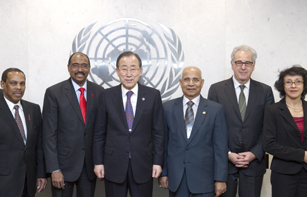
L to R: Edward Greene, Special Envoy on AIDS for the Caribbean, UNAIDS Executive Director Michel Sidibé, United Nations Secretary-General Ban Ki Moon, J.V.R. Prasada Rao, Special Envoy on AIDS for Asia and the Pacific, Michel Kazatchkine, Special Envoy on AIDS for Eastern Europe and Central Asia and Hedia Belhadj, UNAIDS Director, Liaison Offices Coordination.
Credit: UN Photo/Evan Schneider
The United Nations Secretary-General Ban Ki-moon brought together his team of United Nations Special Envoys for AIDS to discuss their strategic directions for the year ahead. UNAIDS Executive Director Michel Sidibé also participated in the meeting that took place on 07 January at the United Nations Headquarters in New York.
Welcoming his first meeting with the Special Envoys since their appointment in 2012, the Secretary-General highlighted their vision and leadership in the AIDS response. “Each of you have demonstrated your commitment by leading by example,” said Mr Ban. “I am very pleased to see you are effective, with an independent vision and working in close coordination with UNAIDS to reach the 2015 goals.”
The new team of Special Envoys is formed by Asha Rose Migiro, Special Envoy for Africa and former United Nations Deputy Secretary-General; Michel Kazatchkine, Special Envoy for Eastern Europe and Central Asia and former Executive Director of The Global Fund to fight AIDS, Tuberculosis and Malaria; J.V.R. Prasada Rao, Special Envoy for Asia and the Pacific and former Director of UNAIDS Regional Support Team; and Edward Greene, Special Envoy for the Caribbean and former CARICOM Secretariat Assistant Secretary-General.
We have a really strong team of Special Envoys on AIDS with great coherence, an outstanding understanding of regional specificities and global issues, and able to work across all sectors
UNAIDS Executive Director Michel Sidibé
The Special Envoys for AIDS are highly experienced individuals dedicated to support the Secretary-General in the final push towards the achievement of the Millennium Development Goals, particularly halting and reversing the course of HIV (MDG6) and reducing child mortality and improving maternal health (MDG 4 and 5). The Special Envoys are also uniquely positioned to communicate the Secretary-General’s messages and vision, leverage political processes and contribute towards shaping the post 2015 development agenda.
"We have a really strong team of Special Envoys on AIDS with great coherence, an outstanding understanding of regional specificities and global issues, and able to work across all sectors," said Mr Sidibé. “I am confident that together we will be able to articulate and advance priorities now and for the post 2015 agenda.”
The main areas of work that the Special Envoys on AIDS are prioritizing include promoting increased access to HIV treatment and prevention, encouraging shared responsibility and global solidarity among countries, and calling for the respect of human rights for all. They will also work with UNAIDS Cosponsors to ensure the prominence of HIV in related thematic areas such as drug policy, HIV within the context of peace and security, and decreasing the vulnerability of women and girls.



Feature Story
Advocating for access to treatment for people living with HIV in India
03 January 2013
03 January 2013 03 January 2013
At the XIX International AIDS conference held in Washington, DC in 2012, DNP+ received the Red Ribbon Award in the advocacy and human rights category.
The Delhi Network of Positive People (DNP+) was set up in 2000 by a couple of friends who operated out of a spare bedroom in an addiction rehabilitation centre.
Their goal was to provide support and advocate for access to HIV treatment for thousands of people in India who were living with HIV but didn’t know where to turn.
“I had seen many people dying because they didn’t have treatment,” said Loon Gangte, the President and a founding member of DNP+.
“I was working in a hospice at the time and I used to attend two or three funerals a month. I tried to teach people living with HIV to think positively, but drugs are expensive and people could not afford them. There was no access to antiretroviral treatment.”
From its humble beginnings, DNP+ has grown to 1300 members and a board of seven. At the XIX International AIDS conference held in Washington, DC in 2012, DNP+ received the Red Ribbon Award in the advocacy and human rights category. The award recognized its continuous and determined support for free antiretroviral treatment, strong campaigning on issues of intellectual property rights to ensure on-going access to affordable treatment and for its work in improving the lives of people living with HIV.
Advocacy is not an easy job. No one likes us because we challenge the status quo, but we are not here to do what you like!
Loon Gangte, President and a founding member of DNP+
India has the largest number of people living with HIV in Asia and the Pacific. But its response has been hampered by high levels of stigma which remains an on-going challenge for DNP+.
“Advocacy is not an easy job,” said Mr Gangte, who has himself been faced with HIV-related discrimination. “No one likes us because we challenge the status quo, but we are not here to do what you like!”
Mr Gangte said that as well as the much needed financial support, the Red Ribbon Award has brought international recognition to the work that DNP+ is doing and the difference its members are making within their communities.
“It’s a stamp of approval from the international community,” he said. “(It shows) that although we do not have much financial support and although we are small in scale, the world is still recognizing our work.”
“Gaining international approval is another step towards building a larger and more vibrant positive community,” he added.
External links
External links
Feature Story
Changing attitudes towards men who have sex with men and transgender people in Myanmar
28 December 2012
28 December 2012 28 December 2012
Minister of Health and Social Affairs of France, Marisol Touraine presents the Red Ribbon Award during the International AIDS conference in Washington, on July 25, 2012.
Credit: UNAIDS/ Yuri Gripas
When Thet Mon Phyo underwent a gender change operation in 2005, her parents told her not to bother returning home.
“They were ashamed and I had to go and live with my aunt,” 34-year-old Phyo recalled. “When I was young my father often scolded me for my feminine behaviour. Later, my lover left me because his parents persuaded him that same-sex love was unnatural,” she said.
In Myanmar, many transgender people and men who have sex with men (MSM) face widespread stigma and discrimination, complicating efforts to halt the spread of HIV.
According to UNAIDS, the HIV prevalence among MSM and transgender people in some places is much higher than that of the general population (9.4% versus 0.53%). Male-to-male sex is illegal in Myanmar and there are no laws to protect MSM and transgender people from discrimination.
“They are objects of ridicule for some people, even hated,” Phyo said.
“There is discrimination in the workplace and even within families….some MSM are disowned, disinherited and expelled from their homes,” she added.
Phyo is Programme Manager at The Help, Myanmar, a group which focuses on HIV prevention, care, support and advocacy for MSM and transgender people and works to ensure their voices are heard and their issues taken up at the national level. All members of The Help are MSM or transgender and almost half are living with HIV.
The Help Myanmar was awarded a prestigious Red Ribbon Award at the XIX International AIDs conference held in August for its work on the prevention of sexual transmission of HIV and other STDs. The Red Ribbon Award is the world’s leading award for innovative and outstanding community work in the response to the AIDS epidemic.
The Help, Myanmar is working to change attitudes, reduce discrimination and improve access to HIV services. It is a challenging task.
We are greatly encouraged for being recognized for helping MSMs and others in the community. The Red Ribbon Award has strengthened our determination to continue our struggle for truth, rights and benefits
Thet Mon Phyo, Programme Manager at The Help, Myanmar
Phyo said MSM and HIV positive people are denied equal employment opportunities and access to proper medical treatment, which in turn discourages them from safe behaviour.
Police often act as barriers in seeking legal protection. Threats and extortion attempts by some police highlight the need for immediate measure to increase public awareness of people’s rights and for the government to enact rights that protect people from discrimination.
Phyo said the authorities have not interfered with The Help’s work to increase MSM and TGs capabilities and set up self-help groups to support them. In fact, The Help sees this as a sign of tacit cooperation. But there is a long way to go.
“We are greatly encouraged for being recognized for helping MSMs and others in the community. The Red Ribbon Award has strengthened our determination to continue our struggle for truth, rights and benefits,” said Phyo.
The Help Myanmar’s efforts may also receive a boost following the recent appointment of Daw Aung San Suu Kyi as UNAIDS Global Advocate for Zero Discrimination.
“She has many things to do, but we believe in her and we think she can make a difference,” said Phyo.
External links
External links
Feature Story
AIDS has been a wake-up call for us all – Dr Paul De Lay
28 December 2012
28 December 2012 28 December 2012
After 10 years with UNAIDS Dr Paul De Lay is taking up his retirement.
At UNAIDS the Deputy Executive Director of the Programme branch Dr Paul De Lay has been known to many as the “voice of reason”, deftly handling complex issues, generating consensus and providing clear direction.
A medical doctor with training and experience in family practice, infectious and tropical diseases, Dr De Lay started working on AIDS at the very beginning of the epidemic. He worked with the Global Programme on AIDS at the World Health Organization and served as Chief of the HIV/AIDS Division at USAID before joining UNAIDS in February 2003. He was appointed the Deputy Executive Director, Programme, in June 2009.
After 10 years with UNAIDS Dr Paul De Lay is taking up his retirement, however before he left unaids.org caught up with him to ask if he would share a few of his thoughts and memories of working for the global AIDS response.
You have dedicated 30 years to the global AIDS response, including almost a decade with UNAIDS. You will be dearly missed by the entire UNAIDS family and the global AIDS community. Your exceptional humour, dedication and humility will always remain unique.
Michel Sidibé, Executive Director, UNAIDS
Q: What do you think is the greatest accomplishment to date in the AIDS response?
Dr De Lay: The very fact that affected communities have kept AIDS so high on the global agenda over the past 30 years. This is a truly remarkable accomplishment. We also have seen the incredible advances in understanding the complexity of the virus, the development of effective treatments, better knowledge about combination prevention, and deeper awareness about the role of human rights and gender in the response. However, none of these would have happened without the constant pressure for the world to keep paying attention to the devastation caused by HIV and to improve the range of tools we have to respond to it.
Q: In your vast career what do you consider the biggest advancement in public health?
Dr De Lay: Not sure how “vast” my career has been. I feel that in many areas of public health, I have barely scratched the surface of a problem. Thus, my response is based on my own, rather narrow perspective. Undoubtedly, there have been astounding biomedical breakthroughs—in vaccine research, the importance of micronutrients like Vitamin A, modern contraceptives, oral rehydration therapy, and many others. However, for me, I think the most important advancement has been the realization as to how the health of individuals and populations reflects a wide range of broader societal issues, like security, nutrition, physical activity, living conditions, basic rights to services, etc. The AIDS response has done a lot to wake us all up on how important the broader social context of any specific disease really is.
Paul, you will always be a champion in our work.
Deborah von Zinkernagel, Principal Deputy Global AIDS Coordinator of PEPFAR
Q: You have been associated with the AIDS response from the very beginning, what were the biggest obstacles you faced?
Dr De Lay: I think my experiences echo those of many others. Clearly one of the most challenging obstacles has been the stigma around how a person is infected and, in the early days, the lack of treatment and the inevitable death sentence that was associated with HIV infection. For me, one of the other major challenges was the lack of a simple, inexpensive, reasonably effective biomedical intervention. In the history of global public health, most resources went to campaigns that used a limited set of cheap interventions, like treating diarrhoea with oral rehydration therapy or preventing malaria with insecticide treated bed nets. Responding to AIDS went against this very narrow thinking and broke the prejudices towards more complicated and more comprehensive solutions.
Q: A new generation is now taking over the AIDS response, what advice would you give them?
Dr De Lay: I think that in some ways it’s harder for the next generation of responders than it was when I first got engaged back in the early 1980’s in San Francisco. There are so many competing priorities and the politicians and Ministries of Finance look to quick fixes and foster the competition between social ills, using mortality and financial impact to decide which problems deserve funding. I would definitely advise anyone who was considering a career in global health to nurture long term thinking and solutions. He or she should also focus on the broader societal problems and not limit themselves to a single disease. I think that the new enthusiasm around non-communicable diseases and their importance all over the world will not only strengthen the AIDS response but continues the same line of thinking that was generated by AIDS- that solutions for health problems need more than just a medical response.
We all have learnt a lot with him, we wish him well. It is a huge loss.
Prof Dirceu Bartolomeu Greco, Director, STD/AIDS/VH Department - Ministry of Health, Térreo – Brasilia
Q: As a film enthusiast, if you were to write a blockbuster about AIDS, what would be your plot?
Dr De Lay: There have been a number of very informative and poignant films and plays about HIV over the past three decades. I still remember how the film Philadelphia in the U.S. reached a very broad audience and helped them to understand not just HIV infection and disease but the real impact it had on people and the limitations of the existing response. Recently, there have been a number of films about the critical role that infected people and activists have played, (for example, How to survive a plague.) However, many of these films are set in high-income countries. It would be good to see more films about activism in low income countries and both its toll for the individual and the successes it can achieve. But for me, if I could make a film, I would rather it would be about the broader issues facing a community in Africa or Asia and the heroism of individuals in dealing with social problems. AIDS would only be part of the social picture and not the sole focus.
He wasn’t really a guy in a suit. He was always just the guy from Malawi.
UNAIDS colleague
Q: How would you define the “end of AIDS”?
Dr De Lay: It would not be the same definition as for the end of smallpox or the current campaigns to end polio. We don’t have the same biomedical tools at our disposal, so the concept that the virus would cease to exist and all infections would stop is not really relevant in the current context of AIDS. For me, the idea of ending AIDS is to take every tool we have available (regardless of cost, complexity, etc.) and to use them in a rational and optimum way that doesn’t violate basic rights. If we really did that, we could drop annual new infections from 2.6 million to just a few thousand, and the same for mortality.
Staff at UNAIDS are proud to have had Dr Paul De Lay as a colleague and mentor and the organization is thankful for his outstanding service.
Related
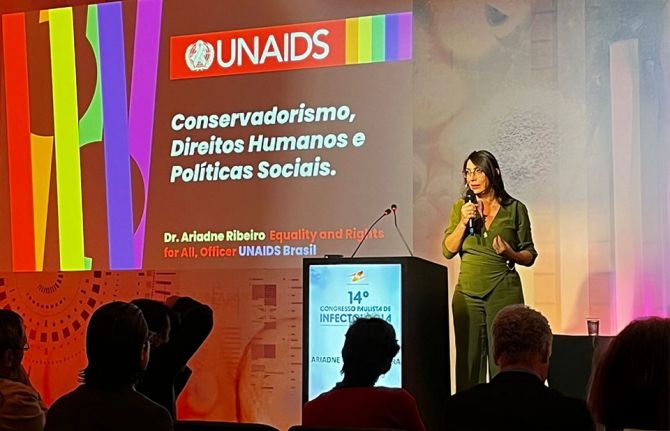 Upholding dignity for everyone: Ariadne Ribeiro Ferreira
21 November 2024
Feature Story
Sudan commits to stepping up its response to HIV
16 December 2012
16 December 2012 16 December 2012
From left to right: Ms. Mahasen Abdelarman, wife of the governor of River Nile State; Dr Hamidreza Setayesh, UNAIDS Country Coordinator; H.E. Mdm Widad Babiker, Wife of the President of Sudan, and other wives of governors and civil society members of “Sudanese Coalition of Women and AIDS”, December 2012, Atbarah, River Nile.
Despite years of conflict and humanitarian emergencies, Sudan is stepping up its response to HIV. Across Sudan there are an estimated 69 000 people living with HIV and HIV prevalence is at 0.4%. Estimates also show that only 10% of the estimated number of people in need of antiretroviral treatment are receiving it.
Sudan has one of the largest populations of people living with HIV in Middle-East and North Africa, and the country is moving forwards in addressing some of the obstacles which have been preventing scale up of HIV prevention, treatment and care. Today, more than 150 centers are providing testing and counselling, and 32 treatment sites have been established around the country to make access to antiretroviral treatment more widely available.
At a meeting organized by the Sudanese Coalition on Women and AIDS* in Atbarah, River Nile State, government officials together with the Sudanese Coalition of Women and AIDS reaffirmed their commitment to providing a comprehensive response to HIV.
Her Excellency Widad Babiker, the wife of the President of Sudan, addressed participants and called for stronger partnerships to prevent new HIV infections. She said “In addition to federal and local governments, responsibility for HIV prevention remains with each of us. We shall commit to a generation free of stigma and discrimination and free from HIV. One of the ways to do that is to expand HIV testing for pregnant women.”
Participants discussed and learnt about the response to HIV in their country and throughout the Arab world. They debated human rights issues, particularly for women and girls in the context of HIV and learnt that the Middle-East and North Africa region has one of the fastest growing HIV epidemics in the world, meaning that prevention interventions in the region have not been sufficient to stop the spread of the epidemic.
We shall commit to a generation free of stigma and discrimination and free from HIV. One of the ways to do that is to expand HIV testing for pregnant women.
Her Excellency Widad Babiker, wife of the President of Sudan
Participants agreed that all sectors of the country will need to contribute to the development of an effective AIDS response that is evidence-based and anchored in the respect for human rights. During the meeting they put together a work plan for each constituency which includes supporting women living with HIV, leading stigma reduction campaigns, mobilizing charities and championing the “show your love, take the test” campaign which is designed to scale up efforts to stop new HIV infections in children.
The Sudanese government demonstrated firm commitment. At a press conference attended by three federal Ministers on the occasion of World AIDS Day, His Excellency Dr Ahmed Bilal, the Federal Minister of Culture and Communication and spokesperson of the Sudanese government said, “HIV is a reality in Sudan and cannot be effectively addressed if we continue to put our heads in the sand.”
His Excellency Dr Amira El-Fadil, Minister of Welfare and Social Security called for a building of sustainable partnerships with civil society, youth organizations and the media as well as the imams and religious leaders to reach all sectors of the population. Dr Bahar Idris, Federal Minister of Health added that reducing new HIV infections will need a significant multi-sectorial effort, “We cannot continue to live in denial and attribute AIDS to neighboring countries,” he said.
UNAIDS Country Coordinator, Dr Hamidreza Setayesh, commended the country’s political commitment to the AIDS response. He also stressed the need for a rapid and significant scale up in the coverage of HIV-related services as well as an increase in domestic resources for AIDS in Sudan. “It is unfortunate and unacceptable to see that 9 out of 10 people in need of antiretroviral treatment in Sudan are deprived of these life-saving measures,” said Dr Setayesh. “With the strong commitment demonstrated by the government and the leadership of Her Excellency Madam Widad, Sudan can show to the region and the Islamic world that universal access is achievable.”
*The Sudanese Coalition on Women and AIDS consists of wives of state governors, women living with HIV, Sudan AIDS Network member associations and local and federal authorities.
Feature Story
UNAIDS salutes the leadership of Burkina Faso’s President
21 December 2012
21 December 2012 21 December 2012
UNAIDS Executive Director Michel Sidibé meets with the President of Burkina Faso, Blaise Compaoré in Ouagadougou, Burkina Faso on 20 December 2012.
UNAIDS Executive Director Michel Sidibé congratulated the President of Burkina Faso, Blaise Compaoré for his personal engagement in his country’s AIDS response during a meeting held on 20 December in the country’s capital of Ouagadougou. New HIV infections in Burkina Faso have dropped by 60% in the past ten years.
“You are a model of good governance and a promoter of peace on the continent,” said Mr Sidibé. “You have invested in the AIDS response. You have shown that when there is strong leadership change is possible.”
The number of people living with HIV who are receiving life-saving treatment have increased significantly. The Burkina Faso Health Ministry’s latest figures show HIV treatment coverage increased by 19% between 2010 and 2012, reaching 60% of people eligible for antiretroviral therapy.
“Burkina Faso has produced remarkable results in its treatment coverage. Making antiretroviral treatment free in 2011 not only symbolizes President Compaoré’s commitment to social justice but is extremely effective,” said Mr. Sidibé.
President Compaoré is also committed to reducing his country’s dependence on external funding and he has taken the initiative by expanding the share of domestic resources allocated to the HIV response from 15% to 25%.
You are a model of good governance and a promoter of peace on the continent and you have invested in the AIDS response and shown that when there is strong leadership change is possible
UNAIDS Executive Director Michel Sidibé
“From the beginning of the epidemic, we considered AIDS was not only a public health problem but a major threat to development and social stability,” said the President of Burkina Faso. “AIDS is threatening the most important resource for development, which is people.”
Earlier in the week, Mr Sidibé had also met with Burkina Faso’s Minister of Health, Professor Adama Traoré and discussed challenges including stopping new HIV infections among children and the country’s reliance on external funding.
Minister Adama Traoré stressed his country’s commitment to the AIDS response and said that his country’s financial resources are limited and they must be used in the best way in order to get results as human lives are at stake.
In a meeting with Minister of Justice Salamata Sawadogo, Mr Sidibé underlined the progress the country has made and the challenges around the criminalisation and stigmatisation of key populations at higher risk and HIV prevention, treatment and care for prisoners. Minister Sawadogo said she is focused on human rights including the rights of people in prison.
Mr Sidibé will wrap up his four-day visit to Burkina Faso on 21 December.
Feature Story
New campaign to stop new HIV infections among children launched in Sierra Leone
17 December 2012
17 December 2012 17 December 2012
First Lady of Sierra Leone, Madam Sia Nyama Koroma.
The First Lady of Sierra Leone, Madam Sia Nyama Koroma has launched a national campaign to prevent new HIV infections among children called “Bon Pikin Wae Nor Get HIV” (Give Birth to Life without HIV).
The new initiative was developed by the First Lady’s Office in collaboration with UNAIDS, the Network of Women Living with HIV (Voice of Women), the National AIDS Control Programme and the National AIDS Secretariat. The campaign, led by the network of women living with HIV aims to raise awareness about HIV prevention among women of reproductive age in order to accelerate the uptake of HIV services to prevent new HIV infections among children.
The availability of services to prevent mother-to-child transmission of HIV has increased substantially in recent years, however, coverage is not uniform across the country. This campaign will try to address the existing gap mainly in rural areas where the service demand is still low.
Besides increasing demand for antenatal services, it is expected that the campaign will help promote the sexual and reproductive health and rights of women; improve access to antiretroviral prophylaxis amongst HIV positive women and strengthen the capacities and participation of women living with HIV in the promotion of the national agenda to stop HIV infections among children in Sierra Leone.
If we are to win the war against AIDS, we will need caring men and women to join us in the campaign
First Lady of Sierra Leone, Madam Sia Nyama Koroma
During the launch, the First Lady called on Sierra Leonean women and the general public to visit hospitals and health clinics to test for HIV. She emphasised the need for male participation in prenatal care services. “If we are to win the war against AIDS, we will need caring men and women to join us in the campaign,” she said.
Madam Kadija Sam Sumana, wife of the Vice-President of Sierra Leone, stressed the lack of education and information as the major cause in the spread of HIV in young girls. She encouraged parents to ensure that girls receive education and also to discourage teenage pregnancy and early marriages.
The UNAIDS Country Coordinator Dr Job Sagbohan welcomed the First Lady’s efforts in promoting maternal and child health and empowering women and girls for their social economic development. He assured UNAIDS continued commitment and support in the response to AIDS and in achieving the vision of zero new HIV infections, zero discrimination and zero AIDS-related deaths by 2015. “Progress is possible when we come together for a common cause—with vision, clear objectives and strong and sustained effort,” he said.

Feature Story
UNAIDS meets with the King of the Mossi
21 December 2012
21 December 2012 21 December 2012
UNAIDS Executive Director Michel Sidibé meets with the King of the Mossi in his palace on 21 December 2012 in Ouagadougou, Burkina Faso.
UNAIDS Executive Director Michel Sidibé thanked the Mogho Naba, the King of the Mossi for encouraging traditional leaders and religious organizations to support the AIDS response in Burkina Faso. Mr Sidibé met with the King in his palace in Ouagadougou on 21 December.
“With your support, we hope that soon no child will be born with HIV in Burkina Faso,” said Mr Sidibé.
The King of the Mossi answered that he was happy to provide support for the good of his people. “We are ready to participate in any action, which aims to inform the people about how to have healthy children.”
The meeting with the King of the Mossi concluded Mr Sidibé’s official four-day visit to Burkina Faso.