Feature Story
University of Senghor master’s degree programme in International Health includes module on HIV for second year running
25 January 2013
25 January 2013 25 January 2013
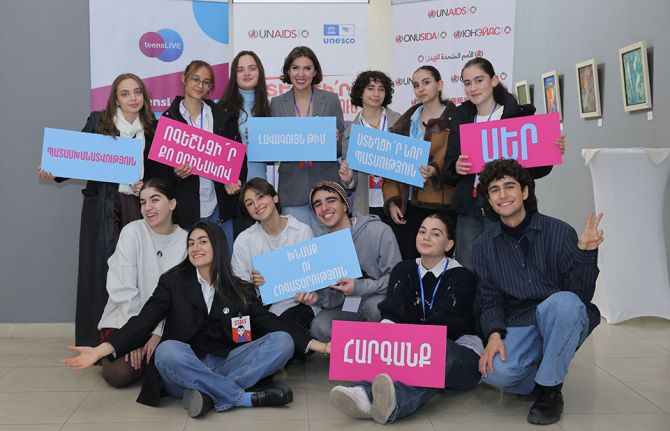
Students that have completed the course on HIV as part of their Master’s Degree in International Health at the Senghor University.
Credit: Senghor University
More than 35 students from 22 countries across sub-Saharan Africa, the Middle East and North Africa, Haiti and France have completed a course on HIV as part of their Master’s Degree in International Health at the Senghor University based in Alexandria. The module was established by UNAIDS and the Department of Health at the University in 2011 in a bid to give students a better understanding of the complexities of the global response to HIV.
This is the second year that students have participated in the programme. “I welcome this strong cooperation between UNAIDS and the Senghor University,” said Professor Albert Lourde, Rector of the Senghor University. “It shows how Francophone expertise is unique and how we need to encourage education and knowledge sharing across Francophone countries to effectively deal with issues related to HIV.”
The course comprises of 10 sessions which aim to strengthen the student’s scientific and global public health knowledge and enable them to support their national AIDS responses once they return to their home countries. This year’s course included sessions on sharing epidemiology and medical knowledge on HIV and the contribution of communities and civil society to the AIDS response.
I welcome this strong cooperation between UNAIDS and the Senghor University. It shows how Francophone expertise is unique and how we need to encourage education and knowledge sharing across Francophone countries to effectively deal with issues related to HIV
Professor Albert Lourde, Rector of the Senghor University
During the course, students were encouraged to reflect on some of the major challenges to achieving the targets and commitments in the 2011 United Nations Political Declaration on HIV/AIDS. The course concluded with an interactive video-conference opened by Professor Lourde that highlighted the major international initiatives to promote effective and efficient responses to HIV. These include an initiative that aims to ensure 15 million people are on antiretroviral treatment by 2015 as well as the Global Plan towards the elimination of new HIV infections among children by 2015 and keeping their mothers alive. During the conference, participants also discussed human rights in the context of HIV and analyzed the specific challenges faced by the West and Central African region.
As part of the programme some of the students had the opportunity to complete a mandatory three month internship at UNAIDS offices in West and Central Africa and the Middle East and North Africa where they learnt first-hand about the complexities of responding to HIV. UNAIDS will continue its partnership with the University to ensure that AIDS remains as part of the curriculum of its Master’s degree in International Health programme as the university expands its campuses to other French speaking countries throughout Africa.
External links
External Links
Related
Feature Story
UNAIDS launches e-consultation to ensure AIDS remains central in the Post-2015 Agenda
23 January 2013
23 January 2013 23 January 2013
The international community is in the midst of negotiating the next global development agenda. This new roadmap is to be put in place after 2015, when the Millennium Development Goals will have reached their target date.
In order to capture a diverse a range of voices and views on how AIDS and health should be reflected Post-2015, UNAIDS is hosting an online and open-to-all consultation. This online conversation will run for two weeks, between 21 January and 3 February, and will be hosted on the official UN and Civil Society joint platform on Post-2015 negotiations, the World We Want.
The consultation invites views around three interrelated themes including: How the HIV epidemic remains relevant to the Post-2015 Agenda; how principles and practices forged in the AIDS response may contribute to a more equitable and sustainable health and development agenda; and how to reform systems of decision-making, monitoring, evaluation and accountability to guide efforts towards the end of the HIV epidemic.
The e-Consultation is being moderated by nine international experts on HIV, human rights, health and development. Together with the UNAIDS, moderators will produce a synthesis report at the end of the consultation. This report will be used widely to influence on-going negotiations, including the High-Level Health Thematic meeting (5-6 March, Botswana) and the UNAIDS-Lancet Post-2015 Commission.
The global HIV epidemic remains one of the world’s leading causes of death and is both a driver and consequence of inequality and social injustice. The AIDS response has always been a pioneer and a pathfinder on many fronts and can make critical contributions to doing health and development differently in the Post-2015 era.
To participate in the e-consultation please visit http://www.worldwewant2015.org/health
Related
 Upholding dignity for everyone: Ariadne Ribeiro Ferreira
21 November 2024
Feature Story
Breaking the conspiracy of silence
22 January 2013
22 January 2013 22 January 2013
UNAIDS Executive Director, Michel Sidibé, shares a moment with Florence Ngoqo, left, and Thabang Lebese’s 101-year-old maternal grandmother, right.
Credit: UNAIDS/M.Safodien
Thabang Lebese was a little boy who grew up in Orlando East, Soweto. From an early age he could kick a ball—dazzling his family with his talent on the pitch. It didn’t take long before he was given the opportunity to join one of the major football clubs in South Africa and by the age 15 he was playing for the Kaizer Chiefs’ junior team.
Thabang played 279 Premier Soccer League (PSL) games in his 13-year long career. He was one of a handful of players to have played for the big teams: Chiefs, Orlando Pirates and Moroko Swallows. He was a much-loved and celebrated player and people today still remember him for his trademark victory dance after scoring a goal.
Then, in early February 2012, Thabang was admitted to Helen Joseph Hospital complaining of a ‘stiff neck and terrible headache’. Days later—on 12 February 2012—he died. Two weeks after his death his family publicly disclosed that Thabang had died of an AIDS-related illness.
“By doing so we wanted to stop the gossip and the whispering. We wanted people to know so that there could be no speculation about why Thabang had died,” said Thabang’s aunt and family spokesperson, Naomi Lebese.
His family said that Thabang lived in silence and suffered alone, with only a few friends knowing the truth but didn’t know how to help him. He wanted to disclose his status but had left it too late.
“Thabang was too afraid to come out publicly and disclose his HIV status,” said Mabalane Mfundisi, director of Show Me Your Number, the HIV prevention programme of the South African Football Players Union. “I think soccer stars have a harder time disclosing their status than ordinary people precisely because the fall from grace is so much harder. The pressure on a football player to be perfect, to perform, is immense—after so much public scrutiny, it is hard to admit being a mere mortal.”
“We need everyone to know that if you are diagnosed with HIV, you are not alone and there is a lot of support available to you including life-saving HIV treatment,” said UNAIDS Executive Director Michel Sidibé.
It is very important to break the conspiracy of silence that exists around HIV
UNAIDS Executive Director, Mr Michel Sidibé
Thabang’s story shows that despite an ambitious AIDS programme, HIV-related stigma is still pervasive in South African communities.
UNAIDS, Show Me Your Number, the South African National AIDS Council (SANAC) and Thabang’s family have teamed up to produce a public service announcement sharing Thabang’s story to highlight issues around HIV stigma, silence and secrecy. The announcement coincided with the start Africa Cup of Nations 2013 which is being hosted in South Africa between 19 January and 10 February.
“It is very important to break the conspiracy of silence that exists around HIV,” said Mr Sidibé. “This is what the Lebese family have done and by doing so, they will save lives,” he added.
“We believe that we can use Thabang’s story to help other people in the same situation”, said Thabang’s mother, Florence Ngoqo. “We hope that people who see the message and will reach out to their loved ones for help and speak out about their status. People need to speak out and communities need to stop living in denial.”
Feature Story
UNESCO booklet promotes improved links between gender, HIV and education
18 January 2013
18 January 2013 18 January 2013
Poverty and gender inequality, in addition to the lack of access to education, increase vulnerability to HIV infection. This is one of the main messages of the Gender Equality, HIV and Education booklet recently produced by the United Nations Educational, Scientific and Cultural Organization (UNESCO).
The new publication stresses that tackling these issues is crucial to meeting the Millennium Development Goals (MDGs) and other international commitments regarding education, human rights, equality and social justice. As part of a UNESCO series on good policy and practice in HIV and health education, the booklet includes discussion papers that explore the links between gender, HIV and education.
Findings reveal that efforts to improve education, gender and HIV-related issues to date have largely been implemented in parallel. There is increasing recognition, however, that these issues cannot be tackled in isolation. According to the booklet, there is a need to find ways to ensure that policies and programmes on gender equality, HIV and education are mutually reinforcing in order to maximize their impact.
By addressing topics of gender equality, poverty, the role of education, engagement between education and the wider community and young people’s leadership, the booklet aims to highlight experiences, innovative approaches and lessons learned, all in order to inform future policy and programming.
Barriers to education for girls
Gender inequalities are deeply entrenched in attitudes and behaviours, and the view that “the girl child is only for marriage” was found to be common among fathers interviewed during baseline research. The booklet quotes a view reinforced by a 13-year-old girl who commented that, “Being in school is a privilege according to our fathers, but not a right.”
Disparities against girls tend to be more extreme and persistent than those against boys. For example, more than 60% of adolescent girls are out of school in countries such as Central African Republic, Djibouti, Eritrea, Guinea, Pakistan and Tanzania, while in Senegal and Niger, the rate exceeds 70%.
Achieving an impact on gender equality and HIV will be possible if urgent action is taken to reduce existing inequalities in wealth and education, the booklet notes. Education has a key role to play in breaking some of the patterns that have been passed down through generations. Programmes that address the immediate barriers to school access, the most pervasive of which is poverty, can have an immediate and beneficial effect on access to education. This, the booklet concludes, will have positive benefits on promoting positive sexual health and preventing HIV infection for all young people.
External links
External links
Publications
Publications
Feature Story
UNAIDS International Goodwill Ambassador Michael Ballack gets a first-hand look at the impact of AIDS on South Africa
21 January 2013
21 January 2013 21 January 2013
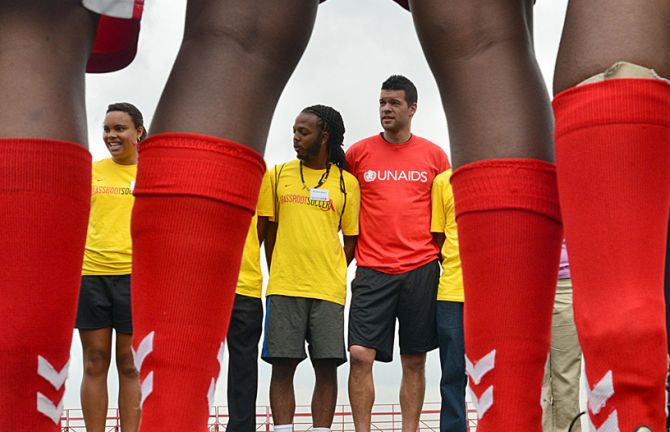
UNAIDS Goodwill ambassador, football player Michael Ballack during his visit to the Health4Men initiative.
Credit: UNAIDS/M.Safodien
In his role as UNAIDS International Goodwill Ambassador, the German football star Michael Ballack conducted a 3-day mission to Johannesburg, South Africa, where he learned about the impact of HIV on communities and used his star-power to raise public awareness of the epidemic.
On 18 January, the first day of his visit, he met with men who have sex with men (MSM), a key population at higher risk of HIV during a visit to the Health4Men initiative at the Yeoville Clinic in Johannesburg. The innovative programme provides free sexual health services to MSM, who often experience stigma and discrimination and struggle with a lack of services catering to their needs. Mr Ballack toured the programme, spoke with health providers and met with MSM.
“I think it is so important that we give attention to HIV because it is everybody’s business,” said Mr Ballack.
“Having somebody like Michael Ballack, who is a big, big celebrity come here to meet people living with HIV, I am very grateful for that and I am very happy,” said one of the Health4men’s clients.
I have really learnt a lot during this trip and I look forward to continuing to work with UNAIDS on stopping the spread of HIV
UNAIDS International Goodwill Ambassador and Football Star, Michael Ballack
“It is almost impossible to discuss MSM sexual issues openly in South Africa. This is why it is important for these kinds of services to be integrated, into mainstream health care services provided throughout the country,” said Glenn de Swardt, Programme Manager at the Health4Men site.
The Grassroot Soccer project in Soweto was on the itinerary on day two. Along with UNAIDS Executive Director, Michel Sidibé Mr Ballack spent time with participants of the programme. Grassroot Soccer uses football to deliver key life-skills to young people.
“Michael Ballack has done so much to raise awareness of AIDS and UNAIDS is so lucky to have him give his time, energy and name to the HIV movement,” said Mr Sidibé.

UNAIDS Goodwill ambassador, football player Michael Ballack delivering key life-skills to young people during his visit to the Grassroot Soccer project.
Credit: UNAIDS/M.Safodien
Mr Ballack also attended the opening of the 2013 Orange Africa Cup of Nations, which is the continent’s most prestigious football tournament. During the tournament, Mr Ballack met with the President of South Africa, Jacob Zuma as well as with other African Head of States, attending the event. UNAIDS launched its HIV awareness campaign, “Protect the Goal” during the opening.
South Africa has the largest HIV epidemic in the world with an estimated 5.6 million people living with HIV. During the past few years the country has made remarkable progress in reversing the course of the AIDS epidemic. Now, the country has the largest HIV treatment programme in the world with 1.9 million people living with HIV on antiretroviral therapy.
“I have really learnt a lot during this trip and I look forward to continuing to work with UNAIDS on stopping the spread of HIV,” said Mr. Ballack.
The football champion has been a UNAIDS International Goodwill Ambassador since 2006 and he has dedicated time and effort to disseminating HIV prevention messages through the media.

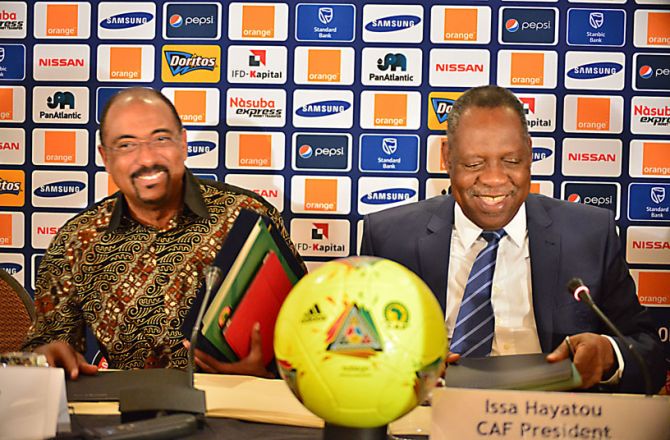
UNAIDS Executive Director Michel Sidibé and President of CAF Issa Hayatou signing the Memorandum of Understanding (MoU) in Johannesburg, South Africa, on 19 January 2013.
Feature Story
UNAIDS and Confederation of African Football Association sign memorandum of understanding to advance HIV prevention
19 January 2013
19 January 2013 19 January 2013UNAIDS and the Confederation of African Football Association (CAF) have strengthened their partnership by concluding a memorandum of understanding (MoU). In Johannesburg, South Africa, on 19 January, UNAIDS Executive Director Michel Sidibé and President of CAF Issa Hayatou signed the MoU, which aims to leverage the popularity of football and advance HIV prevention.
The agreement was launched on the side-lines of the 2013 Orange Africa Cup of Nations, which opened also on 19 January and focuses on a joint initiative called “Protect the Goal”. The campaign is designed to ensure access to HIV treatment and raise public awareness of HIV and prevention, particularly among young people, who are crucial to halting the epidemic.
Quotes
The partnership with CAF brings unprecedented opportunity for social transformation through sports. The new generation must lead the prevention revolution. Globally, we still have nearly 7000 people getting infected with HIV each day – by the time we finish this tournament, 160 000 people will be infected. This is unacceptable.
UNAIDS and CAF through this campaign will disseminate life-saving HIV messages to millions of athletes and fans across the continent and beyond.
Related
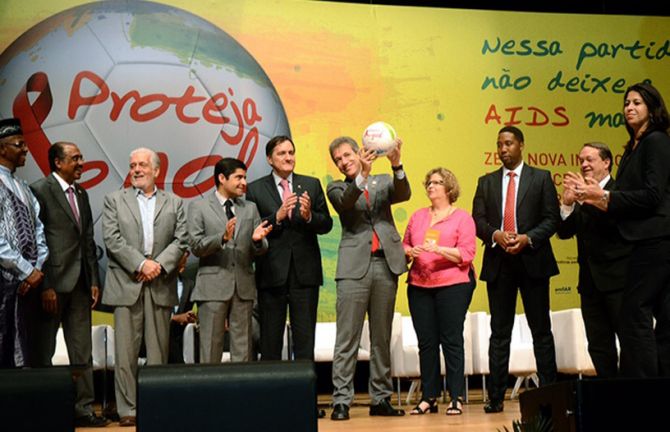

UNAIDS International Goodwill Ambassador and football star, Michael Ballack witnessed how football is transforming lives in South Africa. Credit: UNAIDS/M.Safodien
Feature Story
UNAIDS International Goodwill Ambassador Michael Ballack teams up with young people to tackle HIV prevention
19 January 2013
19 January 2013 19 January 2013UNAIDS International Goodwill Ambassador and football star, Michael Ballack witnessed how football is transforming lives in South Africa. On 19 January, he visited the Grassroot Soccer programme in Soweto, South Africa and watched a Skillz Street practice session involving about 50 boys and girls. Grassroot Soccer uses soccer to educate, inspire and mobilize communities to stop the spread of HIV.
Mr Ballack was joined by UNAIDS Executive Director, Michel Sidibé on his tour of the programme. Mr Ballack is on a 3-day fact-finding mission in South Africa, where he is learning about how HIV impacts lives.
Quotes
As a football player, I know the power of football to educate. As a father, I know the incredible energy and dynamism of youth. Today, I saw how when football and young people join hands, they make a winning team against HIV
I am so thrilled that Michael is taking the time to come to the heart of the AIDS epidemic and learn first-hand about the courage and commitment of people working to stop the spread of HIV. With his super star football status he is a compelling advocate for HIV prevention. He is helping to transform young people into agents of change.
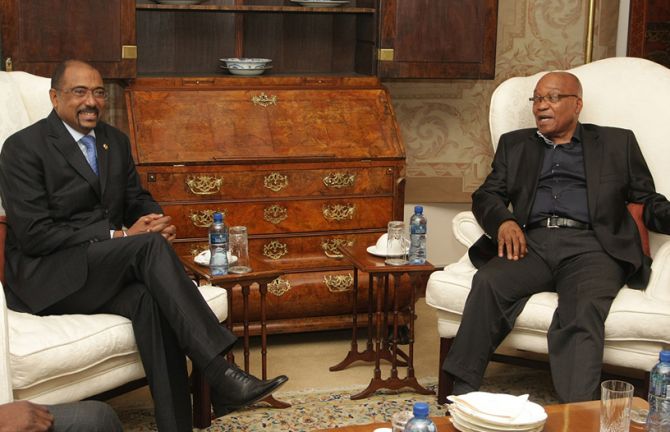
UNAIDS Executive Director, Michel Sidibé meets with the President of South Africa, Jacob Zuma at the president’s official residence in Pretoria on 18 January.
Credit: UNAIDS/ Eugene Arries
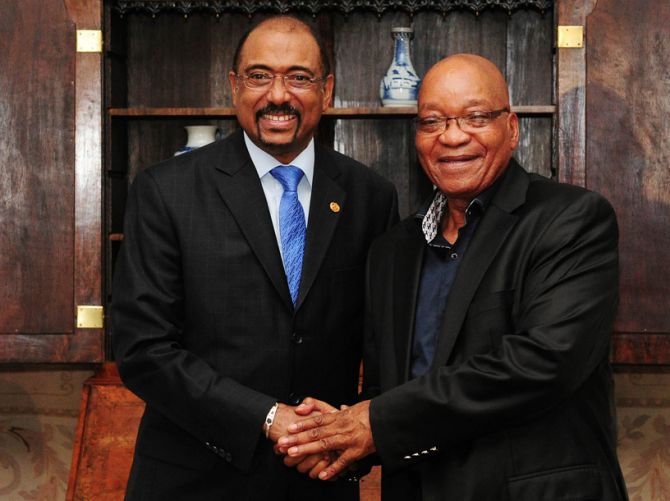
UNAIDS Executive Director, Michel Sidibé meets with the President of South Africa, Jacob Zuma at the president’s official residence in Pretoria on 18 January.
Credit: UNAIDS/ Eugene Arries
Feature Story
UNAIDS Executive Director congratulates President Jacob Zuma of South Africa on progress in the AIDS response
18 January 2013
18 January 2013 18 January 2013The President of South Africa, Jacob Zuma met with UNAIDS Executive Director, Michel Sidibé, on 18 January at the president’s official residence in Pretoria. Mr Sidibé congratulated President Zuma on the country’s achievements in the AIDS response in recent years and reiterated the support of UNAIDS. President Zuma acknowledged that although South Africa has in the past suffered from adverse policy decisions, the current leadership in the country is moving the AIDS response forward.
They discussed the role of South Africa in promoting the African Union’s Roadmap for Shared Responsibility and Global Solidarity, which outlines the long-term sustainable strategies to finance and providing access to HIV treatment and prevention services in Africa. The two leaders also talked about the need to reduce external financial dependency and use the HIV response to encourage technological innovation. South Africa is one of the few countries in Africa to produce antiretroviral medicine for HIV treatment and could serve as a model for the rest of the continent.
Mr Sidibé and the President also discussed the development agenda beyond 2015 and the influence that South Africa can have on the global debate around reaching new development goals.
Quotes
South Africa has not yet told the story of where we were to where we are now in the HIV response... this is a story that should be told. We have made great progress. Going forward, we will enlarge existing programmes and add others. We will consider seriously the goal of producing our own medicine as a continent so that more poor people can have access to live-saving antiretroviral drugs.
President Zuma has completely changed the face of the epidemic through his leadership. South Africa has managed to put 1.9 million people on treatment, more than 15 million people have tested for HIV and the price of medicine has dropped by more than 53%. South Africa is on the way to eliminate mother-to-child transmission by 2015. President Zuma's leadership is a model for others.
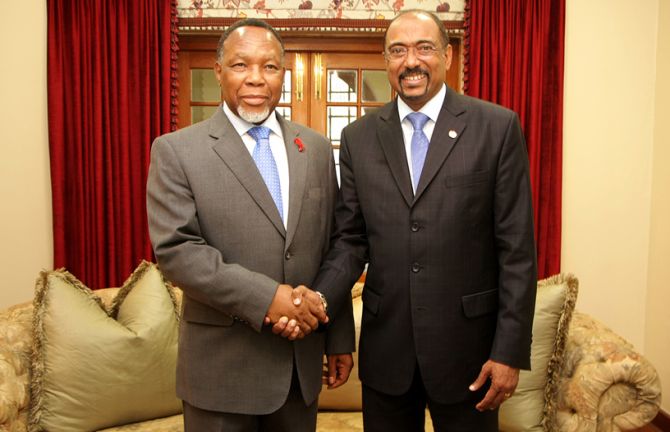
The Deputy President of South Africa, Kgalema Motlanthe meets with UNAIDS Executive Director, Michel Sidibé on 18 January 2013 in Pretoria
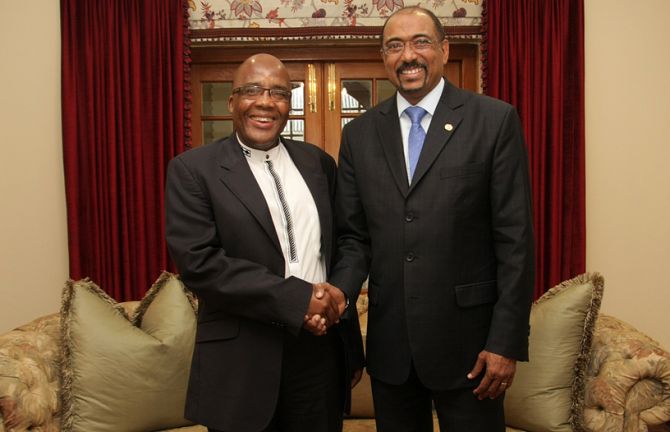
The Minister of Health of South Africa, Dr Aaron Motsoaledi meets with UNAIDS Executive Director, Michel Sidibé on 18 January 2013 in Pretoria
Feature Story
The Deputy President of South Africa reviews country’s progress in HIV response
18 January 2013
18 January 2013 18 January 2013UNAIDS Executive Director, Michel Sidibé met with the Deputy President of South Africa, Kgalema Motlanthe and the Minister of Health, Dr Aaron Motsoaledi on 18 January. The meeting began with a review of the progress made in the HIV response in South Africa in recent years. The Deputy President attributed much of the success of the country to the Health ministry and in particular, the Minister of Health. Dr Aaron Motsoaledi spoke about the country’s achievements, especially in reaching 70% of people, who need HIV treatment with life-saving antiretrovirals.
Mr Sidibé welcomed the advances the country has made but added that stigma and discrimination are still barriers to accessing treatment and that the silence surrounding people living with HIV needs to be broken.
Quotes
I thank UNAIDS for giving us the signposts to follow. The response to HIV has benefitted from UNAIDS. Without the people around me the work wouldn’t have been easy.
In April 2010, the President of South Africa launched the massive HIV Counselling and Testing Campaign. At that time we only had 923 000 people on treatment. Now we have 1.9 million people on treatment, largely thanks to the campaign. Our target for 2015 is 2.5 million people and I believe we are on course to reach that target.
We need to break the conspiracy of silence around HIV. Change will not happen if communities do not buy into it
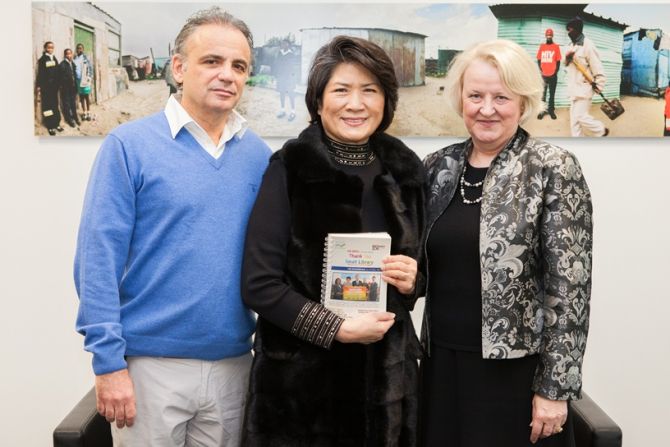
L to R: UNAIDS Deputy Executive Director, Programme, Luiz Loures, Ambassador Dho Young-shim, Chairperson, UNWTO ST-EP Foundation and UNAIDS Deputy Executive Director, Management and Governance, Jan Beagle. Credit: UNAIDS
Feature Story
The Thank You Small Library initiative provides a space for HIV prevention education
16 January 2013
16 January 2013 16 January 2013Ambassador Dho Young-shim, Chairperson, UNWTO ST-EP Foundation and MDG Advocacy Group Member met with UNAIDS Deputy Executive Directors Jan Beagle and Luiz Loures to discuss ways in which the Thank You Small Library programme can be further used as a space for HIV prevention education.
The Thank You Small Library (TYSL) initiative consists of establishing small libraries in communities as an essential basis for development. The TYSL are created in existing structures such as schools, community centers, etc. With help from different partners and sponsors involved, each library is provided with books, furniture and, depending on the location, other items such as computers, notebooks, pencils, educational posters.
On November 2011, the first UNAIDS corner was opened in the TYSL of the Dr Frans Aupa Indongo Primary School in Namibia. Since then, UNAIDS has been donating books, posters and other educational materials to selected small libraries.