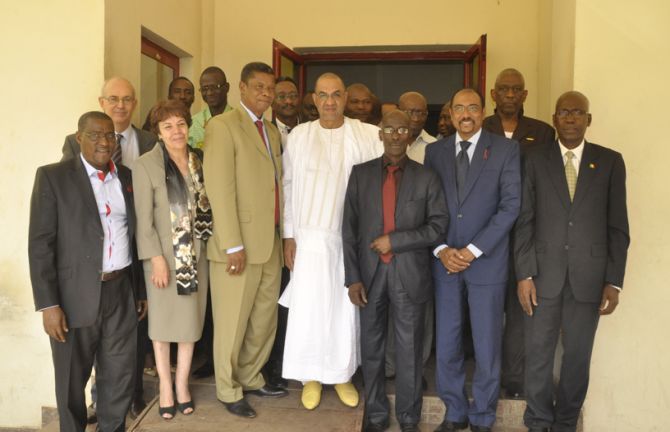
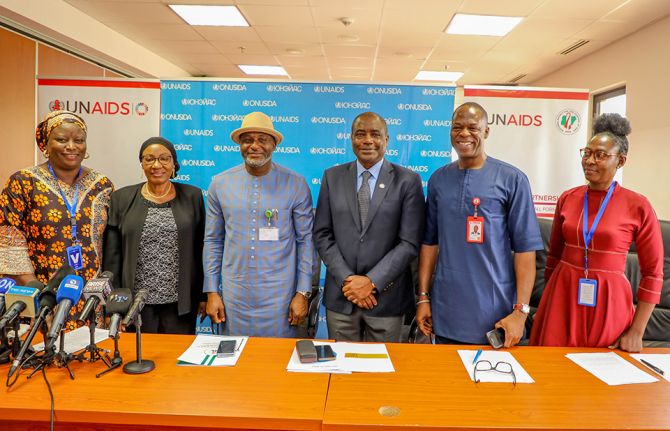
UNAIDS Executive Director with members of the Governemnt, the National AIDS Council and development partners.
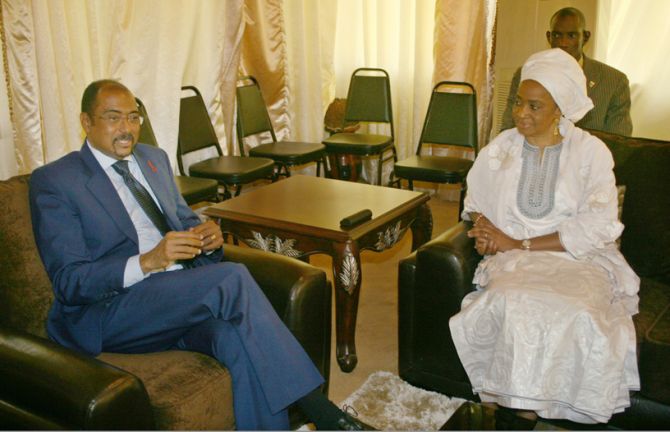
UNAIDS Executive Director Michel Sidibé with the First Lady of Mali Mrs Mintou Douncoure Traore.
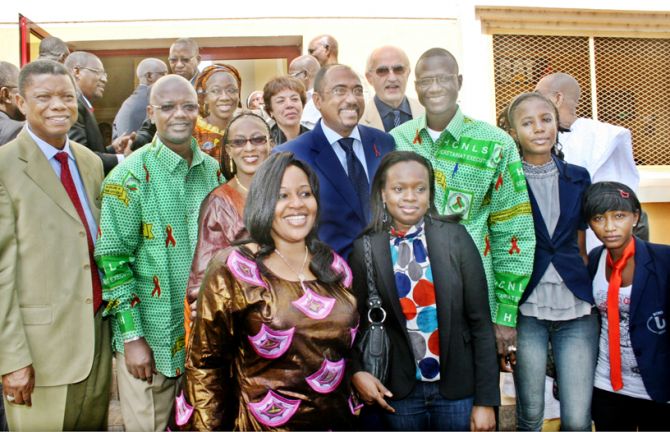
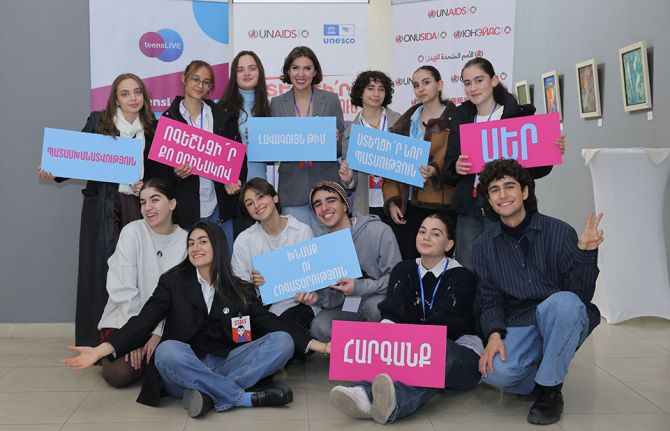
UNAIDS Executive Director with young people and people living with HIV.
Feature Story
Global Fund resumes funding of a full-scale HIV programme in Mali
11 February 2013
11 February 2013 11 February 2013The Executive Director of UNAIDS Michel Sidibé was in the Malian capital Bamako over the weekend. He was there to take part in a ceremony marking the reinstatement of funding by the Global Fund to Fight AIDS, Tuberculosis and Malaria for a full-scale HIV programme in Mali.
Under the new agreement, the Global Fund has approved funding for US$ 75 million for HIV screening, prevention and treatment in Mali over the next three years. Efforts will be increased to expand HIV prevention services, particularly to reach key populations at higher risk. A high priority will be to stop new HIV infections in children and widen voluntary testing efforts. Improvements will also be made in coordination and in monitoring and evaluation of the response to HIV in Mali.
The Global Fund announced that it would be resuming its funding in November last year after having reduced funding in 2011 when mismanagement of funds was discovered. Since then both the Government of Mali and the Global Fund have taken essential measures to restore confidence in grant management and ensure continuity of HIV services for people most in need.
Some 110 000 people are estimated to be living with HIV in Mali and 30 000 are receiving antiretroviral therapy.
Quotes
The implementation of this project is essential for Mali. It will help protect future generations by stopping new HIV infections in children and will ensure that people who are on antiretroviral therapy can continue to receive life-saving medication.
These funds will facilitate the success of our efforts for universal access to HIV prevention, treatment, care and support.
Feature Story
UNAIDS to collaborate with HSRC in HIV prevention research and policy development
08 February 2013
08 February 2013 08 February 2013
Dr Olive Shisana, Chief Executive Officer, HSRC and Professor Sheila Tlou, Director, UNAIDS Regional Support Team for Eastern and Southern Africa signing the memorandum of understanding. 30 January 2013.
UNAIDS and the Human Sciences Research Council (HSRC) have signed a memorandum of understanding to strengthen research, policies, and programmes on HIV prevention globally, with a special emphasis on Africa.
“This partnership is a unique opportunity for UNAIDS to consolidate strategic information on the AIDS epidemic and realise our common vision of zero new HIV infections, zero AIDS-related death and zero discrimination,” said Professor Sheila Tlou, Director, UNAIDS Regional Support Team for Eastern and Southern Africa.
Objectives of the collaboration include developing evidence-based HIV prevention strategies and building capacity at the national level to develop more efficient HIV policies and programmes as well as to improve programme monitoring, evaluation and reporting.
We are pleased that the HSRC’s credibility in HIV research is recognised and that we are able to make a contribution to this global effort
Dr Olive Shisana, Chief Executive Officer, HSRC
“We are pleased that the HSRC’s credibility in HIV research is recognized and that we are able to make a contribution to this global effort,” said Dr Olive Shisana, Chief Executive Officer, HSRC. “It is indeed a great honour and opportunity for the HSRC and we look forward to this collaboration.”
Based in South Africa, HSRC is a statutory research agency focusing on social sciences. It aims to serve as a knowledge hub that bridges the gap between research, policy and action through partnership with several key constituencies including government, universities, NGOs, and donor and development organizations.
External links
External links
Feature Story
Yemen: raising HIV awareness among internally displaced populations
07 February 2013
07 February 2013 07 February 2013
Community leaders representing internally displaced people meeting with representatives from the NGO, UN and government.
As the pressure for better living conditions rises in the camps in the Harad district of Yemen—Community leaders representing internally displaced people are meeting more regularly “We are 10 people in my tent; we have been waiting for new supplies to arrive, why the delay?” said one of the leaders.
The Harad camps host more than 130 000 people affected by long civil unrest in Yemen. To survive, many people walk the seven kilometres to the boarder of Saudi Arabia, hoping to cross into a country that is seen as having more economic opportunities. Others rely on daily wages from jobs at construction, agriculture and fishing sites and yet many people depend on the food provided by host local community.
But most people are not aware of their increased vulnerability to HIV infection as they sometimes resort to high-risk behaviors to meet their basic needs.
Local authorities are concerned about the lack of HIV information and have partnered with UNAIDS and the Office for the Coordination of Humanitarian Affairs (OCHA) to start an HIV awareness raising programme for displaced people.
We must promote the integration of HIV and gender-based violence activities in the overall humanitarian programme
United Nations Resident Coordinator for Yemen Ismail OuldCheikh Ahmed
“We know that HIV is escalating and can grow into a major epidemic—as we have seen this happen in other countries,” said Dr Majed Al Gonaid, Deputy Minister of Health.
Funded by OCHA, the programme is being carried out by the local NGOs Women Association for Sustainable Development (WSAD) and the For All Foundation for Development in partnership with the UNAIDS country coordinator.
The programme consists of awareness-raising sessions on HIV, sexually transmitted infections and life skills to enable young people living in the camps to protect themselves from HIV. Also, as part of the programme, 20 male and female youth peer educators from the camps as well as the host communities will be trained on HIV prevention. Sensitization sessions with religious and community leaders and local council members will also be conducted to eliminate the stigma and discrimination as well as the gender based violence faced by people in the camps. Finally, HIV voluntary counselling and testing services will be provided jointly with the awareness raising activities.
“Such initiatives should be taking place in all humanitarian programmes,” emphasized Renu Chahil-Graf, Director of the UNAIDS Regional Support Team for the Middle-East and North Africa. “We hope that it will be seen as a best practice so that we don’t need to wait—for peace to arrive to provide HIV services.”
Integrating HIV in the humanitarian response
The United Nations Resident Coordinator for Yemen Ismail OuldCheikh Ahmed has been advocating for attention to be paid to HIV. “We must promote the integration of HIV and gender-based violence activities in the overall humanitarian programme,” he said.
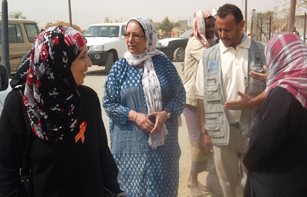
L to R: Ms Sabah Badri, Chair of NGO For All Foundation, Dr Renu Chahil-Graf, UNAIDS Middle East and North Africa Regional Director and Mr Khaled Marh, Assistant Director of the camp.
A report on AIDS, Security and Humanitarian Response presented at the 30th UNAIDS Programme Coordinating Board (June 2012) highlights that a major objective of the work of UNAIDS, its Cosponsors and partners in supporting the HIV response in humanitarian emergencies has been mainstreaming AIDS into the overall humanitarian intervention, integrating it as a cross-cutting issue. The report raises a number of concerns that governments and organizations need to take into account, such as providing refugees and internally displaced people with continued access to antiretroviral therapy and HIV prevention services, as well as strategies which deal with broader issues like gender-based violence.

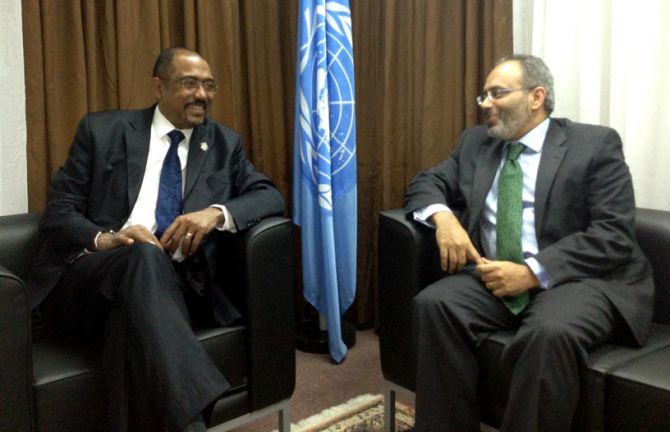
UNAIDS Executive Director Michel Sidibé meets with the Executive Secretary of the Economic Commission for Africa, Dr Carlos Lopes, on the side-lines of the African Union Summit on 26 January in Addis Ababa, Ethiopia. Credit: UNAIDS
Feature Story
UNAIDS and Economic Commission for Africa discuss ways to support Africa’s HIV response
01 February 2013
01 February 2013 01 February 2013UNAIDS Executive Director Michel Sidibé met with the Executive Secretary of the Economic Commission for Africa, Dr Carlos Lopes, on the side-lines of the African Union Summit in Addis Ababa, Ethiopia. They discussed how to support Africa’s HIV response through innovative funding mechanisms and the importance of gathering reliable data, documenting Africa’s potential to produce quality-assured medicines, including antiretroviral drugs.
Dr Lopes said he was committed to strengthening the Commission’s partnership with UNAIDS in order to provide a rigorous and consistent evidence base that can influence the policy debate on AIDS and broader health and development.
Quotes
The Economic Commission for Africa has a major role to play in Africa’s development. It can transform the development paradigm and ensure Africa’s voice is heard by the G8.
If Africa does not control the data, it cannot control the development discourse. Our ambition going forward is to strengthen the rigour and pertinence of the knowledge produced by the Commission.
Press Statement
UNAIDS congratulates Senegal’s President on his election as chair of NEPAD’s Orientation Committee
01 February 2013 01 February 2013Dr. Ibrahim Mayaki re-elected as NEPAD’s CEO
GENEVA, 1 February 2013—The United Nations Joint Programme on HIV/AIDS (UNAIDS) applauds Senegalese President Macky Sall on his election as chairperson of the New Partnership for Africa’s Development’s (NEPAD) Heads of State and Government Orientation Committee. The election took place on the fringes of the African Union Summit in Addis Ababa, Ethiopia. The high level body of 20 African leaders provides leadership and policy guidance to NEPAD.
“I congratulate President Sall on his election to this position which is key to the future of health and development in Africa,” said Michel Sidibé, UNAIDS Executive Director. “NEPAD is a critical partner of UNAIDS and is helping to drive the AIDS response forward on the continent.”
NEPAD in close cooperation with the African Union Commission, and with technical support of UNAIDS is developing the first ever accountability report on AIDS, tuberculosis and malaria in Africa, under the G8-Africa framework for 2013.
The report will assess progress, achievements and shortcomings in delivering commitments made by Africa and the G8 on the three diseases since African Union Heads of State and Government adopted the Abuja Declaration on HIV/AIDS, Tuberculosis (TB) and Other Infectious Diseases in 2001.
President Sall has been an important supporter of the AIDS response. Under his leadership, Senegal’s HIV response has continued to make progress. HIV prevalence is low and the country has made major efforts in the past five years to scale-up access to HIV prevention, treatment, care and support.
NEPAD members also re-elected Dr. Ibrahim Mayaki as Chief Executive Officer. The former Prime Minister of Niger has had a pivotal role in developing the African Union Roadmap on Shared Responsibility and Global Solidarity which calls for innovative solutions to accelerate the response to AIDS, TB and malaria.
Last year, UNAIDS and NEPAD signed a memorandum of understanding calling for strategic collaboration to advance sustainable responses to HIV, health and development across Africa.
Press centre
Download the printable version (PDF)
Feature Story
African Society of Gynaecologists and Obstetricians meets in Niger
29 January 2013
29 January 2013 29 January 2013
UNAIDS Deputy Executive Director, Programme, Dr Luiz Loures and President of Niger H.E. Mahamadou Issoufou.
The annual congress of the African Society of Gynaecologists and Obstetricians (Société Africaine des Gynécologues et Obstétriciens – SAGO) took place in Niger from 21-23 January 2013 under the theme “Mortality Costs and Maternal and Neonatal Morbidity in Africa”. The meeting was attended by the Prime Minister of Niger, and first ladies of Niger, Burkina Faso and Mali. The UNAIDS Deputy Executive Director, Programme, Dr Luiz Loures also participated in the congress as part of his official visit to the country.
Launched in 1988 by African ob-gyns to strengthen scientific discourse and eliminate barriers between African scientists, SAGO members comprise countries mostly from west and central Africa. Focussing on the Millennium Development Goals (MDG) 4 and 5 to reduce child and maternal mortality rates by 2015, SAGO aims to define standards of practice for gynaecologists and obstetricians.

First Lady of Niger Malika Issoufou Mahamadou with UNAIDS Deputy Executive Director, Programme, Dr Luiz Loures.
The Prime Minister of Niger, His Excellency Brigi Rafin said that the Congress was held at a time where surveys show weak progress in reducing maternal and neonatal morbidity and mortality in Sub-Saharan countries. "Every day 24 women die giving birth and 72 newborn children die in my country," he said.
Niger has made considerable progress in maternal and child health because of its policies, resources and strategies, outstripping other countries in the region. Government scale up of high-impact child health services, including eliminating user fees for pregnant women and children and strengthening child nutrition, has brought down annual mortality rate by 5.1%.
Dr Loures pegged these achievements to the country’s transformative and visionary political commitment, backed by judicious budgetary decisions and a focus on high impact strategies for maternal and child health.
A joint agreement of cooperation was signed UNAIDS and SAGO to accelerate the implementation of the Global Plan to eliminate new HIV infections among children and keeping their mothers alive. “The promotion of maternal and child health is the basis for the achievement of the Global Plan,” said Dr Loures.
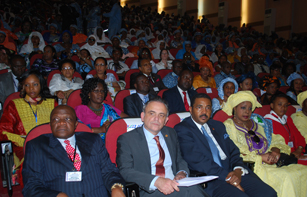
Annual congress of the African Society of Gynaecologists and Obstetricians, Niger, 21-23 January 2013.
According to Dr Loures, professional organisations such as SAGO are uniquely placed to advocate for the rights of their patients and clients, particularly women living with HIV. These organizations can ensure that women are not stigmatized, their confidentiality is not violated, or that they are not forced and coerced into accepting services. They can serve as a collective workforce towards achieving the health MDGs and also provide a forum to expand knowledge, exchange information and legitimise and amplify the contribution of the members.

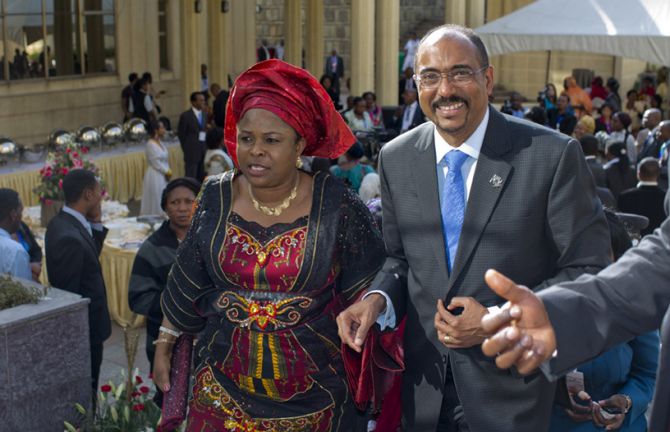
UNAIDS Executive Director, Michel Sidibé leaving Organisation of African First Ladies against HIV and AIDS 10 year anniversary celebration with First Lady of Nigeria, Patience Jonathan on 28 January 2013. UNAIDS/J.Ose
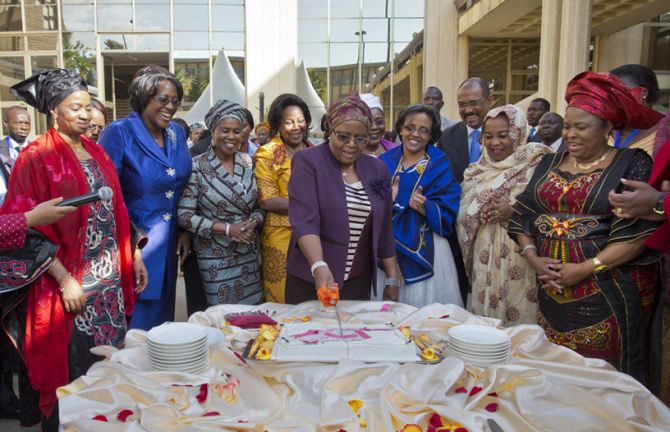
President of OAFLA and First Lady of Namibia, Penehupifo Pohamba, cutting anniversary cake with other First Ladies and UNAIDS Executive Director, Michel Sidibé on 28 January 2013. UNAIDS/J.Ose
Feature Story
African First Ladies come together to mark a decade of work in the AIDS response
29 January 2013
29 January 2013 29 January 2013The Organization of African First Ladies against HIV/AIDS (OAFLA) came together on 28 January to mark its 10-year anniversary and held its annual Extra Ordinary General Assembly on the side-lines of the African Union Summit in Addis Ababa, Ethiopia. UNAIDS Executive Director Michel Sidibé attended the anniversary luncheon and congratulated the organization for its contribution to the AIDS response.
OAFLA was established in 2002 by 37 First Ladies from Africa committed to take action against AIDS and improve the lives of women, young people and children. Women account for 58% of people living with HIV in sub-Saharan Africa.
The First Ladies of Africa, together with national partners have launched many high impact campaigns, including ‘FLAME’ which kicked off in 2011 in nine countries to promote the virtual elimination of new HIV infections among children and keeping their mothers alive.
Led by the First Lady of Namibia, Penehupifo Pohamba, OAFLA currently has 40 First Ladies from the continent as signatories to the organization.
Quotes
As we are celebrating, we are as well commemorating the decade of a long story, where millions of lives were lost, families destroyed and nations shaken. This is a celebration of hope for a new era and a new generation, which will be free of the HIV virus among new born babies.
First Ladies have influenced the political dialogue in their countries with excellent results. Few can ever have the impact of OAFLA and we count you as a critical partner today and the future.
Related
Vote to end AIDS
Feature Story
Vote to end AIDS
30 January 2013
30 January 2013 30 January 2013Make your voice heard.
The United Nations has launched a broad consultation process for the next global development goals.
The original Millennium Development Goals that Member States agreed to in 2000 include a goal focused on the AIDS response.
As part of the outreach effort the UN announced an online crowdsourcing platform called My World where people can prioritize issues and share ideas.
MY World gives people the option to vote on 16 different issues to prioritize and there is an option to ‘SUGGEST a priority’. Ending AIDS is not part of the 16 voting options.
A “get out the vote” campaign has been launched to help make Ending AIDS a priority. Everyone who feels that AIDS should be one of the top issues can write-in “End AIDS”.
MY World will show how votes are trending and use the data to help inform wider consultations on the road to the new global goals.
Quotes
The AIDS epidemic has been one of the defining issues of our time. Like going to the moon, ending AIDS is a dream that is possible. We are on the cusp of reaching the response’s full potential for saving lives. Now is the time to recommit to making this dream come true.
Ending AIDS can be a reality but only if the international community names it as a priority in the post-2015 agenda. If we lose the focus on AIDS, it will not be possible to capitalize on the tools that have been developed to halt infection and keep people living with HIV alive.
Ending AIDS is an essential component for international development now and post 2015. The AIDS response has contributed to the health infrastructure in countries and has stopped unnecessary deaths and new infections. The challenge will continue after 2015 to prevent new infections, support people living with HIV and integrate with other health services.
The community of people living with HIV has significantly contributed to and benefited from progress since the MDGs were put in place, including advancements in treatment and prevention that will contribute to Ending AIDS. After 2015, it is essential that Ending AIDS remains a critical part of the development issues in order to translate success and make real sustainable links with other development issues.
I voted for the end of AIDS! Because it is too early to give up, we are getting results now. Young people still need our commitment!
30 years of HIV has seen great strides in keeping many people living with HIV alive. At the beginning of the forth decade, we know enough to keep all people living with HIV alive, provide HIV treatment to all people in need and to eliminate all new HIV infections among children.
The AIDS epidemic has defined our generation, ending the life of millions of young people in the last decades. The end of AIDS must be a goal for humanity. We need everyone's commitment to make the dream of a world free of AIDS become a reality soon
With my Kora I tell the story, with my vote I help make change happen. I voted against AIDS! You too can make history happen by telling the story and voting to 'END AIDS'.
I voted to end AIDS. Join my team and do the same!! AIDS is everybody's business.
The world has invested billions of dollars to halt and reverse the spread of HIV. We have come close to doing that and need to sustain the gains made. That is why I voted.
We, as a global community, have the opportunity to better the lives of individuals and families all around the world. When we come together in support of a common cause, our potential for impact has no bounds. Join me in supporting young people to lead healthy, HIV-free lives. Vote to end AIDS.


Feature Story
President of South Africa says Africa must deal effectively with HIV to reduce maternal mortality on the side-lines of the African Union Summit
28 January 2013
28 January 2013 28 January 2013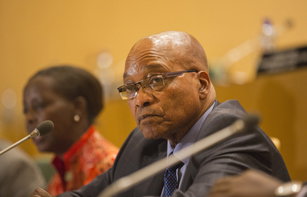
South Africa’s President Jacob Zuma at the New Partnership for Africa’s Development meeting held on the side-lines of 20th African Union Summit in Addis Ababa, Ethiopia on 26 January 2013. Credit:UNAIDS/J.Ose
South Africa’s President Jacob Zuma called on African leaders to effectively deal with HIV and as such eliminate one of the main causes of maternal deaths on the continent.
Addressing the Campaign for Accelerated Reduction of Maternal Mortality in Africa (CARMMA), President Zuma was one of more than 15 Heads of State and policy makers who participated in the High-Level Meeting. The African leaders reviewed past successes and future opportunities for reducing maternal and child mortality in Africa.
“HIV still contributes to about 40% of maternal and child deaths in South Africa. This means that unless we deal decisively with HIV we will not be able to reduce maternal and child mortality to any significant extent,” said President Zuma.
He declared that the extent of the HIV epidemic and decreasing donor funding makes it imperative for Africa to develop its local capacities to produce antiretrovirals for HIV treatment as well as male and female condoms.
“We need to ensure that we can sustain the gains that we have made as reported in the 2012 Global AIDS Report prepared by the UNAIDS, and that we are able to expand access to commodities like condoms and medicines and antiretrovirals,” underscored President Zuma.
Speaking alongside President Zuma, the outgoing Chair of the African Union and President of Benin, Dr Thomas Boni Yayi said thanks to incredible leadership, African countries have turned the story of AIDS from tragedy to hope.
Dr Boni Yayi said “breakthroughs in prevention and treatment have been rolled out, contributing to achievements in several countries.” But he said, “Despite these gains, AIDS is far from over and complacency and competing priorities meant that “we must remain vigilant and committed today, more than ever”.
HIV still contributes to about 40% of maternal and child deaths in South Africa. This means that unless we deal decisively with HIV we will not be able to reduce maternal and child mortality to any significant extent.
Jacob Zuma, South Africa’s President
Benin’s President also pointed to the initiative Roadmap on Shared Responsibility and Global Solidarity, adopted by the African Union in July 2012 as a response to the challenge. “Our Roadmap on Shared Responsibility and Global Solidarity is a new course for our Continent’s response to AIDS, TB and malaria,” said Dr Boni Yayi. “It optimizes the returns from AIDS investments, boosts capacity on the African continent to manufacture essential quality-assured medicines, strengthens mutual accountability and enhances governance.”
According to the World Health Organization’s report, “Trends in Maternal Mortality”, Africa has reduced maternal mortality by 41% and mortality of children under the age of five by 33% between 1990 and 2010.
The Chairperson of the African Union Commission, Dr Nkosazana Dlamini-Zuma emphasized that as Africa celebrates its progress, it must also reassess the persistent challenges to find comprehensive solutions. “We need to adopt an integrated approach to reducing maternal, new-born and child mortality within the overall continuum of care,” she said. “The impact of our combined efforts shall be much greater than the sum of our individual efforts.”
In May 2009, the Conference of Africa Union Ministers of Health launched CARMMA under the theme of “Universal Access to Quality Services: Improve Maternal, Neonatal and Child Health”; with the slogan “Africa cares; no woman should die giving life.” 37 countries have implemented the initiative at a national level, galvanising high level political commitment, country ownership, and social mobilization for maternal, new-born and child health issues in Africa.
The meeting took place on the side-lines of the 20th African Union Summit held in Addis Ababa, Ethiopia where the United Nations Secretary-General Ban Ki-moon addressed the opening.
Ending AIDS in Africa
Mr Ban commended the incredible leadership that enabled Africa to make tremendous progress in reducing new HIV infections and AIDS-related deaths. He said the progress was due to “good policies, strong leadership and global partnerships as well as scientific advances,” and he added, “The UN will continue to support you as we work for an AIDS-free generation, especially by ending HIV in new-borns.”
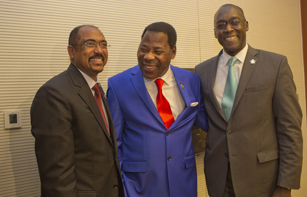
UNAIDS Executive Director Michel Sidibé meets with President of Benin, Dr Thomas Boni Yayi, and Vice President, Africa, World bank, Makhtar Diop, at the 20th African Union Summit in Addis, 27 January 2013. Credit: UNAIDS/J.Ose
Africa has made remarkable progress in the AIDS response. According to the UNAIDS World AIDS Day 2012 Report, new HIV infections dropped by 50% in 13 countries across Africa. The number of children newly infected with HIV, in sub-Saharan Africa fell by 24% between 2009 and 2011.
While acknowledging Africa’s gains towards the Millennium Development Goals (MDGs), Mr Ban raised his concerns over the remaining challenges. “I am still concerned about the hundreds of millions of Africans living in poverty,” said Mr Ban. “We must accelerate our efforts as we near the 2015 deadline.”
He called on African leaders to participate in the Special Event on the Millennium Development Goals at the United Nations General Assembly in September 2013, where world leaders convene to deliberate on MDG targets and the Post 2015 development agenda.
Delivering on Africa’s commitments
The opening of the AU Summit was preceded by the NEPAD Heads of State and Government Orientation Committee (HSGOC) Meeting. Addressing the meeting, NEPAD’s Chief Executive Officer Dr Ibrahim Mayaki stressed the need for continued advocacy for mutual accountability and the fulfilment of past commitments by development partners in Africa. “We are engaging the African Union Commission and UNAIDS on an Accountability report to combat HIV and AIDS, Tuberculosis and Malaria under the G8-Africa framework for 2013,” said Dr Mayaki.
Feature Story
University of Senghor master’s degree programme in International Health includes module on HIV for second year running
25 January 2013
25 January 2013 25 January 2013
Students that have completed the course on HIV as part of their Master’s Degree in International Health at the Senghor University.
Credit: Senghor University
More than 35 students from 22 countries across sub-Saharan Africa, the Middle East and North Africa, Haiti and France have completed a course on HIV as part of their Master’s Degree in International Health at the Senghor University based in Alexandria. The module was established by UNAIDS and the Department of Health at the University in 2011 in a bid to give students a better understanding of the complexities of the global response to HIV.
This is the second year that students have participated in the programme. “I welcome this strong cooperation between UNAIDS and the Senghor University,” said Professor Albert Lourde, Rector of the Senghor University. “It shows how Francophone expertise is unique and how we need to encourage education and knowledge sharing across Francophone countries to effectively deal with issues related to HIV.”
The course comprises of 10 sessions which aim to strengthen the student’s scientific and global public health knowledge and enable them to support their national AIDS responses once they return to their home countries. This year’s course included sessions on sharing epidemiology and medical knowledge on HIV and the contribution of communities and civil society to the AIDS response.
I welcome this strong cooperation between UNAIDS and the Senghor University. It shows how Francophone expertise is unique and how we need to encourage education and knowledge sharing across Francophone countries to effectively deal with issues related to HIV
Professor Albert Lourde, Rector of the Senghor University
During the course, students were encouraged to reflect on some of the major challenges to achieving the targets and commitments in the 2011 United Nations Political Declaration on HIV/AIDS. The course concluded with an interactive video-conference opened by Professor Lourde that highlighted the major international initiatives to promote effective and efficient responses to HIV. These include an initiative that aims to ensure 15 million people are on antiretroviral treatment by 2015 as well as the Global Plan towards the elimination of new HIV infections among children by 2015 and keeping their mothers alive. During the conference, participants also discussed human rights in the context of HIV and analyzed the specific challenges faced by the West and Central African region.
As part of the programme some of the students had the opportunity to complete a mandatory three month internship at UNAIDS offices in West and Central Africa and the Middle East and North Africa where they learnt first-hand about the complexities of responding to HIV. UNAIDS will continue its partnership with the University to ensure that AIDS remains as part of the curriculum of its Master’s degree in International Health programme as the university expands its campuses to other French speaking countries throughout Africa.