Feature Story
AIDS 2012 ends with push towards 2015 global AIDS targets
27 July 2012
27 July 2012 27 July 2012
Bill Clinton addressing delegates at the closing session of the XIX International AIDS Conference in Washington, D.C. The conference was held from 22-27 July.
Credit: UNAIDS/C.Kleponis
The XIX International AIDS Conference concluded in Washington, DC on Friday after five days of hundreds of sessions, programme activities, workshops, poster presentations and side-events aimed at bringing forward the latest thinking and developments in the global HIV response.
The conference, which opened on 22 July, was organized under the theme “Turning the Tide Together.” Presenters at AIDS 2012, from senior government officials and heads of international organizations to civil society leaders and scientists, all echoed that for the first time in the history of AIDS, an end to the epidemic is on the horizon. However, speakers cautioned that there are still numerous challenges that must be addressed before the international community reaches zero new HIV infections and zero AIDS-related deaths.
Throughout the conference, much attention focused on the 10 global AIDS targets agreed upon by UN Member States at the UN High Level Meeting on AIDS held in June 2011—in particular the goal of eliminating new HIV infections among children, reducing sexual transmission of HIV by 50% and getting 15 million people on HIV treatment, all by 2015. Representatives of both international organizations and civil society stressed that unless investments in the HIV response are increased, the goals will not be realized.
Of the 16.8 billion dollars now being invested annually in this effort more than half of it comes from the affected countries themselves and they deserve an enormous amount of credit for that.
President Bill Clinton
Ahead of AIDS 2012, UNAIDS released a new report, titled Together we will end AIDS, that outlined the recent gains made in achieving the global AIDS targets, including increases in HIV treatment coverage and domestic investments in low- and middle-income countries.
Leaders reiterate commitment to an AIDS-free generation
The conference also provided an opportunity for many people from the worlds of politics, science, civil society and the arts to reiterate their support to the effort to end new HIV infections among children by 2015 and keep their mothers alive. An event held on the eve of the conference, Uniting for an AIDS-free generation, brought together musicians, politicians, scientists and activists to rally more support for the goal.

Elly Katabira, IAS President and AIDS 2012 Chair, introducing Nobel Laureate Françoise Barré-Sinoussi, Incoming President of the IAS.
At the conference, several sessions focused on sharing progress to date in stopping mother to child transmission of HIV. UNAIDS Executive Director Michel Sidibé, and Ambassador Eric Goosby, U.S. Global AIDS Coordinator, participated in many events to update partners on the Global Plan, a joint initiative focusing on the 22 countries in which 90% of new HIV infections in children occur, 21 of which are in sub-Saharan Africa.
AIDS 2012 concludes, delegates look to AIDS 2014
The closing session on 27 July featured several addresses from prominent advocates in the global HIV response. Speakers included: Diane Havlir, AIDS 2012 U.S. Co-Chair; Nancy Pelosi, Minority Leader, US House of Representatives; Anna Zakowicz, Global Network of People Living with HIV (GNP+); Elly Katabira, IAS President and AIDS 2012 Chair; Nobel Laureate Françoise Barré-Sinoussi, Incoming President of the IAS; Tanya Plibersek, Australian Minister of Health; and President Bill Clinton.
At the end of the opening session, the conference was handed over to officials representing the organizing committee of the XX International AIDS Conference, which will be held in Melbourne, Australia in 2014.
AIDS 2012 was the first International AIDS Conference to be held in the US in 22 years. The decision by President Obama to lift an HIV travel ban in 2009 was widely acclaimed by all delegates, as a sign of the continued bi-partisan commitment of the US government in responding to HIV, both domestically and internationally.
An estimated 23 000 participants from some 200 countries, and 1800 media representatives attended AIDS 2012. Hundreds of sessions, programme activities, workshops, poster presentations and side-events were held between 22-27 July.
Related
 A tribute to Maeve Kennedy Townsend McKean
09 April 2020
 UNAIDS is awarded the Science and Medicine Award at the 25th Annual Steve Chase Awards
12 February 2019
 AIDS care in the Californian desert
12 February 2019
Feature Story
African leaders highlight progress and challenges in HIV responses
26 July 2012
26 July 2012 26 July 2012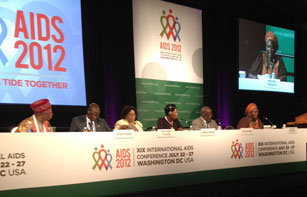
Members of the High-Level panel participating in the session to assess progress made against AIDS and challenges remaining. Washington DC, 26 July 2012. Credit: UNAIDS
How have countries across sub-Saharan Africa fared in responding to the HIV epidemic? What further actions are needed to reach the goal of universal access to HIV prevention, treatment, care and support in the region? These were among the key questions addressed by a high-level panel of African leaders at the XIX International AIDS Conference in Washington DC.
The co-chairs of the panel session—Robert Soudre, President of the Society for AIDS in Africa, and Morolake Odetoyinbo, Chief Executive Officer of Positive Action for Treatment Access, a Nigerian non-governmental organization—noted in their opening remarks the significant strides in reducing new HIV infections and expanding access to HIV treatment across the continent.
Over the past decade, the rate of new HIV infections has declined by more than 25% in 22 countries of sub-Saharan Africa. An estimated 6.2 million people in the region were receiving antiretroviral therapy in 2011—up from just 100 000 in 2003. The most dramatic progress was seen in South Africa, where at least 300 000 people were newly enrolled in HIV treatment in 2011 alone.
Effective prevention programmes are an unfailing vehicle that will take us to the elimination of mother-to-child transmission and to zero new HIV infections among children
Madame Penehupifo Pohamba, First Lady of Namibia and Chair of the Organization of African First Ladies against HIV/AIDS
Jackline Akinyi Odongo, Mentor Mother with the Mothers2Mothers peer-support group at the Nyanza Provincial Hospital in Kenya, described her despair when she found that she was HIV positive and pregnant. She joined the support group, followed guidelines for prevention of mother-to-child transmission of HIV, and took her antiretroviral medications regularly. Her daughter was born HIV-negative.
Madame Penehupifo Pohamba, First Lady of Namibia and Chair of the Organization of African First Ladies against HIV/AIDS, highlighted the considerable gains in reducing new HIV infections among children. About 300 000 children were newly infected with HIV in sub-Saharan Africa in 2011—a 26% decline since 2009. However, more than 90% of children living with HIV globally continue to reside in sub-Saharan Africa.
Madame Pohamba called for strengthening the African ladies' role in promoting the elimination of new HIV infection among children by 2015. “Effective prevention programmes are an unfailing vehicle that will take us to the elimination of mother-to-child transmission and to zero new HIV infections among children,” she said.
Alioune Gueye, President of the West African Youth Leadership Network for the Millennium Development Goals, emphasized the critical role that youth can play in the continent’s HIV prevention revolution. “Young people are at the centre of the AIDS epidemic and youth-led initiatives deserve encouragement and support at the national and international level,” said Mr Gueye.
Between 2001 and 2010, HIV prevalence declined among young people (aged 15-24) in at least 21 of 24 countries with a high HIV burden. However, an estimated 2 400 new HIV infections occur each day in this population.
Organized by the Sub-Saharan Africa Work Group of the AIDS 2012 conference, the High-Level panel also sought to identify set of practical solutions to bring about progress across health and development. Speaking on behalf of the UNAIDS Executive Director, Dr Djibril Diallo, UNAIDS Senior Advisor and Chair of the Sub-Saharan Africa Work Group, emphasized that cooperation between UNAIDS, the African Union and the New Partnership for Africa's Development (NEPAD) led to adopting the landmark roadmap on shared responsibility and global solidarity at the AU Summit this month.
He noted that the Roadmap promotes African-owned solutions which will reinforce the response to AIDS; defines clear goals, expected results and defines role and responsibilities for each stakeholder; and is structured around three pillars: health governance, diversified financing and access to medicine.
Related
Feature Story
Mogadishu – HIV in a time of unrest
27 July 2012
27 July 2012 27 July 2012
Internally displaced woman with 8 day old baby
Credit: UNAIDS
“I want my child to be born HIV negative”, said Mr Mohamoud Mohamed Ahmed, accompanied by his smiling and visibly pregnant wife, Mrs Nasteho Farah Elmi, at a recent discussion with people living with HIV in Mogadishu. This bullet-ridden, crumbling city has a network of five hundred people living with HIV. Created by the South Central AIDS Commission of Somalia, its proactive Director, Mr Ahmed Mohamed Jimale, solves such concerns by directing women to clinics for the prevention of transmission of HIV from the mother to her unborn child. But, there is much frustration due to lack of funding for such services.
Little is known about HIV in Somalia – and even less so in Mogadishu, security concerns limiting the collection of data. The most recent verifiable data obtained was in 2004. Since then, estimates of 0.7% to 1% prevalence have been assumed. However, analysis of data from Voluntary Counselling and Testing Centres and in Tuberculosis clinics indicate HIV infection rates of up to 18% among people with TB and 5.2% among female sex workers. Throughout Somalia conditions exist for a growing epidemic: increased trade, migration and the sprouting of sex work at borders and ports.
The Minister of Women’s Development and Family Care, Mrs Maryam Aweis Jama, expresses deep concern about the lack of resources: “The Somali government has negligible resources for running the government, leave alone funding HIV programmes. We urgently need resources to fight stigma, discrimination and violence towards women living with HIV and their families”. Religious leaders – both male and female – are increasingly active in raising awareness of HIV issues. “We, as religious leaders, can have a major influence on society by creating awareness of HIV issues at Friday sermons”, says Mr Sharif Ibrahim Abdullahi. A woman religious leader, Mrs Hawo Siidow Abdi, reinforces this, saying that she speaks to women in mosques on a one to one basis to assist them to better understand the HIV epidemic. Ms Hind Khatib, Director, UNAIDS Middle-East and North Africa Regional Support Team said, “It is gratifying to know that these religious leaders, after participating in regional HIV training events, carry back messages to their communities.”
With the relative improvement of security in Mogadishu, the city is attracting a growing number of internally displaced persons in search of better livelihoods. They live under dire conditions, with little protection or access to basic services. World Food Programme feeding centres service the displaced and vulnerable populations. “The large numbers of people at these feeding sites could be a prime target for HIV education”, noted Mr. Kilian Kleinschmidt, the United Nations Deputy Humanitarian Coordinator, during a recent site visit.
Mogadishu is characterized by a highly militarized environment with police and militia evident everywhere. Mr Abdinor Osman Weheliya, of the NGO, Organisation for Somalis Protection and Development, said that often in the evenings women stand outside the military installations in search of an opportunity to exchange sex for survival money, making them highly vulnerable to HIV infection.
Most seriously, among communities visited and in the general population, there is a stark lack of awareness and understanding of the HIV epidemic. “If prevention of HIV is not undertaken with an immediacy and urgency, HIV could be another time bomb waiting to explode in Mogadishu” said Dr Renu Chahil-Graf, UNAIDS County Coordinator for Somalia.
Related


Feature Story
CONDOMIZE! Campaign hits AIDS 2012
24 July 2012
24 July 2012 24 July 2012
The CONDOMIZE! Campaign seeks to raise awareness about the importance of condom use in a lively and engaging way.
Credit: Scott Henderson
There is a renewed emphasis on condoms at the XIX International AIDS Conference being held in Washington, DC from 22-27 July as a campaign promoting their use and availability has been re-launched with the distribution of 850 000 condoms.
The CONDOMIZE! Campaign aims to highlight the effectiveness of condoms, male and female, for HIV prevention and calls on governments, donors and users to intensify access to, and demand for, quality condoms as a primary defence against HIV. It advocates investing significant resources and materials into promoting condom use as the most efficient and available prevention technology in the global AIDS response. Challenging the stigma that still often surrounds condoms is also a key objective.
“Let us not forget that the condom remains the cheapest and highly effective method we have to stop the spread of HIV,” said UNAIDS Executive Director Michel Sidibé championing the importance of condoms during his opening speech at the conference. “It is time for all of us to condomize!,” he added.
The initiative was born during the 2010 International AIDS Conference in Vienna and is a partnership between UNFPA and The Condom Project, in close collaboration with Bahamas Red Cross; DKT International, a social marketing NGO; Durex, the Female Health Company, the International AIDS Society and UNAIDS.
In addition to mass condom distribution, rap music with short videos has been created, using key messages from senior international leaders about the importance of condom use. These messages are being shown on TV screens throughout the conference.
Franck DeRose, Executive Director of the Condom Project and Global Coordinator of the CONDOMIZE! Campaign, says “In a modern and exciting way, we are helping people understand very serious issues and the need to promote condom use. We must ensure that those who need condoms can access them when they need them and where they feel most comfortable. The awareness campaign at AIDS 2012 is one step towards making this happen.”
Let us not forget that the condom remains the cheapest and most effective weapon we have to stop the spread of HIV. It is time for all of us to condomize!
UNAIDS Executive Director Michel Sidibé
The campaign noted that there is a considerable shortfall in condom availability in a number of countries. For example, in 2011 in sub-Saharan Africa there were only nine condoms available per man per year and only one female condom for every 10 women. These condoms were mostly provided by donors as most low- and middle-income countries do not have a budget line for condom procurement.
According to UNFPA more support and funding are needed from governments themselves to increase the availability of male and female condoms. They should create awareness initiatives and encourage people to use condoms as an important facet of a combination HIV prevention approach which uses all proven methods of avoiding infection.
“We know that sexual transmission accounts for more than 80% of new HIV infections worldwide – if we increase protected sex, we could reduce HIV incidence,” said Bidia Deperthes, UNFPA’s Senior HIV Technical Advisor.
The social marketing of these commodities is highlighted by the involvement of DKT International whose President Philip Harvey says he wants to make condoms as “attractive and convenient to buy as Coca-Cola”. Condoms manufacturer Durex welcomes the chance to be involved in such an awareness-raising intervention. Charles Shepherd, the company’s Head of Health Promotion comments: “We are delighted to help, not only by donating half a million condoms for the CONDOMIZE! programme at AIDS 2012, but also engaging with the educational sessions.”
Organisers say there has already been a great deal of interest shown with many conference participants urging them to roll out the campaign at country level.
External links



Feature Story
Sex workers demand respect for their fundamental rights in a parallel summit to the AIDS 2012
25 July 2012
25 July 2012 25 July 2012
Sex worker initiative Veshya Anyay Mukti Parishad (VAMP) give a performance at the opening of the Sex Workers’ Freedom Festival in Kolkata, India.
Credit : UNFPA/J.Cabassi
As thousands of delegates gather for the XIX International AIDS Conference (AIDS 2012) in Washington, D.C. this week, a parallel satellite hub, the Sex Worker Freedom Festival, is taking place in Kolkata, India, from 22-26 July.
The event brings together over 600 sex workers, international and national partners from more than 40 countries. The Freedom Festival has been organized by sex workers as a response to extensive visa regulations for sex workers and people who use drugs, which may have prevented many from attending the International AIDS Conference event in Washington DC. The five-day festival gives participants the opportunity to be part of the Washington event through video-conferencing link up with major conference sessions and with the Global Village.
“The Sex Worker Freedom Festival is an alternative event for sex workers and our allies to protest our exclusion and ensure the voices of those excluded are heard in Washington.” said Ruth Morgan the Global Coordinator of the Global Network of Sex Work Projects (NSWP) and Co-Organizer of the Kolkata event.
Speaking at the opening of the Kolkata hub, United Nations Secretary General’s Special Envoy on AIDS in Asia and the Pacific, Prasada Rao, stressed that freedoms and rights of sex workers are being denied on a daily basis.
“Aspects of sex work are criminalized in 116 countries around the world. Laws in many countries conflate adult consensual sex work with human trafficking. Routine police raids, often in the name of anti-trafficking, lead to arrest and harassment of adult consenting sex workers,” said Mr Rao. “These discriminatory practices drive sex workers to social exclusion and into a socially disadvantageous position, accentuating their vulnerability to HIV,” he added.
Despite progress made in reducing the spread of HIV within sex work communities, sex workers are still at increased risk of HIV infection. In the Asia-Pacific region for example, while a number of countries have reduced their HIV infection rates with intensive HIV prevention programmes among people who buy and sell sex, hotspots of high prevalence remain. Surveys of female sex workers in India show prevalence of 18% in Maharashtra and 41% in Pune—the overall adult level in the country is an estimated 0.3%.
Sharing experiences, driving progress
The Sex Worker Freedom Festival programme is structured around fundamental freedoms; human rights that all people are entitled to. These include freedom of movement; freedom to access quality health services; freedom to work and choose occupation; freedom to unionise; freedom to be protected by the law; freedom from violence; and freedom from stigma and discrimination.The Festival aims to facilitate the sharing of experiences as well as dialogue around key issues and priorities for the sex work community and HIV programming.
“Without the right to organize and unionize the sex worker community cannot advance our rights,” stated Bharati Dey, General Secretary, Durbar Mahila Samanwaya Committee (DMSC), co-organizer of the Kolkata Hub.
Discriminatory practices drive sex workers to social exclusion and into a socially disadvantageous position. This accentuates vulnerability to HIV
United Nations Secretary General’s Special Envoy on AIDS in Asia and the Pacific, Prasada Rao
The stigma and discrimination experienced by sex workers was identified as a major obstacle to an effective response to AIDS. “Every day and in every location, we have to battle against stigma and discrimination,” said Lakshmi, a sex worker and the Director of Programmes at the Ashodaya sex worker initiative in Mysore, India, said. “We have found a way to be part of the solution. Our team of HIV positive sex worker volunteers has built an effective partnership between communities and health services. This has changed attitudes of health care providers and has created community confidence to access health services.”
Annah Pickering, a sex worker and Manager of the Auckland Region, New Zealand Prostitutes Collective, underlined the multiple benefits of decriminalization of sex work in her country, both for sex worker rights and the HIV response. “We appreciate many legal freedoms. We can report corrupt officials who demand free sex. We don’t hide our condoms in our bras or behind the picture or in the thermos flask. We can put up signs and promote safe sex and insist on it. Does decriminalising sex work prevent the transmission of HIV? I strongly believe so. When you put all these elements together they contribute significantly to support sex workers in preventing the transmission of HIV,” she said.
A central theme of discussions at the Kolkata Hub has been the widespread experiences of violence faced by sex workers around the globe on a daily basis. Sessions have underlined how documentation of sex workers’ experience of violence is critical to ensuring evidence is used to inform effective responses. A sex worker led research project being conducted in Sri Lanka, Myanmar, Nepal and Indonesia by the Center for Advocacy on Stigma and Marginalization (CASAM), the Asia Pacific Network of Sex Workers (APNSW), UNFPA, UNDP, UNAIDS and Partners for Prevention was highlighted as an important initiative in better identifying the risks and factors that help protect sex workers’ from violence.

UN Secretary General’s Special Envoy for AIDS in Asia and the Pacific Mr Prasada Rao speaks at the opening of the Sex Workers’ Freedom Festival in Kolkata, India.
Credit: UNAIDS
“This research is designed to generate quality data, that ensures sex workers’ lived experiences are used to advocate for better policy and programmes to prevent and respond to violence,” said Meena Seshu, Director of the Sampada Gramin Mahila Sanstha (SANGRAM) sex worker peer education project.
The importance of increasing sex workers’ access to quality, integrated, health services has also been a key issue of emphasis. Kay Thi Win, Director of the Targeted Outreach Programme (TOP) initiative in Myanmar, which provides peer-to-peer HIV prevention and support for sex workers said: “There are few sex worker friendly clinics. When TOP started, there was no comprehensive sexual health intervention in Myanmar for sex workers. However through our work we have been able to increase the linkages by providing a comprehensive sexual and reproductive health package that also includes HIV services.”
The Kolkata Hub is hosted by Durbar Mahila Samanwaya Committee (DMSC), and is co-organized with the Global Network of Sex Workers (NWSP) and the All India Network of Sex Workers (AINSW). It is supported by the Open Society Foundation’s Sexual Health and Rights Program, UNAIDS, the Dutch Ministry of Foreign Affairs, UNFPA, HIVOS (the Humanist Institute for Development Cooperation), AIDS Fonds (a Netherlands-based HIV project funder) and the AIDS 2012 conference secretariat.
External links
Publications
Publications
- HIV in Asia and the Pacific: Getting to Zero (UNAIDS, 2011)

Feature Story
“Abandon the concepts of dependency and charity and explore new possibilities for collaboration, activism and financing”
23 July 2012
23 July 2012 23 July 2012
UNAIDS Director, Evidence, Innovation and Policy, Dr Bernhard Schwartländer speaking at a plenary session at the XIX International AIDS Conference. Washington DC, 24 July 2012.
Credit: UNAIDS/C.Kleponis
At the plenary session titled What will it take to turn the tide? UNAIDS Director, Evidence, Innovation and Policy, Dr Bernhard Schwartländer, highlighted the many new possibilities for collaboration, activism and financing for the AIDS response as economic growth is rapidly changing the global order.
According to Dr Schwartländer, if we continue with the same investment level as we have thus far and doing business usual, over the coming ten years it will lead to stagnation and there will be no positive change in the number of new HIV infections. However, if we focus on successful programs and bring down costs substantial progress can be made. It requires a certain boost in investments for a while—peaking at an additional $7 billion in 2015. This will result in driving down new HIV infections by well over half in less than a decade.
“We should abandon the concepts of dependency and charity, as well as habitual ways of thinking and acting. We should explore new possibilities for collaboration, activism and financing,” said Dr Schwartländer.
Calling on countries to end their dependency on international resources, Dr Schwartländer highlighted the efforts made by low and middle-income countries to increase their domestic funding for HIV. However, there will be a number of low and lower middle-income countries that will continue to need significant amounts of outside assistance for the next decade and beyond.
We should abandon the concepts of dependency and charity, as well as habitual ways of thinking and acting. We should explore new possibilities for collaboration, activism and financing
UNAIDS Director, Evidence, Innovation and Policy, Dr Bernhard Schwartländer
During the plenary session, Dr Schwartländer provided an overview of the current financial situation but also outlined a number of innovative financing methods to increase reliable sources of predictable government revenue such as the financial transaction tax; front-loading investments for health through bonds; or utilizing fines paid by pharmaceutical companies for anti-competitive practices for health assistance.
“Let me be clear, let us not take the pressure off the world’s richest countries to meet their commitments and obligations,” said Dr Schwartländer. “Let us not forget that despite the global financial crisis, there is still economic growth in OECD countries. If we did nothing else but applied this increasing wealth to current levels of ODA, there could be another 50 billion dollars annually by 2020, in addition to the 133 billion today,” he added.
“It would be exactly the wrong moment for international donors to cut back funding, now that the dynamic is going the right way. When we are finally on a path towards sustainability and equity - a truly shared responsibility and true global solidarity,” he concluded.
Related information
Related information
Feature Story
Ways to improve women's health in the HIV context
24 July 2012
24 July 2012 24 July 2012
UNAIDS Deputy Executive Director, Management and Governance, Jan Beagle speaking at the session titled "Securing Investment in HIV and Gender Equality for Social Change". Washington DC, 24 July 2012.
Investing in HIV responses that address the needs and rights of women and girls was the main focus of a High-Level Panel meeting held at the 19th International AIDS Conference titled "Securing Investment in HIV and Gender Equality for Social Change". The aim of the panel was to find ways to secure investment in HIV and gender equality, and to unlock innovative solutions to broader challenges of women’s health, social justice and development.
“We need to have shared responsibility and global solidarity for investing in women and girls,” said UNAIDS Deputy Executive Director, Management and Governance, Jan Beagle. “We also need close collaboration with communities, including women cultural and traditional leaders and women living with HIV. Only together, we can end AIDS,” she added.
Gender inequality and social injustice exacerbates the biological vulnerability of women and girls to HIV. This has resulted in them accounting for 49% of all people living with HIV. In sub-Saharan Africa, in fact, women account for 58% of all people living with HIV. HIV remains the leading cause of death of women of reproductive age whilst maternal mortality would be 20% lower in the absence of HIV.
Despite these facts, 60% of low- and middle-income countries do not allocate dedicated resources to address the specific needs of women and girls in their national HIV responses. Current global policy dialogue also reveals divided views on advancing women’s rights, in particular their sexual and reproductive health and rights, in the context of sustainable development.
The panel discussed ways to capitalize on the experience of the global HIV response and to advance strategic and ground-breaking thinking on securing investment in HIV and gender equality. Panellists exchanged views on innovative and sustainable financing for improved HIV, women's health outcomes and social change, including AIDS tax levy modelled by Zimbabwe, gender-sensitive budgeting, to assess the impact of budget on women and men, and cash transfer, in particular for most vulnerable women and girls.
We need to have shared responsibility and global solidarity for investing in women and girls
UNAIDS Deputy Executive Director, Management and Governance, Jan Beagle
Discussions also focused on accountability for these health outcomes, utilizing as a reference the Harare Call to Action —a call for a unified action plan for women’s health with specific focus on sexual and reproductive health and rights in the context of HIV. The Harare Call to Action resulted from the inaugural GlobalPower Africa Women Network meeting in May 2011 that brought together women political, cultural and traditional leaders, as well as civil society. The Call to Action aims to serve as an important political and advocacy tool, strongly promoting regional ownership and shared responsibility to advance the AIDS response and the wider gender equality agenda. Hon Thokozane Khupe, Deputy Prime Minister of Zimbabwe and President of the Global Power Africa Women Network stressed “We need to deal with HIV from the source. Let the funding deal with the drivers of the epidemic, particularly those affecting women and girls, and we will succeed in ending AIDS”.
Gender inequality
Gender inequality is a key driver of the HIV epidemic. Women can face barriers in accessing HIV prevention, treatment and care services due to limited decision-making power, lack of control over financial resources, restricted mobility and child-care responsibilities. Often, violence and the threat of violence hamper women’s ability to protect themselves from HIV infection and/or to assert healthy sexual decision making.
According to participants, some progress has been achieved, much of it stemming from increased investment in the leadership and meaningful engagement of women and girls, in particular those living with and affected by HIV. However, ensuring that women and girl’s needs and rights are well-addressed and accountability secured remains a promise and a challenge. In line with the 2011 Political Declaration, UNAIDS has committed to advancing human rights, gender equality and zero tolerance for violence in its 2011-2015 Strategy, using the UNAIDS Agenda for Accelerated Country Action for Women, Girls, Gender Equality and HIV.
Publications

Feature Story
“To end AIDS, we need innovation, shared responsibility, mutual accountability and global solidarity”
22 July 2012
22 July 2012 22 July 2012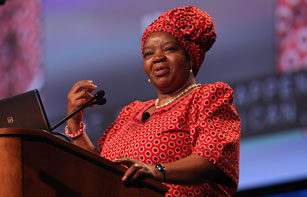
UNAIDS Director, Regional Support Team, Eastern and Southern Africa, Professor Sheila Tlou speaking at a plenary session of the XIX International AIDS Conference. Washington DC, 23 July 2012.
Credit: UNAIDS/K.Cleponis
At the plenary session titled Turning the Tide in Affected Countries (leadership, accountability and targets), UNAIDS Director, Regional Support Team, Eastern and Southern Africa, Professor Sheila Tlou, took stock of the progress made in the AIDS response to date and pointed out the challenges remaining to overcome the AIDS epidemic.
According to Professor Tlou, much progress has been made in the AIDS response. The world is on course to achieve elimination of new HIV infections among children and it is on course to put 15 million people on antiretroviral treatment. Access to HIV treatment in Sub Saharan Africa increased more than 100-fold in less than a decade. In 22 countries, annual new infections declined by more than 25% between 2001 and 2011.
To end AIDS, we need innovation, shared responsibility, mutual accountability and global solidarity
UNAIDS Director, Regional Support Team, Eastern and Southern Africa, Professor Sheila Tlou
However, challenges still remain as punitive laws, stigma and discrimination, gender inequality, violence against women and human rights violations are hindering the AIDS response. Proferssor Tlou spoke about the key requirements for turning the tide. “To end AIDS, we need innovation, shared responsibility, mutual accountability and global solidarity,” said Professor Tlou.
Other key factors to turn the tide of the epidemic according to Professor Tlou include the development of evidence-informed and rights-based HIV responses; enactment of laws that facilitate effective HIV responses; addressing sexual and reproductive health needs of women and girls; Gender equality and involvement of men, and the use of the expertise of communities and people living with HIV.
Related information
Related information
Related
A tribute to Maeve Kennedy Townsend McKean
09 April 2020
UNAIDS is awarded the Science and Medicine Award at the 25th Annual Steve Chase Awards
12 February 2019
AIDS care in the Californian desert
12 February 2019
Feature Story
AIDS 2012: Making sure countries really own their national response to AIDS
23 July 2012
23 July 2012 23 July 2012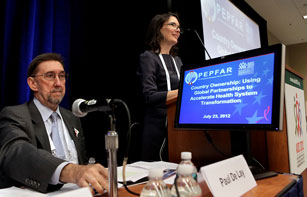
UNAIDS Deputy Executive Director, Programme, Dr Paul De Lay and Kathleen McLaughlin, Director, McKinsey & Company, co-moderators of the satellite session at AIDS2012, Country Ownership: Using Global Partnerships to Accelerate Health System Transformation
Credit: UNAIDS/Y.Gripas
Country ownership and leadership provide a solid foundation for developing national AIDS responses that are effective, efficient, sustainable and, ultimately, successful. How can this be achieved and reinforced in a meaningful way? During the International AIDS Conference a high-level series of panel discussions explored, on 23 July, how countries can play more of a central ownership and leadership role in responding to their epidemics and how partners can support this process to increase the sustainability of national AIDS responses.
The satellite session, Country Ownership: Using Global Partnerships to Accelerate Health System Transformation, was hosted by the US President’s Emergency Plan for AIDS Relief (PEPFAR), the Bill & Melinda Gates Foundation, McKinsey & Company, and the governments of Rwanda, Nigeria and Botswana.
In his opening remarks, UNAIDS Deputy Executive Director, Programme, Dr Paul De Lay reminded delegates that assuring a sustainable response to AIDS is a shared responsibility among countries, donors, civil society organizations, people living with HIV and other key stakeholders. “Each partner has a specific role to play in supporting national AIDS responses and all partners are mutually accountable to each other in maintaining their commitments,” said Dr De Lay.
The first panel discussion revolved around the current status of country ownership of national AIDS responses, and examined the successes and challenges in accelerating ownership. Participants acknowledged that despite recent progress, more efforts were needed to achieve ambitious international targets such as those set out in the 2011 UN General Assembly Political Declaration on AIDS. These goals could only be reached, it was agreed, through countries fully owning and leading their responses.
“Rwanda owns it AIDS response and it has been successful,” said Dr Agnes Binagwaho, Rwandan Minister of Health. “We developed a vision of where we want to go in responding to AIDS and have chosen the path to get us there. We need to align ourselves internally first and before we start worrying about aligning our partners,” she added.
During the discussion, there was a consensus that a number of necessary conditions for true country ownership exist. These include: strong political engagement and inclusive leadership; high-quality strategic information; effective coordination; capacity development; robust national strategic plans with smart investment decisions; integration of HIV into broader health and development strategies; and full engagement of civil society and people living with HIV.
“Civil society organizations need to own the response. They have the potential to play major roles in developing, implementing and monitoring national strategies, but often are not fully welcomed by governments and are thus not fully engaged,” said Rolake Odetoyinbo, Executive Director, Positive Action for Treatment Access of Nigeria. “Without full engagement of civil society organizations, there is no country ownership,” she added.
In the second panel, the idea of shared responsibility was explored in more depth. It was noted that there is a growing appreciation by countries, donors and other key stakeholders that a long-term response to the epidemic requires just such a mechanism. This is especially the case as strong partnerships have been, and will continue to be, the backbone of national AIDS responses. Countries and their partners now acknowledge that ‘we are all in this together’.
Each partner has a specific role to play in supporting national AIDS responses and all partners are mutually accountable to each other in maintaining their commitments
UNAIDS Deputy Executive Director, Programme, Dr Paul De Lay
“For sustainability, we now need to transition programs from PEPFAR implementing partners over to governments,” said Ambassador Eric Goosby, US Global AIDS Coordinator. “This is not an attempt to ‘cut and run’ but to ensure that the life-saving and life-prolonging services that we have put in place will be there for the people who need them for the rest of their lives. Countries need to diversity the resources that support these programs, including increased funding from domestic sources,” he added.
The principle of shared responsibility encompasses the need for countries to achieve stable and predictable financial flows, from both domestic and international sources. This is particularly the case in sub-Saharan Africa where two-thirds of AIDS expenditures come from external sources.
“A major risk to AIDS programs in Africa is lack of long-term funding. Many African economies, however, are growing rapidly. This provides an opportunity for countries to increase domestic financing of the national AIDS responses,” said Professor John Idoko, Director General of the National Agency for the Control of AIDS in Nigeria. “We can and must increase domestic investments for AIDS” he added.
If this shared responsibility and global solidarity is to be attained, it was agreed, countries should demonstrate political leadership through the articulation of a national AIDS, health and development vision that pulls partner efforts into alignment. Development partners and governments can work together to fill the HIV investment gap together, through both traditional and innovative means, investing their ‘fair share’ based on ability and prior commitments. Resources can then be allocated according to countries’ needs and priorities for greatest impact.
“The Global Fund is working closely with countries to help them invest in those activities with the highest return on investment,” said Mark Edington, Head of Grant Management at the Global Fund to Fight AIDS, TB and Malaria. “The Global Fund is committed to country ownership and assuring financial sustainability of national programs. In this regard, we are increasingly working with Ministries of Finance to discuss long term financing,” he added.
Great progress has been made in responding to the global AIDS pandemic, but many challenges remain. Assuring country ownership and acknowledging that responding to AIDS requires a shared responsibility will help countries and partners move towards achieving the vision of zero new HIV infections, zero discrimination and zero AIDS-related deaths.
External links
External links
Publications
Publications
- Country ownership for a sustainable AIDS response: from principles to practice
- AIDS Dependency Crisis: Sourcing African Solutions. Geneva, UNAIDS, 2012.
- The U.S. President’s Emergency Plan for AIDS Relief Five-Year Strategy, 2010-2014. Washington, PEPFAR, 2009.
- The Global Fund Strategy 2012-2016: Investing for Impact. Geneva, The Global Fund, 2012.
- Getting to Zero. UNAIDS Strategy, 2011-2015. Geneva, UNAIDS, 2011.
- United Nations Political Declaration on HIV and AIDS: Intensifying Our Efforts to Eliminate HIV and AIDS. New York, United Nations, 2011.
Feature Story
HIV Travel Restrictions: Latest Developments
22 July 2012
22 July 2012 22 July 2012
L to R: Co-moderators of the satellite session on HIV travel restrictions Dr Paul De Lay, UNAIDS Deputy Executive Director, Programmes and Professor Myongsei Sohn, Dean of the School of Public Health at Yonsei University.
As he opened the satellite session on HIV Travel Restrictions: Latest Developments, UNAIDS Deputy Executive Director, Programmes and co-moderator of the panel, Dr Paul De Lay said “It is fitting that one of the first satellites at AIDS2012 is one on travel restrictions. We would not be here today if the US government had not lifted its HIV-related restrictions on entry, stay and residence in January 2010.”
Co-hosted by UNAIDS and the Korean Center for Disease Control and Prevention, the satellite aimed to hear new developments in Korea about their own restrictions as well as to take stock of where the global situation of travel restrictions stands some 30 years into the epidemic.
“It is very meaningful and significant that there are still many innocent people who have been denied their basic human rights just because they live with HIV,” said Kim Bong-hyun, Deputy Minister for Multilateral and Global Affairs, Ministry of Foreign Affairs and Trade of the Republic of Korea in his keynote speech. “I am pleased to state, on behalf of my government, that the Republic of Korea has no HIV-specific travel restrictions under the Immigration Control Act and its implementing regulations. Lifting travel restrictions is a small step on our long journey to realize a society where there is no discrimination against people with HIV,” he added.
With the announcement of the Republic of Korea , there are 8 countries that have lifted their restrictions since 2010. However, some 45 countries, territories and areas still continue to employ some form of restriction on the entry, stay and residence of people living with HIV (“HIV-related travel restrictions”).
The momentum to remove remaining restrictions is growing. Helga Ying, Senior Director of Worldwide Government Affairs and Public Policy at Levi Strauss & Co., described an initiative by UNAIDS, in partnership with the Global Business Coalition on Health, in which some 24 CEOs have signed a pledge against HIV-related restrictions on entry, stay and residence. “Globalized travel and relocation have become routine; companies need to move their best talent where they need them. These restrictions hurt not only individuals but also businesses,” said Ms Ying. The goal of the initiative is to get 100 CEOs to sign the pledge by World AIDS Day 2012. “Everyone can make a difference and businesses can too,” added Ms Ying.
Lifting travel restrictions is a small step on our long journey to realize a society where there is no discrimination against people with HIV
Kim Bong-hyun, Deputy Minister for Multilateral and Global Affairs, Ministry of Foreign Affairs and Trade of the Republic of Korea
Participants at the satellite also heard the experience of Ukraine in removing its restrictions. Dr Marina Zelenska, Head of HIV/AIDS Department, State Service for Social Diseases of Ukraine described how, in 2010, the country decided to change the law to ensure that it provided legal and social protection of people living with HIV and prevented discrimination. Part of that law reform was to remove the provision banning HIV positive people from entry.
George Bartolome of United Western Visayas, a support group of people living with HIV from Central Philippines, presented a powerful personal story of how travel restrictions had been applied against him as a migrant worker in Saudi Arabia. When he was told he was HIV-positive, he was so shocked that when he stepped out into the street, he was hit by a car. Later he was taken to a hospital and locked in a room for 10 days before he was deported. “It was a horrible experience; I would not wish it to happen to anyone else. It was traumatic.” He recommended that all governments remove such restrictions. “HIV is not a reason for deportation.”
Another key issue discussed at the session was the large numbers of migrant workers who are either subjected to pre-departure and post-arrival mandatory HIV testing or summarily deported when found infected in the country of destination—without informed consent, counselling or confidentiality. Malu Marin of Action for Health Initiatives (ACHIEVE), Inc./CARAM Asia highlighted that such restrictions make even less sense with the significant advancements in HIV treatment which renders people living with HIV long-lived and productive citizens as well as non-infectious.
At this historic moment of the return to of the International AIDS Conference to the United States, the satellite helped to galvanise further action on and attention to the issue of HIV travel restrictions, with the acknowledgement that there are 45 countries to go. UNAIDS committed to support these governments to remove such restrictions and ensure that all countries have effective and rights-based approaches to HIV.